Shop by
The Air Quality Index (AQI) measures how polluted the air is and how it may affect your health.
0–50 (Good): Air quality is satisfactory.
51–100 (Moderate): Acceptable, but some pollutants may pose minor concerns.
101–150 (Unhealthy for Sensitive Groups)
151–200 (Unhealthy)
201–300 (Very Unhealthy)
301+ (Hazardous)
Still okay for most, but if you have asthma or allergies, take it easy and avoid long outdoor workouts.
Shop MERV 11 filters→
By Michelle Wan | Reviewed by David Clark, Licensed HVAC Technician | Published by Filterbuy Canada | Published August 1, 2026
Oakville’s official air quality reading is the Air Quality Health Index (AQHI), a 1 to 10+ scale published hourly by Environment and Climate Change Canada from Ontario’s Oakville station, site 44017. Most maps labelled "AQI" use the American 0-to-500 scale, so the same air can look mild on one and severe on another. Check the live map on this page, then match the number to the indoor steps that follow.
Canada’s official measure is the AQHI, not the AQI. The Air Quality Health Index runs 1 to 10+ and combines ozone, nitrogen dioxide and fine particulate matter (PM2.5).
Bands: 1 to 3 low risk, 4 to 6 moderate, 7 to 10 high, above 10 very high, each with its own health messages.
Oakville has its own provincial monitoring station, site 44017, reporting hourly.
On the morning of 18 July 2026 Oakville’s AQHI reached 10+, the very high band, while an international index showed 142 on the American scale, band three of six.
Wildfire smoke is a major source of air pollution in Halton Region, and Halton Region Public Health notes it can harm health at levels you cannot see or smell.
The live map on this page shows Oakville’s current AQHI, updated hourly. The bands run 1 to 3 low risk, 4 to 6 moderate, 7 to 10 high, above 10 very high. Most days are unremarkable: Ontario reported low-risk air for 92.0% of hours in its 2023 report, moderate 7.5%, high 0.4% and very high 0.1%.
Follows ECCC and Ontario MECP health messages. If you have a heart or lung condition, follow your doctor's usual advice.
Because two different indexes measure the same air. The AQHI is Canada’s, developed by Environment and Climate Change Canada with Health Canada, and it replaced Ontario’s older index in June 2015. It runs 1 to 10+ on the combined risk of three pollutants. The AQI is American, runs 0 to 500, and reports whichever single pollutant is worst. Neither is wrong. On the morning of 18 July 2026, Air Quality Ontario put Oakville at AQHI 10+, its most severe category, while an international index showed 142, the third band of six.
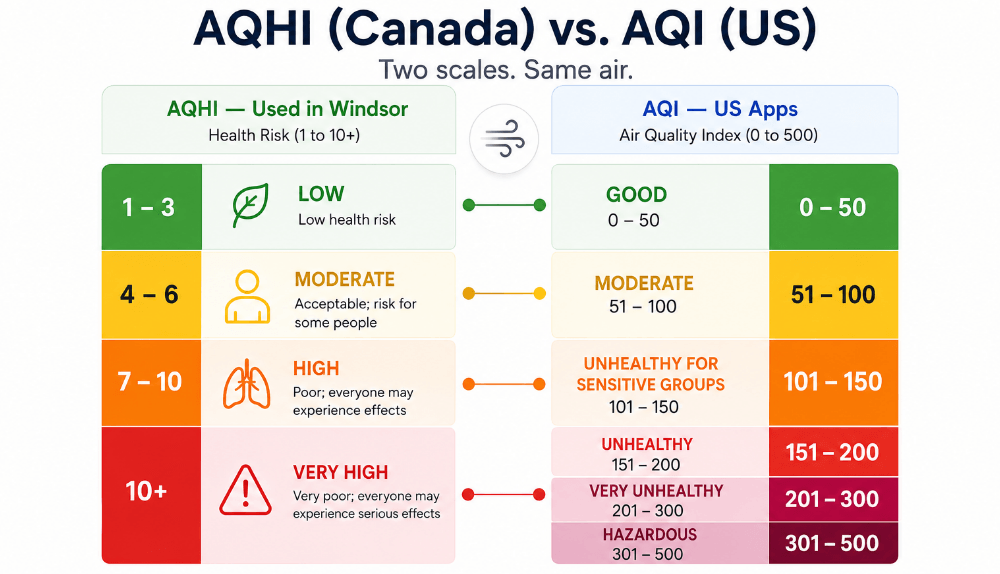
The current reading can outrun the forecast. On 18 July 2026 the forecast maximum issued at 6:00 am EDT put the day at 10. The observed value that same hour was already 10+. Check the current number, not the morning outlook.
Halton Region points residents to the AQHI. Its air quality page links straight to the ECCC AQHI page for Oakville, so that is the scale local health advice is built on.
A mid-range AQHI is not one spike. Because the AQHI adds three pollutants together, a 4 or 5 can mean all three are somewhat above normal at once, which a single-pollutant view will not show.
Which of the three pollutants is pushing the number changes what you should do, and in one case it means filtration will not help.
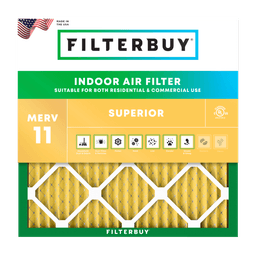
The index covers ozone, nitrogen dioxide and PM2.5. It excludes pollen, coarse dust (PM10), sulphur dioxide and carbon monoxide. So it can read 2 on a high-pollen spring morning while an allergy sufferer feels it clearly: accurate, but measuring something else. For pollen and pet dander the filter in your furnace matters more than the outdoor number, and Filterbuy’s MERV 11 Superior captures pollen, dust mites and mould spores.
Summer, outdoors. Wildfire smoke travels hundreds or thousands of kilometres, so a fire in northern Ontario or the Prairies can lift Oakville’s PM2.5 within a day; Health Canada publishes guidance on wildfire smoke and your health. Separately, hot still afternoons cook traffic emissions into ozone, and Oakville sits on the QEW and Highway 403 corridor, downwind within the western GTA.
Winter, indoors. Homes stay sealed from roughly October to April while the furnace runs for months, so the issue shifts to what builds up inside: dust, pet dander, cooking particles and odours.
Filterbuy manufactures pleated furnace and HVAC filters in its own North American plants and ships to Canada in 600+ sizes. Two honest limits first: a filter does nothing about outdoor air, and little indoors on an ozone day. Where it does help, Health Canada’s guidance on fine particulate matter in residential indoor air notes some furnace filters remove PM2.5.
Close the windows and run the fan. Switch the thermostat fan from auto to on so air moves through the filter continuously, not only during heating or cooling cycles. On a smoke day this matters more than the filter rating.
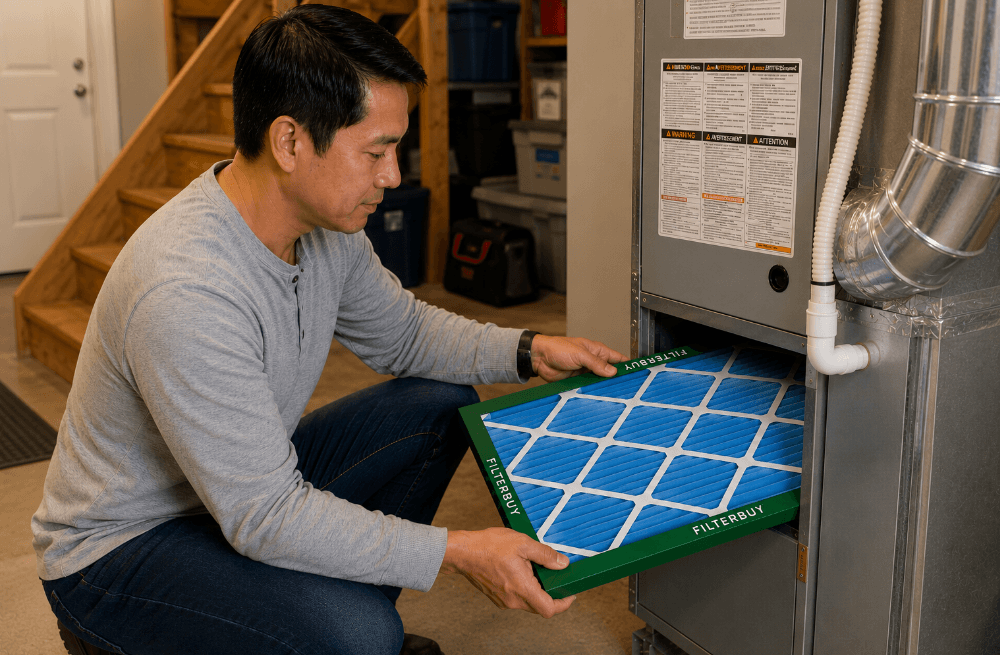
Check the filter early. Canadian furnaces run six to eight months a year, so filters load faster here; every 60 to 90 days is a reasonable heating-season rhythm. Smoke loads a high-MERV filter in days, so check weekly during an episode. The replacement guide covers the swap.
Match the filter to the concern using the MERV rating system.
Over 600 sizes available, including custom. Free shipping to Canada, prices in CAD.
Wildfire smoke caused 25% of all unhealthy-ozone days in the United States between 2018 and 2023, with 2023 the worst year because of wildfires in Canada. From 600 monitoring stations plus satellite data: smoke raises ozone as well as PM2.5. Source: NOAA Climate Program Office.
Traffic emissions fall to near background levels within 150 to 300 metres of a roadway, and in Toronto an estimated 30% to 45% of the urban population lives within 500 metres of a highway, which is why the moderate-AQHI advice is to shut traffic-side windows rather than all of them. Source: CDC, citing Health Effects Institute Special Report 17, published 2013.
Running the HVAC fan continuously cuts indoor particle levels by about 24% with an ordinary filter, and roughly 50% with a high-efficiency one. The free step works before any upgrade. Source: US EPA, citing Fisk and Chan (2017).
All three sources are American; the NOAA finding concerns Canadian fires and the CDC figure measures Toronto.
Check the live AQHI at the top of this page. 1 to 3 is low risk. At 4 to 6, people with heart or breathing conditions should ease off strenuous activity. At 7 or above, everyone should scale back outdoor exertion.
The live module reports fine particulate in micrograms per cubic metre alongside the AQHI. Hourly pollutant readings for station 44017 are also published by Air Quality Ontario.
Ontario’s Oakville ambient air monitoring station, site 44017, with ECCC publishing the AQHI derived from it. Oakville is one of 38 AQHI sites in Ontario and one of three in Halton. Readings are automatically polled and not finally verified.
You can check rather than guess. Halton has three feeds: Oakville, Burlington, and Milton and Halton Hills. Readings across the western GTA move together; short-term gaps usually reflect local traffic or wind.
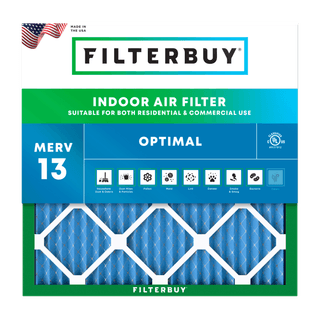
It reduces fine particles in your home’s ducted air, and MERV 13 Optimal is rated to capture smoke particles. It works on air moving through the HVAC system, so it helps most with windows closed and the fan running. It does not treat outdoor air or replace public health guidance.
| Term | Definition |
|---|---|
| Air Quality Health Index (AQHI) | Canada's official scale, ranging from 1 to 10+, based on the combined short-term health risk of ozone, nitrogen dioxide, and PM2.5. |
| Air Quality Index (AQI) | The U.S. EPA scale, ranging from 0 to 500, generally reporting the single worst pollutant. It is not Canada's official measure. |
| MERV | Minimum Efficiency Reporting Value, the North American rating for how well a filter captures airborne particles. Higher numbers capture smaller particles. |
| PM2.5 | Fine particulate matter measuring 2.5 micrometres or smaller, small enough to reach deep into the lungs. It is the dominant pollutant during wildfire smoke. |
| Station 44017 | Oakville's ambient air monitoring site on the Air Quality Ontario network. |