
Air Quality in Ontario
Air quality index (AQI⁺) and PM2.5 air pollution in Ontario •
Live Air Quality Ratings in Ontario
Live city rankings are temporarily unavailable.
The Right Air Filter For High AQI Days
When outdoor air quality drops, the EPA recommends upgrading to a MERV 13 filter — or the highest-rated filter your HVAC system can handle — to help capture more of the fine particulate (PM2.5) that comes with poor air quality. MERV 13 is the highest rating most residential systems can run without restricting airflow.
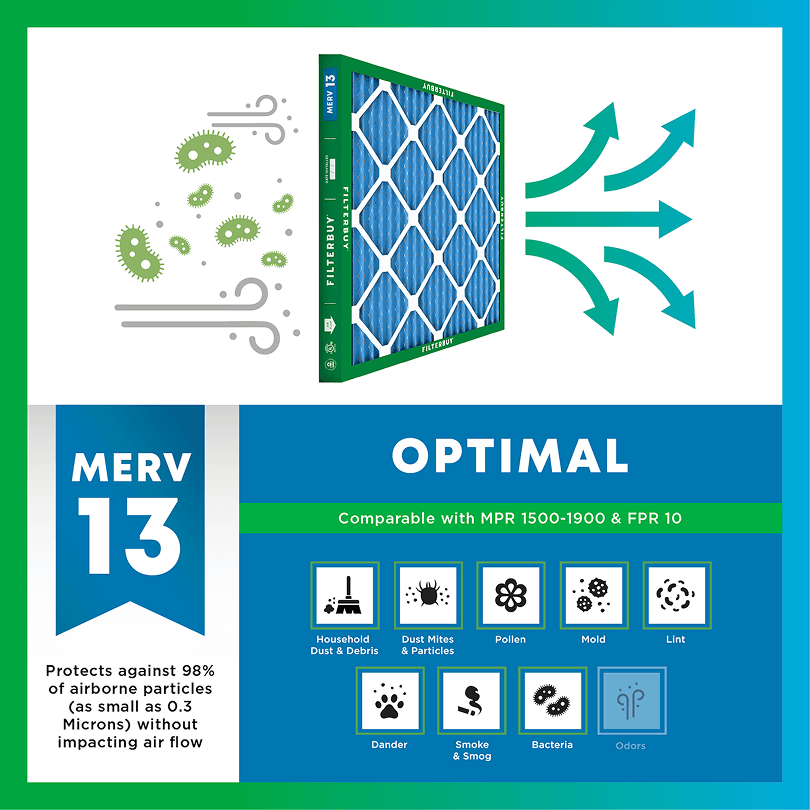
- Captures PM2.5 and other fine particulates
- Filters ash, soot, and smoke particles
- Rated to capture particles as small as 0.3 microns
- Matches the filter rating the EPA suggests during high-AQI and smoke events

AQI FAQs
What is AQI?
AQI stands for Air Quality Index, the EPA's scale for reporting daily air quality. It runs from 0 to 500. The higher the number, the greater the level of air pollution. Values at or below 100 are generally considered satisfactory; values above 100 mean air quality is unhealthy, first for sensitive groups, then for everyone as numbers climb.
What does AQI measure?
The AQI tracks five major pollutants regulated by the Clean Air Act: ground-level ozone, particle pollution (PM2.5 and PM10), carbon monoxide, sulfur dioxide, and nitrogen dioxide. The reported AQI value reflects whichever pollutant is highest at that time — most often ozone or fine particles (PM2.5).
How is AQI calculated?
Monitoring stations measure pollutant concentrations, and the EPA converts each into a standardized 0–500 score using set breakpoints. Each pollutant gets its own sub-index, and the highest sub-index becomes the reported AQI. That's why a single number can represent different pollutants on different days.
What is a good AQI?
An AQI of 0–50 is rated "Good" — air quality poses little or no risk. 51–100 is "Moderate," acceptable for most people though unusually sensitive individuals may want to limit prolonged outdoor exertion. Anything at or below 100 is generally considered satisfactory air quality.
What does an AQI of 100 (or 150) mean?
100 is the dividing line: at or below it, air quality is satisfactory for the general public. From 101–150, air is "Unhealthy for Sensitive Groups" — people with respiratory conditions, older adults, and children. From 151–200, it's "Unhealthy" and everyone may begin to feel effects.
Why is the AQI bad today?
Short-term AQI spikes usually come from wildfire smoke, temperature inversions that trap pollutants near the ground, high-ozone weather (hot, sunny, stagnant days), or heavy traffic and industrial activity. Check a real-time source like the map on this page to see which pollutant is driving today's reading in your area.
What AQI is bad for running or exercise?
Many runners follow the EPA category lines: below 50, no adjustment needed; 51–100, unusually sensitive people may shorten intense workouts; above 100, sensitive groups are advised to reduce prolonged or heavy outdoor exertion; above 150, that advice extends to everyone. Exercise increases how much air you breathe in, which is why thresholds matter more during workouts.
What AQI is safe to open windows?
A common rule of thumb is to keep windows open when the AQI is under 100 and close them when it climbs above, especially during wildfire smoke events when fine particles are elevated. When windows are closed, running your HVAC system with a fresh filter helps capture particles circulating indoors.
Should I wear a mask based on AQI?
Public health agencies generally suggest considering a well-fitted N95-style respirator outdoors when the AQI exceeds 150, particularly during smoke events. Cloth and surgical masks don't filter fine particles effectively. Follow guidance from your local health department, which may adjust recommendations during severe episodes.

Check Today's Live Real Time Air Quality Index AQI Map in Ontario Now
Ontario's air can change in an afternoon. A clear morning in Mississauga can give way to a smoky Tuesday by dinner — drifting in from a fire two provinces away that you didn't even know was burning. Pollen ramps up in May. Ozone climbs on hot July afternoons in the Golden Horseshoe. And the long furnace season, from October through April, keeps your indoor air working hard for half the year. This page gives you the live AQI map and the practical steps that actually help.
TL;DR — Quick Answers
If you're in a hurry, here's the short version.
Today's Ontario AQI: Check the live map at the top of this page — readings update throughout the day for every major city.
AQI vs. AQHI: AQI (0–500) is international; AQHI (1–10+) is Canada's official scale. Both point at the same underlying air.
Safe threshold: AQI 0–50 is good. Above 100, sensitive groups should limit outdoor time. Above 150, everyone should.
Main cause in summer: Wildfire smoke, often drifting in from outside Ontario. PM2.5 is the pollutant that matters most.
Best filter for smoke: MERV 13 (Optimal). For odors that linger after smoke, the Odor Eliminator filter.
What to do today: Check the map. Close windows if AQI is above 100. Run the HVAC fan. Change the filter if it's been a while.
Top Takeaways
Ontario's air quality varies dramatically by region, season, and even hour — always check the live reading before making outdoor plans.
Canada's official scale is the AQHI (1–10+), but most maps and searches use the international AQI (0–500). This page shows AQI; the resources above link to the AQHI.
The biggest threats to Ontario air quality are wildfire smoke (June–September), spring pollen, summer ozone, and winter inversions in urban corridors.
PM2.5 — fine particulate matter from wildfire smoke — is the pollutant most reliably stopped by a MERV 13 (Optimal) filter.
Sensitive groups (children, older adults, asthma and COPD patients) need to act on the AQI sooner than the general population — even a moderate reading can trigger symptoms.
During heavy smoke events, close windows, run your HVAC fan continuously, and change your filter more often than usual.
A clean Filterbuy filter — Standard (MERV 8), Superior (MERV 11), Optimal (MERV 13), or odor Eliminator — is the simplest practical lever you can pull at home.
Free shipping to Canada on every order, no minimum, with prices shown in CAD.
What Today's Reading Actually Means
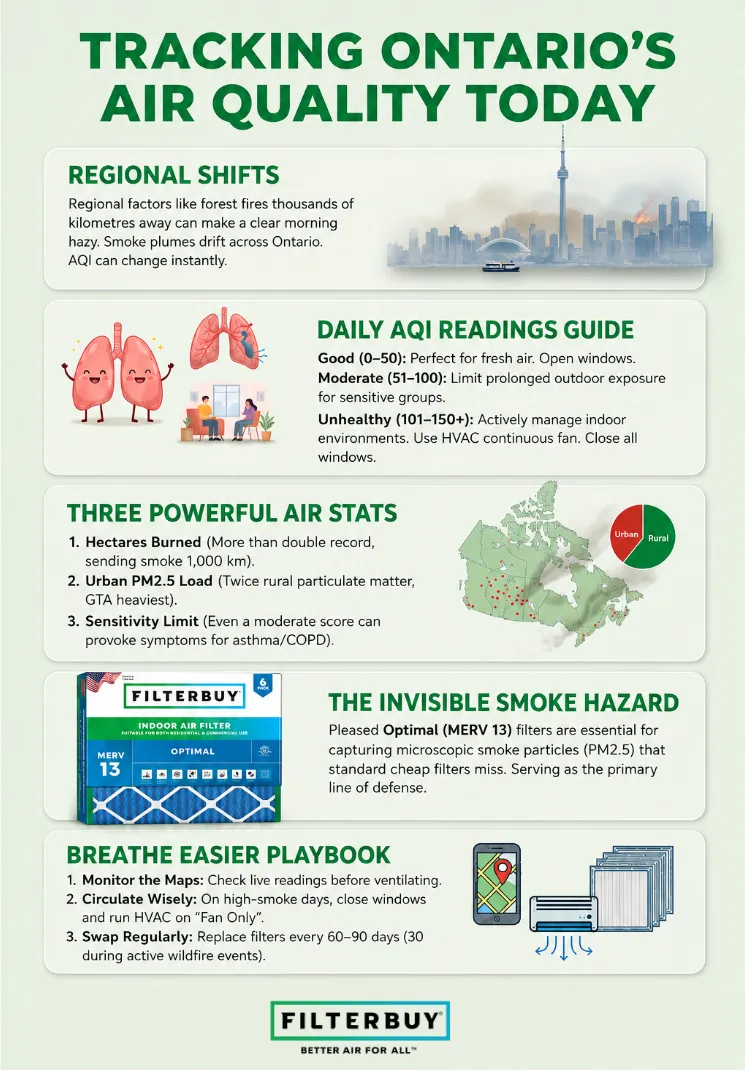
The map at the top of this page shows real-time air quality readings for every region of Ontario, from Windsor and London through the Greater Toronto Area and Ottawa, up to Sudbury and Thunder Bay. Readings update throughout the day. The number itself — that AQI value sitting on your screen — is a snapshot of how clean (or not) the outdoor air is right now in your area.
On the international Air Quality Index (AQI) scale used on this map, anything from 0 to 50 is considered good for the general population. From 51 to 100, the air is generally acceptable, though unusually sensitive people may notice symptoms. Above 100, sensitive groups — children, older adults, anyone with asthma or COPD — should start limiting prolonged time outdoors. Above 150, it's a sensible day for everyone to stay in.
Canada also uses its own official scale, the Air Quality Health Index (AQHI), which runs from 1 to 10+. The AQHI is published by Environment and Climate Change Canada and is built around the specific health risks of three pollutants: fine particulate matter (PM2.5), ground-level ozone (O₃), and nitrogen dioxide (NO₂). You'll see both scales referenced across Ontario — this page leans on AQI because that's the scale most people search for, but we point you to the AQHI in the resources below for the official Canadian reading.
What pushes Ontario's number up varies by season. Wildfire smoke from Northern Ontario, Québec, and the Prairies dominates summer readings — increasingly so over the last few years. Spring brings pollen and mould spores. Hot, sunny summer afternoons cook up ground-level ozone in southern Ontario. Winter inversions trap vehicle and industrial emissions closer to the ground across the GTA and the Hamilton industrial corridor. Knowing which one is driving today's reading is half the battle, and it's what tells you whether to close the windows, upgrade the filter, or just carry on.
After fifteen years on Ontario service calls, the pattern I see is consistent — the homeowners who weather smoke events well aren't the ones with fancy equipment. They're the ones who checked the map before opening the windows. A clean Optimal (MERV 13) filter in a furnace that's actually running on the fan setting will pull more fine smoke out of the air over a day than most people expect. The trick is doing it early, before the smoke settles into your fabrics and carpets. By the time you can smell it indoors, you're playing catch-up.
— Filterbuy Canada
7 Essential Ontario Air Quality Resources Every Household Should Bookmark
These are the sources we trust for current readings, health guidance, and longer-term context. Save them somewhere you can find quickly during smoke season — you'll be glad you did.
1. Ontario AQHI — Real-Time Provincial Readings (Environment and Climate Change Canada)
The official Government of Canada source. The provincial summary view shows current AQHI values and forecast maximums for cities across Ontario, updated continuously. This is the page to trust when you want the federally validated number, not a third-party reading.
→ weather.gc.ca — Ontario AQHI provincial summary
2. Air Quality Ontario — Ministry of the Environment, Conservation and Parks
Ontario's own provincial air quality monitoring network. The MECP runs the stations that feed into the national AQHI for Ontario, and their site offers a station-by-station view, historical data, and pollutant-specific deep dives that go beyond what the national page shows.
→ airqualityontario.com — Ontario MECP air quality portal
3. Health Canada — Fine Particulate Matter (PM2.5) Indoor Air Guidance
When the outdoor AQI climbs, this is the page that tells you what to actually do inside your home. Health Canada's official residential guidance on PM2.5 covers furnace and HVAC strategies, ventilation rules of thumb, and what to prioritise if you have someone with a respiratory condition in the household.
→ canada.ca — Health Canada PM2.5 indoor air guidance
4. Canadian Lung Association — How to Protect Your Lungs from Wildfire Smoke
A practical, plain-language guide written by Canadians for Canadian conditions. Covers who is most at risk, why ordinary masks don't help, and concrete steps for keeping smoke out of your home during an active fire-smoke event in Ontario.
→ lung.ca — Wildfire smoke and lung health
5. World Health Organization — Global Air Quality Guidelines
The WHO sets the benchmark numbers that most national agencies, including Health Canada, reference when establishing exposure thresholds. The European fact sheet is the most accessible WHO entry point and explains the 2021 guideline update that significantly lowered the recommended PM2.5 limit.
→ who.int — Air quality fact sheet
6. Wikipedia — Air Quality Index Overview
If you're not sure what the AQI numbers actually represent — how the scale is calculated, why the United States, Canada, and the EU each use slightly different versions, and how AQI compares to AQHI — this overview is the cleanest starting point with citations to the underlying agency documentation.
→ en.wikipedia.org — Air Quality Index
7. Filterbuy — Live Canadian Wildfire and Smoke Map
Our companion live map for active forest fires and smoke plumes across Canada. Pair it with the AQI map on this page: the AQI tells you what the air is doing right now, and the smoke map tells you where the smoke is coming from and where it's headed next.
→ filterbuy.com — Live Canadian wildfire and smoke map
3 Numbers That Explain Why Air Quality Matters More in Ontario
The data below comes from three different sources — peer-reviewed research, federal statistical analysis, and frontline health advocacy — so you're not relying on one perspective.
15M
Hectares of Canadian forest burned in the 2023 wildfire season — more than double the previous record
The 2023 fire season was the worst in Canada's recorded history. Researchers writing in Nature Communications documented that approximately 15 million hectares burned, more than doubling the previous record of 6.7 million hectares set in 1989.
The smoke from these fires reached major population centres more than 1,000 kilometres away, including southern Ontario, which is why a fire in northern Saskatchewan can show up as a poor AQI reading in Toronto.
Source: Nature Communications — Drivers and Impacts of the 2023 Canadian Wildfire Season
1.9×
Urban Ontarians breathe nearly twice the PM2.5 of rural Canadians — and southern Ontario carries the heaviest load
Statistics Canada's national exposure analysis found that residential PM2.5 exposure averaged 8.03 µg/m³ in urban cores, compared with 4.32 µg/m³ in rural areas — roughly a 1.9× difference.
PM2.5 exposure was especially high in parts of southern Ontario, particularly around Toronto and Windsor. If you live in the GTA, the Golden Horseshoe, or the Windsor-Detroit corridor, your baseline air is consistently working against you more than the national average.
Source: Statistics Canada — Exposure to Fine Particulate Matter Air Pollution in Canada
AQHI 4
Even a moderate AQHI reading can worsen symptoms for Ontarians living with chronic lung conditions
The Canadian Lung Association notes that for anyone diagnosed with a chronic lung condition such as asthma or COPD, even an AQHI score of 4 — which falls in the moderate range and is considered safe for the general population — can be enough to worsen symptoms.
That's a meaningful threshold to know if you or a family member has a respiratory diagnosis. It's also why the “general public” advice line and the “at-risk population” advice line on the AQHI scale exist as two separate sets of guidance.
Source: Canadian Lung Association — How to protect your lungs from wildfire smoke
Where We Stand: Filterbuy's Take on Ontario Air Quality
Here's the honest read. The trend lines for Ontario aren't catastrophic, but they aren't reassuring either. Wildfire smoke events are becoming a regular feature of summer in southern Ontario, not an occasional anomaly. Spring allergy seasons are arriving earlier and lasting longer. The furnace season — already six to eight months in most of the province — isn't getting any shorter. None of that requires panic, but all of it requires a slightly more attentive approach to indoor air than households needed a decade ago.
Our view, after years of helping Canadian homeowners through smoke events: most people overinvest in expensive standalone air purifiers and underinvest in the filter that's already running through their HVAC system for half the year. A well-chosen pleated filter in the furnace, changed on a sensible schedule, does an enormous amount of quiet work. During wildfire smoke season, an Optimal (MERV 13) filter captures the fine PM2.5 particles that lower MERV ratings let pass. During spring allergy season, a Superior (MERV 11) filter handles pollen, dust mites, and mould spores comfortably. During lingering smoke odors, an odor Eliminator filter does what its name suggests.
We won't oversell it. A furnace filter is not a respirator, and it doesn't make outdoor smoke disappear. But for the air inside your home — where most Ontarians spend roughly 90% of their waking hours, especially through the long heating months — it is one of the highest-leverage things you can change. Cleaner filter, fan running, windows closed during high-AQI events. That's the playbook.

Your Next 10 Minutes: A Simple Plan for Today's Air
Practical steps you can take in the next few minutes, depending on what today's reading is telling you.
If AQI is 0–50 (Good)
Open the windows. Air out the house if you've had them closed.
Check when you last changed your furnace filter. If it's been more than 60 days, set a reminder.
If you don't have a subscription set up yet, this is a calm day to do it.
If AQI is 51–100 (Moderate)
Carry on normally, but check on anyone in your household with asthma, COPD, or pollen allergies — moderate days are often when symptoms start showing up before the number climbs.
If you're due for a filter change, do it today rather than waiting.
If AQI is 101–150 (Unhealthy for Sensitive Groups)
Close the windows. Switch your HVAC system to the fan setting so air keeps circulating through your filter.
Limit outdoor time for children, older adults, and anyone with a respiratory condition.
Check the filter. If it's visibly discoloured, replace it now.
If AQI is above 150
Stay indoors. Keep windows and doors closed. Run the HVAC fan continuously.
If you have one, an Optimal (MERV 13) filter or an Odor Eliminator filter is your best in-home defence.
Check on neighbours — particularly older neighbours and those living alone.
If you or anyone in your home experiences chest tightness, persistent coughing, or shortness of breath, contact a healthcare provider or call Telehealth Ontario at 811.
Frequently Asked Questions
Breathe Easier This Season
If today's reading has you thinking about your home's air, you're already a step ahead. Filterbuy ships pleated air filters in more than 600 sizes — including custom — direct from our facilities to your door in Ontario. Free shipping across Canada on every order, no minimum, prices shown in CAD at checkout.
Not sure which filter you need? Our Superior (MERV 11) handles spring allergies and pet dander. Our Optimal (MERV 13) is the one we recommend for wildfire smoke season. Our odor Eliminator clears the lingering smell that often outlasts the worst readings. A short guide on our shop page walks you through which fits your home in about a minute.
Subscribe and save up to 70% per filter with auto-delivery — edit, skip, or cancel anytime. Or order a single pack today and try us out. We've earned over 85,000 five-star reviews from customers across North America, and we'd rather earn your trust than push you into the wrong product.
Air quality readings on this page are provided for informational purposes. If you or a family member is experiencing respiratory symptoms, please contact a healthcare provider or call Telehealth Ontario at 811.
Questions? Call us toll-free at (855) 345-8289 or email info@filterbuy.com.
Filterbuy Canada, 96 Carrier Dr, Toronto, ON M9W 5R1.