
Canada Real-Time Air Quality Map
Air quality index (AQI⁺) and PM2.5 air pollution in Canada •
Live Air Quality Ratings in Canada
Live city rankings are temporarily unavailable.
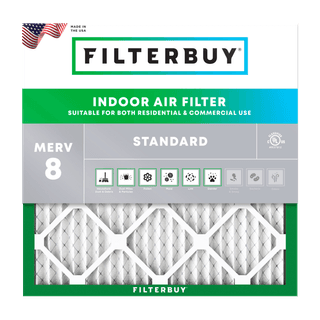
What's the Right Filter for Your AQI Level?




AQI FAQs
What is AQI?
AQI stands for Air Quality Index, the EPA's scale for reporting daily air quality. It runs from 0 to 500. The higher the number, the greater the level of air pollution. Values at or below 100 are generally considered satisfactory; values above 100 mean air quality is unhealthy, first for sensitive groups, then for everyone as numbers climb.
What does AQI measure?
The AQI tracks five major pollutants regulated by the Clean Air Act: ground-level ozone, particle pollution (PM2.5 and PM10), carbon monoxide, sulfur dioxide, and nitrogen dioxide. The reported AQI value reflects whichever pollutant is highest at that time — most often ozone or fine particles (PM2.5).
How is AQI calculated?
Monitoring stations measure pollutant concentrations, and the EPA converts each into a standardized 0–500 score using set breakpoints. Each pollutant gets its own sub-index, and the highest sub-index becomes the reported AQI. That's why a single number can represent different pollutants on different days.
What is a good AQI?
An AQI of 0–50 is rated "Good" — air quality poses little or no risk. 51–100 is "Moderate," acceptable for most people though unusually sensitive individuals may want to limit prolonged outdoor exertion. Anything at or below 100 is generally considered satisfactory air quality.
What does an AQI of 100 (or 150) mean?
100 is the dividing line: at or below it, air quality is satisfactory for the general public. From 101–150, air is "Unhealthy for Sensitive Groups" — people with respiratory conditions, older adults, and children. From 151–200, it's "Unhealthy" and everyone may begin to feel effects.
Why is the AQI bad today?
Short-term AQI spikes usually come from wildfire smoke, temperature inversions that trap pollutants near the ground, high-ozone weather (hot, sunny, stagnant days), or heavy traffic and industrial activity. Check a real-time source like the map on this page to see which pollutant is driving today's reading in your area.
What AQI is bad for running or exercise?
Many runners follow the EPA category lines: below 50, no adjustment needed; 51–100, unusually sensitive people may shorten intense workouts; above 100, sensitive groups are advised to reduce prolonged or heavy outdoor exertion; above 150, that advice extends to everyone. Exercise increases how much air you breathe in, which is why thresholds matter more during workouts.
What AQI is safe to open windows?
A common rule of thumb is to keep windows open when the AQI is under 100 and close them when it climbs above, especially during wildfire smoke events when fine particles are elevated. When windows are closed, running your HVAC system with a fresh filter helps capture particles circulating indoors.
Should I wear a mask based on AQI?
Public health agencies generally suggest considering a well-fitted N95-style respirator outdoors when the AQI exceeds 150, particularly during smoke events. Cloth and surgical masks don't filter fine particles effectively. Follow guidance from your local health department, which may adjust recommendations during severe episodes.
Check Today’s Live Real-Time Air Quality Index (AQI) Map in Canada Now
The map above refreshes every hour, so what you’re seeing is the air outside your door right now, not yesterday’s average. Find your city, and you’ll know in seconds whether it’s a windows-open kind of day or a keep-them-shut one.
Air quality across Canada can shift in an afternoon, especially once wildfire smoke starts moving. So this page keeps things simple. It shows current conditions on a map you can read at a glance, then explains what those numbers actually mean, calmly and without scare tactics. And if today happens to be a smoky one, we’ll walk you through a few easy ways to keep the air inside your home fresh. No panic. Just straight answers from people who think about indoor air all day.
TL;DR: Quick Answers
Want today’s air? Use the live map at the top. Find your city, read the number. Updated hourly.
Is it bad? Good or Low-risk means clean. Unhealthy or High-risk usually means smoke or smog, so stay in and filter the air.
AQI or AQHI? Canada uses AQHI (1–10+). Global apps use AQI (0–500). Higher means more care.
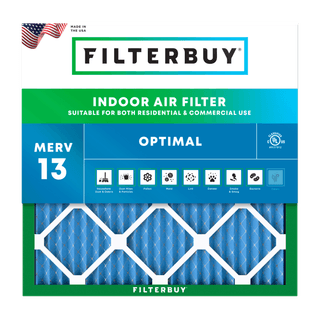
Best filter for smoke? MERV 13 (Optimal). Add Odour Eliminator for the smell.
Easiest fix? Close the windows, run the fan, and swap your filter every 60–90 days.
Top Takeaways
The live map shows current air quality anywhere in Canada, updated hourly. It’s the fastest way to answer “Is it bad out today?”
Canada officially uses the AQHI (1–10+), while most global apps show a U.S.-style AQI (0–500). On both, a higher number means to take more care.
Most elevated readings come from wildfire smoke in summer or smog on hot, still days.
On poor-air days: close the windows, run your HVAC fan, and rely on a higher-rated filter.
A MERV 13 (Optimal) filter captures fine smoke particles standard filters miss, and an Odour Eliminator helps with the smell.
Free shipping to Canada, 600+ sizes, and Subscribe & Save make it easy to stay ahead of smoke season.
How to Read the Map: AQI Numbers Explained
Most maps report air quality as a single number, and it climbs as pollution does. The higher it goes, the more sense it makes to ease up on time outdoors, especially for kids, older adults, and anyone living with asthma or a heart condition. Here's what the standard scale means in plain terms.
| AQI | Category | What It Means for You |
|---|---|---|
| 0–50 | Good | Air is clean. A great day to open the windows. |
| 51–100 | Moderate | Generally fine. Unusually sensitive people may notice mild effects. |
| 101–150 | Unhealthy for Sensitive Groups | Sensitive groups should take it a little easier outdoors. |
| 151–200 | Unhealthy | Everyone may feel some effect, so limit long stretches of exertion outside. |
| 201–300 | Very Unhealthy | Reduce outdoor activity and keep the windows closed. |
| 301+ | Hazardous | Stay indoors where you can and lean on good filtration. |
AQI vs. AQHI: What Canada Actually Uses
Most people don't realise Canada has its own scale. American apps show the AQI you may recognise, but Environment and Climate Change Canada reports something else. It's called the Air Quality Health Index (AQHI), and it runs from 1 to 10+, built around health risk rather than the concentration of one pollutant.
Both scales move the same way. A higher number means take a little more care. They're just calculated differently, so our map tells you which one you're looking at and saves you the guesswork.
| AQI (U.S. Style) | AQHI (Canada) | |
|---|---|---|
| Scale | 0–500 | 1–10+ (Low, Moderate, High, Very High Risk) |
| Based On | The single worst pollutant | Combined health risk from PM2.5, ozone, and NO₂ |
| Reported By | IQAir, aqicn, and many global apps | Environment Canada and provincial agencies |
| You'll See It | On most international maps | On official Canadian forecasts |
Is the Air Quality Bad in Canada Today?
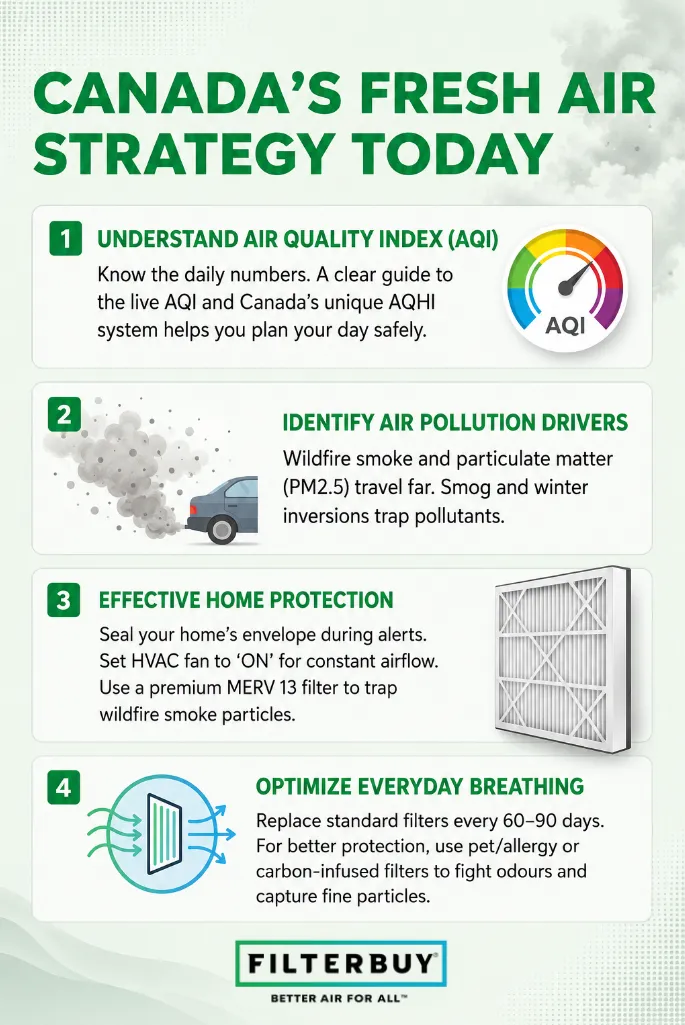
It depends on where you live. Canada covers a lot of ground, and conditions change by province, by season, and even by the hour. The fastest answer is the map above. Find your city, read the number. Anything in the Good or Low-risk range means the air is clean and you can carry on as usual. When readings climb into the Unhealthy or High-risk range, the cause is almost always wildfire smoke in summer or smog on a hot, still day. If your area is running high, keep the windows shut and let a good filter quietly do its job.
What’s Affecting Canada’s Air Right Now
A handful of factors drive most of the day-to-day changes you’ll see on the map:
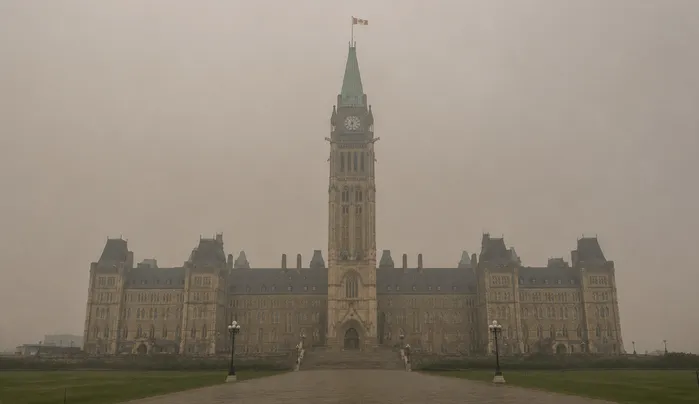
Wildfire smoke. Increasingly common from roughly June through September in British Columbia, Alberta, and parts of Ontario, smoke can lift fine-particle levels fast, sometimes hundreds of kilometres from the fire itself.
Fine particulate matter (PM2.5). These tiny particles are what most indices watch most closely, because they travel deep into the lungs. They come from smoke, traffic, and industry.
Ground-level ozone and smog. On hot, sunny, stagnant days, ozone can build up, especially across southern Ontario and parts of Québec.
Winter inversions. Cold, still conditions can trap pollutants closer to the ground in some valleys and cities through the long heating season.
Following a specific smoke event? Our live wildfire and smoke map for Canada shows where the fires and smoke are right now.

Air Quality by Province and Major City
Vancouver and Toronto rarely share the same air on the same day, and Halifax is its own story again. Zoom into your region on the map, or jump straight to a local view.
By province and territory: Ontario · British Columbia · Alberta · Québec · Manitoba · Saskatchewan · Nova Scotia · New Brunswick · and more.
By major city: Toronto · Vancouver · Calgary · Edmonton · Ottawa · Montréal · Winnipeg · Halifax.
How to Protect Your Indoor Air on Poor-Air Days
When the map turns orange or red, the job is simple. Keep the outdoor air out, and clean the air you already have inside. Here’s how.
Close the windows and doors when smoke or smog is in the area.
Run your furnace or HVAC fan so air keeps cycling through your filter, even if you don’t need the heat.
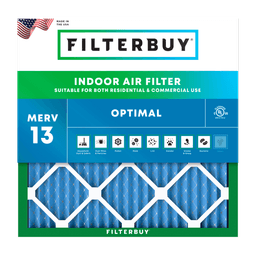
Fit a higher-rated filter. A MERV 13 (Optimal) filter captures the fine smoke particles and allergens that standard filters let slip through.
Change it more often during the smoke season, because a clogged filter can’t do its job.
For smoke and the smell it leaves behind, our Odour Eliminator carbon-infused filters help clear the haze-day odour that settles into a closed-up home. And because every Filterbuy order ships free to Canada with no minimum, keeping a spare on hand before smoke season is easy.
I’ve spent more than a decade around furnace filters, and every summer runs the same way. The day a smoke advisory hits a region, our orders from that province jump. People feel the air change before they ever look at a number. What I tell my own neighbours is simple. You can’t control the wildfire smoke outside, but you can control what your furnace pulls through. On a hazy day, a clean MERV 13 does more for a closed-up home than almost anything else, and most people are running a filter that’s a step or two too low. So check the map, then check the date on your filter. Those two habits, together, are what keep the air inside clean.
— Indoor Air Quality Specialist, Filterbuy
7 Trusted Places to Check and Understand Canada’s Air
We make air filters. We don’t run the monitoring stations. So for the data and the science, we’d rather send you to the people who do. These are the seven sources we trust and check ourselves:
The official federal source for current Air Quality Health Index values and daily forecasts across Canadian communities.
Background on the AQHI program, run jointly by Environment Canada and Health Canada with the provinces and territories.
A plain-English overview of what an AQI is, how different countries calculate it, and how it relates to Canada’s AQHI.
A widely used global map showing real-time AQI, PM2.5, and forecasts down to the neighbourhood level.
A dense, station-by-station real-time map drawing on monitoring data from across the country.
Hyper-local readings from thousands of community sensors, with a layer built specifically around Canada’s AQHI+.
The global authority on how air pollution affects health, including the role of fine particulate matter (PM2.5).
3 Numbers That Put Canada’s Air in Perspective
A little context helps. These three figures, all from sources we trust, explain why checking the map has become a normal part of the Canadian summer, and why the filter in your furnace matters.
From PM2.5, nitrogen dioxide, and ozone combined. A clear reminder that the air we breathe, indoors and out, matters to long-term health.
Canada’s 2023 wildfire season burned about 15 million hectares, more than double the previous record
The largest area burned since the satellite record began in 1972, and the reason smoke-affected air days have become so much more common nationwide.
Smoke isn’t only an outdoor nuisance. It’s a measurable health factor, which is exactly why keeping indoor air clean on hazy days is worth the small effort.
Final Thoughts: Clean Air Is a Habit, Not a Headline
Here’s our honest take. Coverage of air quality tends to swing between two extremes. One week, it’s a five-alarm emergency. The next, it’s ignored until the sky turns orange. Neither helps much. The truth sits somewhere calmer. Most days, in most of Canada, the air is fine, and on the handful of days it isn’t, a few simple habits make a genuine difference.
Checking an air quality map shouldn’t make anyone anxious. It should do the opposite. It should leave you informed and a little more in control, the same way a weather forecast does. You can’t change what’s happening outside, but the air inside your own home is entirely yours to manage. In our experience, the people who breathe easiest aren’t the ones who worry most. They’re the ones who quietly keep a decent filter in the furnace and swap it on schedule. That’s the whole secret.
Your Next Steps for Cleaner Indoor Air
Bookmark this page and check the map whenever the sky looks hazy or a smoke advisory is in the news.
Learn which scale your region reports. AQHI shows on official Canadian forecasts, AQI on most global apps, so the numbers make sense at a glance.
Check the date on your current furnace filter. If it’s been more than 60–90 days, it’s due.
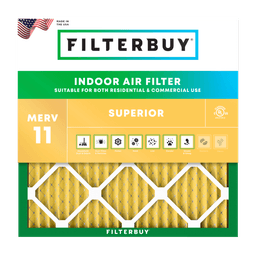
Match the filter to your needs: Superior (MERV 11) for everyday allergens, Optimal (MERV 13) for wildfire smoke and fine particles, or Odour Eliminator for smoke and cooking smells.
Set up Subscribe & Save so a fresh filter arrives on schedule. Edit, skip, or cancel anytime.
Frequently Asked Questions
Breathe Easier, Whatever the Map Says
Clean air shouldn’t depend on the weather. Whatever today’s reading says, the right filter keeps your home’s air fresh through smoke season, allergy season, and the long Canadian winter when the windows stay shut. With over 600 sizes, including the hard-to-find ones, plus free shipping to Canada and Subscribe & Save so you never run out, it’s easy to set and forget.