
Ottawa Real-Time AQI Tracker
What's Actually In Ottawa Air Today?
What High AQI Means for Your Lungs in Ottawa
How to Read AQI
The Air Quality Index (AQI) measures how polluted the air is and how it may affect your health.
0–50 (Good): Air quality is satisfactory.
51–100 (Moderate): Acceptable, but some pollutants may pose minor concerns.
101–150 (Unhealthy for Sensitive Groups)
151–200 (Unhealthy)
201–300 (Very Unhealthy)
301+ (Hazardous)
Moderate
Still okay for most, but if you have asthma or allergies, take it easy and avoid long outdoor workouts.
Shop MERV 11 filters→What's the Right Filter for Your AQI Level?
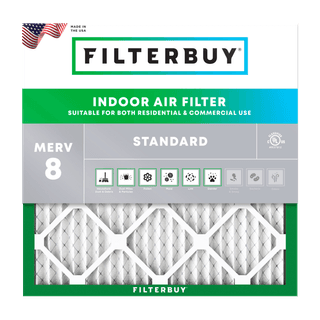

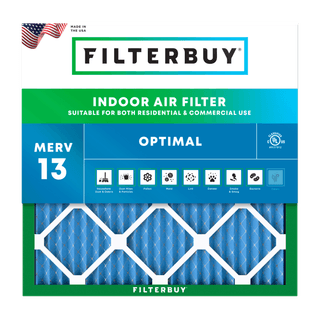




Check Today's Live Real Time Air Quality Index AQI Map in Ottawa, ON Now
In June 2023, Ottawa woke up to the worst air quality of any major city in the world. Smoke from fires in northern Québec and Ontario had settled over the Rideau Canal, and for a few days the capital's sky turned grey. Days like that are rare. Most of the year, Ottawa's air is clean and easy to breathe. It can still shift in an afternoon, though, and the live map below shows you exactly where it stands right now.
TL;DR — Quick Answers
Short on time? Here is the version that fits on a sticky note.
Today's Ottawa AQI: the live map at the top of this page has it, refreshed throughout the day.
AQI vs. AQHI: AQI (0 to 500) is the international scale most people search for. AQHI (1 to 10+) is Canada's official one.
Safe threshold: 0 to 50 is good. Above 100, sensitive groups limit outdoor time. Above 150, everyone should.
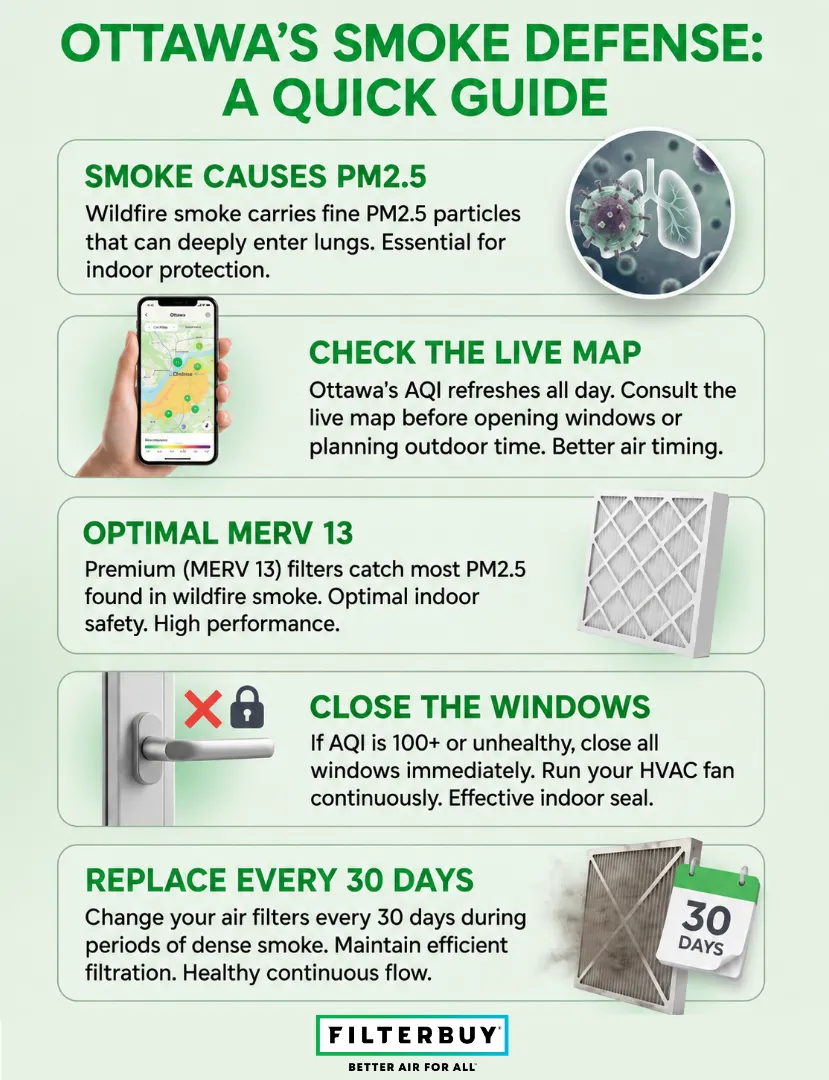
The main summer cause: wildfire smoke from northern Ontario and Québec, and PM2.5 is the pollutant that matters most.
Best filter for smoke: Optimal (MERV 13). For odours that linger after it clears, the Odour Eliminator filter.
What to do today: check the map, close the windows above 100, run the HVAC fan, and change the filter if it is overdue.
Top Takeaways
Ottawa's air is one piece of a larger provincial picture. The Ontario-wide live AQI map gives you the regional view, and you can zoom back to the capital here.
Canada's official scale is the AQHI (1 to 10+). Most maps and searches use the international AQI (0 to 500). This page shows AQI and links you to the official AQHI.
The main pressures on Ottawa's air are summer wildfire smoke, spring pollen, hot-afternoon ozone, and a long heating season.
PM2.5, the fine particles in wildfire smoke, is exactly what an Optimal (MERV 13) filter is built to catch.
Sensitive groups feel poor air quality before the general population does. Even a moderate reading can be enough to start symptoms.
On a smoke day, close the windows, run the HVAC fan, and change the filter more often than usual.
Free shipping to Canada on every order, no minimum, with prices shown in CAD.
What Today's Live AQI Reading Means in Ottawa
The number on the map is a real-time snapshot of how clean Ottawa's outdoor air is at this moment, and it refreshes throughout the day. On the international Air Quality Index scale, anything from 0 to 50 is good for everyone. Between 51 and 100, the air is generally fine, though especially sensitive people might notice it. Once it climbs past 100, sensitive groups, meaning children, older adults, and anyone with asthma or COPD, should ease off on long stretches outdoors. Above 150, it is a sensible day for all of us to stay in.
AQI vs. AQHI: The Two Scales Ottawa Uses
You will see two scales around the capital, and they measure related things in different ways. The AQI runs from 0 to 500 and is the international standard most people search for. Canada's official scale is the AQHI, which runs from 1 to 10+. Environment and Climate Change Canada publishes it, and it tracks three pollutants: fine particulate matter (PM2.5), ground-level ozone, and nitrogen dioxide. The Ottawa Downtown monitoring station feeds into it. We lead with AQI here because that is what most people look for, and we point you to the official AQHI in the resources further down.

What's Driving Ottawa's Air Quality Today
What pushes the number up shifts with the season. Summer is wildfire smoke, drifting in from northern Ontario and Québec, and it has shown up more often over the past few years than it used to. Spring brings pollen and mould spores. Hot, sunny afternoons cook up ground-level ozone, and traffic downtown adds its own fine particulate. Then there is the heating season. Your furnace runs for roughly half the year here, which is why the filter sitting inside it matters more in Ottawa than in a milder climate. When smoke is in the air, an Optimal (MERV 13) filter catches the fine PM2.5 that lower ratings let slip past.
How to Read the Live Map at the Top of This Page
The map covers Ottawa and the area around it, from the downtown core out to Kanata, Orléans, and Barrhaven, and across the river into Gatineau. Each reading comes from the nearest monitoring station, so the number over your street can sit a little higher or lower than one a few kilometres away. Check it before you head outside. On a smoke day, check it more than once, because conditions can turn within a few hours.
The homeowners who come through a smoke event in good shape are rarely the ones with the priciest equipment. They are the ones who checked the map before they opened the windows. A clean Optimal (MERV 13) filter, in a furnace set to run the fan, will quietly pull a surprising amount of fine smoke out of the air over a day. The catch is timing. It has to be in place before the haze arrives. Once you can smell smoke indoors, it has already worked its way into the furniture and the carpets, and you are catching up instead of staying ahead. The fix that actually works is a dull one: change the filter early, run the fan, and keep the windows shut on the bad days.
— Filterbuy Canada
Seven Trusted Sources for Ottawa's Air, Worth Bookmarking Before Smoke Season
These are the sources we check ourselves for current readings, health guidance, and the longer view. Save them somewhere easy to reach, and you will have them ready the next time a special air quality statement lands.
1. The Official Ottawa Reading, from Environment and Climate Change Canada
This is the federal AQHI for Ottawa, updated continuously, with the current value and the forecast high. When you want the validated government figure rather than a third-party estimate, start with the Ottawa AQHI page on weather.gc.ca.
2. Station-Level Detail from Air Quality Ontario
The province runs the Ottawa Downtown station, and its readings break down pollutant by pollutant, including live PM2.5. It is the page to open when you want to see which pollutant is actually driving today's number. Find it at Air Quality Ontario.
3. Local Guidance from Ottawa Public Health
Ottawa Public Health publishes advice geared to this city: who is most at risk, what to do during a smoke event, and which City services are affected. When a statement is in effect for the capital, this is the first place to look. See Ottawa Public Health on wildfire smoke and air quality.
4. What to Do Indoors, from Health Canada
Health Canada's page on fine particulate matter covers the indoor side: furnace and HVAC strategies, sensible ventilation, and what to focus on first if someone in the house has a respiratory condition. Read Health Canada on fine particulate matter (PM2.5).
5. Protecting Your Lungs, from the Canadian Lung Association
Written for Canadian conditions and in plain language, this guide explains who is most at risk, why an ordinary mask does little against smoke, and how to keep it out of your home during an active event. See the Canadian Lung Association's guide.
6. Understanding the Scale: Air Quality Index Explained
If you are unsure what the AQI numbers actually represent, including how the scale is calculated and why Canada, the United States, and the EU each use a slightly different version, this overview is a clean, well-cited place to start: Air Quality Index on Wikipedia.
7. Where the Smoke Is: Filterbuy's Live Canadian Wildfire Map
This is our companion map for active fires and smoke plumes across the country. Pair it with the AQI map above. One tells you what the air is doing now, the other shows you where the smoke is coming from next. See Filterbuy's live Canadian wildfire and smoke map.
Three Numbers That Put Ottawa's Air in Perspective
These three figures come from different kinds of sources: frontline reporting, peer-reviewed research, and federal statistics. Together they give you a fuller picture than any one of them would alone.
-
110+
Ottawa's AQHI Passed the Top of the Official Scale in 2023
In June 2023, Ottawa's AQHI hit 10+, the very-high-risk band that sits past the top of the scale, and the city briefly held the worst air quality of any major city in the world. None of that smoke started here. It drifted in from fires hundreds of kilometres away, which is how a distant fire can grey out the sky over Parliament Hill.
-
215 million
Hectares of Canadian Forest Burned in 2023, More Than Double the Previous Record
Researchers writing in Nature Communications put the 2023 total at roughly 15 million hectares, with smoke reaching communities more than 1,000 kilometres away. Ottawa was one of them.
Source: Nature Communications, the record-breaking 2023 Canadian wildfire season
-
31.9×
Urban Canadians Breathe Nearly Twice the Fine Particulate of Rural Canadians
Statistics Canada measured residential PM2.5 at 8.03 µg/m³ in urban cores against 4.32 µg/m³ in rural areas, a difference of about 1.9 times. For an Ottawa household, that everyday urban level is the baseline, and then it stacks on top of it.
Source: Statistics Canada, exposure to fine particulate matter in Canada
Where We Land on Breathing Easy in the Capital
Here is our honest read. The trend for Ottawa is not alarming, but it is not entirely reassuring either. Smoke has gone from a rare event to a regular part of summer. Allergy seasons start a little earlier and run a little longer. And the heating season, already six to eight months long here, is not getting any shorter. None of that is cause for worry. It is a cause for paying a bit more attention to indoor air than people did a decade ago.
We will say plainly where we stand. Most people spend too much on standalone air purifiers and too little on the filter already running through the furnace for half the year. A well-chosen pleated filter, changed on a sensible schedule, does a great deal of quiet work. In allergy season, a Superior (MERV 11) filter handles pollen, dust mites, and mould spores comfortably. In smoke season, step up to Optimal.
We are not going to oversell it. A furnace filter is not a respirator, and it will not make the smoke outside disappear. For the air inside your home, though, where most of us spend the better part of an Ottawa winter, it is one of the highest-value changes you can make. Keep the filter clean, leave the fan running, and shut the windows when the reading climbs. That is the whole playbook.
What to Do Right Now, Depending on Today's Reading
If AQI is 0–50 (Good)
Open the windows and air the house out if they have been shut.
Check when you last changed the furnace filter. If it has been more than 60 days, it is time.
A calm day is the easy time to set up a subscription, so you are never caught without a fresh filter.
If AQI is 51–100 (Moderate)
Go about your day, but look in on anyone with asthma, COPD, or pollen allergies. Moderate days are often when symptoms start.
If you are due for a filter change, do it today rather than waiting.
If AQI is 101–150 (Unhealthy for Sensitive Groups)
Close the windows and switch the HVAC system to the fan setting so air keeps moving through the filter.
Keep children, older adults, and anyone with a respiratory condition indoors more than usual.
If the filter looks discoloured, replace it now.
If AQI is above 150
Stay inside, keep windows and doors closed, and run the HVAC fan continuously.
An Optimal (MERV 13) or Odour Eliminator filter is your best defence indoors.
Check on neighbours, especially older neighbours and anyone living alone.
If you or anyone at home has chest tightness, a lingering cough, or shortness of breath, contact a healthcare provider or call Health811 by dialling 811.
Frequently Asked Questions
Breathe Easier in Ottawa This Season
If today's reading has you thinking about the air in your home, you are already ahead of most people. Filterbuy makes pleated air filters in more than 600 sizes, custom sizes included, and ships them straight from our own facilities to your door in Ottawa. Shipping across Canada is free on every order, with no minimum, and prices show in CAD at checkout.
Not sure which one fits? Superior (MERV 11) covers spring allergies and pet dander. Optimal (MERV 13) is the one we point Ottawa homeowners to for the smoke season. Odour Eliminator clears the smell that tends to outlast the haze. Subscribe and save up to 70% per filter, on a schedule you control, and edit, skip, or cancel whenever you need to. Or buy a single pack and see what you think. We have earned more than 85,000 five-star reviews from customers across North America, and we would rather earn your trust than talk you into the wrong filter.