Shop by
The Air Quality Index (AQI) measures how polluted the air is and how it may affect your health.
0–50 (Good): Air quality is satisfactory.
51–100 (Moderate): Acceptable, but some pollutants may pose minor concerns.
101–150 (Unhealthy for Sensitive Groups)
151–200 (Unhealthy)
201–300 (Very Unhealthy)
301+ (Hazardous)
Still okay for most, but if you have asthma or allergies, take it easy and avoid long outdoor workouts.
Shop MERV 11 filters→
Author: Michelle Wan | Reviewer: David Clark, Licensed HVAC Technician | Publish date: July 16, 2026 | Updated date: July 16, 2026
London, Ontario's air quality is reported through Canada's Air Quality Health Index (AQHI), a 1 to 10+ scale, not the U.S. 0–500 AQI. For the live reading right now, check Air Quality Ontario or Environment Canada's London station. At AQHI 7 or higher, people in sensitive groups should reduce outdoor activity and head indoors.
London, ON's live air quality is tracked using the Air Quality Health Index (AQHI), jointly run by Environment and Climate Change Canada, Health Canada, and the Province of Ontario. The index runs from 1 (low risk) to 10+ (very high risk), based on ground-level ozone, fine particulate matter (PM2.5), and nitrogen dioxide. London's readings can shift with Highway 401/402 traffic, seasonal furnace use, and wildfire smoke drifting in from northern Ontario, Québec, or the Prairies. Check the live station reading below before you head outside or open the windows, and re-check later in the day since conditions change hour to hour. When smoke does push the reading up, a properly rated Filterbuy filter is what keeps the air inside your home clear while you wait it out.
Canada uses the AQHI (1 to 10+), not the U.S. AQI (0 to 500). The two scales are not directly comparable.
London's AQHI is measured at a monitoring station tracked by Air Quality Ontario and Environment Canada, updated hourly.
At AQHI 7 or above, the Middlesex-London Health Unit and Environment Canada may issue a Special Air Quality Statement for the region.
Local air quality is shaped by the Highway 401/402 traffic corridor, seasonal furnace use, and wildfire smoke that can drift in from hundreds of kilometres away.
The AQHI reads outdoor air only. Indoor air quality depends on your home's ventilation and the filter in your HVAC system.
Filterbuy ships free to Canada with prices in CAD, 600+ filter sizes including custom, and a MERV colour-coded system that makes it easy to match your filter to conditions.
The live map at the top of this page shows London's real-time air quality using the international AQI scale (0 to 500), sourced from Air Quality Ontario and Environment Canada's monitoring station for the city, alongside the timestamp of the latest update. Readings update throughout the day.
For Ontario's official AQHI reading (1 to 10+), the scale used for health guidance in this province, Air Quality Ontario's London AQHI page shows today's hourly reading and forecast maximum for the city. Environment Canada's London page gives the same AQHI reading plus a past-24-hours trend so you can see whether the air is improving or worsening. Both sources caution that real-time data is auto-polled and not yet fully quality-controlled, so treat it as a close, current estimate rather than a certified reading.
The AQHI rates health risk from 1 to 10+, based on the combined concentration of ground-level ozone (O3), fine particulate matter (PM2.5), and nitrogen dioxide (NO2). It was developed jointly by Environment and Climate Change Canada, Health Canada, and the provinces, and it has replaced the older Air Quality Index (AQI) as Canada's public-facing air quality tool. Read the number, the risk category, and the colour together:
Source: Environment and Climate Change Canada and the Province of Ontario, Air Quality Health Index.
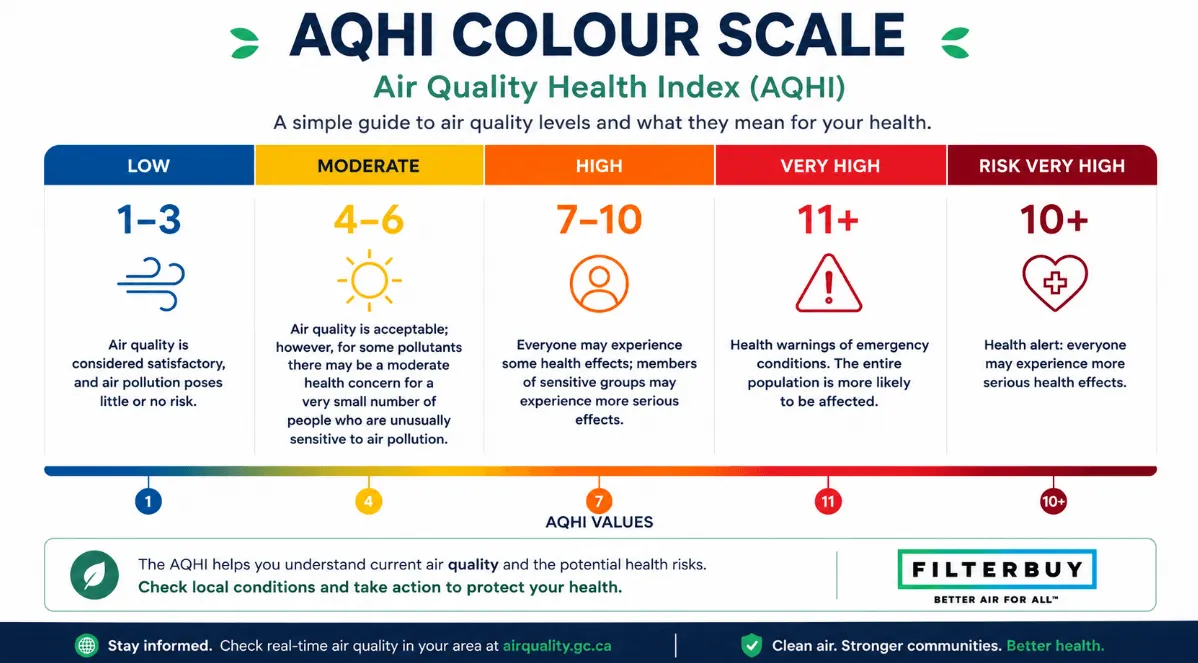
The colour and number tell you the risk level. Here's how that plays out for the everyday decisions London households actually ask us about, based on the same health messages Environment Canada and the Province of Ontario publish:
Running or intense outdoor exercise: Fine through 1–6. At 7–10, ease off or move it indoors, especially if you notice coughing or throat irritation. At 10+, skip strenuous outdoor exercise entirely.
Walking the dog: Fine through 1–6 for most pets. At 7 or higher, keep walks shorter, and watch for laboured breathing in older dogs or those with health conditions, the same way you'd watch for symptoms in people.
Kids playing outside or school recess: Fine through 1–6. At 7–10, active outdoor play should be shortened, especially for children with asthma. At 10+, move activities indoors.
Opening your windows: Comfortable through 1–6. At 7 or higher, especially during a wildfire smoke event, keep windows closed and run your HVAC system on recirculate.
Gardening or yard work: Fine through 1–6. At 7 or higher, take breaks more often and stop if you notice eye or throat irritation.
Cycling to work or school: Fine through 1–6. At 7 or higher, consider driving or transit instead, particularly along busier routes like the 401/402 corridor.
These are general guidelines drawn from official AQHI health messages, not medical advice. If you or someone in your household has asthma, COPD, or a heart condition, follow your doctor's specific guidance over any general rule of thumb.
If you've searched for London's "AQI" and landed on a U.S.-style 0–500 reading from a third-party site, know that it isn't the same scale Ontario uses officially. The U.S. Air Quality Index (AQI) runs 0 to 500 and reflects EPA thresholds, while Canada's AQHI runs 1 to 10+ and is calculated specifically around health risk from the pollutant mix. A U.S.-style AQI of 50 ("Good") does not automatically equal an AQHI of 5. They're built from different formulas. For Ontario-specific decisions about outdoor activity, defer to the official AQHI reading from Air Quality Ontario or Environment Canada rather than a third-party AQI conversion.
The two scales use different formulas and are not directly interchangeable. Always check the official AQHI for Ontario decisions.
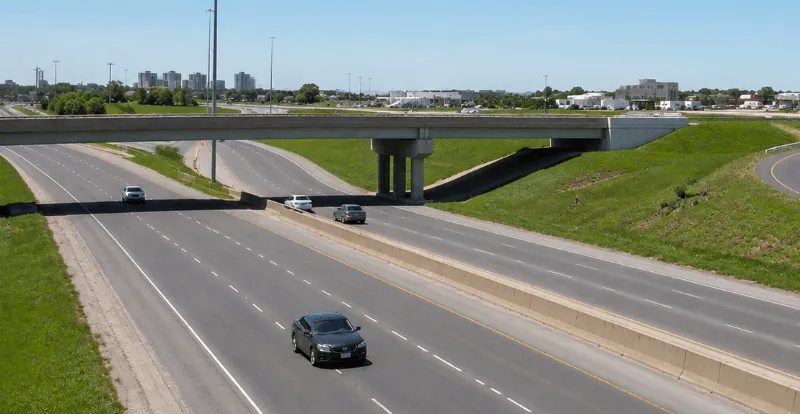
Shipping Filterbuy filters into homes across southwestern Ontario for years has given us a pretty clear picture of what actually moves London's air, and it's rarely just one thing. Highway 401 and Highway 402, two of southwestern Ontario's busiest freight and commuter corridors, meet in London, so vehicle exhaust is a steady contributor to local ozone and NO2 levels, particularly near the interchange and during peak travel periods. Middlesex County surrounding the city is heavily agricultural, which adds seasonal dust and odour patterns. And because London sits inland between Lake Huron and Lake Erie, regional weather patterns and thermal inversions can occasionally trap pollutants closer to ground level.
The factor we field the most questions about, though, is wildfire smoke. Even though London is in southern Ontario, the Middlesex-London Health Unit has repeatedly issued Special Air Quality Statements when smoke from fires burning hundreds of kilometres away in northern Ontario, Québec, or the Prairies drifts into the region on regional winds. This means the air can turn hazy in London with no fire anywhere nearby, and it can happen during summer months even when local conditions are otherwise calm. It's the one factor that surprises people most, since it has nothing to do with anything happening in the city itself.
AQHI health messages call out "at-risk" groups everywhere they apply, but a few groups have a bigger footprint in London specifically. Western University and Fanshawe College together enroll roughly 45,000 students, many living in older housing near campus that wasn't necessarily built with high-efficiency filtration in mind. The city's three major hospitals, Victoria Hospital, University Hospital, and St. Joseph's Hospital, serve patients with existing respiratory and cardiovascular conditions who are more sensitive to air quality swings. And Middlesex County's agricultural workforce spends long hours outdoors during the same summer months when wildfire smoke risk peaks. None of that changes the AQHI reading itself, but it's worth knowing if you fall into one of these groups, or care for someone who does.
Winter (Oct–Apr): London's furnace season is long. Furnaces run harder and longer, so indoor filters load up faster even while outdoor AQHI readings often stay low.
Spring (Apr–Jun): Tree and grass pollen rise across southwestern Ontario. Outdoor AQHI may stay moderate, but allergy-sensitive households often notice symptoms first.
Summer (Jun–Sep): Ontario's wildfire season runs April 1 to October 31, with smoke risk peaking in summer. This is when London's AQHI is most likely to reach the high-risk range. For the province-wide picture, see Filterbuy's live Ontario wildfire and smoke map.
Autumn (Sep–Oct): A transition period. It's the recommended time to schedule furnace maintenance and start a fresh Filterbuy filter before heating season begins.
Not every hazy day in London is wildfire smoke, and not every AQHI increase comes with a visible haze. A few practical cues help sort out what you're actually dealing with:
Wildfire smoke often carries a faint campfire-like smell and can turn the sky a yellowish or orange-grey colour, especially around sunrise or sunset.
Traffic and industrial pollution (more common near the 401/402 corridor) tends to build gradually through the day and ease off overnight, without the smoky smell.
Humidity haze, common on hot, still summer days, can look similar to smoke but has no odour and typically clears once a breeze picks up.
When in doubt, check the live AQHI reading and whether a Special Air Quality Statement is in effect rather than relying on how the sky looks. Air quality can be poor on a day that looks clear, and a hazy-looking day isn't always a high-AQHI day.
Canada averages more than 8,000 wildfires a year, burning over 2.1 million hectares; lightning starts roughly half of those fires but accounts for about 85% of the area burned. (Canadian Wildland Fire Information System, Natural Resources Canada)
Ontario's wildland fire season runs April 1 to October 31 each year. (Government of Ontario)
Fine particles (PM2.5) make up roughly 90% of the particulate mass in wildfire smoke, precisely the particle size a MERV 13 filter is built to capture. (Health Canada)
London's population was 422,324 at the 2021 census, with a wider metro area of roughly 527,000 as of 2025, making it one of Canada's fastest-growing mid-sized cities. (Statistics Canada, via Wikipedia)
The AQHI only measures outdoor air. What you actually breathe at home depends on your home's ventilation and the filter doing the work in your HVAC system. Filterbuy's colour-coded MERV system makes it straightforward to match a filter to conditions:
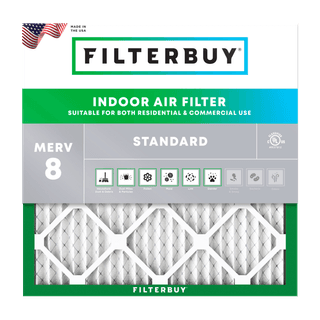
Standard (MERV 8): Everyday filtration for dust, lint, and pollen, a solid baseline for most London homes.
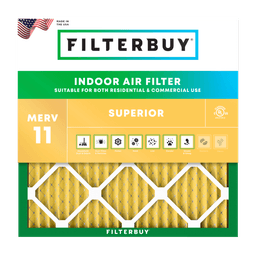
Superior (MERV 11): A step up for homes with pets or seasonal allergies, capturing dust mites, mould spores, and pet dander.
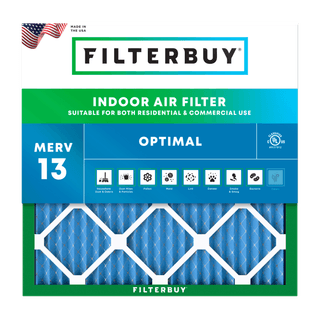
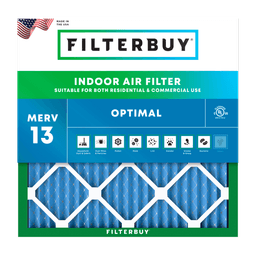
Optimal (MERV 13): The recommended level during wildfire smoke season and for allergy-sensitive or health-conscious households, capturing fine particles and smoke.
Odour Eliminator (carbon): Helps with the lingering smell after a smoke event.
During a Special Air Quality Statement, setting the furnace fan to "on" rather than "auto" keeps air cycling through the filter continuously. Filterbuy ships free to Canada on every order, with 600+ sizes including custom, prices in CAD, and Subscribe & Save scheduling you can edit, skip, or cancel anytime.
Optimal (MERV 13) is the recommended household level once the AQHI reaches high risk.
David Clark, the Licensed HVAC Technician who reviews Filterbuy's HVAC content, shared this perspective on what he sees in London homes each smoke season:
"Southwestern Ontario doesn't need a fire nearby to feel a smoke event. Every summer I get calls from London homeowners asking why the sky looks hazy on a day the forecast called for sun, and the answer is almost always smoke that's drifted in from hundreds of kilometres north. Most of the furnaces I service in this area run a long, hard heating season, so by the time smoke shows up in July or August, a lot of filters are already overdue. The households that stay comfortable are the ones with a clean MERV 13 filter in place before the haze arrives, not after." - David Clark, Licensed HVAC Technician
"If I can't see haze, the air must be fine." Not necessarily. AQHI levels can rise into the moderate range from ozone or traffic-related pollution without visible haze, especially on hot, still summer days.
"AQHI and AQI are basically the same number." They're built on different formulas and different scales entirely (1–10+ versus 0–500), so converting one to the other isn't reliable. Check the AQHI directly for Ontario decisions.
"A good outdoor reading means my indoor air is fine too." Indoor air quality depends on your home's ventilation, filter condition, and indoor sources like cooking or pets. It can differ meaningfully from the outdoor reading.
The AQHI reading published for London reflects the city's monitoring station, but conditions can vary somewhat block to block. Areas closer to the Highway 401/402 interchange and industrial pockets in the city's east end tend to see more traffic-related pollution during peak hours, while leafier residential areas near the Thames River valley and parks like Springbank and Gibbons Park generally see cleaner conditions on an average day. During a region-wide wildfire smoke event, however, these local differences tend to matter far less than the amount of smoke moving through the whole region at once.
Check today's live AQHI reading for London. Below 4 is low risk and fine for usual outdoor activity; 4–6 is moderate; 7 or higher is high risk, when sensitive groups should reduce outdoor exertion and consider heading indoors.
PM2.5 (fine particulate matter) is one of the three pollutants built into the AQHI calculation, alongside ozone and nitrogen dioxide. Rather than a standalone PM2.5 number, the AQHI reading itself already reflects current PM2.5 levels for London. Check today's live AQHI reading for the combined risk score.
Wildfire smoke can travel hundreds of kilometres on regional winds from fires burning in northern Ontario, Québec, or the Prairies. It's common for London's skies to turn hazy, and the AQHI to rise, without any fire burning anywhere close to the city.
An AQHI of 7 or higher is classified as High Risk, when people in sensitive groups (children, older adults, and those with heart or respiratory conditions) should reduce or reschedule outdoor activity. 10+ is Very High Risk, when staying indoors with filtered air is recommended for everyone.
Use Air Quality Ontario's London station page or Environment Canada's London AQHI page for the official, hourly-updated reading. The live widget on this page pulls from these same sources.
Not automatically. The AQHI measures outdoor conditions only. Indoor air quality depends on your home's ventilation and the condition of your HVAC filter, which is why a clean, appropriately rated filter still matters even on low-risk outdoor days. A Filterbuy Optimal (MERV 13) filter is built to capture fine particles year-round, not just during a Special Air Quality Statement.
AQHI (Air Quality Health Index): Canada's official 1 to 10+ scale for reporting the health risk of outdoor air, based on ozone, PM2.5, and nitrogen dioxide.
AQI (Air Quality Index): The U.S. EPA's 0 to 500 scale for reporting air pollution; not directly interchangeable with Canada's AQHI.
PM2.5: Fine particulate matter measuring 2.5 micrometres or smaller in diameter, small enough to penetrate deep into the lungs; a major component of wildfire smoke and vehicle exhaust.
Ground-level ozone (O3): A gas formed when pollutants react with sunlight, typically peaking on hot summer afternoons.
Nitrogen dioxide (NO2): A pollutant produced mainly by vehicle and industrial combustion, one of the three inputs to the AQHI formula.
Special Air Quality Statement (SAQS): An advisory issued by Environment and Climate Change Canada and/or the Province of Ontario when the AQHI has the potential to reach high-risk levels.
MERV (Minimum Efficiency Reporting Value): A rating scale for how effectively an air filter captures particles (full MERV ratings guide); Filterbuy's Standard, Superior, and Optimal lines correspond to MERV 8, 11, and 13.
Air Quality Ontario: London AQHI: Live, hourly Air Quality Health Index readings for London's monitoring station.
Environment Canada: London AQHI: Current values, forecast maximums, and past-24-hour trends for London.
Canada.ca: About the Air Quality Health Index: How the AQHI is calculated and what the risk categories mean.
Middlesex-London Health Unit: News & Advisories: Local Special Air Quality Statements and public health guidance for London and Middlesex County.
Government of Ontario: Forest Fire Information Map: Active wildfires, fire danger ratings, and the fire season calendar.
ECCC FireWork Smoke Forecast: 72-hour forecast of wildfire smoke (PM2.5) movement across Ontario.
Health Canada: Wildfire Smoke and Your Health: Guidance on protecting your health indoors and out during smoke events.
Filterbuy is a direct-to-consumer air filter manufacturer serving homes across Canada through filterbuy.ca, with free shipping to Canada, prices in CAD, and 600+ filter sizes including custom. We've spent years shipping filters into Ontario homes through every heating season and smoke season this province has thrown at them, and that experience shapes how we cover a topic like this one. This page is written by Michelle Wan and reviewed for technical accuracy by David Clark, a Licensed HVAC Technician. We link to official Canadian government sources for all live air quality data and update this page as conditions and guidance change.