
What Temperature Should You Set Your Thermostat? A Season-by-Season Guide
November 10, 2026
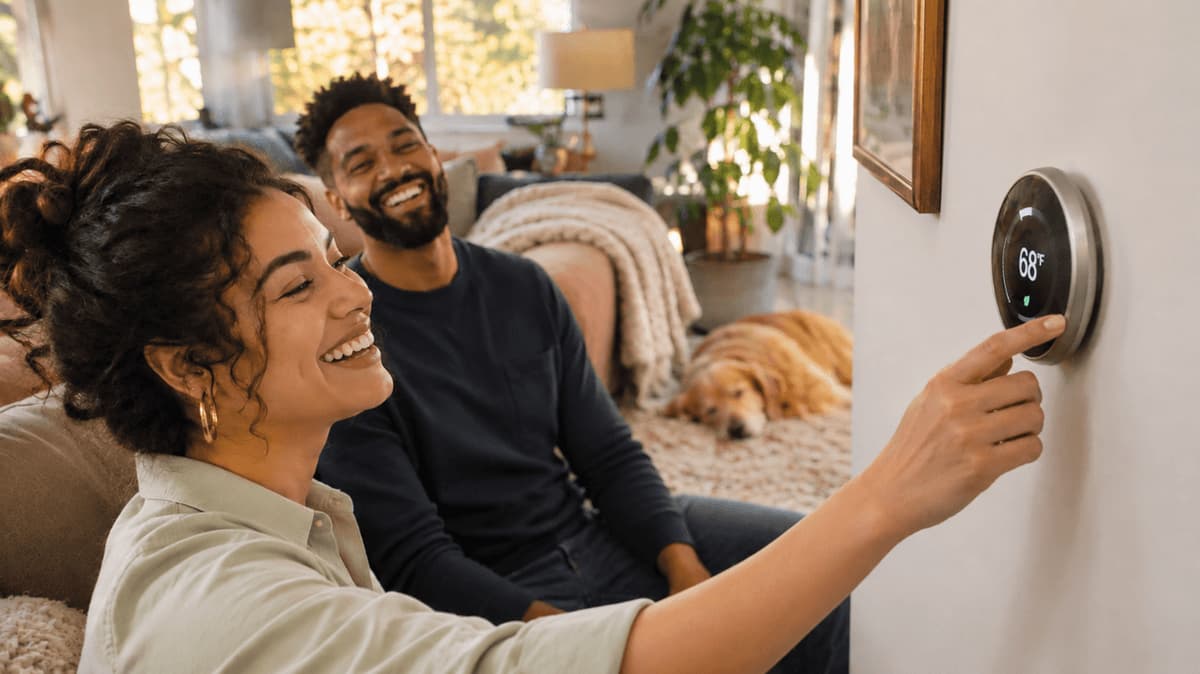
Your Thermostat Settings at a Glance
Find your setting for every part of the day, in both heating and cooling season, in the chart below. Pick your row, program it once, and let your schedule handle the rest.
If your home never reaches the number you set, a loaded air filter is often the reason. It restricts airflow, so each cycle runs longer and delivers less heating or cooling.
Take the quick quiz below to find the right air filter for your system.
Find Your Filter Match
Answer a few quick questions and we'll match you to the right filter for your system.
Set your thermostat to 68°F in winter and 78°F in summer while you're home and awake. The U.S. Department of Energy (DOE) gives both numbers in its thermostat fact sheet as starting points that balance comfort and cost. From there, a 7–10°F setback for about eight hours a day, while you sleep or work, can save up to 10% a year on heating and cooling, according to the U.S. Department of Energy
TL;DR
For most homes, 68°F for heating and 78°F for cooling is the right setting while someone is home and awake. Turn it back at night and when the house is empty, and if the house never reaches the setting, check the air filter.
Key Takeaways
Start at 68°F for heating and 78°F for cooling while you're home and awake.
A 7–10°F setback for eight hours a day can cut annual heating and cooling costs by up to 10%.
Most adults sleep best around 65°F, which makes winter nights an easy place to save.
Keeping humidity between 30% and 50% makes 78°F feel cooler and helps prevent mold.
When a home can't reach its setpoint, Filterbuy's rule is to check the filter before the thermostat.
What Is the Best Thermostat Setting?
The best thermostat setting is the one closest to the outdoor temperature that still keeps your household comfortable. For most U.S. homes, that works out to 68°F in heating season and 78°F in cooling season, because the smaller the indoor-outdoor gap, the less your system works.
If 78°F feels too warm, try 77°F for a week.
“When readers ask me what to set their thermostat to, I tell them 68 in winter and 78 in summer. Then I ask when they last changed their filter.”
— Michelle Wan, Brand Manager and Air Quality Writer, Filterbuy
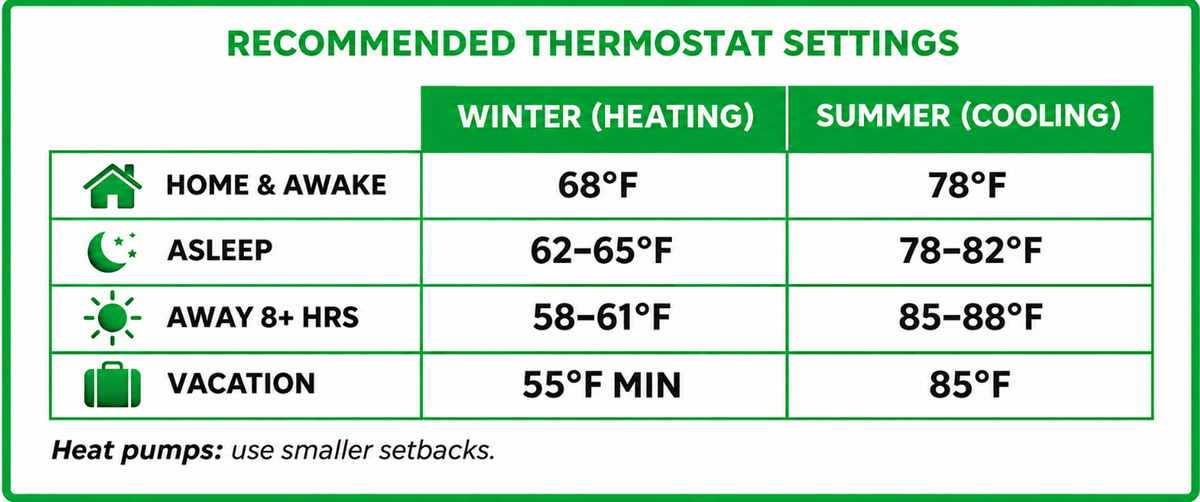
Thermostat Temperature Chart: Recommended Settings by Season
The chart below pulls DOE and ENERGY STAR guidance into one schedule.
Sources: DOE, ENERGY STAR, Sleep Foundation, and American Red Cross. DOE's sample schedule uses 60°F away and 62°F overnight.
What Temperature Should I Set My Thermostat to in Winter?
During winter, keep the thermostat at 68°F while you're home and awake (DOE suggests around 68°F to 70°F), then lower it when you sleep or leave.
Setbacks work because a cooler house loses heat more slowly, and DOE notes that warming it back up doesn't cancel the savings.
What that is worth: ENERGY STAR puts the average home's heating and cooling costs above $900 a year, so DOE's estimate of up to 10% in setback savings works out to roughly $90 a year, and DOE notes the share saved is even larger in milder climates.
Even while you travel, keep the thermostat at 55°F or higher, the minimum the American Red Cross recommends for an empty house in cold weather.
What Temperature Should I Set My Thermostat to in Summer?
During summer, set the thermostat to 78°F when you're home, and let it climb while you're out.
Two habits make 78°F feel cooler:
Run a ceiling fan counterclockwise while you're in the room, and close the blinds on sun-facing windows.
Keep lamps and TVs away from the thermostat, since their heat can make it read high.
As the U.S. Department of Energy (DOE) explains, setting your thermostat lower than normal won't cool your home any faster. Instead, it can lead to overcooling and unnecessary energy costs.
What Temperature Should I Set My Thermostat to at Night?
Most adults sleep best in a bedroom around 65°F, and the Sleep Foundation's bedroom temperature guidance puts the comfortable range at 65°F to 68°F. That makes winter nights a natural time for a setback. In summer, many households raise it to 80–82°F overnight with a fan on.
With heavier bedding, you can go lower, to 62–64°F. Schedule it an hour before bed and back up before you wake.
What Should I Set My Thermostat to When I'm Away or on Vacation?
For absences of eight hours or more, set it back 7–10°F, to about 58–61°F in winter and 85–88°F in summer. For longer trips, hold the winter setting at 55°F or higher (58–60°F in older, drafty homes), as Filterbuy's winter vacation thermostat guide explains. In humid climates, leave summer cooling near 85°F rather than shutting it off, since the air conditioner also removes moisture.
How Should I Adjust My Thermostat for Pets, Babies, and Older Adults?
Pets, babies, and older adults handle temperature swings less easily, so use smaller setbacks when they're home. Older adults may sleep better in a warmer room: a 2023 study of adults 65 and older found sleep was most efficient at 68–77°F.
Do Heat Pumps Need Different Thermostat Settings?
Yes. In heating mode, a deep setback can trigger a heat pump's auxiliary electric heat during recovery, and that backup heat is expensive. The DOE notes that a moderate setting is most cost-effective unless your thermostat has heat pump recovery.
Keep winter setbacks small or use a smart thermostat with heat pump ("adaptive") recovery. In cooling mode, the standard summer schedule applies.
How Does Humidity Change What a Thermostat Setting Feels Like?
At 78°F and 45% relative humidity, a room tends to feel comfortable, while the same room at 65% humidity feels sticky. The EPA's guide to mold and moisture recommends keeping indoor humidity below 60%, and ideally between 30% and 50%, which also helps prevent mold.
So if your home feels muggy at 78°F, check the humidity before you lower the setpoint. Filterbuy's guide to whether an air filter can help with mold goes deeper on moisture.
Why Your Home Can't Hold Its Thermostat Setting
A thermostat only controls when your system runs. Whether your home actually reaches 68°F or 78°F depends on airflow, and airflow starts at the air filter. We call the difference between the number on the wall and the temperature in the room the setpoint gap. From Filterbuy's side of the system, a loaded filter is one of the most common and cheapest causes to fix. As the filter fills up, the blower pulls less air across the coil, so each cycle runs longer and delivers less heating or cooling.
The DOE reports that replacing a dirty, clogged filter with a clean one can lower an air conditioner's energy use by 5% to 15%, and ENERGY STAR warns that a dirty filter can lead to early equipment failure.
In winter, a clogged filter can also trip the furnace's high-limit safety switch, which shuts the system off and leaves it cycling instead of heating. See Filterbuy's winter HVAC airflow guide.
“In our years of manufacturing filters and testing them under real-world conditions, we've found that winter is the season most homeowners underestimate. A filter that looks fine in October can be completely choked by December, and that's when we see the most avoidable furnace failures.”
— Filterbuy Manufacturing Team
At Filterbuy, we make every air filter we sell to order in our own U.S. plants, so we see this question from the return side of your system. In our experience, the thermostat only sets the target, and airflow decides whether your home actually reaches it.
That's why Filterbuy's rule is filter first, thermostat second. Check this setpoint gap troubleshooter before you touch the setting:
Most 1-inch filters need replacing every 60–90 days, and sooner in homes with pets or allergies. Filterbuy builds its pleated filters for about 90 days of use. See how often to change your air filter for a full schedule or find your exact filter size if you're unsure, and let Filterbuy auto-delivery ship your size when it's due.
Supporting Statistics
1. Only One-Third of Programmable Thermostats Are Actually Programmed
53% of U.S. households have a programmable or smart thermostat, but only about one-third of those homes use the scheduling tools to control temperature.
Why it matters: a thermostat only saves money when its schedule is turned on.
Source: U.S. Energy Information Administration, 2020 Residential Energy Consumption Survey (18,496 households).
2. Heating and Cooling Cost the Average Home More Than $900 a Year
That's almost half of the average American household's annual energy bill.
Why it matters: your thermostat controls your home's largest energy expense.
Source: ENERGY STAR, Smart Thermostats, a joint U.S. EPA and Department of Energy program.
3. Heat Caused 2,391 Reported U.S. Deaths in 2024
Adults aged 65–74 made up the largest share of heat-related deaths, at 21.1%.
Why it matters: summer setbacks should never put vulnerable people at risk.
Source: CDC, MMWR QuickStats: Heat-Related Deaths by Age Group, United States, 2024.
Frequently Asked Questions
Is 72°f a good thermostat setting?
It's comfortable for many people, but it costs more than 68°F in winter or 78°F in summer.
What is the lowest safe thermostat setting in winter?
The American Red Cross recommends 55°F or higher; go warmer for infants or older adults.
Does a smart thermostat save money?
Yes, if it automates setbacks. ENERGY STAR estimates about $100 a year in high-bill homes.
Is it cheaper to keep the thermostat at one temperature?
No. A cooler house loses heat more slowly, so setbacks save energy, except with heat pumps.
Will cranking the thermostat heat or cool the house faster?
No. DOE notes an extreme setting only makes the system run longer and overshoot.
Glossary
Setpoint: The target temperature you program into a thermostat.
Setback: A temporary setpoint change that saves energy while you're asleep or away.
Heat pump: An electric system that moves heat into or out of the home.
Auxiliary heat: Electric resistance backup heat in a heat pump system; it costs more to run.
Relative humidity (RH): Moisture in the air as a percentage of the most it can hold at that temperature.
Programmable thermostat: A thermostat that changes setpoints automatically on a set schedule.
Smart thermostat: A Wi-Fi thermostat you can control remotely; many learn your schedule.
DOE (U.S. Department of Energy): The federal agency behind the Energy Saver program.
ENERGY STAR: A joint U.S. EPA and DOE efficiency program.
Sources
U.S. Department of Energy, Home Upgrades
U.S. Department of Energy, Energy Saver Guide (2022)
U.S. Department of Energy, Energy Savers: Tips on Saving Money and Energy at Home
U.S. Department of Energy, Maintaining Your Air Conditioner
ENERGY STAR, Heat & Cool Efficiently
Sleep Foundation, Best Temperature for Sleep
American Red Cross, Preventing & Thawing Frozen Pipes
U.S. Energy Information Administration, 2020 Residential Energy Consumption Survey highlights
ENERGY STAR, Smart Thermostats
CDC, MMWR QuickStats: Heat-Related Deaths by Age Group, 2024
Baniassadi et al., Nighttime Ambient Temperature and Sleep in Community-Dwelling Older Adults, Science of the Total Environment (2023)