
What Temperature Should You Set Your AC in Summer?
November 10, 2026
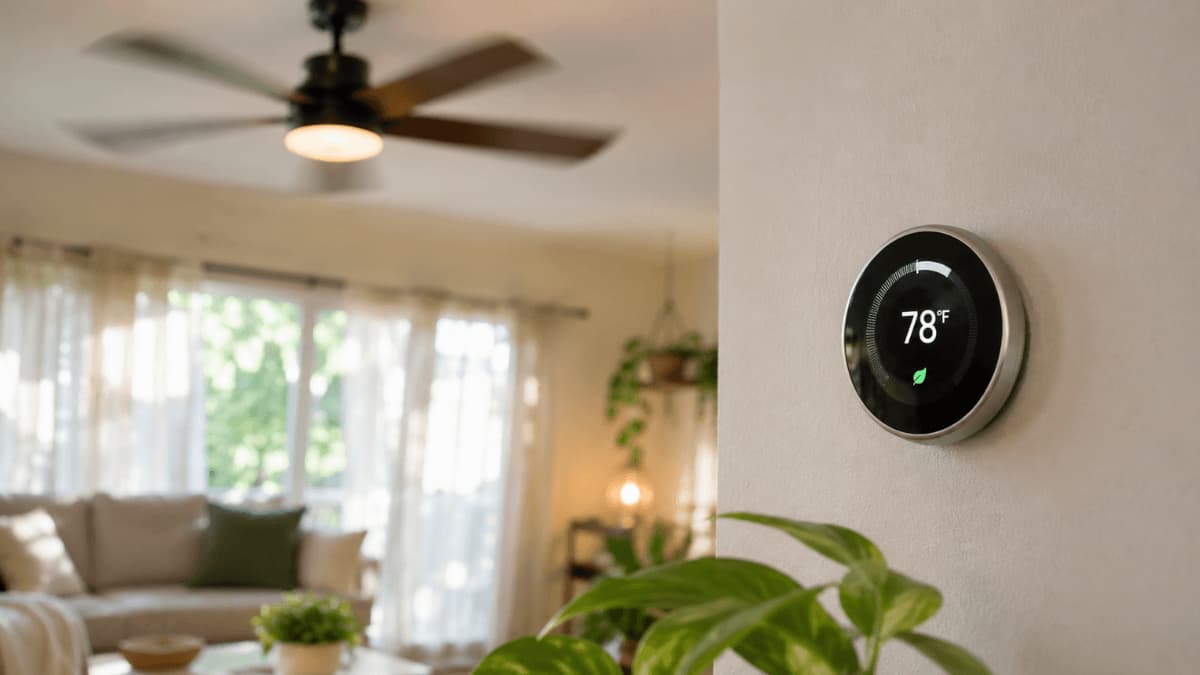
The best summer setting depends on who’s home and what they’re doing. Use the scale below to find yours, from a cooler bedroom at night to a warmer setback while the house sits empty.
Older adults, infants, and anyone with a chronic condition need a cooler, steadier home. For them, treat 78°F as a ceiling, not a target.
Airflow decides how cool any setting actually feels, and your air filter controls airflow. Take the quick quiz below to find your match.
Your summer thermostat, at a glance
Start at 78°F. Go cooler for sleep, warmer when nobody’s home.
What each comfort fix is worth:
Find your filter match
Answer a few quick questions and we’ll match you to the right filter for your home.
TL;DR
Set your AC to 78°F while you're home and awake. That's the at-home setpoint in ENERGY STAR's programmable thermostat guidance. When you leave for 8 hours or more, raise it 7–10°F to save up to 10% a year on heating and cooling. If 78°F still feels warm, check airflow and humidity first: a ceiling fan, indoor humidity under 50%, and a clean filter make the same setting feel cooler.
Key Takeaways
ENERGY STAR's example schedule sets 78°F when you're home, then raises it at least 7°F when you're away and 4°F while you sleep.
With a ceiling fan running, most people can raise the setpoint about 4°F without feeling a difference, according to University of Florida IFAS Extension.
Swapping a dirty air filter for a clean one can cut an air conditioner's energy use by 5% to 15%, per the U.S. Department of Energy (DOE).
The EPA recommends 30–50% indoor humidity, and keeping the system fan on Auto helps you get there.
Older adults, infants, people with chronic conditions, and pets need a cooler, steadier setting than the efficiency benchmark.
What's the Best AC Temperature for Summer?
For most homes, the best thermostat setting for summer is 78°F while you're home and awake. It's the at-home cooling setpoint in ENERGY STAR's example programmable thermostat schedule, which you can adjust for your family. The smaller the indoor-outdoor gap, the less your AC works: raising the setpoint just 2°F can cut cooling costs by 4% to 6%, according to University of Florida IFAS Extension.
Filterbuy sees this question from the filtration side. We've built filters in our own U.S. plants since 2013, giving us insight into how clean air filters support HVAC airflow. When 78°F feels too warm, the cause is usually airflow or humidity rather than the setting.
The ideal AC temperature shifts with who's home and when. Here are Filterbuy's settings for common situations:
Is 78°F Too Hot for AC? Run This Comfort Check First
For most healthy adults, 78°F isn't too hot. It can feel that way when the air is humid or still. Before you lower the setting, work through this check.
Check where your thermostat reads. Your thermostat measures the air at one spot on one wall. If that wall gets afternoon sun or sits next to a return vent, the system chases a number the rest of the house never feels.
Set the system fan to Auto. Set to On, the blower keeps moving air across a wet coil after the compressor stops, sending moisture back inside. Filterbuy technicians check this first; it's free.
Hold your filter against white paper. A light test can fool you, since even a loaded filter passes light between the pleats. Gray, matted media means it's time for a new one.
Read your indoor humidity. Set a hygrometer at chest height, away from vents and windows, and wait 30 minutes. Above 60% means the problem is moisture, not temperature. Filterbuy's guide shows how to measure humidity in a room.
Run one 30–60 minute cooling cycle. With the fan on Auto, humidity should drop along with the temperature and finish under 60%, while the condensate drain drips steadily. If it stays flat, the system is cooling without drying.
Know when to call a pro. Bring in a licensed HVAC technician if humidity stays above 60% after the fan and filter fixes, the system short-cycles, ice forms on the indoor coil, or water pools around the air handler.
If your home passes every step and still feels warm, lower the setting one degree at a time. Otherwise, fix what failed and retest at 78°F first.
How to Make 78°F Feel Cooler: The Comfort Stack
Once the basics check out, Filterbuy's three-part Comfort Stack helps a higher setting feel cooler: move the air, dry the air, and keep the air flowing.
“A humid house does not feel like a filter problem, so nobody calls us about it. They call about the air conditioner. But we build the filter and we service the system, and from where we sit those are the same call arriving from two directions.”
Michelle Wan, Brand Manager and Air Quality Writer, Filterbuy
Lever 1: Move the air with a ceiling fan
University of Florida IFAS Extension finds a ceiling fan lets you raise the setpoint about 4°F without feeling any difference. In summer, run the blades counterclockwise to push air down. Fans cool people rather than rooms, so switch them off when you leave.
Lever 2: Dry the air
Humid air feels hotter because sweat can't evaporate from your skin as easily. The EPA recommends keeping indoor relative humidity below 60%, ideally 30% to 50%.
Very humid climates add a wrinkle. A higher setpoint means shorter cooling cycles and less moisture removal, so moving from 74°F to 78°F can make a house cheaper to run but stickier to live in. If rooms feel clammy, add a dehumidifier instead of dropping the setting. Filterbuy's guide to how air conditioning removes humidity explains why.
Lever 3: Keep the air flowing with a clean filter
A clogged filter starves your system of airflow, so less cool air reaches your rooms and the AC runs longer. According to the U.S. Department of Energy, replacing a dirty filter can lower an air conditioner's energy use by 5% to 15%.
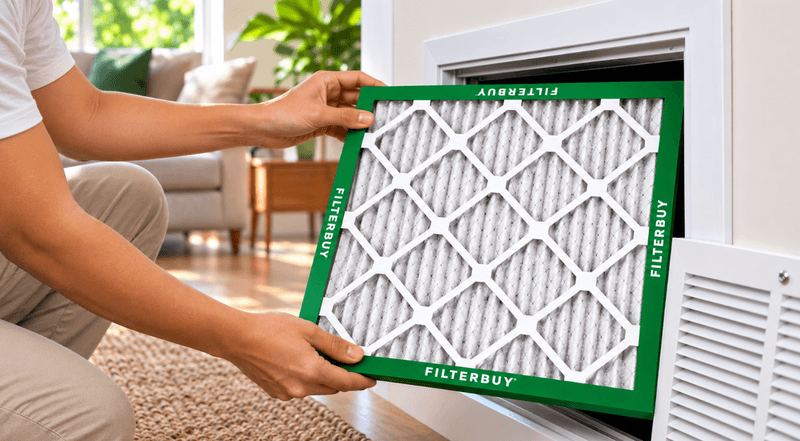
Fit matters too, and Filterbuy controls it at the factory: we cut every filter about half an inch under its nominal size so it seats snugly. A loose filter lets air slip around the edges and carry dust onto the cold, wet coil, cutting both cooling and moisture removal.
Summer run time loads filters faster, so Filterbuy's auto-delivery ships your exact size, from 600+ standard sizes or a custom cut, before the next change is due.
What Temperature Should You Set Your AC When You're Away?
When you'll be gone for 8 hours or more, raise your AC 7–10°F above its normal setting, or about 85–88°F from a 78°F base. The DOE's Building America Solution Center estimates this setback can save up to 10% a year on heating and cooling, and savings run higher in milder climates.
In humid regions, raising the setpoint beats switching the AC off. A shut-down house can climb past 60% humidity, which is when mold spores can take hold. Trane advises keeping the away setting at or below about 80–85°F, so in humid climates, Filterbuy would cap it at 85°F.
Here's a sample weekday schedule for a household that's out during the day:
Vacation: Set about 85°F instead of turning it off, and schedule it to pre-cool a few hours before you return. Pets at home: Keep it at or below 82°F, the summer limit veterinarians cite for dogs, and leave plenty of fresh water.

What's the Best Thermostat Setting for Sleeping in Summer?
For sleep, cooler is better. A Cleveland Clinic sleep psychologist recommends 60–67°F for most adults, since body temperature naturally drops at night. ENERGY STAR's example schedule raises the setting at least 4°F overnight to save energy, which trades some sleep quality for savings.
If cooling the whole house that low isn't practical, pre-cool the bedroom 60–90 minutes before bed and run a fan.
Older adults may sleep better warmer. A 2023 study in Science of the Total Environment found adults 65 and older slept most efficiently between 68°F and 77°F.
Who Should Keep the House Cooler Than 78°F?
In homes with older adults, infants, people with chronic illnesses, or anyone taking medications that affect sweating, treat 78°F as a ceiling rather than a target. The CDC notes that adults 65 and older don't adjust as well to sudden temperature changes and are more prone to heat illness.
Vermont Department of Health caregiver guidance considers 65–78°F generally safe indoors and 79–87°F an increased-risk range. In these homes, skip big setbacks and keep humidity below 60%. In a heat wave, don't rely on a fan alone, and get medical care for signs of heat illness such as dizziness, nausea, or confusion.
Supporting Statistics
1. 88% of U.S. households use air conditioning.
Two-thirds of U.S. households cool mainly with central AC or a central heat pump, per a 2020 survey of 18,496 households.
Source: U.S. Energy Information Administration, 2020 Residential Energy Consumption Survey
2. Nearly half of the average $2,000+ annual energy bill goes to heating and cooling.
ENERGY STAR estimates homeowners save about $180 a year by setting a programmable thermostat properly and sticking with those settings.
Source: ENERGY STAR, U.S. EPA and DOE, Programmable Thermostats
3. An estimated 47% of U.S. homes show dampness or mold.
That's the weighted average of seven U.S. housing studies; the largest, covering 12,842 homes, found 50%.
Source: Lawrence Berkeley National Laboratory, Prevalence of Building Dampness
Summer Thermostat FAQs
Should you turn the AC off when you leave in summer?
Usually not. Raising it 7–10°F saves up to 10% a year on heating and cooling, and leaving it running at 85°F or lower keeps humidity in check in muggy climates.
How often should you change your AC filter in summer?
Check your filter monthly in summer and replace it when it looks dirty. A 1-inch pleated filter usually lasts 60–90 days, but hot climates and heavy AC use can shorten that to 30–60 days. For a schedule by filter depth and household, see Filterbuy's guide to how often to change your HVAC filter.
Is 72°F too cold for AC in summer?
Not for comfort, but it costs more to hold. University of Florida IFAS Extension estimates that raising the setpoint just 2°F can cut cooling costs 4% to 6%, so add a ceiling fan and work up toward 78°F.
What humidity should your house be in summer?
Aim for 30% to 50% and keep it below 60%, per the EPA. Run the system fan on Auto, and add a dehumidifier if readings stay high.
Your Next Step for a Cooler, Cheaper Summer
Set the thermostat to 78°F, turn on the ceiling fan, switch the system fan to Auto, and check your filter. If it's gray, pick your exact size and set up auto-delivery, and a fresh, American-made Filterbuy filter will ship to your door, fast and free.
Glossary
Filterbuy: A family-owned U.S. air filter manufacturer that makes 600+ sizes plus custom cuts in its own plants.
Setpoint: The temperature you set on a thermostat.
Setback: Raising the summer setpoint while you're away or asleep to save energy.
ENERGY STAR: The EPA and DOE program that certifies efficient products.
Relative humidity (RH): The moisture in the air as a percentage of the most it could hold at that temperature.
Nominal size: The rounded size printed on a filter frame; the filter itself is cut slightly smaller to fit.
Sources
Vermont Department of Health, Heat Safety Guidance for Caregivers (April 2025)
Trane, Should You Really Set Your Thermostat to 78 in the Summer?
EnergyBot, Vacation Mode: The Best Thermostat Settings for When You're Away
U.S. Energy Information Administration, Nearly 90% of U.S. households used air conditioning in 2020
Lawrence Berkeley National Laboratory, Prevalence of Building Dampness
U.S. DOE Building America Solution Center (PNNL), Thermostat Controls
University of Florida IFAS Extension, Energy Efficient Homes: Ceiling Fans
U.S. Department of Energy, Maintaining Your Air Conditioner
U.S. EPA, A Brief Guide to Mold, Moisture and Your Home