
Can You Get Sick From Cold Weather? What the Science Says
November 9, 2026
TL;DR
Can you get sick from cold weather? Not on its own; only a virus can give you a cold. But cold, dry air weakens your nose's defenses and helps some viruses survive longer, while winter keeps everyone indoors breathing the same air. That's why colds peak in winter, and why your home's air matters more than wet hair.
Key Takeaways
Colds come from viruses, not temperature. The CDC counts more than 200 of them, with rhinoviruses the most common.
In a 2022 Mass Eye and Ear study, a 9°F drop in nasal temperature cut the nose's virus-trapping vesicles by nearly 42%.
Wet hair won't give you a cold. Balanced humidity and a MERV 13 filter do more to lower your odds.
Does Cold Weather Make You Sick?
No. Colds, flu, RSV, and COVID-19 are all viral infections, so cold weather alone can't make you sick; you have to be exposed to a virus first. What the cold does is tilt the odds. It weakens your nose's defenses and helps some viruses stay stable longer, while winter packs people into shared indoor air.
Colds aren't limited to winter, either. The CDC says adults average two to three a year, in any season.
Why Does Cold Weather Cause Colds?
Winter brings three conditions together: a colder nose with weaker defenses, drier air that helps viruses linger, and more time packed indoors. Each makes it easier for a virus to take hold.
1. A Cold Nose Fights Viruses Less Effectively
Your nose cools with every breath of cold air. In a 2015 study, Yale immunologist Akiko Iwasaki's team found that mouse airway cells kept at 33°C (about 91°F, a typical nose temperature) produced less interferon, a virus-fighting protein, than cells at 37°C body temperature. The rhinovirus replicated more easily in the cooler cells (PNAS, 2015).
A 2022 study from Mass Eye and Ear and Harvard Medical School pointed to a second mechanism. After volunteers spent 15 minutes in 40°F air, the temperature inside their noses fell by about 9°F (5°C). When researchers applied that same drop to nasal tissue, the release of extracellular vesicles, tiny sacs that swarm and trap viruses, fell by nearly 42% (Harvard Medical School).
Both findings come from lab samples rather than real-world colds.
2. Dry Winter Air Helps Viruses Travel and Survive
Cold outdoor air holds very little moisture, so heating it sends relative humidity plunging. According to a humidifier maker's chart cited in Filterbuy's winter humidity guide, 10°F outdoor air at 70% humidity drops to about 6% once it's warmed to 70°F. Dry air also seems to help flu spread. Researchers at Mount Sinai found that airborne flu passed between guinea pigs most efficiently at 20%–35% relative humidity and stopped entirely at 80% (PLOS Pathogens, 2007). A later Columbia University reanalysis found that absolute humidity mattered even more (PNAS, 2009).
3. More Time Indoors Means More Shared Air
In winter, windows stay shut, families gather in the same rooms, and your HVAC system recirculates the same air for hours. Virus-carrying particles from one sick person reach everyone more easily, and your filter does more of the cleanup.
As a filter maker, Filterbuy would add one honest caveat: a filter can only clean the air that reaches it, which is why fit and fan time matter as much as the rating.
Does Being Cold Make You Sick?
So can you catch a cold from being cold? Not on its own, but a chill may turn a virus you're already carrying into a full-blown cold. Researchers at Cardiff University's Common Cold Centre think chilling narrows the blood vessels in your nose, lowering local defenses enough for a quiet infection to take hold.
To test the idea in 2005, they had 180 volunteers sit for 20 minutes with their feet either in ice-cold water or in an empty bowl. Over the next four to five days, 29% of the chilled group reported cold symptoms, compared with 9% of the others (EurekAlert / Cardiff University). Symptoms were self-reported, though, so the study supports the idea without proving it.
Can You Get Sick From Going Outside With Wet Hair?
No. Without a virus, wet hair can't give you a cold. It does chill you faster, and a strong chill could help a virus you already carry gain ground. Dry it for comfort, and focus on clean hands and cleaner air.
Myth vs. Reality: What Cold Weather Actually Does
Sources: PNAS (2015), Harvard Medical School (2022), PLOS Pathogens (2007), PNAS (2009), U.S. EPA.
What Can You Change at Home This Winter?
You can't control the weather, but you can control the air inside your home. Humidity and filtration do most of the work.
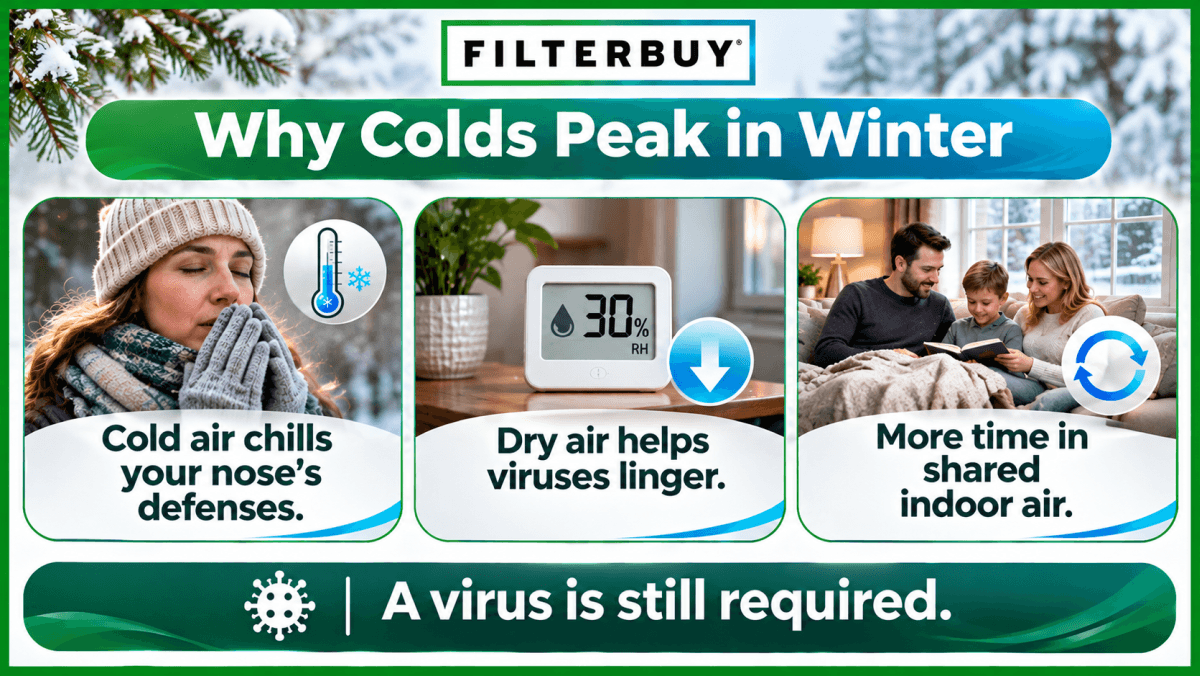
Hold humidity at 30%–50%. That's the range the EPA recommends. In deep winter, Filterbuy's ideal indoor humidity in winter guide suggests aiming lower, around 30%–40%, so your windows don't fog.
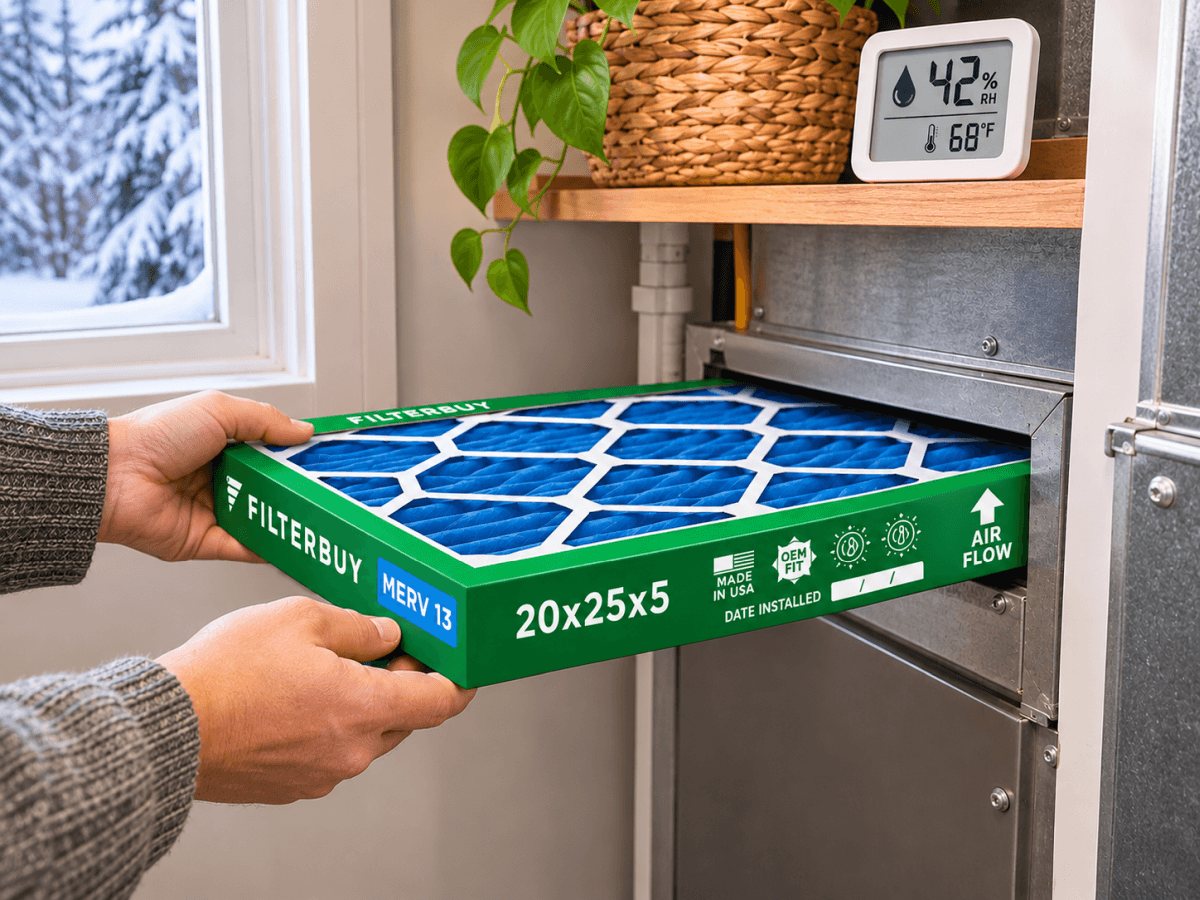
Upgrade your HVAC filter. According to the EPA, filters rated MERV 13 or higher can trap smaller particles, including viruses, and ASHRAE recommends the same level. Filterbuy makes MERV 13 air filters, and we'll still say it plainly: no filter can prevent a cold. It can lower how much virus-carrying air circulates.
Get the fit right. Air that slips around a loose filter never gets filtered, so order by the size printed on your current frame. Filterbuy cuts each filter to seat snugly in that slot.
Change it on schedule. Your furnace runs longer in winter, so the filter loads up faster. Filterbuy's winter furnace filter schedule below shows how often to swap it.
Cover the basics. Crack a window when guests visit, run exhaust fans, cover your nose outdoors, wash your hands, and ask your doctor about a flu shot.
Filterbuy's 5-Minute Winter Air Check
Run this routine monthly; it comes from Filterbuy's humidity and winter filter guides.
Read a hygrometer in the bedroom and in the room with the most windows. Aim for about 40% when it's above 20°F outside, and lower your target by about 5 points for every 10°F colder.
Check the windows at breakfast. If you see fog or frost, humidity is too high for the weather.
Hold your filter against white paper. If it looks gray and matted, replace it, whatever the calendar says.
“ Cold weather itself doesn’t make you sick, but it can create conditions that make it easier for viruses to spread. Cold, dry air can weaken your nose’s natural defenses, while spending more time indoors increases your exposure to germs. Staying healthy in winter isn’t just about keeping warm—it’s also about maintaining good indoor air quality and reducing your exposure to viruses. ”
Someone Sick at Home? Filterbuy's 4-Step Clean-Air Plan
Pick one sick room and keep the door closed when you can.
Size a HEPA purifier to that room. The EPA's sizing chart works out to a clean air delivery rate (CADR) of about two-thirds of the floor area, or roughly 130 for a 200-square-foot bedroom.
Set the thermostat fan to On. The EPA notes that your HVAC system filters air only while the fan runs.
Once they recover, check the filter and swap it early if it looks gray.
Filterbuy Winter Filter Change Schedule
Your filter's depth, the third number on its frame, sets how often to change it.
Ranges follow Filterbuy replacement guidance reviewed by David Clark, Licensed HVAC Technician. Check monthly and follow your HVAC manual first.
Give Your Furnace a Better Filter This Winter
Your heating system is working overtime this season, so give it a filter that keeps up. Filterbuy makes filters in more than 600 sizes in its own U.S. factories and ships them free. Shop MERV 13 air filters or find your exact filter size, then set up an air filter subscription so the next one arrives on time. Before you crack a window, check your local AQI now.
Supporting Statistics
Three federal findings back up this advice.
51 million flu illnesses in one season.
CDC also counted 23 million medical visits and 710,000 hospitalizations in 2024–2025, the first high-severity season since 2017–2018.
Filterbuy's take: A heavy flu season is a good reason to check your filter and humidity early.
90% of our time is spent indoors.
Some indoor pollutants run 2 to 5 times higher than outdoors.
Filterbuy's take: In winter, the air inside your home is most of the air you breathe.
Under 25%: how often home HVAC runs in heating season.
Your filter works only while the fan runs.
Filterbuy's take: Fan time matters as much as filter rating. See whether your HVAC filter can help with colds, flu, and RSV.
Why Filterbuy Wrote This Guide
Cold-and-flu season is also peak furnace season, and that overlap is why we wrote this guide. Filterbuy has built pleated air filters in its own U.S. factories since 2013, and here we pair published research with the methods our team and HVAC reviewer recommend.
Frequently Asked Questions
Can Cold Air Make You Sick?
Not without a virus. Cold air does cool your nose, though, and lab studies show cooler nasal tissue fights viruses less effectively.
When Should I See a Doctor for a Cold?
Call your doctor for severe or unusual symptoms, a high fever, trouble breathing, or any fever in a baby under 3 months. People with asthma or weakened immunity should check in sooner.
Glossary
- Rhinovirus
- The most common family of cold-causing viruses; it infects the lining of the nose and throat.
- Relative Humidity (RH)
- Water vapor in the air as a share of the most it can hold at that temperature.
- MERV (Minimum Efficiency Reporting Value)
- A 1–16 HVAC filter rating; higher numbers capture smaller particles.
- CADR (Clean Air Delivery Rate)
- How much filtered air a portable purifier delivers per minute.
- HEPA (High-Efficiency Particulate Air)
- A standard for portable purifier filters that capture at least 99.97% of 0.3-micron particles.
Sources
Foxman et al., Temperature-dependent innate defense against the common cold virus, PNAS (2015)
EurekAlert / Cardiff University Common Cold Centre – Chilling and the common cold (2005)
EPA – What kind of filter should I use in my home HVAC system?
EPA – Mold Course Chapter 2: Why and Where Mold Grows (humidity guidance)
ASHRAE – Core recommendations for reducing airborne infectious aerosol exposure
CDC – 2024–2025 Influenza Season Summary: Severity, Disease Burden, and Burden Prevented
U.S. EPA – Guide to Air Cleaners in the Home, 2nd edition (PDF)
This article is for general education and isn't medical advice. Talk to your healthcare provider about your specific health concerns.