
Cold vs. Flu: How to Tell Which One You Have
November 9, 2026

TL;DR
A cold usually creeps in over a day or two and stays mostly in the nose and throat. The flu tends to hit within hours, bringing fever, chills, body aches, and exhaustion. COVID-19 can look like either, so only a test confirms it. If you're at higher risk, call a doctor early, and get medical care right away for any emergency warning sign.
Key Takeaways
Influenza viruses cause the flu, while rhinoviruses and other respiratory viruses cause colds.
A sudden start with fever, chills, and strong body aches points toward flu. A runny or stuffy nose and sneezing, with only mild aches, point toward a cold.
Flu antivirals work best in the first two days, and COVID-19 antivirals must start within five to seven.
A fresh MERV 13 filter, an HVAC fan set to "On," and humidity of 40–50% can lower infectious virus in your home's air.
Is It a Cold or the Flu? The Short Answer
The main difference between a cold and the flu is severity and speed. According to the CDC's cold versus flu guidance, the flu is usually worse and comes on faster, while colds lean toward a runny or stuffy nose. Colds rarely lead to serious problems like pneumonia or a hospital stay. The flu can.
The catch, the CDC notes, is that symptoms alone can make the two hard or even impossible to tell apart. A test settles it.
Cold vs. Flu vs. COVID-19 Symptoms, Side by Side
COVID-19 overlaps with both, though a new loss of taste or smell is more common with it. This table combines the CDC's flu symptoms chart and its flu vs. COVID-19 comparison.
Sources: CDC, Signs and Symptoms of Flu; CDC, Similarities and Differences between Flu and COVID-19; Mayo Clinic, Common cold. Symptoms alone cannot confirm which illness you have; a test can.
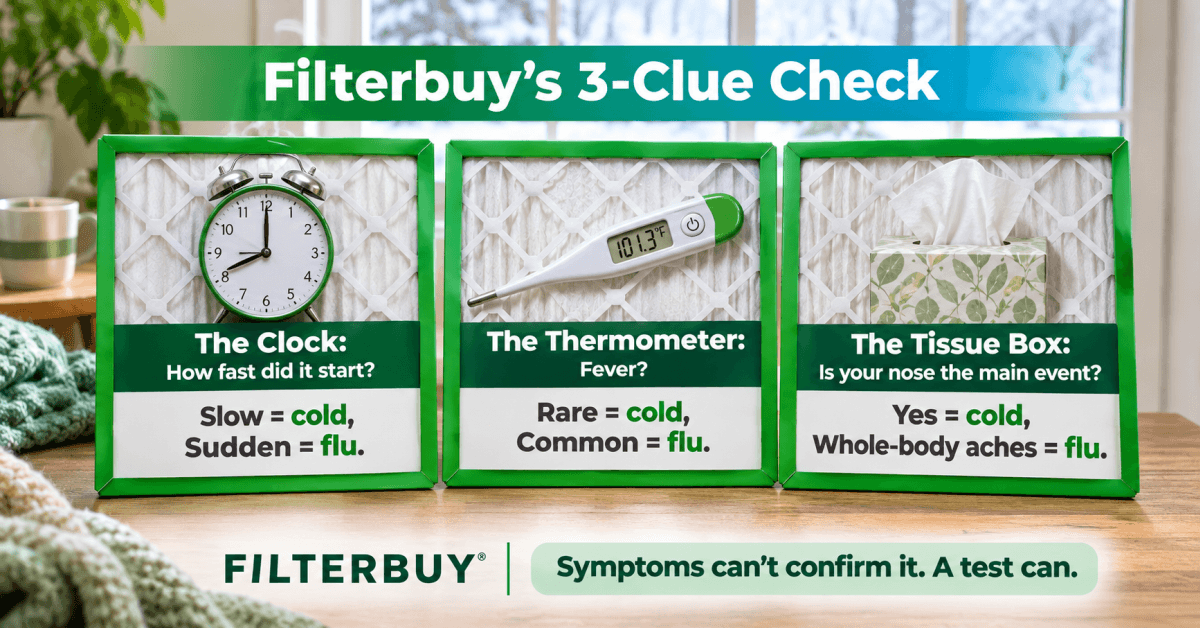
Filterbuy's 3-Clue Check: How to Tell If You Have a Cold or the Flu at Home
Filterbuy's 3-Clue Check sorts a cold from the flu by asking how fast it started, whether you have a fever, and whether the nose is the main problem. If two or three clues point to flu, treat it as possible flu or COVID-19 and consider a test.
The clock: how fast did it start? If you can name the afternoon it hit you, that leans flu. If it built slowly from a scratchy throat over a day or two, that leans cold.
The thermometer: do you have a fever? A reading of 100.4°F or higher leans flu or COVID-19, since adults with a cold rarely run a fever. Not everyone with flu gets one, though.
The tissue box: is the nose the main event? When sneezing and congestion are the worst of it and the rest of you feels mostly fine, that leans cold. Whole-body aches that keep you on the couch lean flu.
Bonus clue: Lost your sense of smell without a stuffy nose? Test for COVID-19.
How Long Does a Cold or the Flu Last, and When Are You Contagious?
Most colds ease within a week to 10 days, and most people recover from the flu within two weeks. COVID-19 often shows up later and stays contagious longer than flu.
Sources: CDC; Mayo Clinic; SA Health. Timing varies from person to person.
The Filterbuy Sick-Day Timeline: What to Do, and When
Every cold and flu deadline counts from the day symptoms start, so Filterbuy put them all on one clock. Day 1 is the first day of symptoms.
The Filterbuy sick-day timeline. Sources: CDC; SA Health; Mayo Clinic. Day 1 is the first day of symptoms. General guidance, not a diagnosis.
Sources: CDC; SA Health; Mayo Clinic.
Who should test and call early: People at higher risk of flu complications include adults 65 and older, pregnant women, young children (especially under 2), and anyone with a chronic condition such as asthma, diabetes, or heart disease. An at-home test can check for flu and COVID-19 at once.
Skip antibiotics, which don't work on viruses like these.
When to Call a Doctor About a Cold or the Flu
With a cold, Mayo Clinic advises calling if a fever above 101.3°F lasts more than three days, or you develop shortness of breath, wheezing, or intense throat, head, or sinus pain. With the flu, get medical care right away for any of the CDC's emergency warning signs of flu below.
Get care right away for adults with:
Difficulty breathing or shortness of breath
Persistent pain or pressure in the chest or abdomen
Persistent dizziness, confusion, or trouble waking
Seizures, severe muscle pain, or severe weakness
Not urinating
Fever or cough that improves, then returns or worsens
A chronic condition that gets worse
Get care right away for children with:
Fast or labored breathing, or ribs pulling in with each breath
Bluish lips or face
Chest pain or severe muscle pain (a child who refuses to walk)
Signs of dehydration: no urine for 8 hours, dry mouth, no tears when crying
Not being alert or interacting when awake, or seizures
Fever above 104°F that medicine doesn't bring down, or any fever in a baby younger than 12 weeks
Fever or cough that improves, then returns or worsens
Call your provider about other severe symptoms.
How to Keep a Cold or Flu from Spreading Through Your Home's Air
When one person gets sick, everyone else breathes the same air. The CDC counts taking steps for cleaner air as a core prevention strategy, and this is where our filter-making experience comes in.
Here is the Filterbuy sick-room air plan:
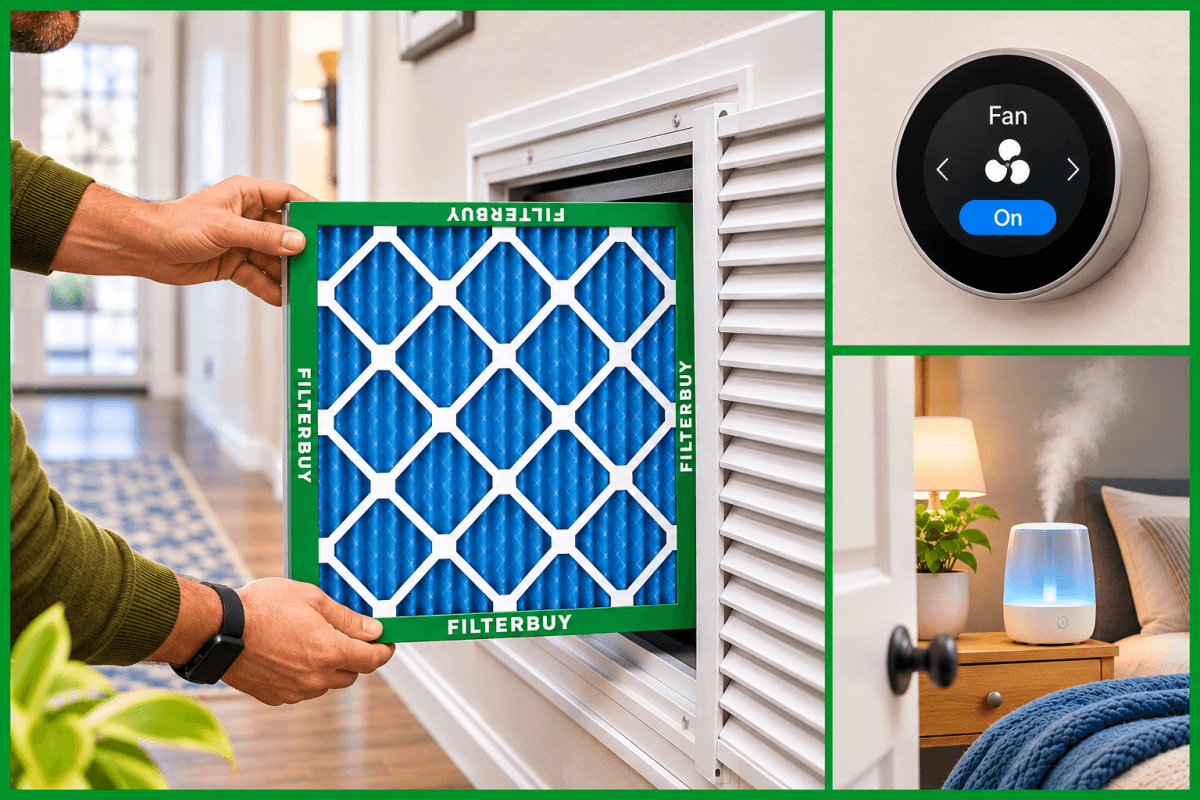
Put in a fresh MERV 13 filter, if your system allows it. The EPA says MERV 13 can trap smaller particles, including viruses, and most systems handle it if it's changed often. The mistake we see most is the wrong size, not the wrong rating: a filter that's even slightly small lets air slip around the frame unfiltered. Order by the size printed on your current filter. Our MERV rating chart compares ratings.
Switch the thermostat fan from "Auto" to "On." A filter only cleans air that moves through it, and the EPA says most systems run less than 25% of the time in heating and cooling season. It's our simplest fix, though longer run times add some electricity cost.
Keep indoor humidity between 40% and 50%. In a CDC study of simulated coughs, flu virus in air at 23% humidity or lower kept 71–77% of its ability to infect after an hour. At 43% or higher, only 15–22% stayed infectious. Winter heating dries the air, so a humidifier helps, but the EPA advises staying at or below 50% to prevent mold.
Close the sick-room door and add a portable HEPA air purifier. Use our guide to choosing the right air purifier size.
Keep filter changes on autopilot. Filterbuy filter auto-delivery ships the exact size you need every 30, 60, or 90 days.
For more, read can your HVAC filter help with colds, flu, and RSV, or shop Filterbuy MERV 13 air filters, made in the USA in more than 600 sizes.
This Season's Flu: What's Different in 2026–27
Flu season started earlier than usual this fall. For the week ending October 31, 2026, the CDC's weekly flu surveillance report estimated at least 1.7 million flu illnesses, 25,000 hospitalizations, and 1,400 deaths, with H1N1 behind nearly all subtyped flu A cases. The CDC recommends an annual flu vaccine for everyone 6 months and older.
Supporting Statistics
Three U.S. government numbers behind Filterbuy's advice:
About 90% of our time is spent indoors.
Why it matters: the air at home shapes how illness spreads.
Source: U.S. EPA
In recent seasons, 9 in 10 people hospitalized with flu had an underlying condition.
Why it matters: people at higher risk should call a doctor early.
Source: CDC
Adults average 2–3 colds a year, and kids get more.
Why it matters: most sniffles are colds, not flu.
Source: CDC
Cold vs. Flu FAQ
Can A Cold Turn Into The Flu?
No, because different viruses cause them. You can catch one right after the other, though, and a lingering cold can lead to a sinus or ear infection.
Can You Have The Flu Without A Fever?
Yes. Not everyone with flu runs a fever, so sudden aches and exhaustion still point to flu.
Can An Air Filter Keep Me From Catching A Cold Or The Flu?
No, and as a filter maker, Filterbuy won't claim otherwise. MERV 13 lowers virus-carrying particles in the air and works best alongside vaccination and handwashing.
Glossary
Common cold
A mild, contagious infection of the nose and throat caused by more than 200 respiratory viruses, most often rhinoviruses.
Influenza (flu)
A contagious respiratory illness caused only by influenza viruses, which infect the airways and lungs.
COVID-19
A contagious respiratory illness caused by SARS-CoV-2, a coronavirus.
Antiviral medication
A prescription drug that fights a specific virus.
MERV (Minimum Efficiency Reporting Value)
A 1–16 scale that rates how well an HVAC filter captures airborne particles.
HEPA filter
A high-efficiency particulate air filter used in portable air purifiers.
Relative humidity
How much moisture the air holds compared with the most it could hold at that temperature.
Sources
CDC: Taking Steps for Cleaner Air for Respiratory Virus Prevention
CDC: Weekly U.S. Influenza Surveillance Report, week ending October 31, 2026
EPA: What kind of filter should I use in my home HVAC system?
Filterbuy: MERV 13 Air Filters (source of David Clark quote)
Filterbuy: Michelle Wan author page (source of Michelle Wan quote)