
Pickering Real-Time AQI Tracker
What's Actually In Pickering Air Today?
What High AQI Means for Your Lungs in Pickering
How to Read AQI
The Air Quality Index (AQI) measures how polluted the air is and how it may affect your health.
0–50 (Good): Air quality is satisfactory.
51–100 (Moderate): Acceptable, but some pollutants may pose minor concerns.
101–150 (Unhealthy for Sensitive Groups)
151–200 (Unhealthy)
201–300 (Very Unhealthy)
301+ (Hazardous)
Moderate
Still okay for most, but if you have asthma or allergies, take it easy and avoid long outdoor workouts.
Shop MERV 11 filters→What's the Right Filter for Your AQI Level?





Live Air Quality Index AQI Map Pickering, ON Today
By Michelle Wan, Brand Manager and Air Quality Writer, Filterbuy Canada
Reviewed by David Clark, Licensed HVAC Technician
Published 17 September 2026 | Updated 17 September 2026
TL;DR
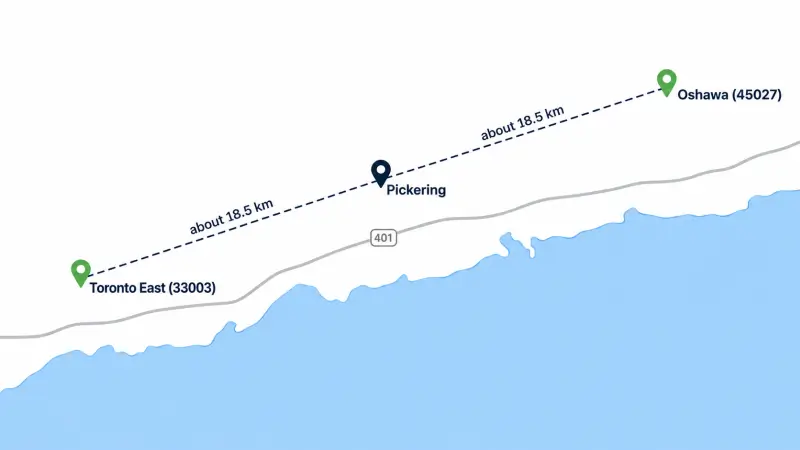
The map above shows Pickering's live AQI (0 to 500). Canada's official reading is the Air Quality Health Index (AQHI), a 1 to 10+ health risk scale. No provincial monitoring station sits inside Pickering. The two nearest, Toronto East in Scarborough and Oshawa, each sit about 18.5 km away, so the most reliable way to read Pickering's air quality today is to check both.
Key Takeaways
The AQHI is Canada's 1 to 10+ scale; many apps show the U.S. AQI (0 to 500) instead.
Pickering's southwest lakeshore sits nearer Toronto East, while Claremont sits nearer Oshawa. The city centre and Seaton are close to a tie.
The Region of Durham, Pickering's public health authority, directs residents to the Oshawa AQHI forecast.
At a map AQI of 100, we recommend MERV 13 in the furnace, the fan set to On, a portable HEPA cleaner in each occupied room, and a closed-up house.
A yellow Air Quality Warning is issued when the AQHI is forecast to reach 7 or higher. An orange warning applies at 10+.
What Is The Air Quality In Pickering Today?
The live map above gives Pickering's AQI. For the official Canadian number, use the AQHI, published hourly by Environment and Climate Change Canada (ECCC) with Ontario's Ministry of the Environment, Conservation and Parks (MECP). It combines ground-level ozone, fine particulate matter (PM2.5, particles too small to see) and nitrogen dioxide into one reading. Lower numbers mean lower health risk.
AQHI Risk Bands And Health Messages
Source: ECCC and Air Quality Ontario.
Check the forecast too. ECCC notes live AQHI data isn't fully quality-checked. ECCC's health risk guide explains who counts as higher risk.
Where Pickering's Air Quality Reading Actually Comes From
At Filterbuy Canada, we looked for the monitor behind Pickering's reading and found none. Pickering, a Durham Region city of 99,186 people (City of Pickering 2021 Census profile), is not on Air Quality Ontario's 38-station list or ECCC's Ontario forecast list. So we measured the distances to the two nearest, Toronto East in Scarborough and Oshawa, from their published coordinates. They landed within about 60 metres of each other.
The Two Stations Nearest Pickering
Station data: Air Quality Ontario. Distances: Filterbuy Canada calculation from MECP coordinates to Pickering (43.8394, -79.0814).
Three findings came out of that check.
1. Pickering Sits Almost Exactly Between Two Stations
The stations are about 36.8 km apart, with Pickering near the midpoint. The Region of Durham sends residents to the Oshawa forecast, even though Pickering borders Toronto, home of Toronto East (see our live air quality page for Toronto).
2. Which Station Fits Which Part Of Pickering
We ran the same check for four points across the city. Where you live tips the balance.
Pickering Station Lookup
Filterbuy Canada straight-line calculations. A guide, not a local air measurement.
3. Pickering Sits Both Above And Below Its Monitors
Our first pass assumed both monitors sat above the whole city. They don't. The stations sit at 161 to 168 metres. Pickering's lakeshore is near Lake Ontario's level, about 75 metres, but Claremont sits near 266 metres, above both. On calm nights, cool air can settle in low ground by the lake while higher ground clears, so a lakeside street and a monitor uphill can briefly differ.
"Pickering is the first city in this series where I could not name a single monitor. The distances landed 60 metres apart, and Claremont sits higher than both stations. So this page shows how to use both."
Michelle Wan, Brand Manager and Air Quality Writer, Filterbuy Canada
When we pulled both forecasts for this page, they sat within one point of each other. Filterbuy Canada also covers Oshawa's live air quality and Whitby's live air quality next door.
The Two-Station Check: How To Read Pickering's Air Quality Now
Filterbuy Canada built the Two-Station Check because no single reading fits a city split between two stations.
Open both readings. Check ECCC's Toronto East AQHI and Oshawa AQHI.
Compare the numbers. Within one point, either reading is a fair guide.
When they differ, use the lookup table. It shows which station is nearer to your part of Pickering, and when to plan around the higher reading.
Check PM2.5 on hazy days. If it climbs at both stations, regional smoke is the likely cause.
Get email warnings through Air Quality Ontario's alert sign-up (pick York - Durham), or hear AQHI values by phone at 1-800-387-7768.
Why Your Phone Shows A Different Air Quality Number
The map above and many apps use the U.S. AQI (0 to 500), which reports the worst single pollutant. The AQHI (1 to 10+) adds up the risk of three. No official conversion exists, and Ontario acts on the AQHI. For the U.S. ranges, see what counts as a good AQI.
What Moves Pickering's Air Quality Through The Year
Pickering shares the seasonal pattern Filterbuy Canada tracks for air quality across Ontario and across Canada: winter furnace season and still nights, spring pollen the AQHI doesn't measure, and summer ozone and wildfire smoke. The Filterbuy guide to why the air quality is bad today explains the causes.
Supporting Statistics
Three U.S. federal findings behind this page.
Winter traps highway pollution near the 401
Nitrogen oxides drop fastest within 50 metres of a major road and near background by about 500 metres.
Beside the 401 in Toronto, downwind levels ran 2 to 3 times higher at minus 5 to minus 15 degrees Celsius than at 5 to 15 degrees.
Why it matters: neither station sits on Pickering's stretch of the 401, so readings there can differ.
Source: U.S. EPA near-road NOx review (2026), NIH PubMed Central
One monitor per region is a known limit
On 7 June 2023, Canadian wildfire smoke pushed New York's daily PM2.5 to 55.2 to 122.3 micrograms per cubic metre.
In New York's Eastern Lake Ontario region, asthma emergency visits rose 179.1 per cent against the 1 to 5 June average.
Why it matters: the authors flagged one monitor per region as a limitation, the gap the Two-Station Check addresses.
Source: CDC, Morbidity and Mortality Weekly Report (2023)
Closing up the house cuts smoke indoors, but not all of it
Windows shut: indoor PM2.5 runs about 55 to 60 per cent of outdoor levels.
Home to home, that ranges from 30 to 100 per cent.
Left open, indoor and outdoor levels end up similar.
Why it matters: filtration works on the smoke that still gets in.
Source: US EPA, Strategies to Reduce Exposure Indoors
What To Do When The Map Reads AQI 100 Or Higher
Follow official warnings from Air Quality Ontario and the Region of Durham first. At AQI 100, we recommend MERV 13 in the furnace, the fan set to On, a portable HEPA air cleaner in each occupied room, and a closed-up house.
What To Do By Map AQI
AQI ranges are the U.S. EPA's. Acting at 100 is our recommendation; 100 is still the top of the EPA's Moderate range.
Put MERV 13 in the furnace. It treats the whole house.
Set the thermostat fan to On. Auto only filters while heating or cooling. On filters all the time.
Run a portable HEPA air cleaner in each occupied room, bedrooms first. HEPA belongs in the portable unit, never in the furnace. Our MERV 13 vs HEPA guide explains why.
Close the house up. Keep windows shut, and skip candles, frying, smoking and vacuuming.
No ductwork or central system? Then portable HEPA air cleaners are your main defence, not an extra.
Health Canada recommends filters rated MERV 13 or more for smoke. The U.S. EPA says most furnaces can use MERV 13 without equipment problems if the filter's replaced often. Check your filter size before ordering, as you would for any replacement.
For room units, the EPA advises a smoke CADR of at least two-thirds of the room's square footage. A 300 sq ft (28 square metre) bedroom needs a smoke CADR of about 200. The EPA also advises against air cleaners that produce ozone.
During smoke, check the furnace filter and replace it when it looks dark brown or black. The EPA notes that can be sooner than the usual interval, so keep spares on hand. A pleated filter captures particles, not the gases in smoke, and it reduces smoke in the air rather than removing all of it.
Where Filterbuy Canada Fits
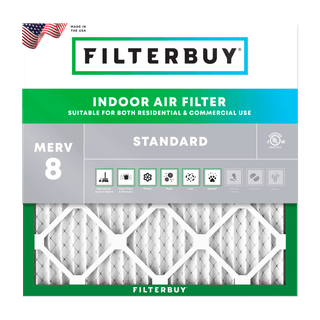
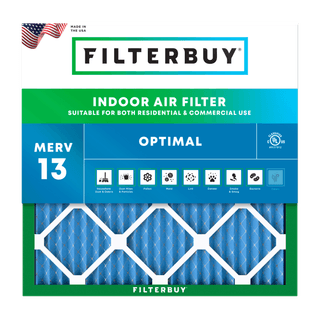
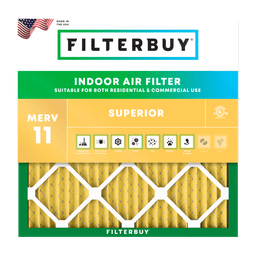
Filterbuy Canada carries MERV 8 Standard, MERV 11 Superior and MERV 13 Optimal filters in more than 600 sizes, with free shipping to Canada and no minimum purchase. MERV 13 is the tier we recommend for smoke, in your size. For odours, there's the carbon Odour Eliminator line.
Filterbuy Canada's take: which station you trust matters less than the filter in your furnace. Get MERV 13 in before smoke season and keep a spare, or subscribe and save on a schedule you can edit, skip or cancel anytime.
Frequently Asked Questions
Glossary
AQHI (Air Quality Health Index): Canada's official 1 to 10+ air quality scale, calculated from ozone, PM2.5 and nitrogen dioxide.
PM2.5: Fine particles 2.5 micrometres across or smaller, measured in micrograms per cubic metre. The main pollutant in wildfire smoke.
Nitrogen dioxide (NO2): A combustion gas from vehicles and heating equipment. See Filterbuy's nitrogen dioxide guide.
MECP and ECCC: Ontario's environment ministry, which runs the 38-station network, and Environment and Climate Change Canada.
Toronto East (33003) and Oshawa (45027): The two MECP stations nearest Pickering.
MERV: Minimum Efficiency Reporting Value, a rating of how well a filter captures particles. Filterbuy labels MERV 8, 11 and 13 as Standard, Superior and Optimal.
HEPA: A high-efficiency filter used in portable air cleaners, not in furnaces.
CADR: Clean air delivery rate. Match a room unit's smoke CADR to the room's size.
About The Author And Reviewer
Michelle Wan, Author. Brand Manager and Air Quality Writer at Filterbuy Canada. More on her author page.
David Clark, Reviewer. Licensed HVAC Technician. Reviewed the filter guidance here.