
Oshawa Real-Time AQI Tracker
What's Actually In Oshawa Air Today?
What High AQI Means for Your Lungs in Oshawa
How to Read AQI
The Air Quality Index (AQI) measures how polluted the air is and how it may affect your health.
0–50 (Good): Air quality is satisfactory.
51–100 (Moderate): Acceptable, but some pollutants may pose minor concerns.
101–150 (Unhealthy for Sensitive Groups)
151–200 (Unhealthy)
201–300 (Very Unhealthy)
301+ (Hazardous)
Moderate
Still okay for most, but if you have asthma or allergies, take it easy and avoid long outdoor workouts.
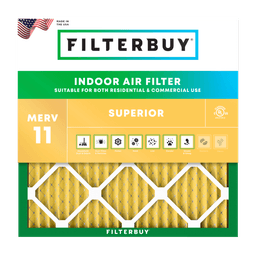
Shop MERV 11 filters→What's the Right Filter for Your AQI Level?



Check Today’s Live Real Time Air Quality Index AQI Map in Oshawa, ON Now
By Michelle Wan, Brand Manager & Air Quality Writer
Reviewed by David Clark, Licensed HVAC Technician
Published 6 August 2026 | Updated 6 August 2026
Disclosure: Filterbuy manufactures and sells the air filters referenced here. All readings and health guidance come from ECCC, Health Canada and Ontario MECP, and are cited.
TL;DR
Oshawa’s official reading is the Air Quality Health Index (AQHI), a 1 to 10+ scale published hourly by Ontario MECP and ECCC. Ontario retired the older Air Quality Index (AQI) in June 2015, so an app showing an “AQI” of 34 is on the U.S. EPA’s 0–500 scale. Check the live map, then match your filter to it.
Key Takeaways
The AQHI is Ontario’s official scale: 1 to 10+, lower meaning lower health risk.
It combines ozone (O3), nitrogen dioxide (NO2) and fine particulate (PM2.5).
Oshawa’s reading comes from one station on Britannia Ave. W., of 38 province-wide.
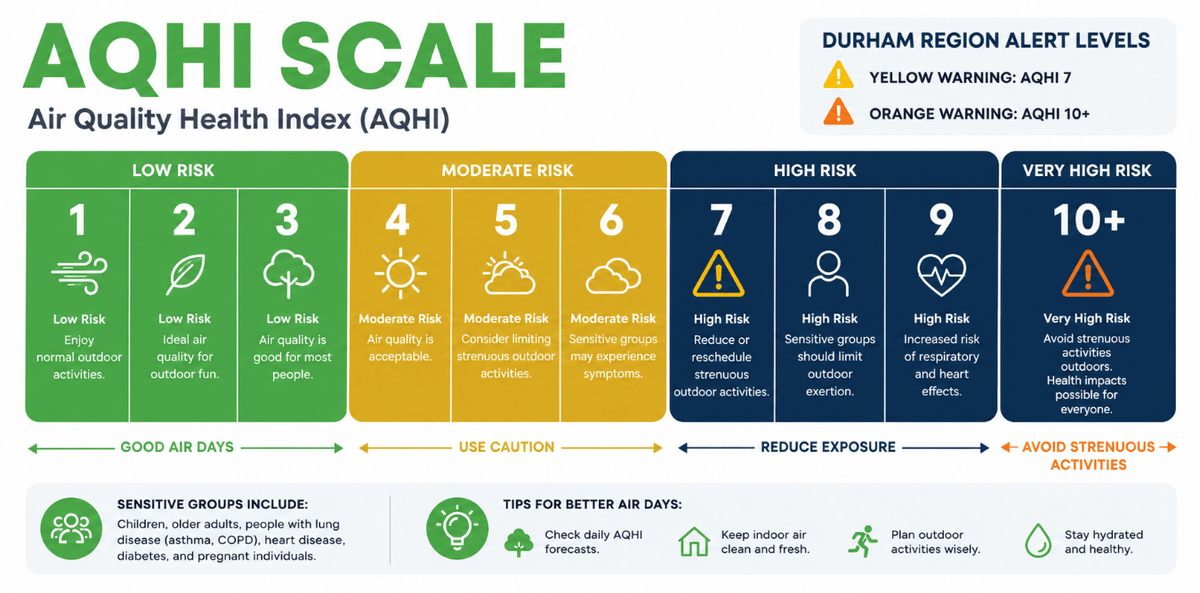
Durham Region issues a yellow warning at AQHI 7 and orange at 10+.
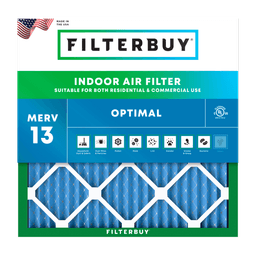
Health Canada recommends MERV 13 or higher during wildfire smoke. Filterbuy calls that rating Optimal.
What Is The Air Quality In Oshawa Today?
The AQHI scores short-term health risk from air pollution. Oshawa’s updates hourly: 1 to 3 is low risk, 4 to 6 moderate, 7 to 10 high, above 10 very high. Across all 38 Ontario sites in 2022, readings sat in the low-risk band 94.40%.
Why Oshawa’s AQHI And Your App’s “AQI” Don’t Match
Ontario replaced the AQI with the AQHI in June 2015. The scales measure different things, so they give different numbers for the same air. No official conversion exists.
AQHI compared with the U.S. AQI
There is no official conversion between the AQHI and the U.S. AQI. Ontario replaced the AQI with the AQHI in June 2015.
The AQHI adds up risk from all three pollutants, because elevated ozone and particulate together are worse than either alone. The AQI reports only the worst one. For health decisions here, the AQHI is what Ontario and Durham Region act on. Ontario added a PM2.5 trigger in May 2024, so smoke alone can push it high.
Where Oshawa’s Air Quality Reading Actually Comes From
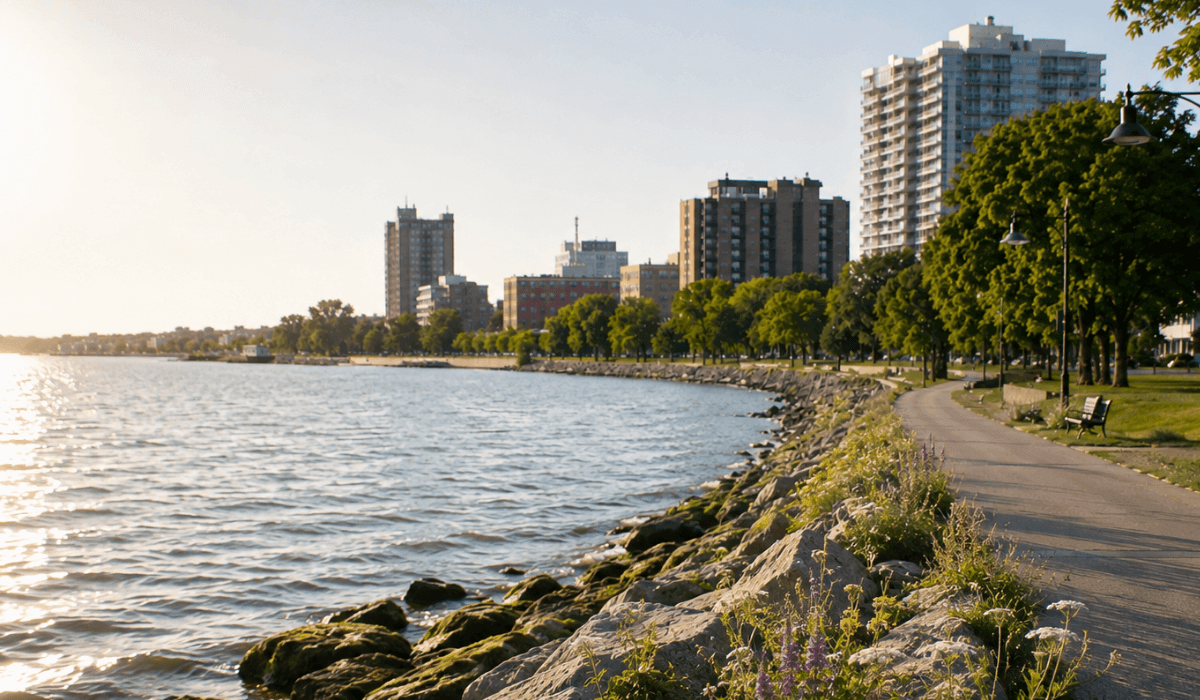
Oshawa’s AQHI comes from one provincial station in the north end, one of 38.
The Oshawa Air Monitoring Station
Source: Air Quality Ontario, Ministry of the Environment, Conservation and Parks. Oshawa is one of 38 provincial monitoring stations. A second Oshawa record, the former Durham College site, is no longer reporting.
Pulling Oshawa’s numbers for this page, we found two station records. The active site is on Britannia Avenue West. The second, the old Durham College site, is flagged closed and reports no pollutants. Yet the AQHI page still resolves under it.
From its coordinates, that station sits about 7 km northwest of downtown and 10 km inland. One urban station gives a sound picture of regional air, but not a street-level one. Near the 401, the harbour, or downwind of a wood stove, your air differs.
That gap is why indoor filtration matters. You cannot change the outdoor reading, but the MERV rating of your furnace filter is the biggest lever you control. It is the gap Filterbuy exists to close.
When The Reading Looks Wrong
Feeds break, and the pages do not say so. Four checks.
Check the timestamp. Hours or days behind means a cached figure, not live air.
Cross-check the sources. When Air Quality Ontario and ECCC disagree, take the fresher timestamp. Oshawa’s provincial forecast block has been returning an error.
App disagrees with the government site? That is the AQI-versus-AQHI difference, not a fault.
Numbers fine but your eyes and throat are not? Trust your symptoms. The index is regional, not local.
Readings are auto-polled and unverified, so treat the current hour as an indicator. Whatever the outdoor number does, the indoor variables do not: windows shut, fan on, filter fresh.
Oshawa’s Air Quality Calendar: What Drives It Season By Season
Seasonal Drivers and Filtration Response
Canadian furnaces typically run six to eight months a year, so filters work longer here than in milder climates.
Canadian furnaces run six to eight months a year, so a filter here works harder. Plan the step from MERV 11 Superior to MERV 13 Optimal before smoke season.
What To Do When Oshawa’s AQHI Is High
At AQHI 7 Durham Region issues a yellow warning; at 10+, orange.
Reduce strenuous outdoor activity. Children, older adults and anyone with asthma, COPD or heart conditions first.
Keep windows and doors closed while the reading stays high.
Set the HVAC fan to “on”, not “auto”, so air keeps passing through the filter.
Switch to recirculate, and back once the smoke clears.
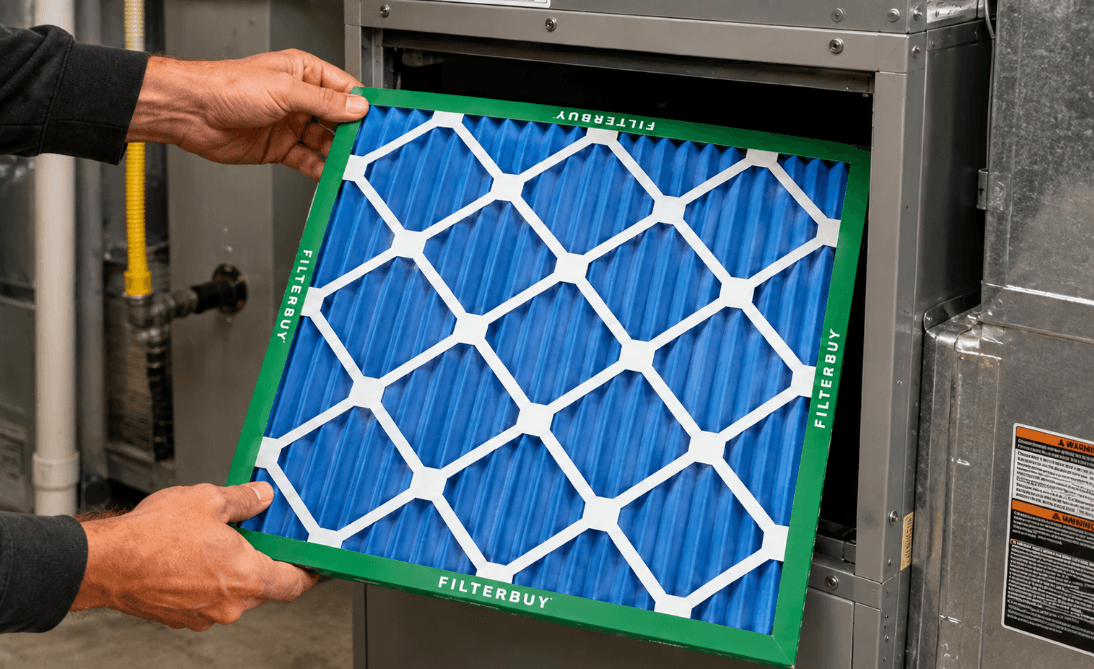
Check your filter. Smoke loads one in days. The ones we get back are grey well before ninety. Run a MERV 13 Optimal filter.
Add a portable HEPA cleaner where you sleep. Our MERV 13 versus HEPA comparison explains why.
No ductwork? A DIY Corsi-Rosenthal box is an EPA-studied stopgap for one room.
If breathing becomes uncomfortable, stop and contact a health care provider.
Why A Filter Company Is Writing About Oshawa’s Air Quality
Filterbuy is an air filter manufacturer, not an air quality agency. We have made our own filters since 2013, in over 600 sizes plus custom cuts, and ship across Canada.
The vantage point: we see what happens to filters. Customers send them back, and one pulled after a smoke week looks nothing like one pulled in January. The blind spot: we do not measure outdoor air. Every reading here is ECCC, MECP or Durham Region.
One position we would rather state than sell around: if your furnace is older, a clean MERV 11 your system can move air through beats a MERV 13 that starves the blower. We make both.
“The AQHI tells you what is happening outside your front door. It cannot tell you what is happening in your hallway. That gap is the part you can actually do something about, and it costs less than most people expect.”
Michelle Wan, Brand Manager & Air Quality Writer, Filterbuy
Choosing The Right Filter For An Oshawa Home
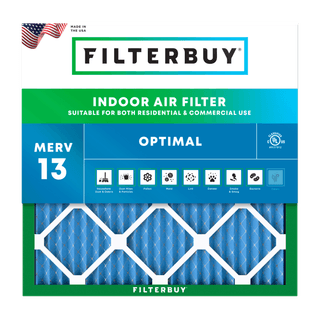
Health Canada recommends MERV 13 or higher for PM2.5 during wildfire smoke, provided your system handles the pressure drop. If your furnace is older, ask an HVAC technician or start at MERV 11. Our guide to MERV ratings covers each rating.
Filterbuy Ratings for Oshawa Homes
Health Canada recommends MERV 13 or higher during wildfire smoke events. Confirm your HVAC system can handle the added resistance before upgrading.
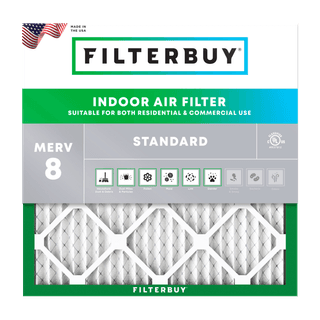
Free shipping Canada-wide: MERV 8 Standard, MERV 11 Superior, MERV 13 Optimal, or the carbon Odour Eliminator. Odd size? We cut to custom dimensions. Or subscribe and save.
Supporting Statistics
Three findings from U.S. federal agencies. One measured a plume off Canadian fires.
1. 55–60% of outdoor PM2.5 gets into a closed house.
Windows and doors shut, no air cleaner. Range across homes: 30% to 100%.
A high-efficiency filter with the fan on continuous cuts that by half.
Sealing up is step one. Filtration does the rest.
Source: Strategies to Reduce Exposure Indoors
2. 52% of U.S. fine particulate comes from wildland fires.
Figure from the EPA’s 2020 National Emissions Inventory.
PM2.5 is a smoke problem, which is why the summer row above matters more each year.
Source: Wildland Fire Research: Reducing Exposures
3. 179% more asthma emergency visits on the far shore of Lake Ontario.
Eastern Lake Ontario, New York, 7 June 2023, during smoke from Eastern Canadian wildfires.
Visits rose 81.9% statewide the same day.
Same lake, same plume as Oshawa. This is what a high-AQHI day costs.
Source: CDC MMWR, 2023
Frequently Asked Questions
Glossary
AQHI: Canada’s official air quality scale, 1 to 10+, from Health Canada and ECCC.
AQI: A 0–500 U.S. EPA index based on the worst single pollutant. Ontario retired its own in 2015.
PM2.5: Fine particulate 2.5 micrometres or smaller. The main pollutant in wildfire smoke.
Ground-level ozone (O3): Formed when sunlight reacts with vehicle and industrial emissions. Peaks on hot days.
Nitrogen dioxide (NO2): From traffic and fuel combustion. One of three AQHI pollutants.
MERV: Minimum Efficiency Reporting Value. How well a filter captures particles. Filterbuy labels its ratings Standard (8), Superior (11), Optimal (13).
Special Air Quality Statement: An ECCC alert when smoke may worsen air quality.
MECP: Ontario’s Ministry of the Environment, Conservation and Parks.
About The Author And Reviewer
Michelle Wan, Author. Brand Manager and Air Quality Writer at Filterbuy, turning MERV ratings and HVAC efficiency into plain-language advice for homeowners (B.A., UC Santa Cruz). She works directly with our manufacturing teams. More on her author page.
David Clark, Reviewer, Licensed HVAC Technician. Licensed HVAC Technician at Filterbuy. Checked every claim here on MERV ratings, airflow and static pressure.
Our story · Customer reviews · Customer care
Sources: ECCC; Health Canada; Ontario MECP (Air Quality Ontario); Region of Durham; U.S. EPA; CDC.