Shop by
The Air Quality Index (AQI) measures how polluted the air is and how it may affect your health.
0–50 (Good): Air quality is satisfactory.
51–100 (Moderate): Acceptable, but some pollutants may pose minor concerns.
101–150 (Unhealthy for Sensitive Groups)
151–200 (Unhealthy)
201–300 (Very Unhealthy)
301+ (Hazardous)
Still okay for most, but if you have asthma or allergies, take it easy and avoid long outdoor workouts.
Shop MERV 11 filters→
Kingston's air quality is reported on Canada's Air Quality Health Index, a scale that starts at 1, where 1-3 means low risk. The reading comes from one provincial station at 23 Beechgrove Lane in the city's west end, measuring ozone, fine particulate matter and nitrogen dioxide. Check the live map above, then the forecast, before you plan time outdoors. The U.S. AQI is a secondary reference, but AQHI is the Canadian standard.
Canada reports air quality on the Air Quality Health Index (AQHI), a scale from 1 upward, not the 0 to 500 U.S. AQI.
Kingston's AQHI comes from one Ministry of the Environment station at 23 Beechgrove Lane, about 3.4 kilometres west-southwest of City Hall. Pollen is not in the index.
The nearest AQHI stations are Belleville, 70 kilometres west, and Ottawa Downtown, 151 kilometres northeast.
AQHI covers outdoor air only. Indoor air depends on ventilation, source control and filtration.
The Air Quality Health Index reports Kingston's outdoor air on a scale that starts at 1 and has no fixed ceiling. Readings of 1-3 are low risk, 4-6 moderate and 7-10 high, and above 10 is very high risk. It updates hourly, so the current air quality in Kingston is never more than an hour old, and each reading comes with forecast maximums.
Environment and Climate Change Canada pairs each band with two sets of guidance, one for the general population and one for people at higher risk.
At low risk, conditions suit your usual outdoor activities. At moderate risk, the at-risk group is advised to consider easing off or rescheduling strenuous activity outdoors if symptoms appear, while everyone else needs no change unless coughing or throat irritation sets in. At high risk that group should cut back, and above 10 the advice is to avoid strenuous outdoor activity altogether.
The local definition of at risk is wider than the federal wording suggests. Southeast Public Health, the health unit covering Kingston, counts infants and children, older adults, anyone with a chronic illness such as asthma, diabetes or heart and lung disease, people who are pregnant or underhoused, people who work outdoors, and anyone exerting themselves outside.
A single number also hides its own direction, which matters as much as its value. A 4 that has climbed from 2 over three hours is a different afternoon from a 4 on its way down, which is why the forecast maximums are worth a glance. If you have a heart or lung condition, your doctor's usual advice comes first.
Kingston's AQHI comes from a single provincial monitoring station in the city's west end. Most air quality pages hand you a number without saying where it was measured, so we went and found out, and once you know where it sits the number reads differently.
The station is at 23 Beechgrove Lane, latitude 44.219953, longitude -76.521143. The Ontario Ministry of the Environment classifies the site as urban, drawing air from an intake 5 metres above ground at an elevation of 84 metres, and it measures ozone, fine particulate matter and nitrogen dioxide.
We took those coordinates and measured the distances ourselves. The station sits about 3.4 kilometres west-southwest of Kingston City Hall and roughly 2 kilometres from Queen's University and Kingston General Hospital, so the figure published for Kingston is really a west-end measurement applied citywide.
We then repeated that measurement against every neighbouring station. Kingston's monitor is one of 38 ambient air monitoring stations the Ontario Ministry of the Environment runs province-wide, and the nearest of them is Belleville, about 70 kilometres west. In the other direction the next are Ottawa Downtown at roughly 151 kilometres and Cornwall at 167. Across some 220 kilometres of the Highway 401 corridor, this one station is the only AQHI reference point.
Two things follow. The first is that the index is a regional signal rather than a street-level one: a smoke episode covers the whole area and the station catches it, while a local source, idling traffic on Princess Street or a neighbour's woodstove, may never reach Beechgrove Lane. The second is that an intake 5 metres up sits well above sidewalk breathing height, so roadside air can differ.
There is also a consequence that catches people out. When the reading shows N/A, which is how the province flags missing data, there is no second monitor in the city to fall back on. The nearest substitute is Belleville, 70 kilometres away, which describes the region rather than your street. On those days the forecast maximums are the better guide.
None of this makes the AQHI unreliable. It makes it a specific measurement with a specific origin, worth knowing when you are deciding whether to head out for a run.
At Filterbuy Canada we pulled the Kingston station record from Air Quality Ontario for its coordinates, intake height, classification and pollutants, then did the same for Belleville, Ottawa Downtown and Cornwall. The distances above are great-circle calculations from those coordinates rather than estimates read off a map, and every source is linked below so you can repeat it.
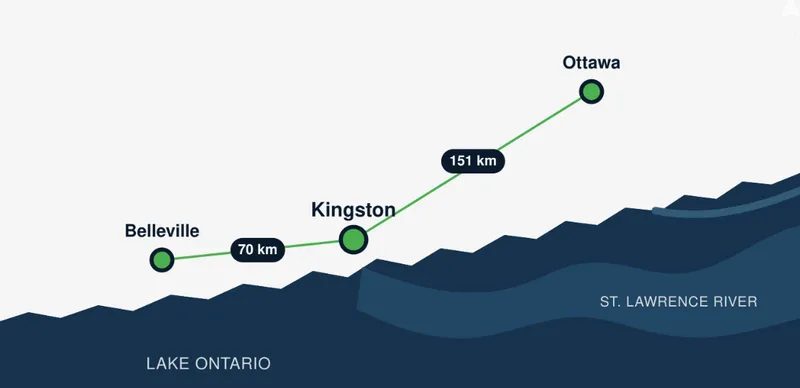
Much of Kingston's air pollution today arrives from somewhere else. The city sits at the northeastern end of Lake Ontario, where the lake narrows into the St. Lawrence River, and that decides what reaches it and when. Summer is ozone season: ozone forms when sunlight acts on precursor pollutants already in the air rather than coming straight from a tailpipe or chimney, so the highest readings come on hot, still afternoons rather than at rush hour, and because those pollutants travel far the episodes are usually regional.
Late spring through early autumn is wildfire smoke season, and those events push Kingston into the moderate or high bands more often than anything else. Winter flips the pattern: cold, calm nights create temperature inversions, layers of warmer air that trap emissions near the ground, while wood burning adds fine particulate matter. Furnaces here run six to eight months a year, so the indoor side matters most when windows stay shut.
The AQHI describes outdoor air. It says nothing about the air in your kitchen, and that gap matters because of where people spend their time.
Indoor air mixes two things: what drifts in from outside, and what is made inside. Outdoor fine particulate matter infiltrates through gaps, doorways and ventilation, which is why a smoke event registers indoors within hours. Inside, cooking particles, dust, pet dander, mould spores and odours build up over a long season.
Your furnace filter is the one point where circulating air is treated consistently. Its MERV rating, short for Minimum Efficiency Reporting Value, describes the size range of particles it captures, and higher ratings capture smaller ones.
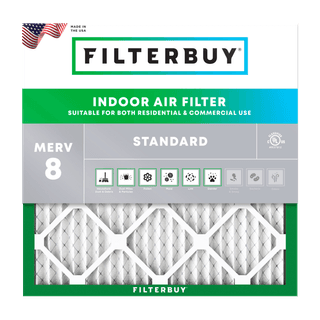
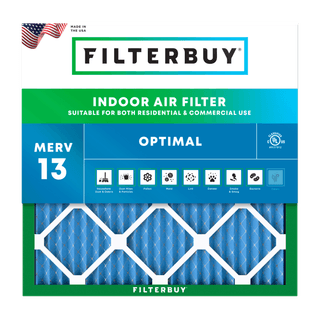
Filterbuy Canada carries pleated filters in MERV 8, MERV 11 and MERV 13, plus an Odour Eliminator option with activated carbon for smells pleated media does not address. Our guide to MERV ratings covers the scale; our guide to choosing a filter for wildfire smoke covers the swap.
One caution worth stating plainly: a higher MERV rating also resists airflow more, and not every system has the headroom for it. Check your documentation first, or ask a licensed HVAC technician to measure static pressure.
Our view at Filterbuy Canada is a deliberately unexciting one. The outdoor number gets the attention because it moves hour to hour, but the air you can actually change is already inside, and for most Kingston households that lever is the filter in the furnace. We would rather you check it than refresh a map.
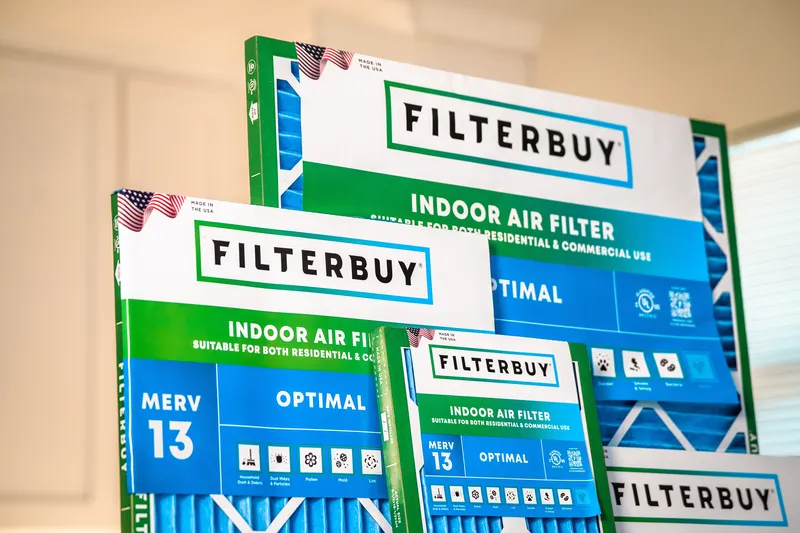
Southeast Public Health, the health unit serving Kingston, advises running the highest rated MERV filter your system supports, ideally 13 or higher, with the fan on continuously during smoke events. Two steps put that into practice.
Close the house up and keep the air moving. Shut windows and doors, close the fresh-air damper if you have one, and switch the thermostat fan from Auto to On, since on Auto the blower runs only during heating or cooling cycles and air reaches the filter for part of the day.
Inspect the filter instead of working from a date, because heavy smoke loads one far faster than household dust and a clogged filter restricts airflow without filtering any better. Close the slot cover firmly too, since air takes the easiest path around a loose frame.
Filterbuy Canada ships free across the country with no minimum, so stocking up is easy, and an air filter subscription keeps replacements on schedule. That matters because shipping slows when all of eastern Ontario orders at once.
The three figures below come from U.S. federal agencies. The physics of particle size and filtration is not country specific, though Canadian standards differ.
The U.S. Environmental Protection Agency reports people spend about 90 percent of their time indoors, where some pollutants run two to five times outdoor levels. Source: U.S. EPA, Report on the Environment: Indoor Air Quality.
The EPA defines PM2.5 as fine inhalable particles 2.5 micrometres and smaller. An average human hair is about 70 micrometres across, roughly 30 times the largest fine particle. Source: U.S. EPA, Particulate Matter (PM) Basics.
During smoky periods, the EPA recommends an HVAC filter rated MERV 13 or higher for smoke particles indoors. Most systems accommodate MERV 13 without equipment problems, provided it is replaced frequently. Source: U.S. EPA, Preparing for Smoke and Heat.
Read the band rather than the raw number. Most Kingston days sit in the low band, with higher readings turning up during summer smoke episodes and on hot, still afternoons when ozone builds.
Fine particulate matter is measured hourly in micrograms per cubic metre, alongside ozone and nitrogen dioxide, on the Kingston station page.
They are different scales measuring the same air. AQHI runs from 1 upward and is built around health risk, while the U.S. AQI runs from 0 to 500 and is tied to concentration breakpoints. Mapping sites convert Ontario data into AQI, so the two numbers rarely match.
AQHI (Air Quality Health Index). Canada's official outdoor air quality scale, running from 1 upward with no fixed ceiling. It is a health-based index calculated from ozone, nitrogen dioxide and fine particulate matter.
PM2.5. Fine particulate matter: airborne particles 2.5 micrometres or smaller. Wildfire smoke, combustion and vehicle exhaust are common sources.
Ozone (O3). A gas formed when sunlight reacts with precursor pollutants. In eastern Ontario it peaks on hot, sunny summer afternoons.
Nitrogen dioxide (NO2). A combustion gas produced by vehicles, furnaces and industry, and one of the three pollutants in the AQHI calculation.
MERV (Minimum Efficiency Reporting Value). A standardised scale under ASHRAE Standard 52.2 describing the size range of particles a filter captures. Higher ratings capture smaller particles and resist airflow more
Written by Michelle Wan, Brand Manager and Air Quality Writer at Filterbuy, who covers indoor air quality and filtration for Canadian homes.
Published: 31 August 2026. Last updated: 31 August 2026.
This page is general information about air quality reporting and home filtration. For questions about your own health, speak with a qualified healthcare professional. For questions about your HVAC system, speak with a licensed HVAC technician.