Shop by
The Air Quality Index (AQI) measures how polluted the air is and how it may affect your health.
0–50 (Good): Air quality is satisfactory.
51–100 (Moderate): Acceptable, but some pollutants may pose minor concerns.
101–150 (Unhealthy for Sensitive Groups)
151–200 (Unhealthy)
201–300 (Very Unhealthy)
301+ (Hazardous)
Still okay for most, but if you have asthma or allergies, take it easy and avoid long outdoor workouts.
Shop MERV 11 filters→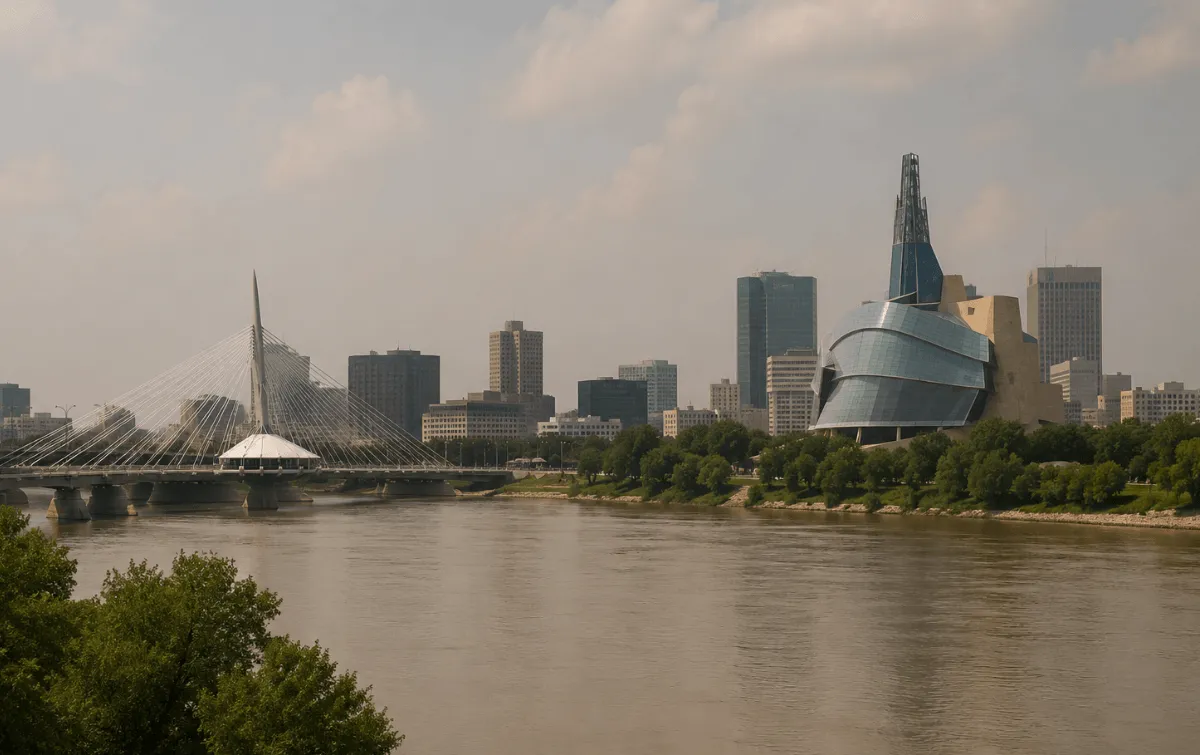
By Michelle Wan | Reviewed by David Clark, Licensed HVAC Technician | Published June 25, 2026 | Updated June 25, 2026
You cannot always see what you are breathing, and in Winnipeg, the gap between air that looks fine and air that is actually full of wildfire smoke has widened with every recent summer. The direct answer is that Winnipeg's air quality is measured by Canada's Air Quality Health Index, or AQHI, a scale that runs from 1 to 10+ and is published by Environment and Climate Change Canada. That is a different system from the 0-to-500 U.S. Air Quality Index that many phone apps display, so the number you see depends on which tool you are looking at.
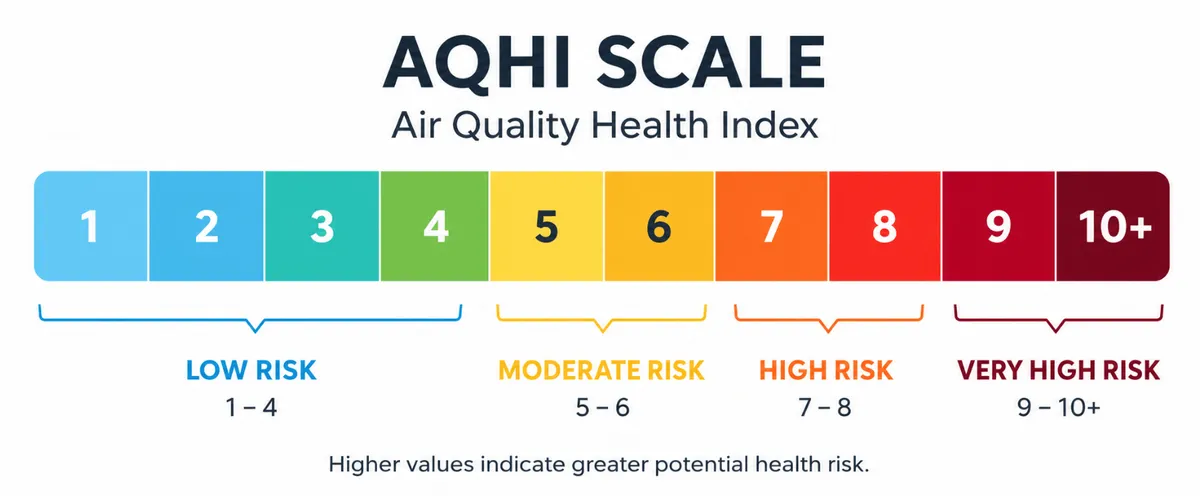
On the AQHI, a Winnipeg reading of 1 to 3 means low health risk, 4 to 6 means moderate risk, 7 to 10 means high risk, and 10+ means very high risk, the level where everyone should limit time outdoors, no matter their age or health. The smartest habit on any smoky day is to check the live reading first, then take control of the air inside your home, where you and your family spend most of your hours. This guide shows you how to read both numbers correctly, where to find the live data and maps, and exactly what to do indoors when the air turns.
Q: What is the air quality in Winnipeg today?
A: Open the live Winnipeg AQHI from Environment and Climate Change Canada for a current reading on the 1-to-10+ scale. The page also shows the forecast for the next two days, which helps you plan outdoor activities and decide when to run indoor filtration.
Q: Why does my weather app show a different Winnipeg AQI number?
A: Most apps report a U.S.-style Air Quality Index from 0 to 500, while Canada's official measure is the AQHI from 1 to 10+. The two use different formulas, so they will rarely match. For health decisions in Winnipeg, follow the AQHI.
Q: Is the air quality bad in Winnipeg today?
A: Check the AQHI band. A reading of 1 to 3 is low risk and 4 to 6 is moderate, but 7 to 10 is high, and 10+ is very high. Wildfire smoke is the main reason Winnipeg readings spike, and during heavy smoke, the index can climb past the top of its scale.
Q: What is Winnipeg's PM2.5 today?
A: PM2.5, the fine particle pollution in wildfire smoke, is the pollutant that drives most of Winnipeg's bad-air days. During smoke events, Environment and Climate Change Canada calculates the AQHI from PM2.5 on an hourly basis, so a high AQHI usually means high PM2.5.
Q: Where is the Winnipeg air quality map?
A: Use the Environment and Climate Change Canada AQHI station view for Manitoba, or the AirNow Fire and Smoke Map for a visual of smoke plumes and nearby monitors. Both are linked in the resources below.
Q: What should I do when the air is bad?
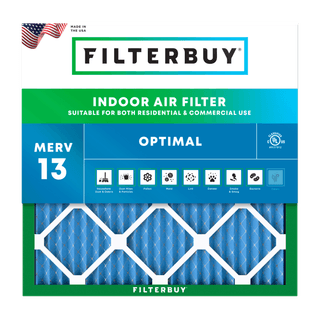
A: Stay indoors, keep windows and doors closed, set your HVAC system to recirculate, run a high-efficiency MERV 13 filter or a portable air purifier, and wear a well-fitted N95 if you must go outside.
Winnipeg's official air quality measure is the AQHI (1 to 10+) from Environment and Climate Change Canada, not the U.S. AQI (0 to 500) shown by many apps.
Wildfire smoke is now the dominant driver of poor air days in Winnipeg. According to Environment and Climate Change Canada, 2025 was the city's smokiest summer in records going back more than seven decades.
Fine particle pollution (PM2.5) is the health risk that matters most in smoke. It is small enough to reach deep into the lungs and pass into the bloodstream.
When the AQHI hits 7 or higher, reduce outdoor activity. At 10+, everyone should stay in, regardless of health status.
Your home's air is the variable you control. Closing up, switching to recirculate, and running a MERV 13 filter can make your house the cleanest air space available to you.
One detail trips up almost every Winnipeg resident who searches for a quick air quality number. Canada and the United States use two separate systems. Environment and Climate Change Canada runs the Air Quality Health Index, a health-risk scale from 1 to 10+ that blends fine particles, ground-level ozone, and nitrogen dioxide into a single risk category. The U.S. Environmental Protection Agency uses the Air Quality Index, a 0-to-500 scale tied to specific pollutant concentrations. Popular apps and global ranking sites usually report the U.S. AQI because it is the same everywhere, which is why the number on your phone often looks nothing like the official Winnipeg reading.
The table below lines them up so you can translate at a glance. Treat it as a rough guide, not a precise conversion, because the two indices are built on different math.
Comparison is approximate. The AQHI and U.S. AQI use different formulas, so the values do not convert exactly.
Most of the time, Winnipeg's air is clean. The province has historically met the Canadian Ambient Air Quality Standards for fine particulate matter and ground-level ozone. The trouble arrives in the warm months, when smoke from wildfires across Manitoba and neighbouring provinces pushes the AQHI up fast, sometimes within minutes as winds shift.
The summer of 2025 made the pattern impossible to ignore. According to Environment and Climate Change Canada, it was Winnipeg's smokiest summer on record, breaking a mark that had stood since 1961, as Manitoba faced its worst wildfire season in three decades. On several days, the Winnipeg AQHI reached the very high risk 10+ level, the point where the scale runs out of room, and the air is unhealthy for everyone.
Fine particulate matter, written as PM2.5, is the main ingredient of wildfire smoke and the reason smoky air is dangerous. These particles are roughly thirty times smaller than the width of a human hair, small enough to slip past your nose and throat, settle deep in the lungs, and pass into the bloodstream. That is why Environment and Climate Change Canada switches the AQHI to a PM2.5-only, hourly calculation during smoke events, so the index responds quickly as particle levels surge.
Ground-level ozone can also climb on hot, sunny, stagnant days, and nitrogen dioxide from traffic adds to the mix near busy roads. For day-to-day decisions, though, PM2.5 from smoke is the number to respect in Winnipeg.
You have three reliable ways to see what the air is doing, and it helps to know what each one is best for.
The live Winnipeg AQHI. This is the official current reading and the next two-day forecast from Environment and Climate Change Canada. Bookmark it and check it before outdoor plans.
The AQHI station map. Environment and Climate Change Canada also shows readings by monitoring stations across Manitoba, which is useful because air quality can vary from one part of the city to another.
The AirNow Fire and Smoke Map. This map plots smoke plumes and nearby monitors on a U.S.-style AQI, which is handy for seeing where smoke is coming from, as long as you remember it reports the AQI rather than the AQHI.
A quick word on apps. Free apps are fine for a glance, but many pull from low-cost sensors that can be inaccurate, and most report the U.S. AQI. When a decision matters, confirm against the official AQHI.
Knowing the number only helps if you act on it. Use the AQHI band to guide both your outdoor plans and your indoor activities.
When the AQHI reaches 10+, everyone should limit time outdoors regardless of age or health status.
Smoke does not stop at your front door, and that is the part many people miss. Fine particles drift in through gaps, vents, and every time a door opens, so indoor air on a smoky day can carry a surprising load of PM2.5. The good news is that your home is the one place you can actively clean, and a few moves make a real difference.
If your HVAC system has a fresh-air intake, switch it to recirculate or close the outdoor damper so you are not pulling smoke inside. Then let the system's fan run as much as possible, because every pass sends indoor air back through the filter.
For wildfire smoke, the U.S. Environmental Protection Agency recommends MERV 13 filters, which capture a large share of the fine particles that ordinary, low-MERV filters let slip through. A MERV 13 pleated filter in your furnace or air handler turns your whole HVAC system into a home-wide air cleaner, and our guide to how MERV ratings work explains where each rating lands on the scale. If you also run a portable purifier, choose one with a true HEPA filter and size it to the room.
During heavy smoke, a filter can load up with particles in days rather than the usual months. Check it often and swap it the moment it looks dirty or starts to carry a smoky smell. Keeping spare MERV 13 filters on hand before fire season means you are never stuck running a clogged filter when the air is at its worst. This is exactly where having the right filter, in the right size, ready to go, pays off.
“On the worst smoke days in a place like Winnipeg, the single biggest lever a homeowner controls is the air inside the house. Set your system to recirculate so you are not pulling smoke in from outside, put a high-efficiency MERV 13 filter in place, and change it the moment it looks loaded, because during heavy smoke, that can happen in days rather than months. Those three moves quietly turn your HVAC system into the cleanest-air room you have.”
David Clark, Licensed HVAC Technician
Each link below points to an authoritative, article-level source. They draw from separate organizations, so you can cross-check the same facts across independent authorities.
Live Winnipeg AQHI (Environment and Climate Change Canada)
The official current reading and 72-hour forecast for Winnipeg on the 1-to-10+ scale. This is the source to trust for health decisions.
Source: Winnipeg Air Quality Health Index from Environment and Climate Change Canada
How The AQHI Works (Government of Canada)
A plain-language explanation of the AQHI scale, its four risk categories, and how the index is adjusted during wildfire smoke.
Source: About the Air Quality Health Index on Canada.ca
Manitoba Air Quality Monitoring (Province of Manitoba)
Details on where and how Manitoba measures ambient air, including its partnership in the national AQHI program and its CAAQS reporting.
Source: Manitoba air quality monitoring program overview
Protect Your Lungs From Wildfire Smoke (Canadian Lung Association)
Ten practical steps to reduce the effect of wildfire smoke on your lungs, including mask guidance and advice for people living with lung disease.
Source: How to protect your lungs from wildfire smoke from the Canadian Lung Association
Fires And Your Health (AirNow)
A clear summary of why fine particles are the biggest smoke health threat and what to do indoors and outdoors during a smoke event.
Source: Fires and Your Health guidance from AirNow
Ambient Air Quality And Health (World Health Organization)
The global health authority's overview of how outdoor air pollution affects the body, including its PM2.5 guideline levels.
Source: WHO ambient air quality and health fact sheet
Particulate Matter Basics (U.S. EPA)
What PM2.5 and PM10 are, how small they are, and why fine particles pose the greatest health risk.
Source: Particulate Matter (PM) Basics from the U.S. EPA
These figures come from a separate set of sources from the resources above, with no shared organizations, so the numbers stand on an independent footing.
1. Wildfire smoke can be far harder on the lungs than ordinary particle pollution. A Southern California study found that each 10 microgram-per-cubic-metre rise in wildfire-specific PM2.5 was linked to respiratory hospitalization increases of up to roughly 10 percent, compared with up to about 1.3 percent for the same amount of PM2.5 from other sources.
Source: Aguilera and colleagues, 2021, Nature Communications (PMC)
2. Wildfire smoke travels far, and Canada's worst year on record was recent. The American and Canadian Lung Associations note that 2023 was Canada's worst wildfire year ever, with large fires burning in all 13 provinces and territories, and that wildfire smoke can drift hundreds to thousands of miles from where it starts.
Source: American and Canadian Lung Associations wildfire smoke briefing
3. Long-term smoke exposure carries a measurable death toll. A national analysis estimated that long-term exposure to wildland-fire smoke PM2.5 contributed to about 11,415 non-accidental deaths per year in the contiguous United States between 2007 and 2020, a signal of how serious repeated smoke seasons are for public health across North America.
Source: Ma and colleagues, 2024, PNAS wildfire smoke mortality study
For most of its history, Winnipeg did not think much about checking the air before stepping outside. That has changed, and the honest read is that it is not going back. Wildfire smoke has become a regular summer visitor, and the people who handle it best are the ones who treat clean air at home as part of keeping their household healthy, the same way they think about a working furnace or a stocked first-aid kit.
Our view at Filterbuy is simple. You cannot control the wildfires, and you cannot always control the outdoor AQHI, but you have real power over the air your family breathes indoors. Making the invisible visible, by knowing what PM2.5 is and watching the index, is the first step. Acting on it, by sealing up and filtering hard on smoky days, is what turns that knowledge into protection. That is the role of the household protector, and it is more achievable than most people realize.
Bookmark the live Winnipeg AQHI and check it before outdoor plans on smoky days.
Install the AQHI Canada app and set alerts so you know the moment air quality shifts.
Stock up on the correct MERV 13 filter size for your system before fire season starts. Our filter size guide walks you through measuring and ordering.
Locate your HVAC recirculate setting or fresh-air damper now, so you are not hunting for it during a smoke event.
Pick one room as a clean room and have a portable HEPA purifier ready for it.
No. Winnipeg and the rest of Canada use the Air Quality Health Index (AQHI), a 1-to-10+ health-risk scale from Environment and Climate Change Canada. The United States uses the 0-to-500 Air Quality Index (AQI) from the EPA. Many apps show the U.S. AQI even for Canadian cities, which is why the numbers often differ.
Far more often than usual. During heavy smoke, a filter can clog within days instead of the typical one to three months. Check it frequently and replace it as soon as it looks dirty or smells smoky. Keep spares on hand so you are never running a loaded filter.
Yes, within limits. A high-efficiency MERV 13 filter in your HVAC system captures a large share of the fine PM2.5 in smoke as air circulates. It will not remove odors or gases on its own, so pair it with recirculate mode and, for a single room, a true HEPA purifier. Our guide to how HEPA and MERV filters compare explains the difference.
MERV 13 is the level the U.S. EPA points homeowners to for smoke, because it captures fine particles that lower-rated filters miss. Confirm your system can handle a MERV 13 filter without restricting airflow, and step up filter changes during smoke.
Moderate risk (4 to 6) is generally acceptable for healthy people, but if you have asthma, heart disease, or another condition, watch for symptoms and ease off hard exertion. When the AQHI reaches 7 or higher, everyone should reduce outdoor activity.
Environment and Climate Change Canada shows AQHI readings by monitoring stations across Manitoba, and the AirNow Fire and Smoke Map plots smoke plumes and monitors. Both are linked in the resources section above.
Yes. Fine particles work their way in through gaps, vents, and open doors, so indoor PM2.5 rises during smoke events even in a closed-up home. Recirculating your HVAC system through a MERV 13 filter and running a purifier keeps indoor levels much lower.
You are the one who keeps your household's air clean, and Winnipeg's smokier summers have made that job matter more than ever. Filterbuy MERV 13 filters come in hundreds of sizes, so you can match the right filter to your system and keep your home's air working in your favour when the AQHI climbs.
Find your size and stock up before the next smoke event. Shop MERV 13 Filters →