
North Vancouver Real-Time AQI Tracker
What's Actually In North Vancouver Air Today?
What High AQI Means for Your Lungs in North Vancouver
How to Read AQI
The Air Quality Index (AQI) measures how polluted the air is and how it may affect your health.
0–50 (Good): Air quality is satisfactory.
51–100 (Moderate): Acceptable, but some pollutants may pose minor concerns.
101–150 (Unhealthy for Sensitive Groups)
151–200 (Unhealthy)
201–300 (Very Unhealthy)
301+ (Hazardous)
Moderate
Still okay for most, but if you have asthma or allergies, take it easy and avoid long outdoor workouts.
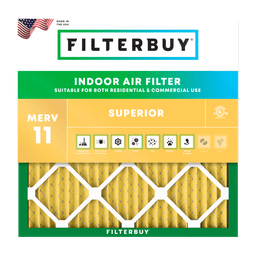
Shop MERV 11 filters→What's the Right Filter for Your AQI Level?



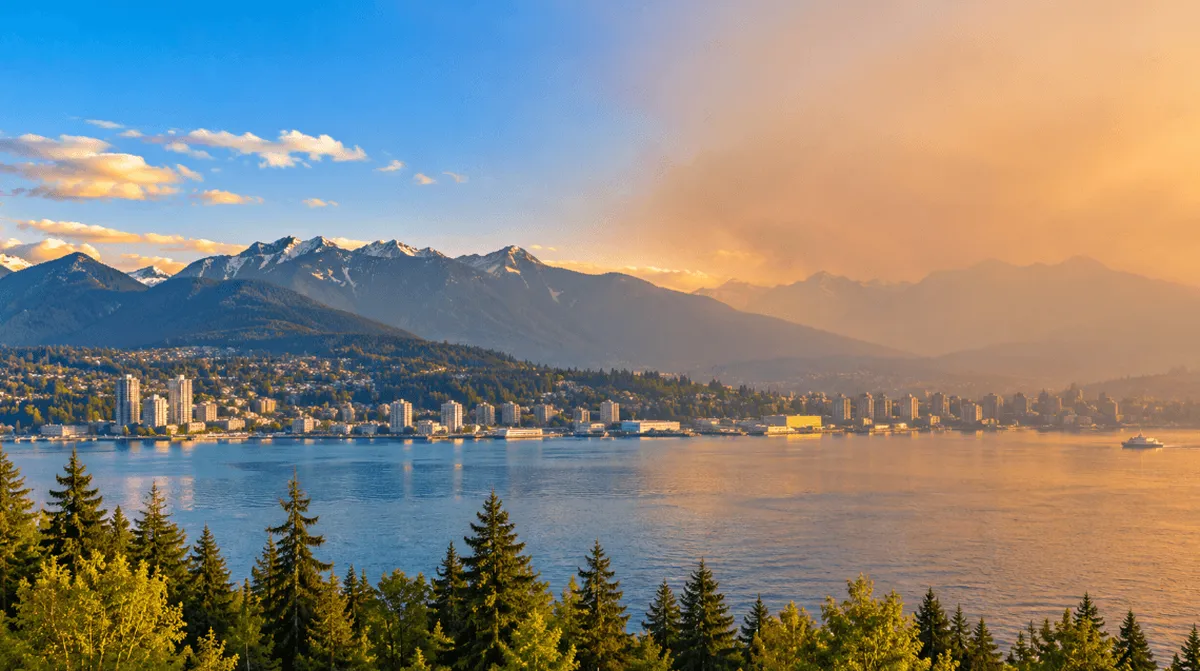
Check Today's Live Real Time Air Quality Index AQI Map in North Vancouver, BC Now
TL;DR
Check the live air quality map above for current conditions in North Vancouver. Canada's official measure is the Air Quality Health Index (AQHI), a 1 to 10+ health-risk scale that Environment and Climate Change Canada reports hourly for the Metro Vancouver Northwest zone, which includes the Mahon Park and Second Narrows monitoring stations. At 7 to 10 (high risk), people at risk should reduce or reschedule strenuous outdoor activities, and at 10+ (very high risk), everyone should. North Vancouver's worst days usually come from summer wildfire smoke or wood smoke trapped by still winter air.
Key Takeaways
Canada's AQHI runs from 1 to 10+: 1 to 3 is low risk, 4 to 6 moderate, 7 to 10 high, and 10+ very high.
Residential wood burning, Metro Vancouver's largest fine-particle source, is restricted from 15 May to 15 September.
Filterbuy recommends MERV 13 in the HVAC plus a portable HEPA cleaner in each occupied room once the AQHI reaches 7, or 4 if someone at home is at higher risk.
How to Read the North Vancouver Air Quality Map
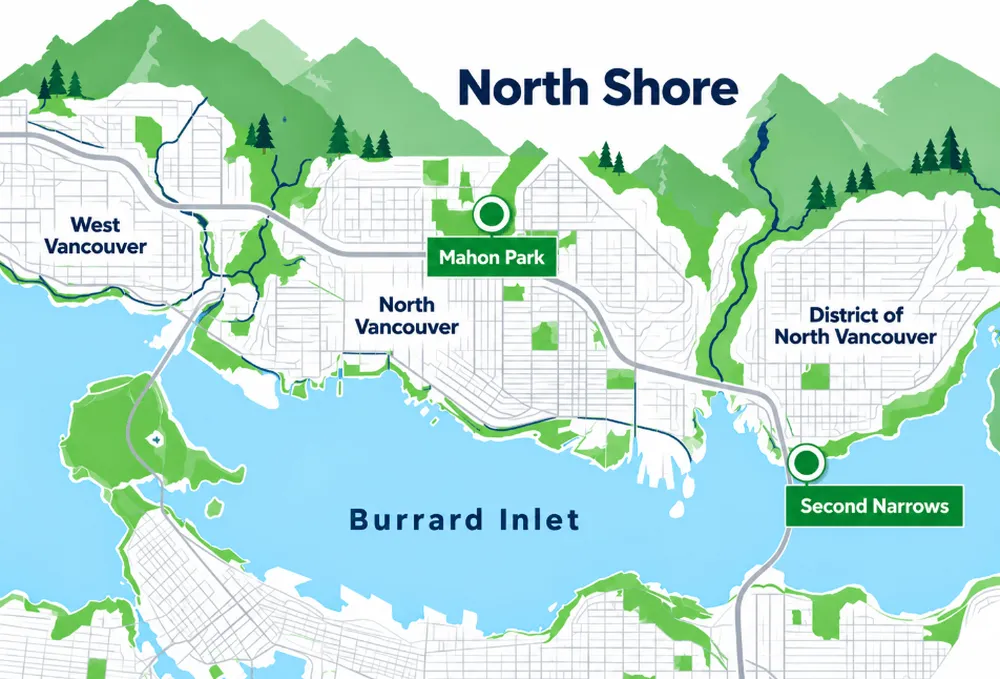
Each marker on North Vancouver's live air quality map is a monitoring station, coloured by health category and labelled with its dominant pollutant, usually PM2.5. If it shows a U.S. 0 to 500 AQI number, use it to spot rising stations, then check the AQHI for the official risk.
The two stations sit in different settings: Mahon Park in a neighbourhood park, Second Narrows on the waterfront, where ship emissions have influenced readings. The Filterbuy team's review of Metro Vancouver's monitoring reports shows the difference. In 2021, Second Narrows logged 476 hours with a 24-hour PM2.5 average between 10 and 20 micrograms per cubic metre; Mahon Park logged 149, according to the 2021 Lower Fraser Valley monitoring report. Second Narrows also topped the hourly nitrogen dioxide objective in 2021, 2023, and 2024, with nearby construction cited as the likely cause. For the south shore, see Filterbuy's Vancouver, BC map.
What Each AQHI Level Means for Your Day on the North Shore
B.C. calculates the AQHI two ways every hour, once from ozone, nitrogen dioxide, and PM2.5 together and once from PM2.5 alone, then reports whichever is higher. The table below shows the PM2.5-only values and health messages published by the BC Centre for Disease Control (BCCDC).
PM2.5 in micrograms per cubic metre. Source: BCCDC, Wildfire Smoke and the Air Quality Health Index (May 2024), using Health Canada health messages.
People at higher risk include infants and young children, pregnant people, older adults, and people with chronic lung or heart disease. BCCDC suggests they, and anyone with symptoms, act at moderate values; others may wait until high or very high.
AQHI vs. AQI: Why Two North Vancouver Numbers Can Disagree
If your weather app and Environment Canada disagree, the app is probably showing a North Vancouver AQI from the U.S. Air Quality Index, a 0 to 500 scale set by the single worst pollutant. The AQHI is Canada's official measure and blends three pollutants into one health-risk number.
Filterbuy author Michelle Wan says: "The single thing I explain most about air quality in Canada is why a weather app and a government site rarely show the same number."
The scales don't convert exactly, so BCCDC points people to the BC Air Quality website and WeatherCAN app.
Is It Safe to Be Outside in North Vancouver Right Now?
Whether it's safe outside depends on North Vancouver air quality today, measured by the AQHI, and on how hard you're working. A Mount Seymour climb pulls in far more air than a Spirit Trail stroll.
When the air is poor, take it easy: BCCDC notes that the harder you breathe, the more smoke you inhale. With a chronic condition, follow your doctor's plan. For time outside in smoke, BCCDC suggests a well-fitted respirator.
Where to Get North Vancouver Air Quality Forecasts and Warnings
North Vancouver forecasts come from Metro Vancouver's AirMap and Environment Canada's AQHI forecast for Metro Vancouver NW.
Under Metro Vancouver's warning levels, yellow means high health risk and orange means very high.
On ECCC's zone page, choose AQHI by Station, where offered, to see stations separately, per ECCC's AQHI guide.
Get warnings and seasonal updates through Metro Vancouver's air quality mailing list.
Compare other Canadian cities on Filterbuy's live air quality map for Canada.
What's Actually in North Vancouver's Air?
PM2.5: Residential wood burning is the region's largest source, with traffic, ships, industry, and wildfire smoke adding to it.
Nitrogen dioxide (NO2): Mostly vehicle exhaust, highest near busy roads.
Sulphur dioxide (SO2): Highest near Burrard Inlet, mainly from marine vessels and the Burnaby refinery.
Ground-level ozone: Tends to peak in the eastern Fraser Valley. In 2024, Metro Vancouver's only warning was for ozone in eastern areas, not the North Shore.
When North Vancouver's Air Gets Worst
North Vancouver's air is usually worst in late summer, when wildfire smoke drifts in, and on calm winter days, when inversions trap neighbourhood wood smoke near the ground.
Most of the year, the air is clean. In 2024, every Metro Vancouver station stayed below the region's PM2.5 objectives of 25 micrograms per cubic metre over 24 hours and 8 over a year.
September 2020: An advisory for smoke from U.S. wildfires took effect on 8 September and was cancelled on 19 September.
5 August 2026: A yellow smoke warning covered the North Shore, and the Northwest zone read AQHI 7 while the Southwest zone read 3, Vancouver Is Awesome reported.
Follow active fires and plumes on Filterbuy's British Columbia wildfire and smoke map or the live Canada wildfire and smoke map.
Under Bylaw 1303, burning wood for heat is banned from 15 May to 15 September, with limited exceptions. Since 15 September 2025, wood-burning devices in urban areas must be registered to be used, except in emergencies.
What a Yellow or Orange Air Quality Warning Means for Your Home
A warning means outdoor air is unhealthy or soon will be. Start with Metro Vancouver's advice: limit outdoor activity and check the AQHI often.
Then take Filterbuy's four steps during any warning, at AQHI 7, or from 4 if someone at home is at higher risk. They build on Health Canada's advice for sheltering at home.
Close windows and doors, set your HVAC to recirculate, and limit exhaust fans except while cooking.
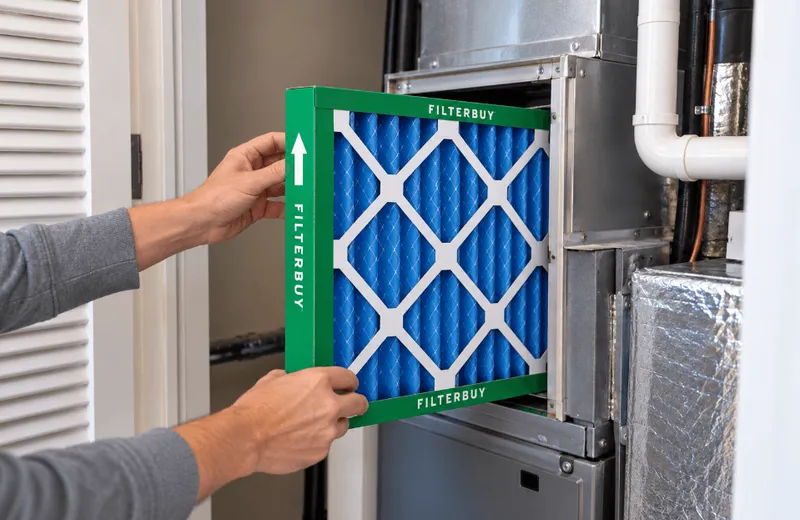
Use a MERV 13 or higher filter, as Health Canada recommends. Set the fan to On so air keeps passing through it. BCCDC suggests confirming with your service provider.
Run a certified portable HEPA air cleaner in each occupied room, bedrooms first.
Skip smoking, candles, incense, and vacuuming without a HEPA filter. If the house gets too hot, cool down first: BCCDC notes heat stress is a bigger risk than smoke for most people.
No Ducts? Clean-Air Options for Baseboard, Boiler, and Mini-Split Homes
Baseboards, boilers, and ductless heat pumps don't filter smoke, so a portable HEPA air cleaner is your primary defence, not a supplement.
Choose an AHAM-certified unit. BCCDC explains that the AHAM label lists the room size each unit can clean, and its tobacco smoke CADR (clean air delivery rate) is the closest match to wildfire smoke. Run it continuously with doors and windows closed. Skip ozone generators and ionizers, which can't effectively remove smoke particles.
A box fan with a MERV 13 filter is a reasonable stopgap, not a replacement. Canada's National Collaborating Centre for Environmental Health recommends adding a cardboard shroud, which raised clean air delivery by nearly 40 percent in testing. Use a certified 2012-or-newer fan, kept clear of obstructions. Already run a purifier? Filterbuy carries replacement air purifier filters.
Read Both North Shore Stations Before You Decide
Filterbuy reads every air quality map with one question: will this reach the air inside your home? In North Vancouver, comparing the two local stations answers it.
Both stations rising: it's usually regional smoke that will reach every neighbourhood, so take the four steps.
Only Second Narrows rising: the source is likely local traffic, industry, or construction near the water, which says less about Lynn Valley or Edgemont.
Neither rising but the air smells smoky: a nearby chimney can outrun the monitors, so trust your nose and close up.
In August 2026, an ECCC meteorologist told Vancouver Is Awesome that smoke stayed thicker on the North Shore and over higher terrain, so uphill neighbourhoods get no pass.
Author Michelle Wan says: "My advice for North Shore readers is to check two numbers, not one. Look at the Northwest zone AQHI for the official risk, then at the station closest to your street. The waterfront and the upper slopes do not always breathe the same air."
What Filterbuy's support team hears: Filter questions spike during smoke events. Our advice is two decisions a year:
Fit a MERV 13 before August. While smoke lingers, check it often and replace it when it turns dark brown or black.
Put in a fresh filter by 16 September, when indoor wood burning resumes.
Which Furnace Filter Matches North Vancouver's AQHI?
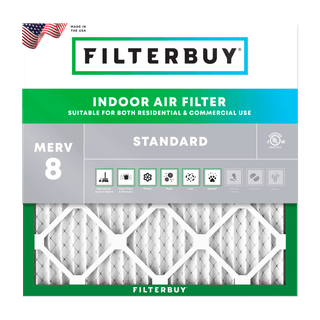
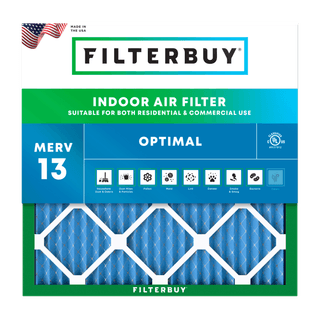
MERV 8 and MERV 11 air filters handle dust and pollen on clear days, but wildfire or wood smoke calls for MERV 13 air filters in your home's filter size.
Health Canada recommends HVAC filters rated MERV 13 or higher to remove PM2.5 during smoke events. See Filterbuy's guides to how MERV ratings work and MERV 13 vs. HEPA. Copy the inch size printed on your old filter, such as 20x25x1.
Filterbuy carries MERV 8, 11, and 13 pleated filters in over 600 sizes plus custom sizes, with free shipping to Canada. An air filter subscription makes sure spares arrive before smoke season does.
Supporting Statistics on Smoke and Filtration
1. Adding a portable air cleaner to MERV 13 cut indoor smoke by more than half.
Indoor smoke fell from 55 percent to 22 percent of outdoor levels.
Setting: a 1928 Portland home during the 2020 wildfire smoke event.
Source: Antonopoulos, Dillon and Gall, 2024, U.S. National Library of Medicine
2. A thicker MERV 13 filter more than doubled a box-fan cleaner's output.
A 4-inch MERV 13 filter raised output by 123 percent.
Dirty filters left the units almost useless.
3. Certified wood stoves release far less smoke.
Older stoves: 15 to 30 grams of smoke per hour.
Certified stoves: 4.5 grams or less.
Source: U.S. EPA Burn Wise, Choosing the Right Wood-Burning Stove
Frequently Asked Questions
Is the air quality bad in North Vancouver today?
Check the live map above, then the AQHI for Metro Vancouver - NW. At 7 or higher (high risk), people at higher risk should reduce or reschedule strenuous outdoor activity.
What MERV rating do I need for wildfire smoke?
MERV 13, in your system's filter size. Filterbuy recommends making the switch when the AQHI reaches 7, or 4 if someone at home is at higher risk.
What is North Vancouver's PM2.5 level today?
To check North Vancouver PM2.5 today, use the live map, which shows current PM2.5 when it's the dominant pollutant. A quick way to read it: divide the 1-hour PM2.5 by 10 and round up to get B.C.'s smoke-based AQHI, so 65 means 7, high risk.
Why does my weather app show a different number than Environment Canada?
Most apps use the U.S. 0 to 500 AQI; Environment Canada uses the 1 to 10+ AQHI, which measures combined health risk.
Does a furnace filter remove smoke smell?
No. Pleated filters capture particles, but smoke odour is a gas. For odours, look at Filterbuy's Odour Eliminator carbon filters.
Glossary
AQHI (Air Quality Health Index): Canada's official 1 to 10+ health-risk scale, blending ozone, nitrogen dioxide, and PM2.5.
AQHI-Plus: B.C.'s smoke-focused AQHI: 1-hour PM2.5 divided by 10, rounded up, reported when it exceeds the standard AQHI.
PM2.5: Particles 2.5 micrometres or smaller that can reach deep into the lungs.
MERV: Minimum Efficiency Reporting Value, a 1 to 16 rating of filter efficiency. Filterbuy carries MERV 8, 11, and 13.
HEPA: High-efficiency particulate air filtration, used in portable air cleaners, never in a furnace slot.