Shop by
September 18, 2026
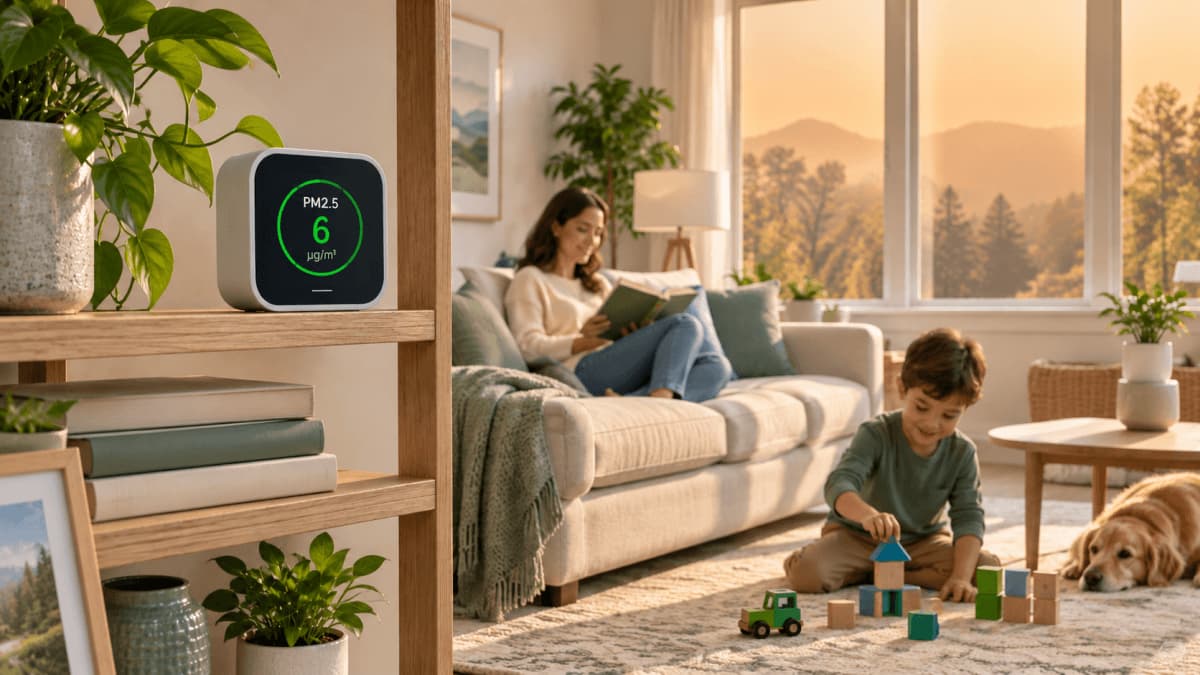
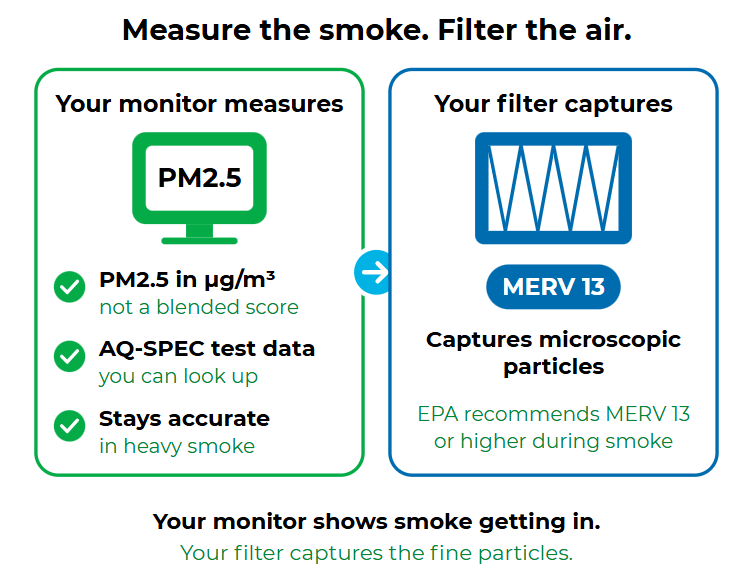
Choose a monitor that measures PM2.5 directly, shows it in µg/m³, and has independent test results showing it stays accurate in heavy smoke. Low-cost sensors can read low when smoke gets thick, so check the model's South Coast AQMD AQ-SPEC report before you buy.
A monitor works best alongside a good filter. EPA recommends a MERV 13 or higher HVAC filter during smoky periods, and your monitor shows whether it's working.
Not sure which filter fits your system? Take the quick quiz below.
Answer a few quick questions and we'll match you to the right filter.
By Michelle Wan | Reviewed by David Clark, Licensed HVAC Technician, Filterbuy HVAC Solutions | Published September 18, 2026 | Updated September 18, 2026
Pick a monitor whose PM2.5 sensor stays accurate in heavy smoke and has independent test results. Set it at breathing height and compare it with outdoor readings. When indoor levels climb, close up the house and switch to MERV 13 if your system allows. Add an air cleaner if needed.
PM2.5 is the spec that matters. Fine particles are the biggest health threat in wildfire smoke, so your monitor must measure them directly.
Heavy smoke can trip up low-cost sensors. Uncorrected PurpleAir sensors can respond nonlinearly above 300 µg/m³.
A monitor works best alongside a good filter. EPA recommends MERV 13 or higher during smoky periods, and your monitor shows whether it is working. That pairing is Filterbuy's approach.
A good wildfire smoke monitor starts with an optical PM2.5 sensor that stays accurate at hundreds of micrograms per cubic meter. CO2 or humidity sensors are nice, but a trustworthy PM2.5 reading is the one feature you can't skip.
At Filterbuy, we judge monitors the way we judge filters: by independent test data, not the box. This checklist applies that standard using U.S. Environmental Protection Agency (EPA) guidance (EPA) and published research. Unsure about indoor or outdoor? Read our guide to outdoor vs. indoor air quality monitors.
Sources: U.S. EPA wildfire sensor guidance; South Coast AQMD AQ-SPEC evaluations.
Consumer PM2.5 sensors estimate particle mass from scattered light, so accuracy shifts with particle type, humidity, and concentration. In very heavy smoke, an uncorrected sensor can stop rising with the real pollution, a problem called saturation. You get false reassurance when accuracy matters most.
EPA saw this during the 2020 wildfires, when some sites topped 1,000 µg/m³ and sensors in PurpleAir, a popular low-cost network, underestimated concentrations above 250 µg/m³ (EPA Science Inventory). EPA then extended its correction for extreme smoke, and corrected PurpleAir data now appears on the AirNow Fire and Smoke Map (Barkjohn et al., Sensors, 2022).
You also won't find a "smoke-certified" label, since none of EPA's sensor performance targets account for smoke (EPA). Humidity adds error too, and several models in South Coast AQMD testing grew more biased as humidity rose (AQ-SPEC). As a filter maker, Filterbuy sees the cost of a low reading: it can convince you to put off a filter change you need.
No. A smoke alarm warns you about a fire inside your home. A PM2.5 monitor tracks fine particles seeping in from a distant wildfire, which can reach unhealthy levels without setting off an alarm.
PM2.5 sensors can't measure gases either (EPA), so keep your carbon monoxide (CO) alarms working, especially if you run a generator.
PM2.5 readings are reported in micrograms per cubic meter (µg/m³) and line up with the U.S. Air Quality Index (AQI). Since EPA's update took effect May 6, 2024, "Good" ends at 9.0 µg/m³, while AQI 100 and 150 stayed at 35.4 and 55.4 µg/m³ (Federal Register).
Source: U.S. EPA PM2.5 AQI breakpoints, effective May 6, 2024.
AQI categories use averages, while a home monitor updates every minute. Watch direction and duration, not single spikes, and if you feel smoke symptoms, act regardless of the reading (EPA).
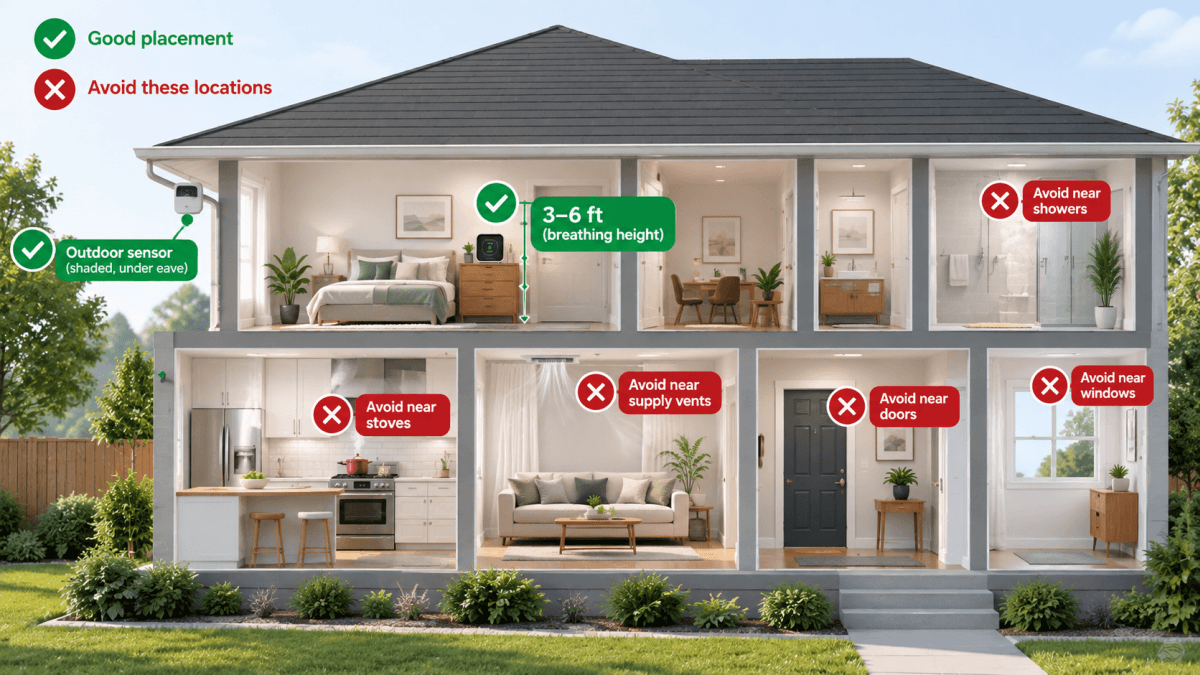
EPA recommends placing a sensor 3 to 6 feet off the ground, near breathing height, where air moves freely. Keep it away from exterior doors, windows, stoves, HVAC vents, humidifiers, and showers, where temperature and humidity swings distort readings (EPA).
One quick calculation shows how well your home keeps smoke out. Divide indoor PM2.5 by the outdoor reading from the Filterbuy live AQI map or the AirNow Fire and Smoke Map.
Example: 20 µg/m³ indoors ÷ 80 µg/m³ outdoors = 0.25, or 25% of outdoor levels.
Benchmark: EPA says a closed-up home without an air cleaner typically runs 55% to 60% of outdoor PM2.5 during smoke (EPA).
Well below 0.55? Your home is beating a typical closed-up home.
Close to 1.0? Your home is acting like an open window. EPA notes indoor and outdoor levels match when doors and windows stay open.
A monitor shows smoke getting in, and filtration takes it back out. During smoky periods, EPA recommends a MERV 13 or higher HVAC filter, along with recirculating indoor air and running an air cleaner (EPA).
When fine particles are the concern, Filterbuy's Michelle Wan puts it simply: "The rating matters far more than the schedule" (PM10 vs. PM2.5). For smoke, get MERV 13 in place first, then let your monitor tell you when to swap.
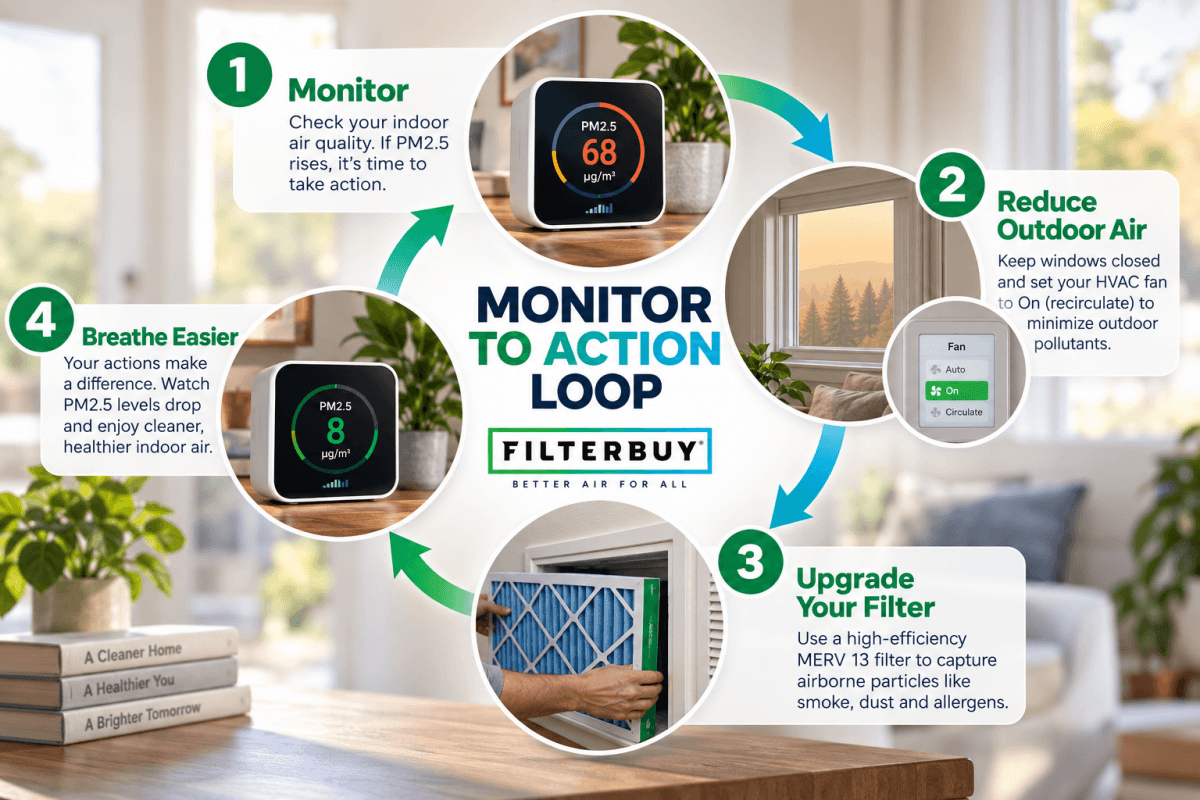
Record a baseline. On a clear day, note your normal indoor PM2.5.
Seal the house. Close windows and doors, then shut fresh air intakes or set the system to recirculate. Our checklist on how to keep wildfire smoke out of your house has more.
Upgrade the filter. Use MERV 13, which Filterbuy makes in 600+ sizes, or the highest rating your system allows. If unsure, EPA suggests asking an HVAC technician (EPA). See the best MERV rating for wildfire smoke for compatibility.
Keep air moving through the filter. Switch the thermostat fan from "Auto" to "On." EPA says a high-efficiency filter with the fan running continuously may cut indoor PM2.5 by about 50% (EPA).
Set up a cleaner air room. Run a portable or DIY box-fan air cleaner in the bedroom. In one study cited by EPA, a DIY air cleaner cut PM2.5 about 99% within an hour in a small room (EPA).
Cut indoor sources. Hold off on candles, frying, broiling, and non-HEPA vacuuming until the smoke clears.
Watch the trend and adjust. If readings stay high, check the filter for gaps. During heavy smoke, EPA advises replacing filters more often than the manufacturer recommends (EPA). See how often to change your air filter.
From our factory floor: Filters are cut slightly under their nominal size so they slide in. A Filterbuy 20x25x1 measures 19½ × 24½ × ¾ inches. That clearance is normal, but the wrong size or a bent frame lets smoky air slip around the media (EPA). If your monitor doesn't budge after an upgrade, check the fit first.
Keep a spare Filterbuy filter on hand before smoke season. Shop MERV 13 filters for smoke protection.
Over several days, the line's shape says more than any single number. The Filterbuy team reads common patterns this way.
Sources: EPA sensor guidance and Filterbuy filtration experience.
Most homes do best with an indoor PM2.5 monitor that has a display and app history, paired with outdoor data from a networked sensor or public map. CO2-only monitors can't detect smoke.
AQ-SPEC is the South Coast AQMD sensor testing program. Check its published reports before you buy.
Look up its test report. Find your model in the AQ-SPEC sensor evaluations and note its R² (how closely it tracks reference instruments) and error.
Run a quick response test. EPA suggests safely lighting a match near the sensor to make sure it reacts (EPA).
Americans spend about 90% of their time indoors.
Some indoor pollutants reach 2 to 5 times typical outdoor levels.
Source: EPA Report on the Environment
Indoor PM2.5 nearly tripled during wildfires.
Researchers tracked 1,400+ California buildings with PurpleAir sensors.
Homes with air conditioning or filtration let in less smoke.
Source: PNAS, 2021
Asthma ER visits ran 17% above expected.
The study covered 19 U.S. smoke days from April to August 2023.
Source: CDC MMWR
Filterbuy recommends a monitor that reports µg/m³ and has AQ-SPEC test results you can look up. A humidity sensor helps, and battery backup keeps it running during outages.
When South Coast AQMD evaluated 12 low-cost sensors, 6 averaged an R² of 0.70 or higher for PM2.5 below 50 µg/m³, with mean absolute error of 4.4 to 7.0 µg/m³ (AQ-SPEC).
PM2.5: Fine particles 2.5 micrometers or smaller, a main pollutant in wildfire smoke.
MERV: Minimum Efficiency Reporting Value, the ASHRAE rating for HVAC filter particle capture.
Michelle Wan is Filterbuy's Brand Manager and Air Quality Writer. She works with our U.S. manufacturing team, so her advice reflects how filters are built.
David Clark is a Licensed HVAC Technician with Filterbuy HVAC Solutions who reviews Filterbuy's technical content.
Ready to breathe easier this smoke season? Check local conditions on the Filterbuy live AQI map, then shop MERV 13 filters for smoke protection and set up Filterbuy auto-delivery so a fresh filter arrives on time.
