
Vancouver Real-Time AQI Tracker
What's Actually In Vancouver Air Today?
What High AQI Means for Your Lungs in Vancouver
How to Read AQI
The Air Quality Index (AQI) measures how polluted the air is and how it may affect your health.
0–50 (Good): Air quality is satisfactory.
51–100 (Moderate): Acceptable, but some pollutants may pose minor concerns.
101–150 (Unhealthy for Sensitive Groups)
151–200 (Unhealthy)
201–300 (Very Unhealthy)
301+ (Hazardous)
Moderate
Still okay for most, but if you have asthma or allergies, take it easy and avoid long outdoor workouts.
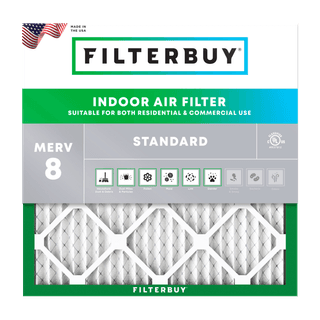
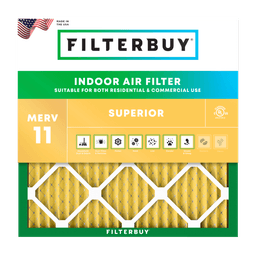
Shop MERV 11 filters→What's the Right Filter for Your AQI Level?



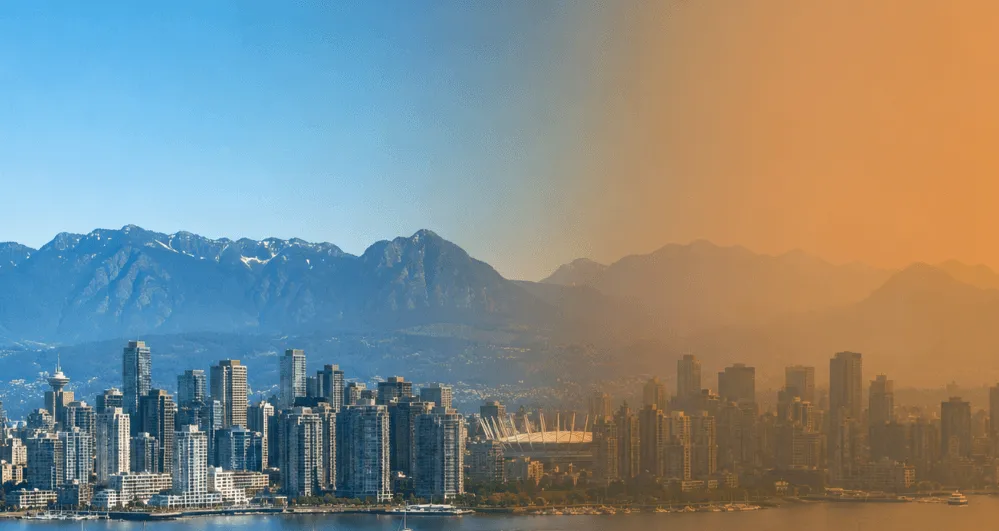
Check Today's Live Real Time Air Quality Index AQI Map in Vancouver, BC Now
By Michelle Wan | Reviewed by David Clark, Licensed HVAC Technician | Published: July 6, 2026 | Updated: July 6, 2026
Vancouver usually enjoys some of the cleanest air in Canada. That can change within hours when wildfire smoke drifts across the Lower Mainland or a summer inversion traps pollution close to the ground. Knowing what you are breathing right now starts with a live look at the city’s air quality.
Air is invisible, which is exactly why a real time reading matters so much. At Filterbuy, we manufacture air filters and spend our days thinking about the fine particles most people never see. That manufacturing vantage changes how we read an air quality map. Most guides stop at the outdoor number, yet the air you breathe through a smoky week is mostly indoor air, and indoor air is the part you can actually control. Our goal here is to help you check today’s conditions and then breathe easier inside your own home.
Quick Answers On Vancouver Air Quality Right Now
Is The Air Quality Bad In Vancouver Today?
Vancouver’s air quality changes throughout the day, so check a live source before heading out. The Metro Vancouver AirMap and Environment and Climate Change Canada both post the current Air Quality Health Index for the region in real time. During wildfire season the reading can climb from low to high risk in a single afternoon, so treat any map you saw this morning as out of date by evening.
Because these readings update constantly, this page does not publish a fixed number. The live map above always reflects the latest measurement for stations across the region.
Top Takeaways
Vancouver reports air quality using the Air Quality Health Index (AQHI), a 1 to 10+ scale from Environment and Climate Change Canada and Health Canada, not the United States 0 to 500 AQI that many apps display.
The Metro Vancouver AirMap shows real time AQHI readings and a two day forecast for monitoring stations across the Lower Mainland.
Fine particulate matter, known as PM2.5, is the pollutant that matters most during wildfire smoke, and it is small enough to reach deep into the lungs and bloodstream.
Research links wildfire smoke PM2.5 to far greater respiratory harm than the same amount of PM2.5 from everyday sources.
A furnace filter rated MERV 13, paired with recirculated indoor air and a portable HEPA cleaner, is the most practical way to lower indoor particle levels on a smoky day.
Vancouver’s main air quality risk is wildfire smoke from late June through September, and the air is usually clean the rest of the year.
How To Read Vancouver’s Live Air Quality Map
A live air quality map for Vancouver plots monitoring stations across the region and colours each one by its current Air Quality Health Index. Blue and green tones mean low risk, yellow means moderate, and orange to red means high or very high risk. Tap a station near your neighbourhood to see its latest reading, since air quality in Richmond can differ from air quality in North Vancouver on the same day.
Local differences happen because wind, geography, and distance from the fires all shape where smoke settles. Metro Vancouver and Environment and Climate Change Canada operate the monitoring network that feeds these maps, so the station closest to you gives the most useful picture of your own air.
AQHI Versus AQI, And Why Vancouver Uses A Different Scale
Canada measures air quality with the Air Quality Health Index, while the United States uses the Air Quality Index. The AQHI runs from 1 to 10+ and describes health risk. The US AQI runs from 0 to 500 and describes pollutant concentration against national standards. Many phone apps show Vancouver an American style AQI number, so the reading you see depends on which system your app follows.
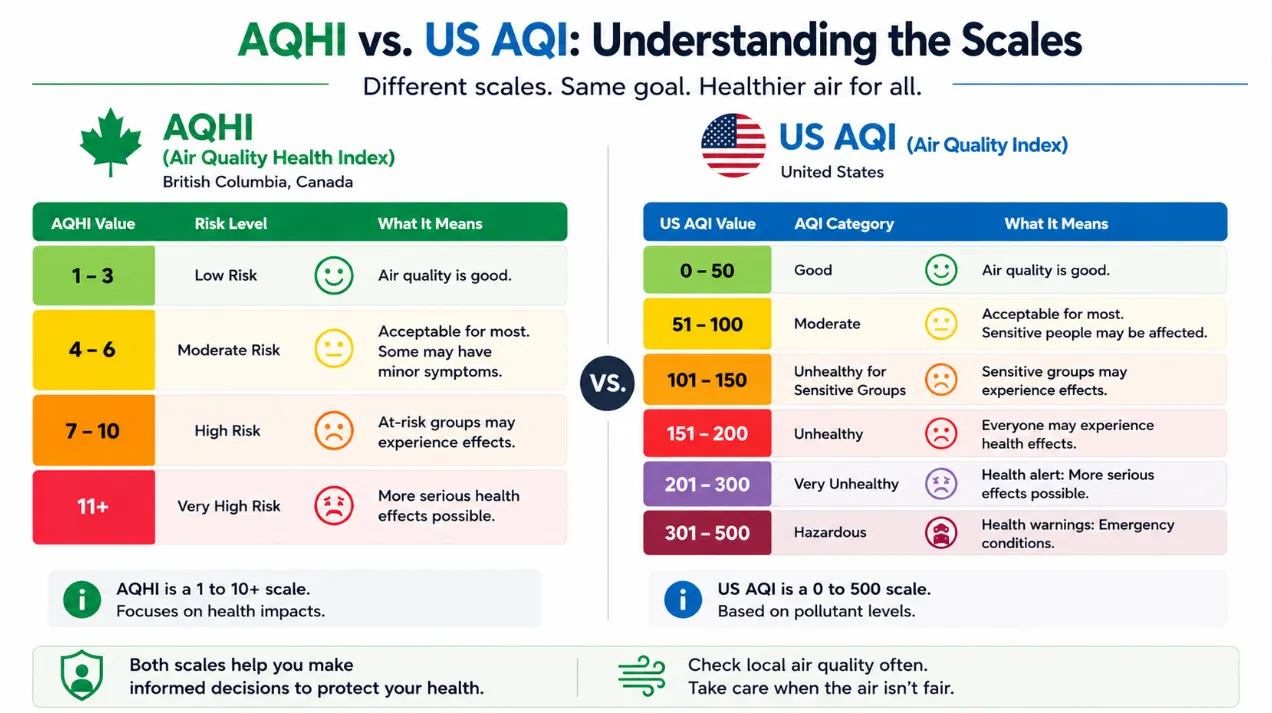
Source: Environment and Climate Change Canada and Health Canada define the AQHI. Check live values on the Metro Vancouver AirMap.
A note from author Michelle Wan: The single thing I explain most about air quality in Canada is why a weather app and a government site rarely show the same number. One is reporting the US-style AQI and the other is reporting Canada’s AQHI. Once you know which is which, you can stop second-guessing the reading and act on it.
What Each Air Quality Level Means And What To Do In Vancouver
The Air Quality Health Index sorts conditions into four risk bands. Levels 1 to 3 are low risk, 4 to 6 are moderate, 7 to 10 are high, and anything above 10 is very high. At-risk people, including children, seniors, pregnant people, and anyone with a heart or lung condition, should take action one band earlier than the general population.
Source: Health guidance follows the Environment Canada AQHI messages for the general population. At-risk groups should act at lower levels. During wildfire smoke the AQHI can rise quickly.
If you feel symptoms such as a scratchy throat, coughing, or shortness of breath, act sooner than the table suggests. Symptoms are a better guide for your own body than any single number.
Wildfire Smoke And PM2.5 In Vancouver
Wildfire smoke is the main reason Vancouver’s air quality spikes, usually between June and September. Smoke carries fine particulate matter called PM2.5, particles no wider than about a thirtieth of a human hair. These particles travel deep into the lungs and can pass into the bloodstream, which is why a smoky day raises health risks even for healthy adults.
Smoke reaching Vancouver often comes from fires in the BC interior, other provinces, or the western United States, then pools in the Lower Fraser Valley airshed. Research on Southern California wildfires found that smoke PM2.5 was tied to much larger increases in respiratory hospital visits than the same amount of everyday PM2.5. The exact figures appear in the statistics below.
When Is Vancouver’s Air Quality Usually Bad?
Vancouver’s air is clean for most of the year. The main risk window is wildfire smoke season, which usually runs from late June through September, when smoke can drift into the Lower Mainland and push the reading up quickly. Spring brings pollen, and cold, calm winter days can trap wood smoke and traffic pollution near the ground. Outside those windows, readings are typically low.
Spring, March to May: air is usually good, though tree and grass pollen can bother allergy sufferers even when the AQHI stays low.
Summer, late June to September: this is the highest risk window, when wildfire smoke can push the AQHI from low to high within a day, sometimes during a heat wave.
Fall, October to November: smoke risk fades as the rains return, and air quality is usually good.
Winter, December to February: air is generally clean, but a cold, still day with a temperature inversion can trap wood smoke and traffic pollution in the Fraser Valley for a day or two.
How To Protect Your Indoor Air On A Smoky Day
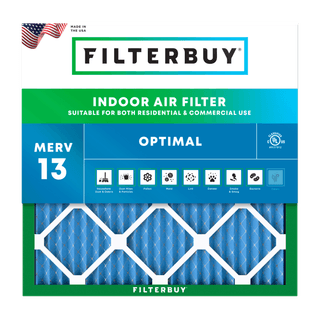
The most effective response to outdoor smoke is to clean and recirculate the air inside. Close windows and doors, switch your HVAC system to recirculate rather than pull in outside air, and run it with a high efficiency filter rated MERV 13. Add a portable air cleaner with a HEPA filter in the rooms where your family spends the most time.
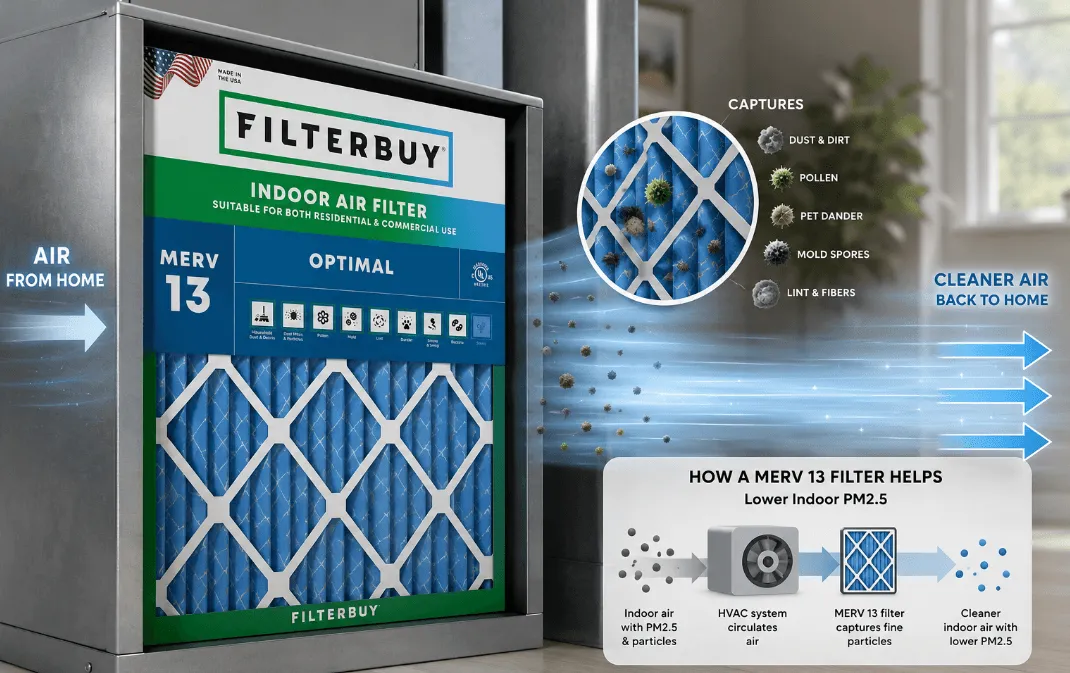
Filterbuy builds filters specifically for wildfire smoke, so the routine we recommend does not change much from year to year. Set up one cleaner-air room where everyone can gather, run your system continuously rather than in short bursts, and change filters more often during smoke season because they load up faster. Skip anything that adds indoor particles, such as candles or frying, until the air clears. Fitting your system with MERV 13 air filters before the smoke arrives makes all of this easier, and an air filter subscription keeps fresh filters arriving through the season.
Filterbuy insight: During wildfire smoke events, our customer support and HVAC education teams consistently receive more questions about filter replacement intervals than at other times of the year. One practical pattern we emphasize is that smoke can load a MERV 13 filter much faster than normal household dust, so homeowners should inspect their filter monthly during active smoke events and replace it if it appears visibly dark or airflow is reduced, rather than relying solely on a standard replacement schedule. This aligns with EPA guidance to use MERV 13 where the HVAC system can accommodate it and to monitor filters more closely during smoke events.
If a store-bought air cleaner is out of reach, a box fan with a MERV 13 filter taped to the intake is a low-cost way to clean the air in one room. Public health groups, including the U.S. EPA and the BC Lung Foundation, have found that these do-it-yourself cleaners work well. Use a newer fan and do not leave it running unattended for long stretches.
What To Do When Smoke And Heat Arrive Together
Wildfire smoke and extreme heat often overlap in a Vancouver summer, and they pull you in opposite directions. Smoke says keep the windows closed, while heat says open them to cool down. When the heat is dangerous, treat staying cool as the first priority, then clean the air you keep inside. Run air conditioning or fans on recirculate, keep a MERV 13 filter in your system, and set up one cool, cleaner-air room with a portable HEPA cleaner.
Health Canada gives the same order of priority for combined heat and smoke events. Check on neighbours, older family members, and anyone with a heart or lung condition, since the two hazards together are harder on the body than either one alone. If your home cannot stay both cool and clean, a public library, community centre, or shopping mall can work as a cooler, cleaner space for a few hours.
After manufacturing filters for over a decade and serving more than two million households, we have seen how quickly indoor air follows outdoor air during wildfire season. The homes that stay comfortable are the ones that seal up, recirculate, and run a high efficiency filter before the smoke arrives, not after.
— David Heacock, Founder and CEO, Filterbuy
7 Essential Resources For Vancouver Air Quality
Source: Metro Vancouver AirMap Real Time Air Quality
Source: Environment and Climate Change Canada AQHI for British Columbia
Source: BC Air Quality Health Index Interactive Data
Source: Health Canada Guide to Wildfire Smoke and Your Health
Source: FireSmoke Canada BlueSky Smoke Forecast
Source: BC Lung Foundation Wildfire Smoke and Lung Health
Source: World Health Organization Ambient Air Quality and Health
3 Supporting Statistics On Air Quality And Health
Wildfire smoke PM2.5 is up to about 10 times more harmful to respiratory health than PM2.5 from other sources. Source: Aguilera et al. 2021, U.S. National Library of Medicine
People spend about 90 percent of their time indoors, where some pollutants run 2 to 5 times higher than outdoors. Source: U.S. EPA Indoor Air Quality
About 152.3 million people (roughly 44 percent of the U.S.) live in counties with failing grades for ozone or particle pollution, with wildfires among the drivers. Source: American Lung Association 2026 State of the Air
Final Thoughts And Opinion
Our view at Filterbuy is that Vancouver residents should treat a live air quality check like a weather check during fire season. The city’s clean reputation is real, but a single smoky week can undo months of good air. Watching the AQHI and preparing your home before the smoke arrives beats reacting once your eyes and throat already sting. Clean indoor air is one of the few parts of air quality you fully control.
Next Steps
Bookmark the Metro Vancouver AirMap and check it each morning during wildfire season.
Fit your HVAC system with a Filterbuy MERV 13 filter now, before smoke season peaks.
Set up a cleaner-air room with a portable HEPA cleaner for the worst days.
If you live elsewhere in the province, watch for our other Canadian city air quality guides.
Frequently Asked Questions
Breathe Easier Indoors With Filterbuy
You cannot control the wildfire smoke outside, but you can control the air your family breathes at home. Filterbuy manufactures high efficiency filters sized for your system and built to capture the fine particles that smoke leaves behind. Shop Filterbuy furnace filters and get your home ready before the next smoky day.
Glossary Of Air Quality Terms
Air Quality Health Index (AQHI): Canada’s official 1 to 10+ scale that reports the health risk from a mix of air pollutants, created by Environment and Climate Change Canada and Health Canada.
Air Quality Index (AQI): The United States 0 to 500 scale that reports air pollution based on concentration against national standards. Many apps show this number for Vancouver.
PM2.5: Fine particulate matter 2.5 microns or smaller. It is the main health concern in wildfire smoke because it reaches deep into the lungs.
MERV: The Minimum Efficiency Reporting Value, a scale that rates how well a furnace or HVAC filter captures particles. Higher numbers capture more fine particles, and MERV 13 is the level commonly recommended for wildfire smoke. Learn more about choosing a MERV rating.
HEPA: A High Efficiency Particulate Air filter used in portable air cleaners to trap very fine particles.
Air Filter: An air filter is a device that removes particles from the air moving through an HVAC system.
Lower Fraser Valley Airshed: The region around Metro Vancouver and the Fraser Valley where air circulates together, which is why smoke and pollution can settle across the whole area at once.