
Freeze Warning: What It Means and How to Protect Your Home
October 8, 2026
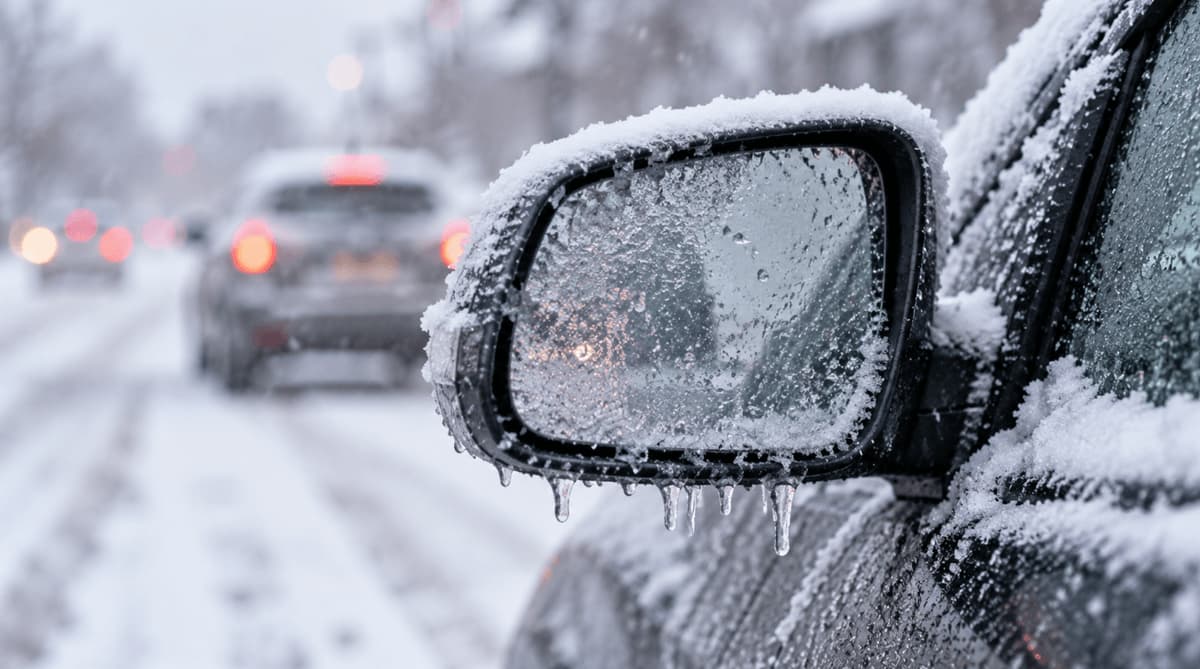
A freeze warning means the National Weather Service expects your area to reach 32°F or colder, usually within the next day. Tender plants, pets, hoses and outdoor spigots are the first things at risk. Here's how it compares to the other cold alerts.
Frost advisory: lows of about 33 to 36°F
Freeze watch: a freeze is possible, often 24 to 48 hours out
Freeze warning: 32°F or lower is expected
Hard freeze: about 28°F or lower, now often folded into the freeze warning
Your furnace or heat pump runs longer on a freeze night, and all of that air passes through your filter first. A clogged filter cuts airflow, which can make a furnace overheat and shut itself off. Check yours before dark and swap it if it looks gray or dirty. Not sure which filter fits? Take the quick quiz below.
Standard and custom sizes, with fast and free 2-day delivery to most US states. Keep a spare on hand for the next cold snap.
Answer a few quick questions and we'll match you to the right filter before the next freeze.
TL;DR
A freeze warning is a National Weather Service (NWS) alert that temperatures are expected to drop to 32°F or lower, usually within the next 24 hours. That is cold enough to kill tender plants and burst exposed pipes, and your heating system will work harder than on any other night. Before sunset, cover or bring in your plants, disconnect hoses, drip faucets on exposed pipes, keep the thermostat at 55°F or higher, and check that your furnace or heat pump has a clean air filter.
Key Takeaways
A freeze warning means the NWS expects temperatures of 32°F or below, typically within 24 hours, during the local growing season.
A freeze watch is the earlier heads-up, often issued 24–48 hours out. A frost advisory covers lows of roughly 33–36°F.
Since fall 2024, many NWS offices have folded "hard freeze" conditions (about 28°F or lower) into the Freeze Warning rather than issuing a separate Hard Freeze Warning.
Pipes most often freeze below 20°F, but outdoor spigots, sprinkler lines and pipes on exterior walls can freeze at warmer temperatures.
Your HVAC system runs longest on freeze nights, which is exactly when a clogged air filter does the most harm.
What Does a Freeze Warning Mean?
A freeze warning means the National Weather Service expects temperatures in your area to fall to 32°F or lower, usually within the next 24 hours. Forecasters issue it mainly during the local growing season, when a freeze does the most damage to crops, gardens and landscaping.
The exact criteria depend on your local NWS office. NWS Charleston, WV issues a freeze warning for expected lows of 29–32°F, while NWS Tallahassee waits until it expects 32°F or lower for at least two hours.
Most freeze guides skip one fact the Filterbuy team always stresses. Once your growing season ends, many NWS offices stop issuing frost and freeze alerts until spring. A 25°F night in December may arrive with no warning at all, so keep protecting your pipes even when your weather app stays quiet.
Freeze Warning vs. Frost Advisory vs. Freeze Watch
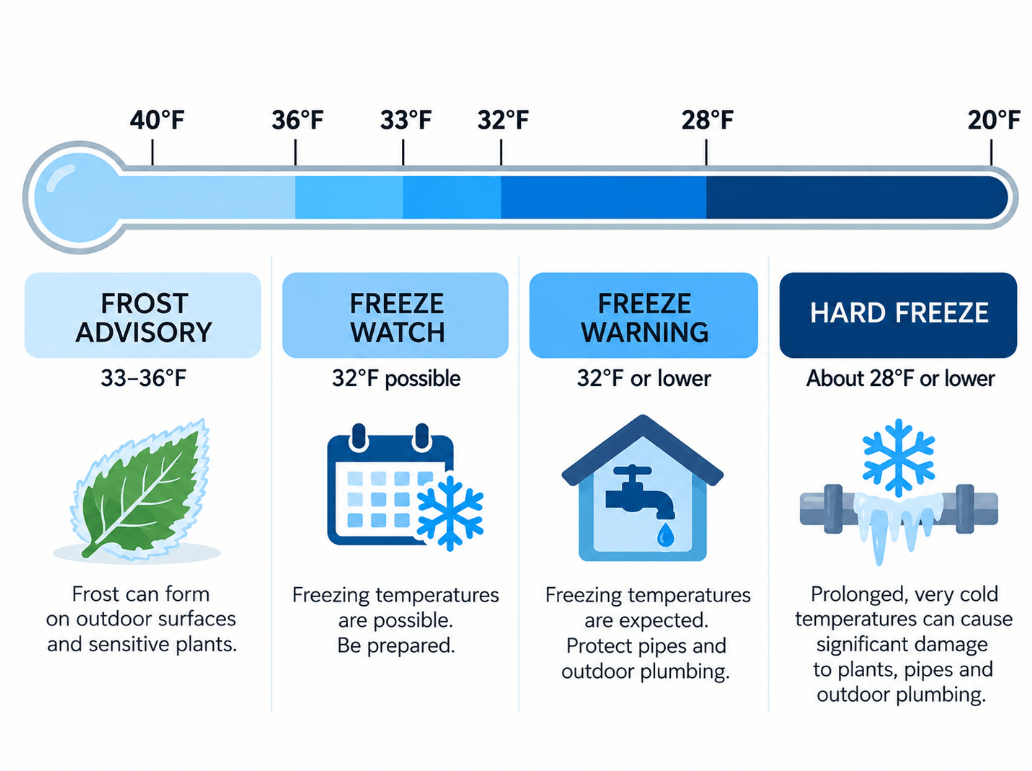
The three cold-season plant alerts rise in urgency. A frost advisory covers lows just above freezing, a freeze watch flags a possible freeze a day or two out, and a freeze warning means the freeze is on its way.
Sources: NWS Aberdeen; NWS Raleigh; NWS Charleston.
What Is a Hard Freeze Warning?
A hard freeze warning is an NWS alert for temperatures of about 28°F or lower that last for several hours. Some offices, including NWS Tallahassee, draw the hard freeze line at 25°F instead.
Since fall 2024, the NWS Hazard Simplification effort has folded hard freeze conditions into the Freeze Watch or Freeze Warning in many areas (NWS Charleston). Read the full alert text and look for the words "hard freeze" or lows in the mid-20s.
What Temperature Is a Freeze Warning?
A freeze warning goes out when lows of 32°F or lower are expected. How long the cold lasts matters as much as how low it goes. A few hours at 30°F mostly threatens plants, while a long night in the low 20s puts plumbing at risk. Consumer Reports notes that household pipes usually freeze below 20°F.
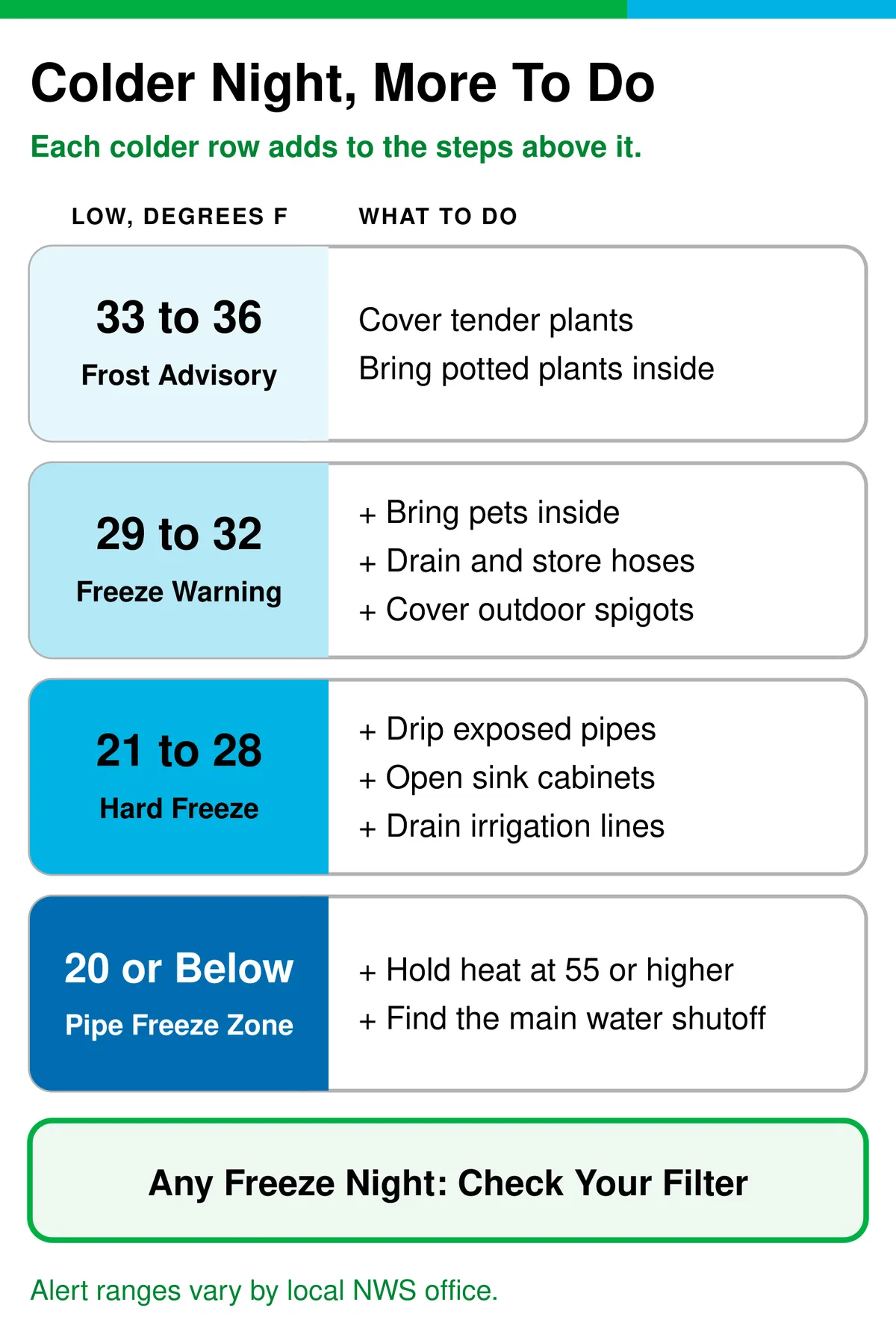
Filterbuy freeze-night action guide. Find tonight's forecast low, then do everything in that row and in every row above it.
Sources: NWS thresholds, Red Cross guidance and Consumer Reports. Wind and exposure raise risk at warmer temperatures.
How to Protect Your Pipes During a Freeze Warning
Protecting your pipes costs far less than repairing a burst one. The American Red Cross recommends these steps, ideally before sunset:
Disconnect garden hoses and drain outdoor hose bibs. Shut off the indoor valve to outdoor spigots if you have one.
Open kitchen and bathroom cabinet doors on exterior walls so warm room air reaches the plumbing.
Let cold water drip from faucets served by exposed pipes. A trickle of moving water is harder to freeze.
Keep the thermostat steady day and night.
Never set heat below 55°F, even if you're traveling.
Insulate exposed pipes in garages, crawl spaces and attics with foam sleeves or heat tape.
If only a trickle comes out of a faucet the next morning, a pipe has probably frozen. Leave the faucet open and warm the pipe with a hair dryer or heating pad, never an open flame. If you can't find or reach the frozen section, call a licensed plumber. (Red Cross guidance via NBC Montana)
How to Protect Plants During a Freeze Warning
Plants ride out a freeze best when you trap the ground's stored heat around them. Bring pots indoors, then cover in-ground plants with frost cloth, old sheets or buckets that reach the soil. Pull the covers off the next morning once temperatures climb above freezing.
Keep plastic from touching leaves, since it conducts cold straight to the plant.
Source: University of Georgia - Extending the Crop Season: Unheated Spaces, University of Georgia - Extending the Crop Season: Unheated Spaces
What a Freeze Warning Means for Your Furnace, Heat Pump and Air Filter
On a freeze night, your furnace or heat pump runs longer cycles to hold temperature, and every bit of that air passes through your filter first. Filterbuy has shipped air filters to homes in all 50 states since 2013, and every winter the pattern repeats: urgent filter orders spike during cold snaps, often from homeowners whose furnace has already shut down. A clogged filter starves the system of airflow, which can make a furnace overheat and switch itself off. So a fresh filter sits at the top of Filterbuy's list of ways to prepare your HVAC system for freezing winter weather.
During cold snaps, check the filter every 30 days and replace it once it looks gray. Filterbuy's guide to how often to change your furnace filter in winter has the full schedule.
Heat pump owners have two extra rules. See Filterbuy's pre-winter heat pump checklist.
Expect defrost cycles. Your heat pump will periodically run in reverse to melt frost off its outdoor coil, and a little steam from the outdoor unit is normal. It is also one of the most common "is my heat pump broken?" questions Filterbuy hears.
Don't cover a running heat pump or pour hot water on an iced-over unit. Keep snow and leaves off the coil instead.
Heating safety: If you add a space heater, keep it at least three feet from anything that can burn, and never leave it running unattended. Don't try to heat your home with an oven, stove or grill.
"The systems that quit on the coldest night of the year are rarely the oldest ones. In our experience, they're the ones that went into winter with a dirty filter," says the Filterbuy Team.
What to Do Tonight: Your Freeze Warning Checklist
Run through this list before sunset whenever a freeze warning goes out. It is the list the Filterbuy team would hand a neighbor.
Bring pets indoors and give outdoor animals a warm, dry, wind-protected shelter.
Move potted plants inside; cover garden beds with frost cloth or sheets.
Disconnect, drain and store garden hoses; cover outdoor spigots.
Open sink cabinets on exterior walls and drip faucets served by exposed pipes.
Set the thermostat to a steady temperature, never below 55°F.
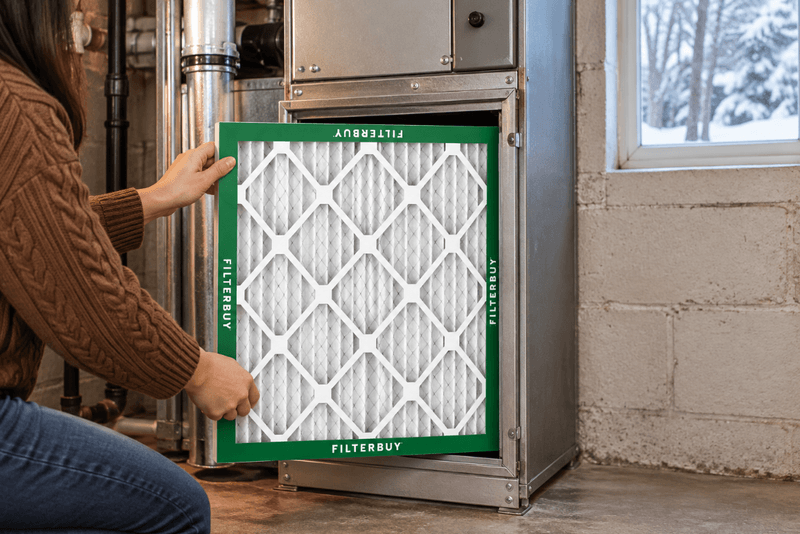
Check your HVAC air filter and replace it if it's dirty. Not sure of the size? Filterbuy explains how to measure your air filter.
Clear the area around your heat pump or outdoor unit.
Test smoke and carbon monoxide alarms before running space heaters.
Supporting Statistics
Frozen and burst pipes are expensive. About one in 60 insured homes files a water damage or freezing claim each year, and the average claim from 2019 to 2023 was $15,400. Source: Insurance Information Institute
Heating and cooling use nearly half of a home's energy. ENERGY STAR, the EPA and Department of Energy program, says to check your filter monthly in winter and change it at least every three months, since a dirty filter slows airflow and can lead to early system failure. Source: ENERGY STAR
Space heaters drive most heating fire deaths. U.S. fire departments responded to an average of 44,210 home heating fires a year from 2016 to 2020, which killed 480 people. Space heaters were involved in about a third of those fires but most of the deaths. Source: National Fire Protection Association
Freeze Warning FAQ
How Do I Check for a Freeze Warning Tonight?
Enter your city or ZIP code at weather.gov, the National Weather Service's site, to see active alerts for your area. Many phone weather apps also display NWS alerts, and NOAA Weather Radio broadcasts them 24 hours a day.
Will a Freeze Warning Kill My Plants?
Tender plants such as tomatoes, peppers, basil and annuals can die at 32°F if left uncovered, but covering them or bringing pots indoors usually saves them.
Can I Turn My Heat Down at Night During a Freeze Warning?
It is better not to. Keep the thermostat steady and never below 55°F, because steady heat protects the pipes inside your walls.
Should I Change My Air Filter Before a Freeze?
Yes, if it's dirty or overdue. Filterbuy recommends checking it every 30 days during cold snaps. Your heating runs longest on freeze nights, and a clean filter keeps air moving so your system heats efficiently.
Glossary
National Weather Service (NWS): The U.S. federal agency, part of NOAA, that issues official weather forecasts, watches and warnings.
Freeze warning: An NWS alert that temperatures of 32°F or lower are expected soon, usually within 24 hours.
Freeze watch: An NWS alert that freezing temperatures are possible, typically 24–48 hours ahead.
Frost advisory: An NWS alert for expected lows of about 33–36°F with conditions favorable for widespread frost.
Hard freeze: Temperatures of roughly 28°F or lower for several hours, cold enough to kill most vegetation.
Growing season: The locally defined period between the last spring freeze and first fall freeze, when frost and freeze alerts are issued.
Defrost cycle: A normal heat pump function that briefly reverses operation to melt frost from the outdoor coil.
About the author: Michelle Wan is Filterbuy's Brand Manager and Air Quality Writer. Reviewed by David Clark, a Licensed HVAC Technician with Filterbuy HVAC Solutions. Filterbuy is a family-owned American manufacturer that has made air filters in the USA since 2013.