
Extreme Cold Watch: What It Means and How to Protect Your Home
October 5, 2026

TL;DR
An extreme cold watch is a National Weather Service alert. It means life-threatening cold, from low temperatures, wind chill, or both, could reach your area, usually within 12 to 48 hours. Treat a watch as the cue to prepare; a warning means the cold has arrived. Use the time to check your furnace filter, test your CO detectors, clear outdoor vents, and protect your pipes.
Key Takeaways
A watch means dangerous cold is possible, not certain. Some National Weather Service (NWS) offices describe this as roughly a 50 to 80 percent chance of reaching warning levels.
The extreme cold watch replaced the wind chill watch in October 2024.
Wind chill can't make your pipes colder than the air. It only cools them faster, so protect pipes based on the actual temperature.
A clogged furnace filter is a common, preventable cause of no-heat shutdowns. During a long cold snap the furnace runs nearly nonstop, and restricted airflow makes it overheat.
Why we wrote this guide: Filterbuy is a family-owned American manufacturer, and we make every air filter to order in our own U.S. plants. Most coverage stops at "dress in layers," so we cover what we know best: keeping your heating system breathing on its hardest nights.
What Is an Extreme Cold Watch?
An extreme cold watch is an alert from the National Weather Service, the U.S. government's official forecasting agency. Local NWS offices issue one when life-threatening temperatures or wind chills are possible but not yet certain, typically 12 to 48 hours ahead and sometimes up to 72.
On October 1, 2024, the NWS renamed its cold-weather products as part of its Hazard Simplification initiative:
Wind Chill Watch became the Extreme Cold Watch
Wind Chill Warning became the Extreme Cold Warning
Wind Chill Advisory became the Cold Weather Advisory
Extreme Cold Watch vs. Extreme Cold Warning: What's the Difference?
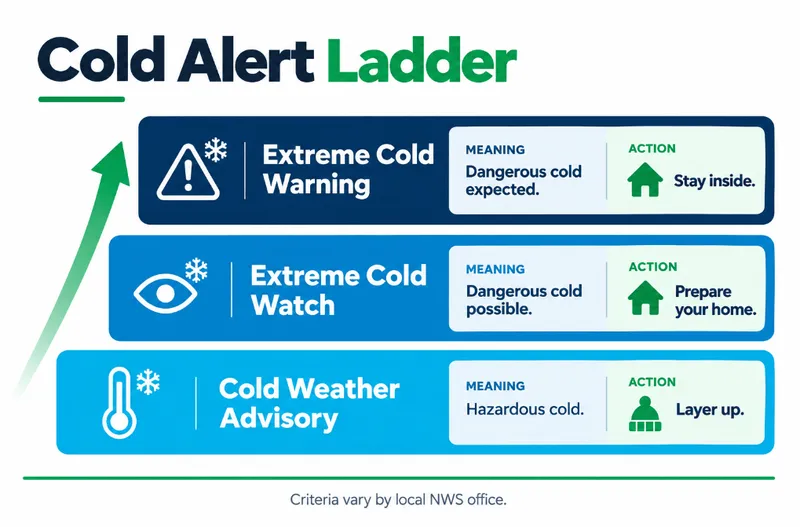
The difference between an extreme cold watch and a warning is certainty. A watch means dangerous cold is possible, so it's time to prepare. A warning means dangerous cold is expected or already here, so it's time to act to prevent frostbite and hypothermia.
Source: National Weather Service. Timing and criteria vary by local NWS forecast office.
What Temperature Triggers an Extreme Cold Watch?
No single temperature triggers an extreme cold watch. Each NWS forecast office sets its own extreme cold watch criteria according to what is dangerous for the people it serves, so a watch in Florida and a watch in Minnesota mean very different thermometer readings.
Source: National Weather Service forecast offices (Twin Cities, Omaha, Binghamton, Jackson). Check your local NWS office for exact criteria.
In January 2026, the NWS issued a rare extreme cold watch for Central Florida, with wind chills forecast as low as 7°F.
Wind chill matters for your body. According to the National Weather Service, a 0°F day with a 15 mph wind feels like -19°F, and at that level exposed skin can freeze in 30 minutes.
Your house plays by different rules. Wind chill applies only to people and animals, and the NWS notes that wind can't push pipes, cars, or outdoor HVAC equipment below the actual air temperature. It just cools them to that temperature faster. Protect pipes and heat pumps based on the thermometer, not the "feels like" number.
Extreme Cold Watch Safety Tips: A 48-Hour Home Checklist
Most alert pages stop at warm clothes. This checklist adds the home steps that keep your heat running when the coldest night arrives.
Check your furnace air filter. In a deep freeze, a clogged filter can make the furnace overheat until its high-limit switch shuts the burners off, often overnight. Try the Filterbuy white-paper test: hold the filter against a white sheet of paper. If the media looks gray by comparison, or you can't remember the last change, replace it now. See how often to change your furnace filter in winter.
Keep a spare filter on hand before the season starts. A watch usually gives you 12 to 48 hours of notice. Filterbuy makes each filter after it's ordered, so it ships within 24 hours and typically arrives in about two days. That's longer than most watch windows, so order early. Double-check the depth, too; it's the dimension the Filterbuy manufacturing team sees ordered wrong most often.
Test your carbon monoxide (CO) and smoke detectors. Fuel-burning appliances produce CO, and CDC data show that accidental CO deaths peak in December and January, when homes are sealed tightest.
Clear your outdoor furnace vents. High-efficiency furnaces often vent through white PVC pipes on an exterior wall. If snow or ice blocks the intake or exhaust, the furnace can shut down, and the EPA advises clearing furnace vents to prevent carbon monoxide buildup.
Protect your pipes. Open sink cabinets on exterior walls and let faucets drip during the coldest hours. Disconnect garden hoses, and find your main water shut-off now.
Hold a steady thermostat setting. Turning the heat way down overnight forces a long, hard recovery right when temperatures bottom out.
Stock an emergency kit. Gather flashlights, batteries, blankets, water, food, medications, and pet supplies.
Check on people and pets. Older adults and infants are most vulnerable, as is anyone with heart or lung disease. Bring pets inside.
Why Does Extreme Cold Strain Your Furnace?
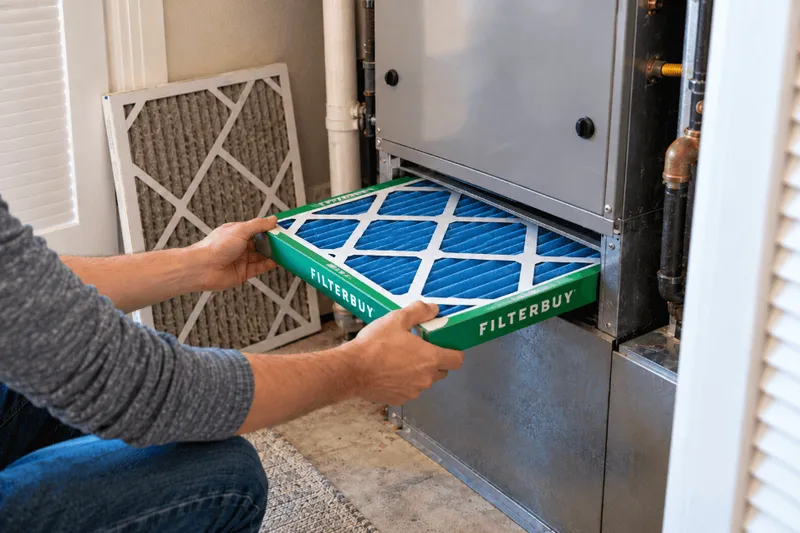
In extreme cold, a furnace barely rests, pulling far more air through the filter than usual. As the filter loads up and airflow drops, heat builds inside the furnace until it shuts itself down to prevent damage, leaving you without heat when you need it most.
"In our years of manufacturing filters and testing them under real-world conditions, we've found that winter is the season most homeowners underestimate. A filter that looks fine in October can be completely choked by December, and that's when we see the most avoidable furnace failures."
The Filterbuy manufacturing team
Heat pumps hit a similar wall. As temperatures fall, they lean on backup electric heat strips, so a clean filter and a snow-free outdoor unit matter even more. See Filterbuy's guide to protecting your furnace during a cold snap.
What If Your Furnace Shuts Off During Extreme Cold?
If the heat quits mid-freeze, try these safe checks before you call for service.
Thermostat: make sure it's set to heat and above room temperature. If the display is blank, swap in fresh batteries.
Air filter: a clogged filter can trip the high-limit switch. Replace it, give the furnace time to cool, and let it restart.
Outdoor vents: clear any snow or ice from the intake and exhaust pipes.
Power: check the furnace's on/off switch, which often looks like a light switch near the unit, then check your breaker panel.
If it still won't run, call a technician rather than pressing the reset button repeatedly, which can mask a real problem. And if you smell gas or your CO alarm sounds, get everyone outside first, then call 911 or your gas utility.
How Does Extreme Cold Affect Indoor Air Quality?
The same sealed-up house that keeps you warm also traps pollutants. With windows shut for days, dust and pet dander have nowhere to go, and the furnace keeps sending them through every room. That makes the HVAC air filter the main barrier between those particles and your family's lungs.
Winter air is dry, too, which can irritate your sinuses and skin. The U.S. Environmental Protection Agency (EPA) recommends keeping indoor humidity between 30 and 50 percent, but during extreme cold you'll want to stay toward the low end. If moisture starts collecting on your windows, your humidifier is set too high, according to EPA guidance. Learn more about why your home's air gets worse when it's cold, or check your local air quality on the Filterbuy live AQI map.
What Should You Do When the Watch Becomes a Warning?
Once a watch is upgraded to a warning, your focus shifts from preparing to protecting.
Limit time outdoors. Cover exposed skin and wear dry layers.
Know the warning signs. Frostbite causes numbness and white or grayish skin on fingers, toes, ears, and the nose. Hypothermia, a body temperature below 95°F, causes shivering, confusion, slurred speech, and drowsiness. Call 911 if you suspect hypothermia.
Heat safely. Keep space heaters 3 feet from anything that can burn, and never run a generator, grill, or camp stove indoors or in a garage.
Have a backup plan. If your heat fails, gather in one interior room and dial 211 to find a local warming center.
Supporting Statistics
More than 19,000 Americans died from cold-related causes from 1979 to 2016, and people without adequate home heating are among those at highest risk. Source: U.S. EPA
Space heating is 42% of U.S. home energy use, averaging $519 per household in 2020. Source: U.S. Energy Information Administration
Portable heaters cause 3% of home heating fires but 41% of fatal ones. Source: U.S. Fire Administration
Frequently Asked Questions
What Does an Extreme Cold Watch Mean?
It means the National Weather Service sees a real chance of life-threatening cold or wind chills in your area, usually within 12 to 48 hours. Use that time to prepare your home and family.
Is an Extreme Cold Watch the Same as a Wind Chill Watch?
Yes. In October 2024, the NWS renamed the wind chill watch the extreme cold watch to make clear that dangerous cold can happen with or without wind.
What Temperature Is an Extreme Cold Watch?
It depends on where you live. Local NWS offices set the criteria, from wind chills near 10°F in parts of the Deep South to -35°F or colder in the Upper Midwest.
How Do I Know If There's an Extreme Cold Watch Today?
Enter your ZIP code at weather.gov, or tune in to NOAA Weather Radio, which broadcasts NWS watches and warnings around the clock.
Should I Change My Furnace Filter Before an Extreme Cold Watch?
Yes. Filterbuy recommends checking your filter every 30 days in winter and replacing it if it looks gray against white paper or is more than a couple of months old.
Get Your Home Ready Before the Next Cold Snap
Filterbuy makes air filters in the USA in more than 600 sizes and ships them free. Find your exact filter size, learn how often to change your air filter, and set up Filterbuy auto-delivery so a fresh filter shows up before every season.
Glossary
National Weather Service (NWS): The U.S. government agency, part of NOAA, that issues official forecasts and weather alerts.
Wind chill: How cold it feels on exposed skin, based on how fast wind and cold pull heat from the body.
Carbon monoxide (CO): A colorless, odorless, poisonous gas produced when fuel burns.
High-limit switch: A furnace safety device that shuts off the burners when the furnace gets too hot, often because of restricted airflow.