
Did the NWS Get Rid of Wind Chill Warnings? What Replaced Them
October 8, 2026

Yes. The NWS no longer issues wind chill alerts and now uses Extreme Cold and Cold Weather alerts for the same dangerous conditions. Wind chill is still calculated, and it still shows up inside the new alerts. The NWS made the switch because cold can be dangerous with or without wind.
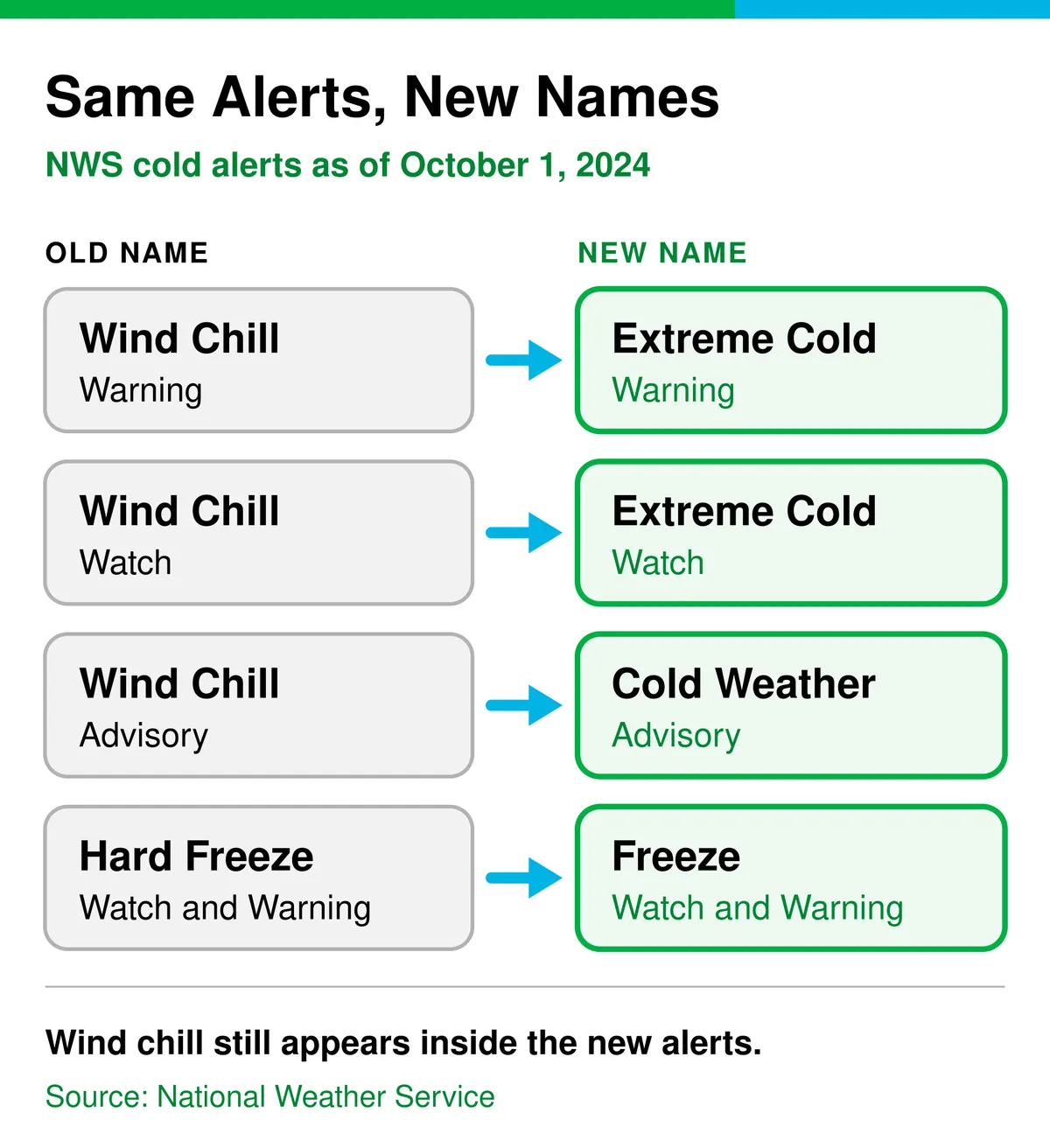
Wind Chill Warning is now Extreme Cold Warning
Wind Chill Watch is now Extreme Cold Watch
Wind Chill Advisory is now Cold Weather Advisory
Hard Freeze Watch and Warning is now Freeze Watch and Warning
A Cold Weather Advisory is a good time to check your air filter. If you can't see light through it, swap it out and keep a spare ready before deeper cold arrives. Not sure which filter you need? Take the quick quiz below to find your match.
Standard and custom sizes, with fast and free 2-day delivery to most US states.
Answer a few quick questions and we'll match you to the right filter for your home.
TL;DR
Yes. On October 1, 2024, the National Weather Service (NWS) retired its wind chill alerts and gave them new names. A Wind Chill Warning is now an Extreme Cold Warning, a Wind Chill Watch is now an Extreme Cold Watch, and a Wind Chill Advisory is now a Cold Weather Advisory. The reason: cold can be dangerous even in still air. Wind chill still shows up in NWS cold alerts.
Key Takeaways
On October 1, 2024, the NWS stopped issuing wind chill watches, warnings, and advisories nationwide.
An Extreme Cold Warning means dangerously cold air is expected, whether or not the wind is blowing.
The Cold Weather Advisory and Extreme Cold Watch took over from the old Wind Chill Advisory and Wind Chill Watch.
Wind chill is still calculated, and it still appears in cold weather alerts.
Thresholds depend on your local NWS office, so a warning in Louisiana kicks in at far warmer readings than one in northern Indiana.
If you haven't seen a wind chill warning in a while, you haven't missed anything. The alert just goes by a different name now. At Filterbuy, we build air filters in Alabama, Pennsylvania, Texas, and Utah, which puts our plants under four NWS offices that each define extreme cold differently. So this guide also covers what each alert means for your home.
What Replaced NWS Wind Chill Warnings?
The Extreme Cold Warning took the place of the Wind Chill Warning on October 1, 2024. The National Weather Service, the federal forecasting agency within NOAA, renamed all three wind chill alerts at the same time and rolled the change out nationwide.
The alerts weren't discontinued so much as renamed and broadened:
Source: National Weather Service, Hazard Simplification cold product changes, effective October 1, 2024.
Why Did the NWS Get Rid of Wind Chill Warnings?
The short answer is that "cold is cold," with or without wind. Under the old system, a calm, bitterly cold morning could pass without any warning at all. The NWS explained that the new names are meant to correct a common belief that extreme cold is only dangerous when it's windy.
Three problems pushed the agency to act:
Calm cold was going unwarned. The old criteria called for about 5 mph of wind, yet the coldest mornings are sometimes windless.
There were too many overlapping alerts. A meteorologist at NWS Jackson told WMKY that the public felt overwhelmed by the number of products.
Cold was getting lost behind snow. The NWS found that cold warnings were being drowned out by snow and ice headlines.
The change came out of the NWS Hazard Simplification initiative.
When Are Extreme Cold Warnings Issued Where I Live?
Each NWS office sets thresholds to fit its climate, as criteria from NWS New Orleans and NWS Northern Indiana show:
Sources: NWS New Orleans; WPTA 21Alive, January 2025. Criteria vary by office, so check your local NWS page.
Does Wind Chill Still Matter?
Yes. The NWS fact sheet makes clear that wind chill will not go away. Wind chill is now one of two triggers for a cold alert rather than the only one, so either very low temperatures or very low wind chills can set off a warning.
How to Read a Cold Alert in 10 Seconds
Every NWS alert includes a "WHAT" line that names the main threat. In the NWS sample alerts, for example, it reads "Dangerously cold wind chills expected." Look at that line first:
If it mentions wind chills, wind is driving the danger. Cover exposed skin and keep time outside short.
If it mentions air temperatures, the cold is calm and still. That's the situation the old system could miss, and it's when the heat in your home matters most.
What to Do When an Extreme Cold Warning Is Issued
An NWS alert tells you how dangerous the cold will be, but not what to do about your house. So the Filterbuy team matched each alert level to the steps we'd take ourselves. For a deeper look, see our guide to protecting your furnace during a cold snap.
Filterbuy's Alert-to-Action Plan
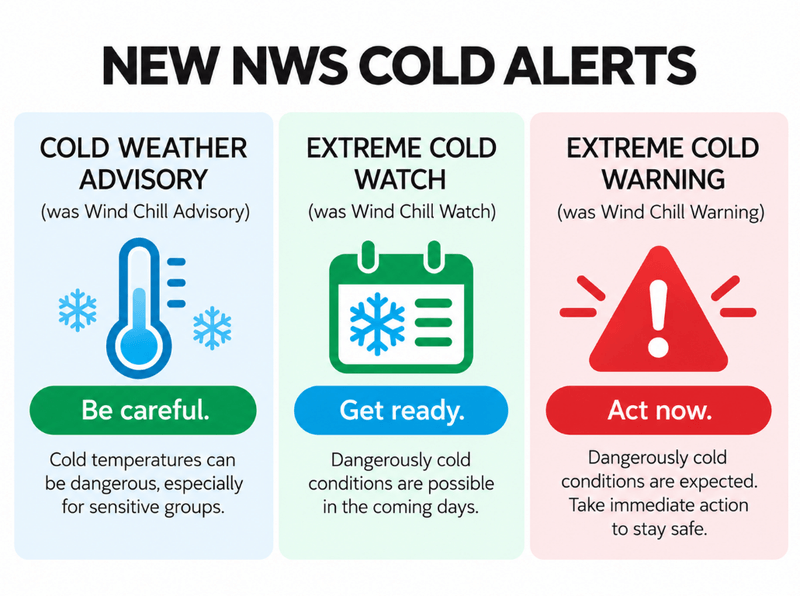
Cold Weather Advisory: be careful, and check your filter. Hold it up to a light, and if you can't see through it, replace it. This is also a good time to order a spare from Filterbuy, while delivery can still arrive before the coldest days.
Extreme Cold Watch: get your home ready. If your filter is due, replace it now, since restricted airflow in many furnaces trips a safety switch that shuts off the burners. Test your carbon monoxide (CO) alarms, too. Then clear snow from your heat pump's outdoor unit and from any high-efficiency furnace vent pipes. Modern cold-climate heat pumps keep heating well below freezing, but only with clear airflow.
Extreme Cold Warning: act now. Hold the thermostat steady, since big setbacks force your system to work harder to catch up. Leave supply vents and return grilles open. Open the sink cabinets on exterior walls and let faucets drip. If you use a space heater, keep it 3 feet from anything flammable, and never run a generator or grill indoors.
Our guide to how often to change your furnace filter in winter breaks it down by filter thickness and household.
“A filter that looks fine in October can be completely choked by December, and that's when we see the most avoidable furnace failures.”
— Filterbuy, from our winter furnace filter guide
"During a cold snap, many of the no-heat calls I see come down to two things: a filter so clogged the furnace overheats and shuts itself off, or snow blocking the intake and exhaust pipes on a high-efficiency furnace. Both take about five minutes to check, and checking them first can save you a long wait for a service visit."
— David Clark, Licensed HVAC Technician
If Your Heat Stops During an Extreme Cold Warning
HVAC companies are busiest during cold snaps, so rule out simple problems first. Work through these checks in order:
Check the thermostat. Make sure it's on Heat, set above room temperature, with good batteries.
Check the filter. A clogged filter can trip the furnace's high-limit safety switch. Swap in your spare (Filterbuy recommends keeping one on hand), then give the system a few minutes to restart.
Check the power. Look for a tripped breaker or a furnace power switch that someone turned off by mistake.
Check outdoor vents and units. Clear snow and ice from the furnace vent pipes and the heat pump's outdoor unit. If a CO alarm goes off, get everyone outside and call 911.
Still no heat? Call a licensed HVAC technician. Tell them what you've checked.
How Extreme Cold Changes Indoor Air
With windows shut against the cold, the air in your home cycles through your HVAC system more than at any other time of year. Dust and pet dander have nowhere to go except through your filter. For most households, the right MERV rating for winter is MERV 11. Homes with allergies or asthma can step up to MERV 13 if the system allows.
Fit matters as much as rating. Filterbuy cuts each filter roughly half an inch under its nominal size, so it slides into the slot easily and still seals. A loose filter lets dusty air slip past the edges.
We make air filters in the USA to order in more than 600 sizes, including custom sizes, and ship them fast and free. If you'd rather not keep track, set up auto-delivery and a fresh filter will arrive on schedule. Not sure what you need? Find your filter by size in a few clicks.
Supporting Statistics: What the Research Shows
Federal and national safety data back up why steady, safe home heat matters during extreme cold.
1. Hypothermia Hits Hardest in Winter, Often at Home
83% of deaths happened October–March, and 23% of victims were at home. Source: CDC.
2. Carbon Monoxide Exposures Peak at Home in Winter
77.6% happened in a residence and 53.5% from November–February, with about 15,000 ER visits and nearly 500 deaths a year. Source: CDC.
3. Space Heaters Are the Deadliest Heating Source
They're involved in about 1 in 3 heating fires but nearly 9 in 10 heating fire deaths. Source: NFPA.
The Filterbuy take: All three risks peak in the same months, and all three hit hardest at home. That's why we see an Extreme Cold Warning as a home maintenance alert as much as a weather headline.
Frequently Asked Questions
When did the NWS get rid of wind chill warnings?
The NWS retired wind chill warnings on October 1, 2024, which made the 2024–25 winter the first season without them.
Are NWS wind chill warnings still issued?
No. The NWS no longer issues them anywhere in the U.S. If you come across one, it's probably from an outdated app or an older article.
What is the difference between an Extreme Cold Watch and an Extreme Cold Warning?
A watch means dangerously cold air, with or without wind, is possible, so it's time to prepare. A warning means that cold is expected or already happening, so it's time to act. Filterbuy's Alert-to-Action Plan above lists the home and HVAC steps for each level.
What temperature triggers an Extreme Cold Warning?
There's no single national number. Each NWS office sets criteria for its area. NWS New Orleans, for example, issues one when temperatures or wind chills fall below 10–15°F, depending on the zone, while NWS Northern Indiana issues one at wind chills of -25°F or below.
How can I get Extreme Cold Warning alerts?
Check your local forecast page on weather.gov, use a weather app that carries NWS alerts, or keep a NOAA Weather Radio at home. NOAA Weather Radio All Hazards broadcasts official NWS warnings, watches, and forecasts 24 hours a day from more than 1,000 transmitters, though it needs a special receiver. A battery-powered model keeps working if a winter storm knocks out power.
Glossary
National Weather Service (NWS): The U.S. federal agency, part of NOAA, that issues official weather forecasts, watches, warnings, and advisories.
NOAA: The National Oceanic and Atmospheric Administration, the federal agency that oversees the NWS.
Wind chill: The "feels like" temperature on exposed skin, calculated from air temperature and wind speed.
Wind Chill Warning: A retired NWS alert for dangerous wind chills, replaced by the Extreme Cold Warning on October 1, 2024.
Extreme Cold Warning: The NWS alert issued when dangerously cold air, with or without wind, is expected or occurring.
Extreme Cold Watch: The NWS alert issued when dangerously cold air, with or without wind, is possible; it replaced the Wind Chill Watch.
Cold Weather Advisory: The NWS alert for very cold conditions less severe than a warning; it replaced the Wind Chill Advisory.
Hypothermia: A dangerous drop in core body temperature below 95°F (35°C), caused by prolonged exposure to cold.
Carbon monoxide (CO): An odorless, colorless gas from incompletely burned fuel that can build up indoors.
Hazard Simplification: The NWS initiative that uses public research to make weather alerts clearer and easier to act on.
HVAC air filter: The filter in a furnace, heat pump, or air handler that traps airborne particles.
About the Author and Reviewer
Written by Michelle Wan. Michelle Wan is Brand Manager and Air Quality Writer at Filterbuy, where she turns MERV ratings, filtration, and HVAC efficiency into plain-English advice. She works directly with Filterbuy's manufacturing teams and holds a B.A. from the University of California, Santa Cruz.
Reviewed by David Clark, Licensed HVAC Technician. David Clark is a Licensed HVAC Technician with Filterbuy HVAC Solutions, the company's residential HVAC repair, installation, and maintenance service.
Sources
National Weather Service revises watch, warning and advisory products for cold (NWS)
Extreme Cold Consolidation Fact Sheet (NWS Hazard Simplification)
Cold Weather Product Changes, New Orleans/Baton Rouge (NWS New Orleans)
NWS scraps wind chill advisory, watch and warning (WPTA 21Alive)
National Weather Service gives wind chill the cold shoulder (Aberdeen Insider)
Hypothermia-Related Deaths, United States, 1999–2002 and 2005 (CDC MMWR)
Carbon Monoxide Exposures, United States, 2000–2009 (CDC MMWR)
Home Heating Fires report (NFPA)