
What Temperature Should You Set Your Thermostat in Winter? Day, Night & Away Settings
October 6, 2026
What Temperature Should You Set Your Thermostat in Winter?
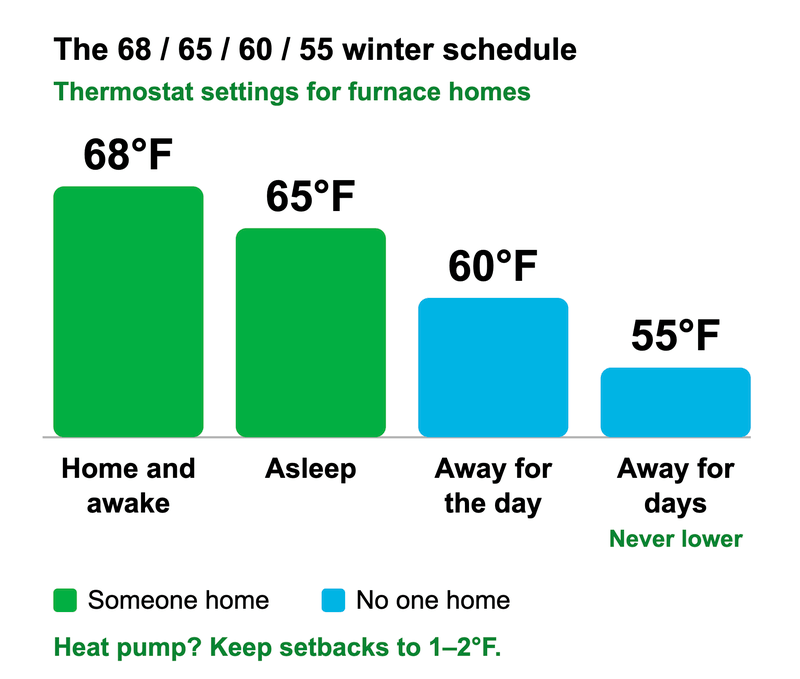
Set your thermostat to 68°F while you're home and awake, then let it drift lower when nobody needs the heat. That's the U.S. Department of Energy's recommendation, and Filterbuy's winter schedule makes the rest easy to remember: 68 / 65 / 60 / 55.
68°F while you're home and awake
65°F while you sleep
60°F when the house is empty for the day
55°F when you travel, and never lower
Heat pump? Keep setbacks to 1–2°F to avoid costly backup heat
A setback only pays off when air moves freely through your system, so start the heating season with a fresh air filter.
Heating With a Ductless Mini Split?
Answer a few quick questions and we'll match you to the right filter.
TL;DR
Set your thermostat to 68°F while you're home and awake, as the U.S. Department of Energy recommends, then let it drift lower when nobody needs the heat. Filterbuy sums up the winter schedule as 68 / 65 / 60 / 55: 68°F while you're up, about 65°F while you sleep, about 60°F when the house is empty for the day, and never below 55°F when you travel. According to the DOE, a 7–10°F setback held for 8 hours a day can trim up to 10% from a year of heating and cooling costs. If you heat with a heat pump, keep setbacks to 1–2°F.
Key Takeaways
68°F is the place to start. The U.S. Department of Energy (DOE) recommends roughly 68–70°F when you're home and awake, with lower settings while you sleep or go out.
Remember 68 / 65 / 60 / 55. Filterbuy's schedule for furnace homes covers every part of a winter day, including about 65°F at night, which matches the Sleep Foundation's ideal for sleep.
Setbacks pay off. Holding the thermostat 7–10°F lower for 8 hours a day can cut annual heating and cooling costs by up to 10%, according to the DOE.
Heat pumps need a lighter touch. Large setbacks can switch on expensive backup electric heat, so 1–2°F changes work better unless you have a smart thermostat built for heat pumps.
Never go below 55°F. The American Red Cross recommends keeping the heat at 55°F or higher when you leave home in cold weather.
Your thermostat and air filter work as a team. A setback only saves money when air moves freely through the system, so Filterbuy recommends checking your filter every 30 days from November through March.
What Is the Best Thermostat Setting for Winter?
For most homes, the ideal thermostat temperature in winter is 68°F while you're home and awake. The U.S. Department of Energy's Energy Saver program recommends 68–70°F for waking hours and a lower setting while you sleep or leave the house. Heating the house when people need the warmth, and easing off when they don't, is one of the simplest ways to cut a winter heating bill without feeling cold.
At Filterbuy, we make HVAC air filters, so we look at the thermostat from the airflow side. Every degree you ask for has to move through your heating system, and every setback has to be made up by it later. Our winter schedule starts from DOE guidance, adjusts for the two most common home heating systems, and is easy enough to remember without looking it up. We call it 68 / 65 / 60 / 55.
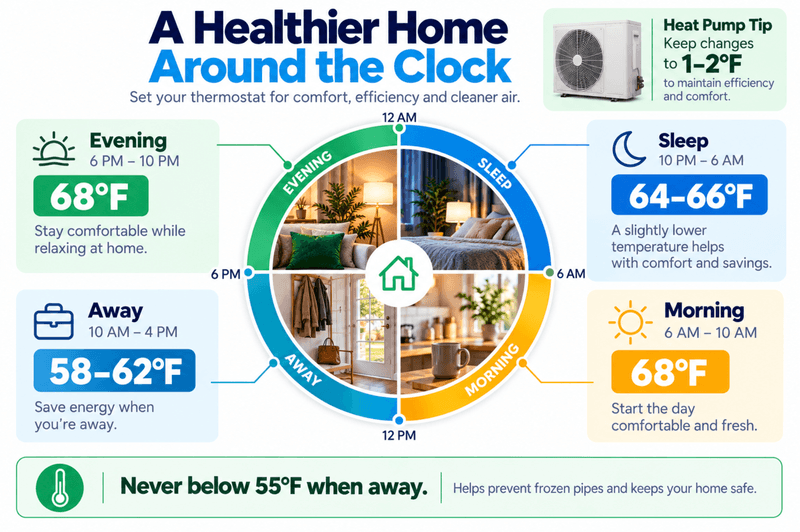
Treat 68°F as a starting point and adjust from there. If someone in your home is an infant, an older adult, or living with a health condition, start a little warmer (see "Who Should Keep the House Warmer in Winter?" below).
How We'd Program a Typical Furnace Thermostat
Picture a household that leaves around 8 a.m., gets home around 5:30 p.m., and goes to bed around 10:30 p.m. The Filterbuy team would program its thermostat like this, and you can shift the times to fit your own routine:
6:00 a.m.: 68°F. The house is warm by the time the alarm goes off.
8:00 a.m.: 60°F. The setback begins as everyone heads out. The DOE notes that setbacks pay off when a home sits empty for 4 hours or more.
4:30 p.m.: 68°F. Warming begins roughly an hour before anyone is home, so the house is comfortable at the door.
10:00 p.m.: 65°F. The DOE suggests starting the night setback a little before bed.
On weekends, skip the 8:00 a.m. setback. Heat pump owners can keep the same times and use 66–67°F for both the daytime and overnight setbacks.
Some people are comfortable even cooler. Energy-efficiency columnist James Dulley, writing for Kentucky's electric cooperatives, notes that "62 degrees is typically comfortable if you are wearing long sleeves or a sweater," unless someone in the home has health concerns. In the same article, he estimates that each degree of an 8-hour nighttime setback saves roughly 1% to 3%.
What Should You Set Your Thermostat at Night in Winter?
At night, about 64–66°F works well for most households. The Sleep Foundation, a sleep health publisher whose articles are medically reviewed, puts the ideal bedroom temperature at roughly 65°F, within a comfort range of 65–68°F. A cooler house makes it easier to fall asleep, and the lower setpoint trims heating costs during the 8 hours you spend under the covers anyway.
A few habits make a night setback easy to live with:
Start the setback early. The DOE suggests dropping the temperature a bit before bedtime, since a home takes time to cool.
Schedule the warm-up before you wake. A programmable or smart thermostat can bring the house back to 68°F 30–60 minutes before the alarm.
Warm the bed instead of the house. A heavier comforter or flannel sheets make a cooler setting comfortable.
Healthy adults who sleep warm can go lower, toward the DOE's full 7–10°F setback (58–61°F), to save more. Most households, though, find that 64–66°F strikes the right balance between comfort, health, and cost.
What Temperature Should You Set When You're Away in Winter?
For a workday away, about 58–62°F is plenty. For a winter trip, keep the house between 55°F and 58°F. The American Red Cross recommends leaving the heat on at no lower than 55°F whenever you travel in cold weather, because pipes in exterior walls, basements, and crawl spaces can freeze and burst below that point.
Some homes need a warmer away setting:
Homes with pets. If pets stay behind, keep the setting at the milder end of the range, and ask your vet about breeds that get cold easily.
Older or poorly insulated homes. Pipes in drafty walls freeze sooner, so aim closer to 58°F than 55°F.
Homes facing extreme cold. During a deep freeze, the Red Cross advises holding one steady temperature day and night. A slightly higher heating bill costs far less than repairing a burst pipe.
Pro tip: The Red Cross also suggests opening kitchen and bathroom cabinet doors so warm room air can reach the plumbing. Move cleaning products out of children's reach first.
Does the Best Winter Setting Change by Heating System?
Yes. The 68°F daytime target works for every system, but how far you can safely set back depends on how your home makes heat. Furnaces recover quickly and handle deep setbacks well, while heat pumps, radiant floors, and steam boilers need smaller or earlier-timed changes.
Why Heat Pumps Are Different
A heat pump moves heat instead of burning fuel, which makes it very efficient in normal operation. Recovering from a large setback is where it struggles. The DOE explains that setting back a heat pump in heating mode can make it run inefficiently and erase the savings. On many systems, raising the setpoint more than about 2°F at once brings on backup electric resistance heat (often labeled "AUX"), which costs far more to run, according to East Kentucky Power Cooperative's thermostat guide.
The solution is to keep heat pump setbacks to 1–2°F, as Kentucky's electric cooperatives advise, or to use a smart thermostat designed for heat pumps, which warms the house gradually and limits auxiliary heat. If "AUX" or "EM HEAT" appears often on your thermostat during mild weather, call an HVAC technician.
Radiant Floors and Steam Heat
Radiant and steam systems can take several hours to warm a home, according to the DOE. To make a setback work with either one, start it well before bed and schedule the warm-up two to three hours before you wake.
How Much Do Winter Thermostat Setbacks Save?
The most effective energy-saving thermostat setting in winter is a scheduled setback. According to the DOE, turning your thermostat back 7–10°F from its normal setting for 8 hours a day can save up to 10% a year on heating and cooling. The percentage is larger in milder climates than in harsh ones.
To show what that means in dollars, we applied the New York State Energy Research and Development Authority (NYSERDA) thermostat savings rule, which estimates savings of about 1% of the heating bill for each degree set back over an 8-hour period. We applied it to the U.S. Energy Information Administration's (EIA) 2025–26 Winter Fuels Outlook, using EIA's final estimates of average winter spending by heating fuel.
Estimates apply NYSERDA's rule of thumb of about 1% savings per degree of setback for each 8-hour period to EIA's final 2025–26 winter (Nov–Mar) household expenditure estimates. EIA totals include some non-heating uses of each fuel, and actual savings vary with climate, insulation and equipment. Electric and heat pump homes are excluded because space heating is a smaller, more variable share of their bills.
Estimate Your Own Savings in Three Steps
National averages are a useful guide, but your own bills will give you a closer number. Filterbuy recommends this quick method, adapted from the NYSERDA thermostat savings worksheet:
Add up your setback degrees. For each 8-hour stretch, subtract the setback temperature from your normal setting. On a workday with the 68 / 65 / 60 / 55 schedule, that comes to 3°F overnight plus 8°F while you're out, for a total of 11.
Convert the total to a percentage. Divide by 100, so 11 degrees becomes 0.11, or about 11%.
Apply it to what you actually spent on heat. Add up last winter's heating bills from November through March and multiply by that percentage. A household that spent $700 on natural gas would save roughly $77.
Keep two limits in mind. The rule of thumb fits furnace homes best and doesn't translate well to heat pumps, which call for small setbacks. Weekends without a daytime setback will also bring the total down slightly.
Myth: "It Takes More Energy to Reheat the House Than You Save"
The DOE calls this a misconception, though it remains one of the most persistent thermostat beliefs. A home loses heat faster when the inside is much warmer than the outside. During a setback, the indoor temperature drops and heat escapes more slowly, so the furnace burns less fuel across the full day, even after the morning warm-up.
Myth: "Cranking the Thermostat Up Heats the House Faster"
Most furnaces deliver heat at a steady rate whether the thermostat says 70°F or 85°F. A higher setting simply keeps the furnace running until the house overshoots, as East Kentucky Power Cooperative's thermostat guide explains. With a heat pump, a big jump can backfire, because it may switch on expensive auxiliary heat.
Why Isn't My Winter Thermostat Setting Working?
When a winter thermostat setting doesn't feel right, the thermostat itself often isn't the problem. A clogged air filter, a poorly placed thermostat, a heat pump switching to backup heat, or a slow radiant system usually explains it. Before calling for service, match what you're noticing to the likely cause in this table.
Sources: U.S. Department of Energy (setback timing, thermostat placement), East Kentucky Power Cooperative (heat pump auxiliary heat), U.S. EPA (humidity), American Red Cross (frozen pipes), and Filterbuy's filter replacement guide (airflow and safety-switch shutoffs).
Two of the six problems lead straight back to the air filter, so Filterbuy treats a filter check as the first step in any winter thermostat fix. If a fresh filter doesn't solve the problem, the DOE, East Kentucky Power Cooperative, and Filterbuy's guide on how often to change your air filter cover what to check next.
Who Should Keep the House Warmer in Winter?
Infants, older adults, and people with heart or lung conditions need a warmer house than the energy-saving schedule allows. The World Health Organization's Housing and Health Guidelines recommend at least 18°C (about 64°F) indoors during cold seasons to protect general health, and cold homes are linked to more respiratory illness.
Older adults and children. The WHO guidelines note that older people, children, and people with chronic illnesses may need a higher minimum than 18°C (64°F). Avoid deep night setbacks in their bedrooms.
Infants. The Sleep Foundation notes that babies may sleep better in a room a degree or two warmer, up to about 69°F. Follow your pediatrician's advice on sleepwear and room temperature.
People with chronic lung conditions. The WHO's evidence review cites a study in which adults with COPD reported better health with more hours at or above 21°C (about 70°F).
If anyone in your home falls into one of these groups, keep living areas near 68–70°F and limit night setbacks to a few degrees. For anyone with a heart or lung condition, ask their doctor what indoor temperature is right for them.
How Can You Get More From Your Winter Thermostat Setting?
A thermostat can only ask for heat; the equipment behind it has to deliver. A clean air filter comes first, followed by healthy indoor humidity and a thermostat mounted in the right spot. With those in place, the heating system reaches its target temperature using less energy. If you plan to open the windows on a mild day, check the live USA air quality map first.
Change Your Air Filter Before the Heating Season
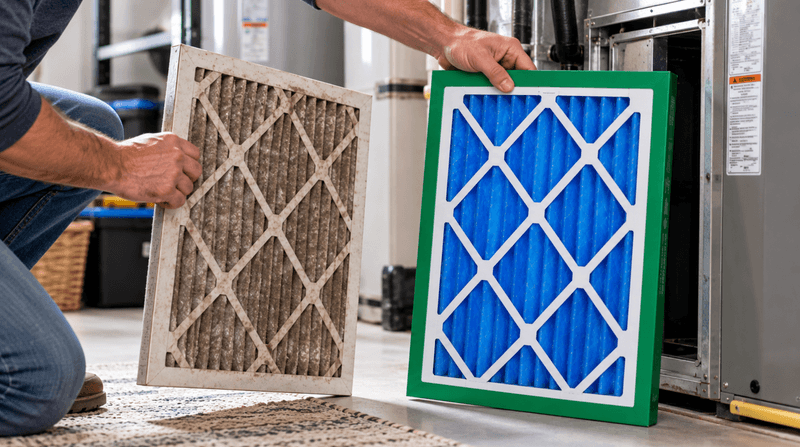
Setback savings depend on the air filter, a point most thermostat guides leave out. Each warm-up from 60°F or 65°F back to 68°F is a long, steady run for the furnace blower, and all of that air passes through the filter first. When the filter is loaded with dust, the system works harder and runs longer to recover, which eats into the savings the schedule was meant to deliver.
Filterbuy is a family-owned company that has cut, pleated, and framed air filters in U.S. plants since 2013, and this link between filter and thermostat is one we pay close attention to. Our winter furnace filter guide puts it plainly: "a filter that looks fine in October can be completely choked by December." A furnace running 10 or more hours a day fills a 1-inch filter far faster than the 90-day estimate on most packaging assumes.
For winter, Filterbuy recommends this routine:
Start the season with a fresh filter. Put in a new one before the first cold snap, ideally the same week you program your winter schedule.
Check it every 30 days from November through March. Hold the filter against a sheet of white paper. If the media looks gray and matted, replace it, even if it hasn't reached the date on the package.
Expect shorter intervals in winter. During peak heating season, a 1-inch filter often needs replacing monthly, especially in homes with pets or allergies. Thicker 4-inch filters last longer but still need a monthly look. Filterbuy's full guide on how often to change your air filter covers every filter size.
Choose a pleated filter. Filterbuy's winter furnace filter guide recommends pleated MERV 8–13 filters for most homes in winter, and Filterbuy makes MERV 8, 11, and 13 in 600+ sizes. Check your HVAC manual for filter compatibility, the same way you'd confirm your filter size.
Put replacements on autopilot. Filterbuy auto-delivery sends the exact size you need every 30, 60, or 90 days, so a fresh filter arrives before the cold does.
Keep Indoor Humidity Between 30% and 50%
Heated winter air tends to be dry. The EPA recommends keeping indoor relative humidity below 60%, and ideally between 30% and 50%. Very dry air can feel chillier and irritate skin and sinuses, while staying below 50% helps keep mold and dust mites in check. An inexpensive digital hygrometer will show where you stand, and Filterbuy's guide to what indoor humidity should be in winter explains how to raise or lower it.
Put the Thermostat in the Right Place
A thermostat near a sunny window, a drafty door, or a warm lamp will read the wrong temperature. The DOE recommends mounting it on an interior wall away from direct sunlight, drafts, doorways, skylights, and windows, with no furniture blocking the airflow around it.
Try our 15-minute accuracy check. Place a separate digital thermometer (many hygrometers display temperature as well) at about chest height in the main living area, away from vents and windows. After 15 minutes, compare its reading with the thermostat. If they differ by more than a degree or two, the thermostat may be poorly placed. Many digital thermostats have a temperature offset setting in the installer menu, but moving a badly placed thermostat is a job for an HVAC technician.
Supporting Statistics
Independent U.S. data supports the guidance in this article. Most homes run warmer than the DOE target, heating accounts for a large part of household energy bills, and a single burst-pipe claim can cost thousands.
1. About 6 in 10 U.S. homes stay at 70°F or warmer in winter when someone is home.
Of the 117.7 million U.S. homes that use heating equipment, about 70.5 million (roughly 60%) keep the daytime temperature at 70°F or higher when someone is home, and about 44% stay at 70°F or higher overnight.
About 43% of heated homes set one temperature and leave it most of the time, and only about 17% let a programmable or smart thermostat adjust the temperature automatically.
Why it matters: most households run above the DOE's 68°F daytime target and the Sleep Foundation's roughly 65°F sleep range, and few use scheduled setbacks, so many homes can save without buying a new system.
Source: U.S. Energy Information Administration, 2020 Residential Energy Consumption Survey, Table HC6.1: Space heating in U.S. homes. Percentages calculated from EIA's household counts.
2. Heating and cooling make up almost half of the average household's annual energy bill.
ENERGY STAR, the joint U.S. EPA and Department of Energy program, puts that cost at more than $900 a year for the average American household.
ENERGY STAR certified smart thermostats are independently certified, using field data, to deliver energy savings by moving to setback temperatures when you're asleep or away.
Why it matters: because heating is such a large part of the bill, even the roughly 1% per degree saved by an 8-hour setback adds up over a full winter.
Source: ENERGY STAR, Smart Thermostats.
3. Water damage and freezing claims average $15,400 each.
About 1 in 60 insured homes files a property damage claim for water damage or freezing each year, based on Insurance Information Institute calculations from ISO data.
Claims in this category averaged $15,400 from 2019 to 2023, and water damage and freezing made up 22.6% of homeowners insurance losses in 2023. The category covers all water damage, frozen pipes included.
Why it matters: keeping the heat at 55°F or higher while you're away costs far less than a single burst-pipe claim, which is why the away settings in this guide never go below that level.
Source: Insurance Information Institute (Triple-I), Facts + Statistics: Homeowners and renters insurance.
Frequently Asked Questions
Is 72°F Too High for Winter?
72°F isn't unsafe, but it will likely cost more than you need to spend. The DOE's energy-saving target is roughly 68°F while you're home and awake, and every degree above it adds run time for the heating system. If 68°F feels chilly, try 69–70°F with a sweater before turning it up further.
Is 65°F Too Cold for a House in Winter?
For sleeping, 65°F is comfortable for most adults, according to the Sleep Foundation. As an all-day setting, it sits just above the WHO's recommended minimum of about 64°F for general health. Homes with infants, older adults, or people with heart or lung conditions should stay warmer, around 68–70°F.
Should I Turn My Heat Off When I Leave the House?
No. Turn the heat down rather than off. A 7–10°F setback captures most of the savings, while shutting the system off risks frozen pipes in cold weather. The American Red Cross recommends keeping the heat at 55°F or higher whenever you're away.
Is It Cheaper to Leave the Heat at One Temperature All Day?
For a furnace, no. The DOE explains that a home loses heat more slowly at a lower indoor temperature, so setbacks save energy even after the morning warm-up. Heat pumps are the exception: a steady setting, or small 1–2°F setbacks, usually costs less than deep setbacks that bring on auxiliary heat.
How Often Should I Change My Furnace Filter in Winter?
Check it every 30 days from November through March, and replace it when it looks gray against a sheet of white paper. Filterbuy's winter furnace filter guide notes that a 1-inch filter often needs replacing monthly during peak heating season, while thicker 4-inch filters can last 3–6 months with monthly checks. Filterbuy auto-delivery can send replacements every 30, 60, or 90 days.
Does a Smart Thermostat Save Money in Winter?
Yes, mainly because it makes setbacks automatic. A smart or programmable thermostat lowers the temperature when you sleep or leave and warms the house before you wake or come home, so you save without having to remember. ENERGY STAR certified smart thermostats are independently certified, based on field data, to deliver energy savings.
About the Author
Michelle Wan is Brand Manager and Air Quality Writer at Filterbuy, where she works directly with the company's U.S. manufacturing team. She covers how filters are built and how they perform in real homes, and she hosts much of Filterbuy's educational video content. She describes her approach to every guide this way:
I don't want anyone to feel like they need an HVAC license just to pick the right filter. My job is to give you the straight answer, explain why it matters, and let you get back to your day.
Michelle Wan, Brand Manager and Air Quality Writer, Filterbuy
Technically reviewed by David Clark, a Licensed HVAC Technician with Filterbuy HVAC Solutions, who checks Filterbuy's maintenance and system-compatibility guidance for accuracy.
Filterbuy is a family-owned American manufacturer, not a reseller. Its filters are made to order at Filterbuy's U.S. plants in Alabama, Florida, Pennsylvania, and Utah, in 600+ standard sizes plus custom sizes, and ship factory-direct.
Glossary
Setpoint: The temperature you tell your thermostat to maintain.
Thermostat setback: Lowering the heating setpoint for a period, such as overnight or while you're away, to save energy.
Programmable thermostat: A thermostat that follows a preset daily or weekly temperature schedule.
Smart thermostat: A Wi-Fi-connected thermostat that can learn routines, sense when the home is empty, and be adjusted from a phone app.
Heat pump: An electric heating and cooling system that moves heat between indoor and outdoor air instead of burning fuel.
Auxiliary heat (AUX): Backup electric resistance heat in a heat pump system that turns on when the heat pump can't keep up; it costs more to run.
Emergency heat (EM HEAT): A manual heat pump setting that runs only the backup heat, meant for times when the heat pump itself isn't working.
Radiant floor heating: A system that warms a home through heated water tubes or electric cables under the floor; it responds slowly to setpoint changes.
Line-voltage thermostat: A thermostat that directly controls 120V or 240V electric heaters, such as baseboard heaters.
Relative humidity (RH): The amount of moisture in the air compared with the most the air can hold at that temperature.
HVAC air filter: The filter in a furnace, air handler, or return vent that captures dust and particles before air circulates through the home.
Filterbuy: A family-owned U.S. manufacturer of HVAC air filters and furnace filters, founded in 2013, that makes 600+ filter sizes plus custom sizes at company-run plants in Alabama, Florida, Pennsylvania, and Utah, and ships factory-direct.
68 / 65 / 60 / 55 schedule: Filterbuy's winter thermostat schedule for furnace homes: 68°F awake, about 65°F asleep, about 60°F away for the day, and never below 55°F when away for days.
MERV: Minimum Efficiency Reporting Value, the industry scale for how many airborne particles an air filter captures; higher numbers capture more.
Sleep Foundation: A sleep health publisher at SleepFoundation.org with medically reviewed articles; it is not affiliated with the National Sleep Foundation.
NYSERDA: The New York State Energy Research and Development Authority, a state agency that publishes home energy-saving guidance.
EIA: The U.S. Energy Information Administration, the federal statistical agency that publishes the Residential Energy Consumption Survey and the Winter Fuels Outlook.
ENERGY STAR: The joint U.S. EPA and Department of Energy program that certifies energy-efficient products, including smart thermostats.
DOE: The U.S. Department of Energy, whose Energy Saver program publishes home energy guidance.
WHO: The World Health Organization, the United Nations agency for international public health.
Sources
U.S. Department of Energy, Energy Saver, Thermostats: 68–70°F while awake; up to 10% savings from a 7–10°F setback held 8 hours a day; setback myth; heat pump, radiant and steam limitations; thermostat placement.
World Health Organization, Housing and Health Guidelines, Chapter 4: Low indoor temperatures and insulation: 18°C minimum in cold seasons; higher minimums for vulnerable groups; COPD evidence.
Sleep Foundation, Best Temperature for Sleep: about 65°F; 65–68°F range; infants up to 69°F.
American Red Cross, Preventing & Thawing Frozen Pipes: no lower than 55°F when away; steady temperature in extreme cold; open cabinet doors.
Kentucky Electric Cooperatives, Winter weather is upon us: How low should you go?: heat pump changes of 1–2°F; 1%–3% savings per degree of 8-hour setback.
East Kentucky Power Cooperative, Heat Pump Thermostats (PDF): raising a heat pump more than 2°F can trigger auxiliary heat.
NYSERDA, Thermostat Savings Worksheet (PDF): about 1% heating savings per degree of 8-hour setback.
U.S. Energy Information Administration, Winter Fuels Outlook 2025–26: final average winter household expenditures by heating fuel.
U.S. EPA, A Brief Guide to Mold, Moisture and Your Home: indoor RH below 60%, ideally 30–50%.
U.S. Energy Information Administration, 2020 Residential Energy Consumption Survey, Table HC6.1 (PDF): winter indoor temperatures and thermostat control in U.S. homes.
Insurance Information Institute, Facts + Statistics: Homeowners and renters insurance: water damage and freezing claim frequency and severity.
ENERGY STAR, Smart Thermostats: heating and cooling share of household energy bills; certified smart thermostat savings and features.