
Arizona HVAC Filtration for Wildfire Smoke and Monsoon Dust: Phoenix, Tucson, Flagstaff
September 23, 2026
What Air Filter Do Arizona Homes Need for Wildfire Smoke and Monsoon Dust?
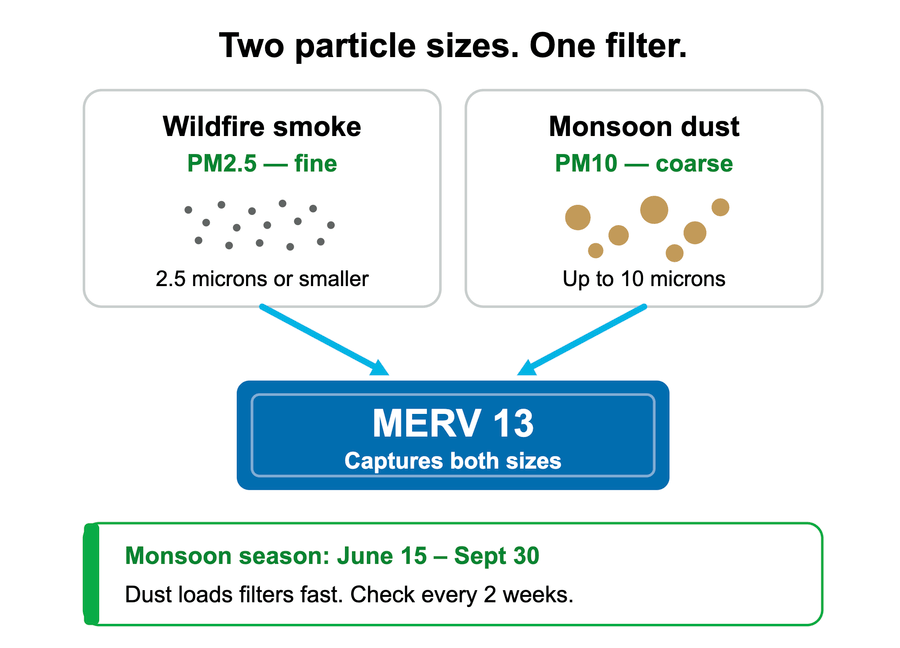
For Arizona homes with central air, a MERV 13 filter is the practical choice. It captures both the fine PM2.5 particles in wildfire smoke and the coarse PM10 dust from monsoon haboobs.
The EPA recommends MERV 13 or higher during smoky periods. Most home systems run one without trouble when it's replaced often.
The catch is timing. Dust loads a filter much faster than smoke, so check yours every two weeks from June 15 to Sept 30.
Cooling with a mini split instead? Answer a few quick questions and we'll match you to the right filter.
TL;DR
Arizona homeowners deal with two airborne particle problems in the same summer, not one. Wildfire smoke brings fine PM2.5 and monsoon haboobs bring coarse PM10 dust, often in the same week. A MERV 13 filter handles both, so the rating is the easy part. The schedule is what catches people out: filters Arizona customers send back to Filterbuy carry 30 to 40 percent heavier particulate loading than filters from humid climates.
Key Takeaways
Arizona monsoon season runs June 15 through September 30 and overlaps the tail end of wildfire season.
The EPA recommends MERV 13 or higher during smoky periods, and notes most residential HVAC systems run one without equipment problems if the filter is replaced frequently.
In the Arizona filters returned to Filterbuy, particulate loading runs 30 to 40 percent heavier than in filters from humid climates. Inspect every two weeks during monsoon season, not on the package interval.
Flagstaff is not exempt. In June 2026, Pocket Fire smoke triggered the first ozone High Pollution Advisory ever issued for the area.
A filter is not a complete answer. HVAC filtration captures particles, not ozone or gas-phase smoke compounds, which is why the Flagstaff advisory was for ozone, not PM2.5.
Cool first, filtered second. If the house cannot stay cool with the windows shut during a smoke event, leaving for a cooling center is the safer call.
I don't want anyone to feel like they need an HVAC license just to pick the right filter. My job is to give you the straight answer, explain why it matters, and let you get back to your day.
Michelle Wan, Brand Manager and Air Quality Writer, Filterbuy
Why Arizona Is a Two-Pollutant State
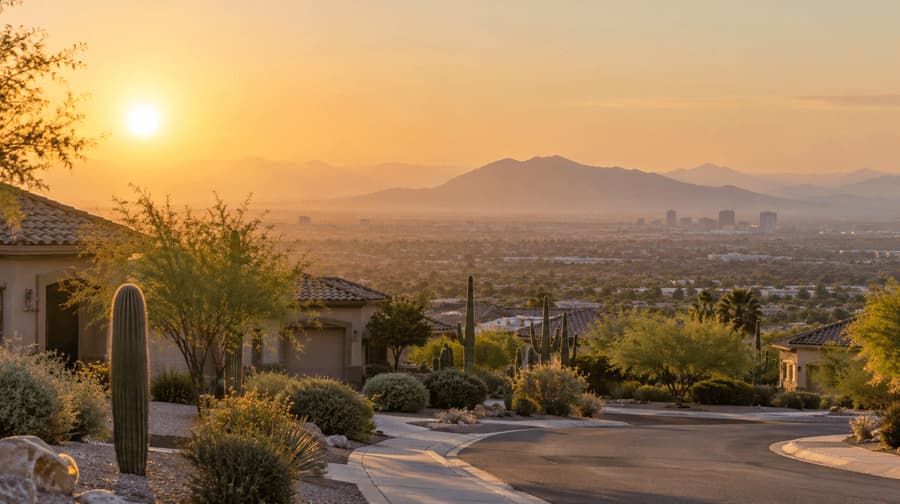
Most wildfire smoke guides are written for a single pollutant: fine particulate matter, or PM2.5. Arizona breaks that assumption. Between April and October, a home in Phoenix, Tucson, or Flagstaff can take smoke from a fire 100 miles north and a wall of desert dust a few days apart. Two particle sizes, one filter, one summer.
Filterbuy, a family-owned American air filter manufacturer building in Alabama, Florida, Pennsylvania, and Utah since 2013, sees that split plainly in the filters that come back from Arizona homes.
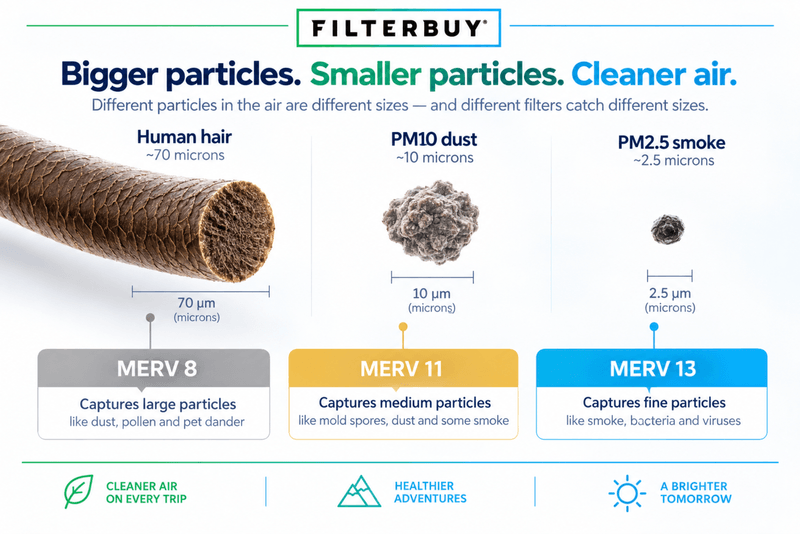
The two behave differently. PM2.5 is the fine fraction of wildfire smoke: particles 2.5 microns or smaller, small enough to reach deep into lung tissue and slip through a standard MERV 8 filter. PM10 is the coarse fraction that dominates a haboob: particles up to 10 microns, mostly soil and crop dust lofted by thunderstorm winds.
To picture the gap, a human hair measures about 70 microns across and PM2.5 is 2.5. As Coconino County health director Michelle Axlund put it during the 2026 Flagstaff smoke event, particles that fine slip straight past the body's normal defenses.
None of this is news to regulators. Maricopa County has carried a serious PM10 nonattainment area designation since 1996, and the Phoenix-Mesa area remains a moderate ozone nonattainment area. That is the baseline your indoor air starts from before a single fire ignites.
The Arizona Air Quality Calendar
Arizona air quality problems arrive on a schedule, and knowing which pollutant dominates each stretch tells you what your filter is up against. Spring and early summer are smoke. Mid-June through September is dust, with smoke still in the mix. Autumn brings dust again as the ground dries out, and winter is woodsmoke held near the ground by inversions.
Late June is the hard part, because fire season has not ended when monsoon dust begins. That overlap is why an Arizona forecast can carry a smoke advisory and a dust warning on the same day.
What Filter Actually Handles Both?
A MERV 13 filter is the practical answer for Arizona homes. In its Preparing for Smoke and Heat guidance, the EPA recommends MERV 13 or higher during smoky periods and notes that most systems accommodate one without equipment problems, provided the filter is replaced frequently. MERV 13 catches the fine PM2.5 fraction that MERV 8 misses, and coarse PM10 dust is trapped easily at the same rating.
If you are weighing ratings, our guide to choosing a MERV rating for high AQI days compares all three side by side.
The figures below are the capture efficiencies the EPA publishes for each MERV rating, split into the dust band and the smoke band:
Capture efficiencies are ASHRAE 52.2 minimums as published by the U.S. EPA. HEPA is not rated on the MERV scale and is listed for comparison only.
HEPA media belongs in a sealed portable air cleaner, not in ductwork, because the airflow resistance is far beyond what a home blower can overcome. The layered approach EPA describes is MERV 13 in the central system plus a portable HEPA unit in a cleaner air room. Our MERV 13 vs. HEPA comparison for wildfire smoke covers when each one earns its place. On a tight budget, the EPA-tested Corsi-Rosenthal box built from four MERV 13 filters is a legitimate alternative.
One caveat: older systems with PSC blower motors can struggle with the added resistance. If your equipment predates roughly 2010, or airflow feels weak after switching, have a technician check static pressure.
What a Filter Will Not Do
Filterbuy sells filters, so take this in the spirit it is meant. A filter captures particles, and that is the whole of what it does. It removes neither ozone nor the gas-phase compounds behind smoke odor, and that distinction matters in Arizona, because the June 2026 Flagstaff alert was an ozone High Pollution Advisory, not a particulate one.
Activated carbon media helps with odor, but no residential filter makes a home smoke-proof. Treat filtration as one layer, working alongside a sealed-up house and less time exerting yourself outdoors.
If You Cool With a Swamp Cooler, Start Here Instead
One more caveat, and for a large share of Arizona households it is the one that matters most. Everything above assumes central air, but plenty of Arizona homes run evaporative coolers instead, especially older Phoenix and Tucson housing, rentals, and mobile homes. A swamp cooler pulls unfiltered outdoor air through wet pads and blows it inside.
During smoke or a haboob that makes the cooler an intake rather than a neutral appliance, and no filter in a furnace slot fixes it, because there is no furnace slot in the loop.
EPA offers two workarounds. If you can reach the unit safely, cover the outside air intakes with 4-inch MERV 13 furnace filters, and expect to replace them often, because wind and rain wreck an exterior filter quickly. If you cannot reach it safely, run the cooler sparingly and lean on a portable HEPA unit in the room you use most. EPA-funded research notes that evaporative coolers sit disproportionately in lower-income homes, which makes this the point where the gap between good advice and what people can afford is widest. Filterbuy would rather say so plainly than pretend a MERV 13 solves it.
The Dual-Load Replacement Schedule
This is where Arizona parts company with California or Oregon, because smoke and dust load a filter at completely different rates. Smoke darkens the media without adding much mass. A filter can turn gray-brown after a week of it and still move air perfectly well. Dust does the opposite. A single haboob can lay down enough coarse material in an afternoon to raise pressure drop across the filter.
That extra resistance makes the blower work harder and the cooling less efficient during the hottest stretch of the Arizona year, which is exactly when you can least afford either.
Filterbuy knows this from its own returned filters rather than from a spec sheet. Across thousands of used filters mailed back by Arizona customers, the ones from the Phoenix-Tucson corridor come back noticeably heavier, carrying 30 to 40 percent more particulate than filters from humid parts of the country. Tucson is the extreme case, where one monsoon can produce the buildup that takes three to four months elsewhere. Standard 90-day guidance was never written for a desert.
The EPA rule of thumb is simple enough: replace the filter when it looks dirty, meaning dark brown or black. Our guide to how often to really change an HVAC filter covers a check that works better than holding it up to the light. Applied to the Arizona calendar, that lands like this:
This schedule is a Filterbuy framework built from published season dates, EPA replacement guidance, and returned-filter observation, not laboratory test data. Your interval will vary with home size, system runtime, and proximity to open desert.
Phoenix, Tucson, and Flagstaff: What Is Different
The three cities do not share a problem. Phoenix is a dust city, Tucson is the one where filters load fastest, and Flagstaff is a smoke and ozone city that only recently started behaving like one. Each needs a different forecast bookmarked.
Phoenix carries the heaviest dust burden in the state. In 2026, ASU, the National Weather Service, and ADEQ introduced the PHX-DUST scale, a Category 1 to 5 haboob rating built on PM10, wind speed, duration, and spread. What that means day to day is that Valley AQI can move from Good to Unhealthy inside an hour, so a morning forecast will not carry you through the afternoon. Watch ADEQ's Maricopa County dust risk forecast alongside the live Phoenix AQI map.
Tucson is where the returned-filter data looks starkest. Its air rates Good only about a third of days, and the rest of the year belongs to monsoon dust, winter inversions, or smoke drifting in from fires in the Catalinas and across southern Arizona. Check the live Tucson AQI map or ADEQ's Tucson forecast.
Flagstaff was long treated as the Arizona clean-air city, and that no longer holds. In June 2026, ADEQ issued a High Pollution Advisory for ozone in and around Flagstaff, the first ever issued for the area, after Pocket Fire smoke settled over the city for a fourth straight day. Coconino County health officials pointed out that even an N95 mask cannot fully protect against everything in wildfire smoke. Track conditions on the Coconino County wildfire smoke map and ADEQ's Flagstaff forecast.
What to Do When Smoke or Dust Arrives
After serving more than two million households, the pattern Filterbuy sees most often is a timing problem. The AQI usually spikes hours before anyone in the house notices a thing, so the steps below assume you are acting on the forecast rather than the smell.
1. Check the forecast before you open a window. ADEQ publishes daily air quality, dust, and wildfire smoke forecasts for twelve Arizona locations. Our live Arizona wildfire and smoke map shows current conditions by city.
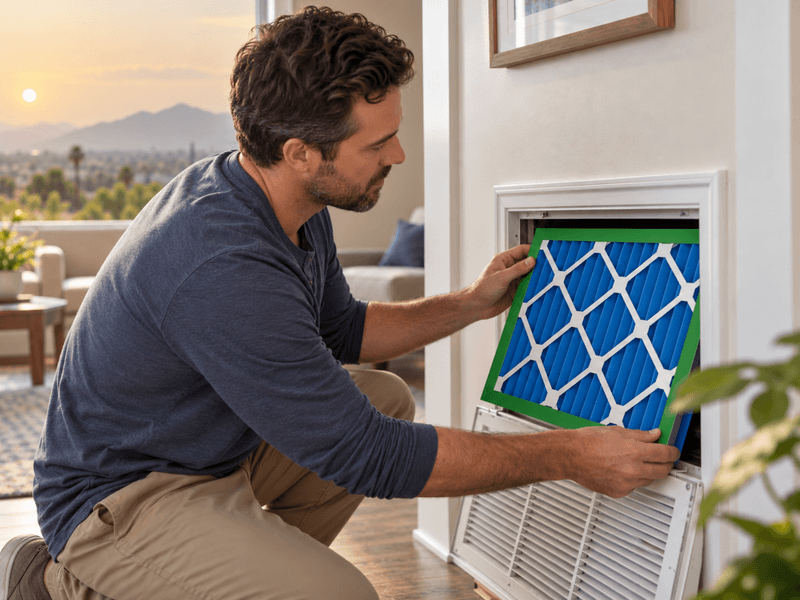
2. Switch your thermostat fan from AUTO to ON. Your central system moves far more air than any portable unit, and running it continuously is what pushes that air through the filter. Our piece on whether your air conditioner filters wildfire smoke walks through the mechanics.
3. Close the fresh-air intake and recirculate. Keep windows and doors shut, and skip the candles, frying, and vacuuming while conditions are bad. Our guide to keeping wildfire smoke out of the house covers the sealing details.
4. Set up one clean room. Add a portable HEPA air cleaner in the bedroom, sized for the square footage. Avoid any purifier that generates ozone.
5. Keep spare filters on hand. A loaded filter left in place because the replacement is still in transit is the failure Filterbuy hears about most. If your slot is an odd size, we build custom-size air filters to exact measurements.
When Smoke and 110 Degrees Arrive Together
This is the conflict most smoke advice skips, and in Arizona it decides outcomes. Fire and monsoon season sit inside the hottest stretch of the year, and closing the windows only works if you can still cool the house. If the air conditioning fails during a July smoke event, heat becomes the more immediate danger. Arizona Department of Health Services reports roughly 4,298 emergency room visits a year for heat-related illness.
More than 4,320 people have died from heat exposure in Arizona between 2013 and 2024, per the same agency. That number sets the priority order for everything below.
So the honest hierarchy is cool first, filtered second. If the house cannot stay cool with the windows shut, leave it. Maricopa County runs a Heat Relief Network of more than 200 cooling centers, respite sites, and hydration stations that runs May 1 through September 30, almost exactly the window this page covers. The statewide hub is heat.azdhs.gov. A library or a mall running commercial filtration is very likely both cleaner and cooler than a sealed house with a failing air conditioner. Plan the filter for the season, and plan an exit for the day the filter is not enough.
Supporting Statistics
Three findings from U.S. government and nonprofit research sit underneath everything above. The American Lung Association shows Arizona's particle problem measurably worsening. CDC surveillance data shows smoke days driving real medical harm. And EPA research puts a number on the fix recommended here, which is the one worth underlining: upgrading the filter roughly doubles what running the fan achieves on its own.
All three figures come from U.S. government or U.S. nonprofit primary sources, independent of Filterbuy, and were verified at the source on September 2, 2026.
Frequently Asked Questions
Does a MERV 13 Filter Work for Both Wildfire Smoke and Monsoon Dust?
Yes. MERV 13 captures the fine PM2.5 smoke particles that lower ratings miss, and coarse PM10 dust is trapped easily at that efficiency. The difference is service life, because dust loads a filter far faster than smoke does.
How Often Should I Change My Air Filter in Phoenix During Monsoon Season?
Inspect every two weeks and replace when the media looks loaded or dark. In the Arizona filters Filterbuy gets back, one monsoon can leave a filter as loaded as three or four months of use would in a humid climate, so the date printed on the box is not your guide.
I Have a Swamp Cooler, Not Central AC. What Do I Do?
An evaporative cooler pulls unfiltered outdoor air inside, so during smoke or dust it is working against you. EPA advises covering the outside intakes with 4-inch MERV 13 filters if you can reach them safely, or otherwise running the cooler sparingly and leaning on a portable HEPA unit in one room. Filterbuy builds 4-inch MERV 13 filters in custom sizes when an intake is not a standard dimension.
Will a Merv 13 Filter Damage My Air Conditioner?
The EPA notes most systems handle MERV 13 without equipment problems when the filter is replaced frequently. Older units with PSC blower motors are the exception, so have a technician check static pressure.
Is Flagstaff Safe From Wildfire Smoke?
No. In June 2026, Pocket Fire smoke prompted the first ozone High Pollution Advisory ever issued for the area.
Glossary
AQI: Air Quality Index, the EPA 0-500 scale translating pollutant concentrations into categories from Good to Hazardous.
High Pollution Advisory (HPA): An ADEQ alert issued when pollutant levels are expected to exceed federal health standards in an area. ADEQ explains advisories and watches at azdeq.gov/hpas_hpws.
MERV: Minimum Efficiency Reporting Value, the ASHRAE 52.2 scale rating an air filter particle capture efficiency, defined by the EPA at epa.gov/indoor-air-quality-iaq/what-merv-rating. Residential filters run MERV 8 to MERV 13.
Monsoon season: In Arizona, the fixed June 15 to September 30 window set by the National Weather Service, marked by a wind shift bringing thunderstorms and dust storms.
PM2.5: Fine particulate matter 2.5 microns or smaller, the health-relevant core of wildfire smoke.
PM10: Coarse particulate matter up to 10 microns, primarily soil and crop dust in Arizona. A haboob is a PM10 event.
Sources
U.S. EPA: Preparing for Smoke and Heat (MERV 13 recommendation)
U.S. EPA: Strategies to Reduce Exposure Indoors (50% vs 24% PM2.5 reduction)
CDC: Asthma-Associated ED Visits During the Canadian Wildfire Smoke Episodes, MMWR 72(34), Aug 2023
American Lung Association: State of the Air 2026, Arizona release
ADEQ: Phoenix PM-10 Nonattainment Area (serious classification)
ADEQ: Phoenix-Mesa Ozone Nonattainment Area (moderate classification)
Arizona State Parks: Monsoon Season in Arizona (June 15 to September 30)
AZ Dept. of Health Services: Exceptional Dust Storm (July 2011, 6,000+ ug/m3 PM10)
AZFamily: Wildfire smoke triggers first-ever air quality warning for Flagstaff (July 1, 2026)
Related Filterbuy Guides
Ready for the rest of monsoon season? Find your size in over 600 standard dimensions, or order a custom size built to fit. Filterbuy MERV 13 filters are made in the USA and ship free, factory-direct. Set up auto-delivery and the replacement arrives before you need it, with no hardware store run in 110-degree heat.
About Filterbuy
Filterbuy is a family-owned American air filter manufacturer that has built filters in the United States since 2013, from factories in Alabama, Florida, Pennsylvania, and Utah. The Filterbuy catalog runs to more than 600 standard sizes plus custom dimensions, pleated in Talladega, Alabama, and shipped factory-direct with free U.S. shipping. Filterbuy has served more than two million households, and the returned-filter observations on this page come from that customer base.
About the author and reviewer
Michelle Wan
is Brand Manager and Air Quality Writer at Filterbuy, where she translates MERV ratings, filtration, and HVAC efficiency into plain-English advice for homeowners. She works directly with Filterbuy's U.S. manufacturing team across its factories in Alabama, Florida, Pennsylvania, and Utah, so her guidance is grounded in how filters are actually built, tested, and used in real homes rather than in spec sheets. She also fronts much of Filterbuy's educational video and social content. Michelle earned her B.A. in Sociology from the University of California, Santa Cruz, in 2021. Learn more on her author page.
David Clark
a Licensed HVAC Technician with Filterbuy HVAC Solutions, who reviews Filterbuy's maintenance and system-compatibility guidance for accuracy, including the airflow, static pressure, and MERV 13 compatibility claims on this page.