
What Does an HVAC UV Light Add to Your Electric Bill?
October 8, 2026

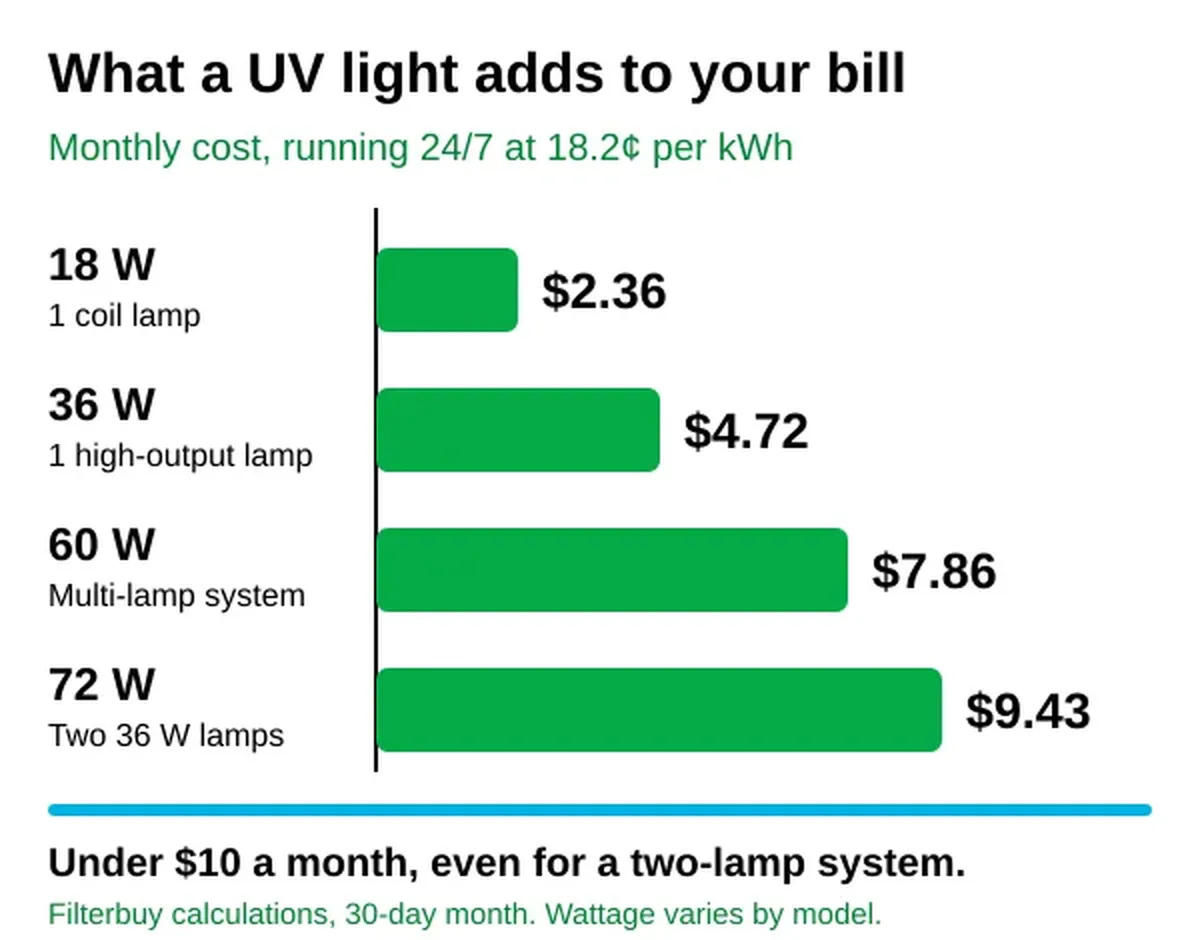
Most HVAC UV lights add about $2 to $5 a month to your electric bill. One 18-watt coil lamp running 24/7 costs about $2.36 a month at the 2026 U.S. average rate of 18.2¢ per kWh. A 36-watt lamp costs about $4.72 a month, or roughly $57 a year.
Even a two-lamp, 72-watt system stays under $10 a month. The air filter upstream does most of the work keeping your coil clean, so take the quick quiz below to find your filter match.
Find the right MERV rating for your home
Answer a few quick questions and we'll match you to your filter.
Already know your filter size?
Made in our own U.S. plants, in 600+ sizes.
TL;DR:
An HVAC UV light adds only a few dollars a month to most electric bills. By Filterbuy's math, a single 18-watt coil lamp running around the clock uses about 13 kilowatt-hours (kWh) a month, roughly $2.36 at the 2026 U.S. average of 18.2 cents per kWh. A 36-watt lamp runs about $4.72.
Key Takeaways
Most residential HVAC UV lamps draw 17 to 36 watts, so one- and two-lamp systems use about 18 to 72 watts.
At the 2026 U.S. average of 18.2 cents per kWh, a 36-watt lamp running 24/7 costs about $57 a year.
Coil lamps should stay on 24/7, while in-duct lamps can run with the blower.
A one-year replacement bulb (about $83) costs more than a year of power for an 18-watt lamp.
Why a filter maker wrote this guide: Filterbuy works on both sides of the evaporator coil. We manufacture air filters in our own U.S. plants, and our service team, Filterbuy HVAC Solutions, installs UV lights in South Florida homes, where humid air keeps coils wet. We wanted real numbers instead of "very little," so we worked them out.
"My job is to give you the straight answer, explain why it matters, and let you get back to your day."
Michelle Wan, Brand Manager, Filterbuy
How Much Electricity Does an HVAC UV Light Use?
An HVAC UV light uses very little electricity. Most residential UV-C lamps are rated between 17 and 36 watts, about the same as two to four LED bulbs, and Filterbuy HVAC Solutions technicians tell customers a standard single lamp costs 5 to 10 cents a day to run. Left on 24/7, an 18-watt lamp uses about 13 kWh a month, and a 36-watt lamp uses about 26 kWh.
DiversiTech's Pure-Beam lamp is rated at 17 watts, Emerson's UVC Light System comes in 18- and 36-watt versions, and Field Controls' UV-Aire UVX uses either 21 or 36 watts.
Most of that power never becomes germicidal light. Atlantic Ultraviolet's AeroLogic spec sheet rates a 30-watt duct lamp at about 10.4 watts of UV-C output, and the rest becomes visible light and heat.
How Do You Calculate What a UV Light Costs to Run?
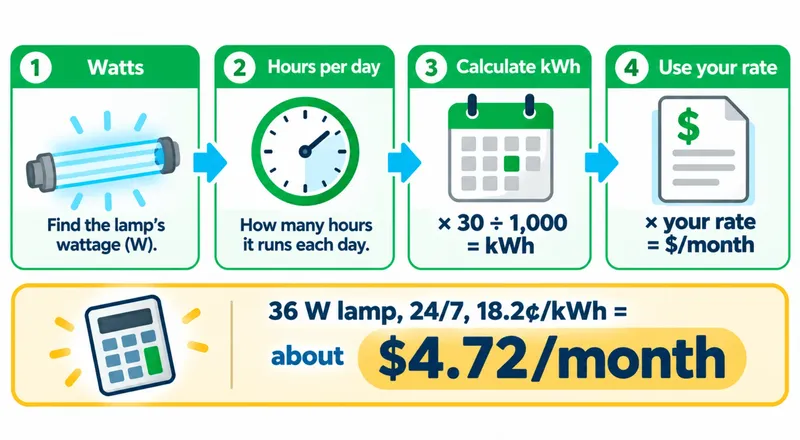
To calculate a UV light's running cost, multiply its watts by daily run hours and 30, divide by 1,000, then multiply by your electric rate.
Find the wattage. Look for the input wattage on the power supply label, and add up every lamp in the system.
Pick the run hours. Use 24 for a coil-mounted lamp. For a blower-linked lamp, use fan hours from your smart thermostat's runtime report.
Convert to kWh. Watts × hours per day × 30 ÷ 1,000.
Multiply by your rate. For an all-in rate, divide your total bill by the kWh you used that month.
Worked example: A 36-watt coil lamp running 24 hours a day uses 36 × 24 × 30 ÷ 1,000 = 25.9 kWh a month. At $0.182 per kWh, that comes to $4.72 a month, or about $57 a year.
HVAC UV Light Running Cost by Wattage and Run Pattern
At the 2026 average rate, a UV light costs about 79 cents to $9.43 a month, depending on total wattage and daily run hours.
Monthly costs at 18.2¢/kWh, the U.S. Energy Information Administration 2026 forecast average residential rate, using a 30-day month. Filterbuy calculations; lamp input wattage varies by model.
In the field, Filterbuy is seeing more two-lamp installs, with one lamp at the coil and a second at the blower or supply plenum. For those systems, use the 36- or 72-watt row. Our guide to coil-mounted vs. in-duct UV lights explains when a second lamp earns its keep.
How Much Does Your Electric Rate Change the Total?
Where you live can matter more than which lamp you buy. Here's the same 36-watt lamp at March 2026 residential rates.
Sources: U.S. EIA Short-Term Energy Outlook (national average); March 2026 state rates from EIA data. Rates change monthly.
Should Your UV Light Run 24/7 or Only With the Blower?
Whether a UV light should run 24/7 depends on what it's aimed at. A coil-mounted UV light should stay on around the clock, because the Air-Conditioning, Heating, and Refrigeration Institute (AHRI) advises against cycling UV lights with the fan; mold grows fastest when air is still. An in-duct lamp only treats moving air, so wiring it to the blower cuts hours without losing treatment.
Run-pattern guidance per AHRI. Costs at 18.2¢/kWh, 30-day month.
At Filterbuy, we sum this up as the target sets the schedule. Leave rewiring to a licensed technician, and see our guide to how UV lights work in an HVAC system for more on each type.
The trade-off few guides price: for a 36-watt in-duct lamp, blower-linked wiring saves about $28 to $38 a year. Frequent starts wear lamps out faster, though, and one early $83 bulb can wipe out most of that savings. Before rewiring, ask whether the lamp is rated for cycling.
Coil lamps are a different story. Cycling one to save $2 a month leaves the coil exposed when growth is most likely, and Atlantic Ultraviolet notes that frequent starts shorten lamp life.
What Else Belongs in the True Cost of a UV Light?
Electricity is usually the smallest recurring cost. Emerson's spec sheet calls for a new bulb after 9,000 hours of use, and a one-year Fresh-Aire UV replacement lamp sold for $82.50 in October 2026. That puts an 18-watt lamp's true yearly cost near $111.
Bulbs: UV-C output fades even while the lamp still glows, and most bulbs last one or two years. Filterbuy HVAC Solutions recommends two-year bulbs, which cost more up front but cut bulb changes in half.
Dust: A dusty lamp emits less UV-C, so a filter changed on schedule helps keep it clean.
Five-year cost of one 18-watt coil lamp (Filterbuy HVAC Solutions pricing, South Florida):
Installation: $299 (current special, parts and labor)
Electricity: about $144 (5 × $28.70)
Bulbs: about $330 (four yearly $82.50 replacements after the first)
Total: about $773, or roughly 42 cents a day, with electricity making up less than one-fifth.
Is Your UV Light Behind a Higher Electric Bill?
A UV light is almost never the cause. Even a two-lamp, 72-watt system running nonstop adds only about $9.43 a month. If your bill jumped more, check these first:
The thermostat fan. A fan set to "On" runs the blower 24/7, and a blower draws 50 to 800 watts. See running your HVAC fan nonstop for the cost.
The filter. A clogged filter makes the AC run longer.
The lamp's real draw. Plug-in 120-volt units, like Field Controls' UVX-16/120, can be checked with a watt meter. Hardwired units list input watts on the power supply label.
The bulb date. An overdue bulb keeps glowing and drawing power as its UV-C output fades, so you pay the same for less protection. Write the install date on the power supply.
Does an HVAC UV Light Lower Your Energy Bill?
Don't count on a UV light to pay for itself. According to AHRI, a cleaner coil helps a system hold its efficiency. Still, Penn State researchers found little independent research on UV coil cleaning, and the EPA says typical home UV units have limited effect on mold. Count any energy savings as a bonus.
The bigger lever sits upstream. Lawrence Berkeley National Laboratory found filter efficiency is among the biggest factors in how fast coils foul, and fit matters too. On Filterbuy's production lines, we cut every filter half an inch under its nominal size so it slides in and seals. A rattling filter lets dusty air slip past onto the coil, and no UV lamp stops that.
Filterbuy's take: Because we sell both filters and UV installs, we have no reason to oversell either. A UV light is a low-cost way to fight coil mold, while the filter does most of the work. Start with a well-fitting filter changed on schedule, and add a coil UV light if mold keeps returning to the coil.
"Before I recommend a coil lamp, I check the coil and drain pan for growth and make sure the filter fits snugly. If the real complaint is dust or allergies, I start with the filter."
David Clark, Licensed HVAC Technician and President, Filterbuy HVAC Solutions
Filterbuy Pro Tip: Before you approve an install, ask for the system's input wattage and replacement bulb price, then run the formula.
To protect your coil, pair a UV light with Filterbuy's American-made MERV 13 air filters and air filter auto-delivery.
Supporting Statistics
A UV lamp barely registers on a home's bill.
The average U.S. home bought 10,791 kWh of electricity in 2022.
An 18-watt lamp running 24/7 uses about 158 kWh a year, or roughly 1.5% of that.
Source: U.S. EIA, How much electricity does an American home use?
Air conditioning is the load worth protecting.
AC accounted for about 19% of home electricity use in 2020 (254 billion kWh).
For an average home, that's roughly 2,050 kWh a year.
Source: U.S. EIA, How much electricity is used for air conditioning?
A clean filter saves about what a UV lamp uses.
Replacing a clogged filter can cut AC energy use by 5% to 15%.
That's about 100 to 310 kWh a year, close to one or two UV lamps running nonstop.
Source: U.S. Department of Energy, Maintaining Your Air Conditioner
Frequently Asked Questions
Is Operating an HVAC UV Light System Costly?
No. By Filterbuy's calculations, it costs from under $1 to about $10 a month at the 2026 U.S. average rate, depending on wattage and run hours.
How Many Watts Does an HVAC UV Light Use?
Most residential HVAC UV lamps draw 17 to 36 watts each. Two-lamp or long in-duct systems total 36 to 72 watts.
Does a UV Light Raise Your Electric Bill?
Only slightly. Even a 72-watt, two-lamp system running nonstop adds about $9.43 a month at the 2026 average rate.
How Long Does an HVAC UV Bulb Last?
Most bulbs are rated for about 9,000 hours, or roughly one year of continuous use.
Can I Turn My UV Light Off in Winter to Save Money?
You can, but it saves only $2 to $5 a month, and AHRI recommends keeping UV lights on. If you do, turn it back on before cooling season.
Glossary
Kilowatt-hour (kWh): 1,000 watts used for one hour.
UV-C: Short-wave ultraviolet light (about 200 to 280 nm) that inactivates microbes.
Coil-mounted UV light: An HVAC UV lamp aimed at the evaporator coil and drain pan.
In-duct UV light: An HVAC UV lamp that treats air moving through a duct.
Airflow-linked operation: Wiring a UV lamp to run only when the blower runs.
AHRI: The Air-Conditioning, Heating, and Refrigeration Institute, an HVAC trade association.
Filterbuy: A family-owned U.S. air filter manufacturer based in Talladega, Alabama, making MERV 8, 11, and 13 filters in 600+ sizes.
Filterbuy HVAC Solutions: Filterbuy's licensed HVAC team in Pompano Beach, Florida.
Sources
U.S. EIA, Short-Term Energy Outlook (Oct. 2026)
Research and guidance: AHRI, U.S. EPA, Lawrence Berkeley National Laboratory, PHCP Pros (2017)
Manufacturer spec sheets: Copeland (Emerson), Field Controls, DiversiTech, Atlantic Ultraviolet
SupplyHouse, Fresh-Aire UV TUVL-115 replacement lamp