
How Long Do HVAC UV Bulbs Last, And When Should You Replace Them?
October 8, 2026
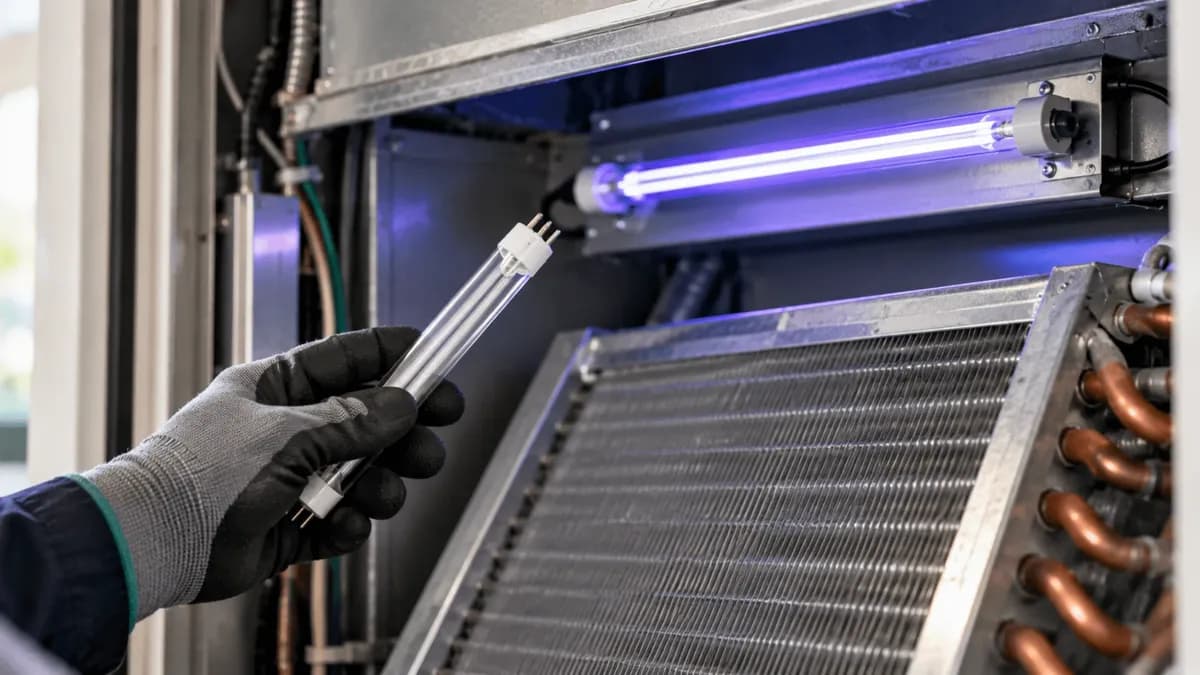
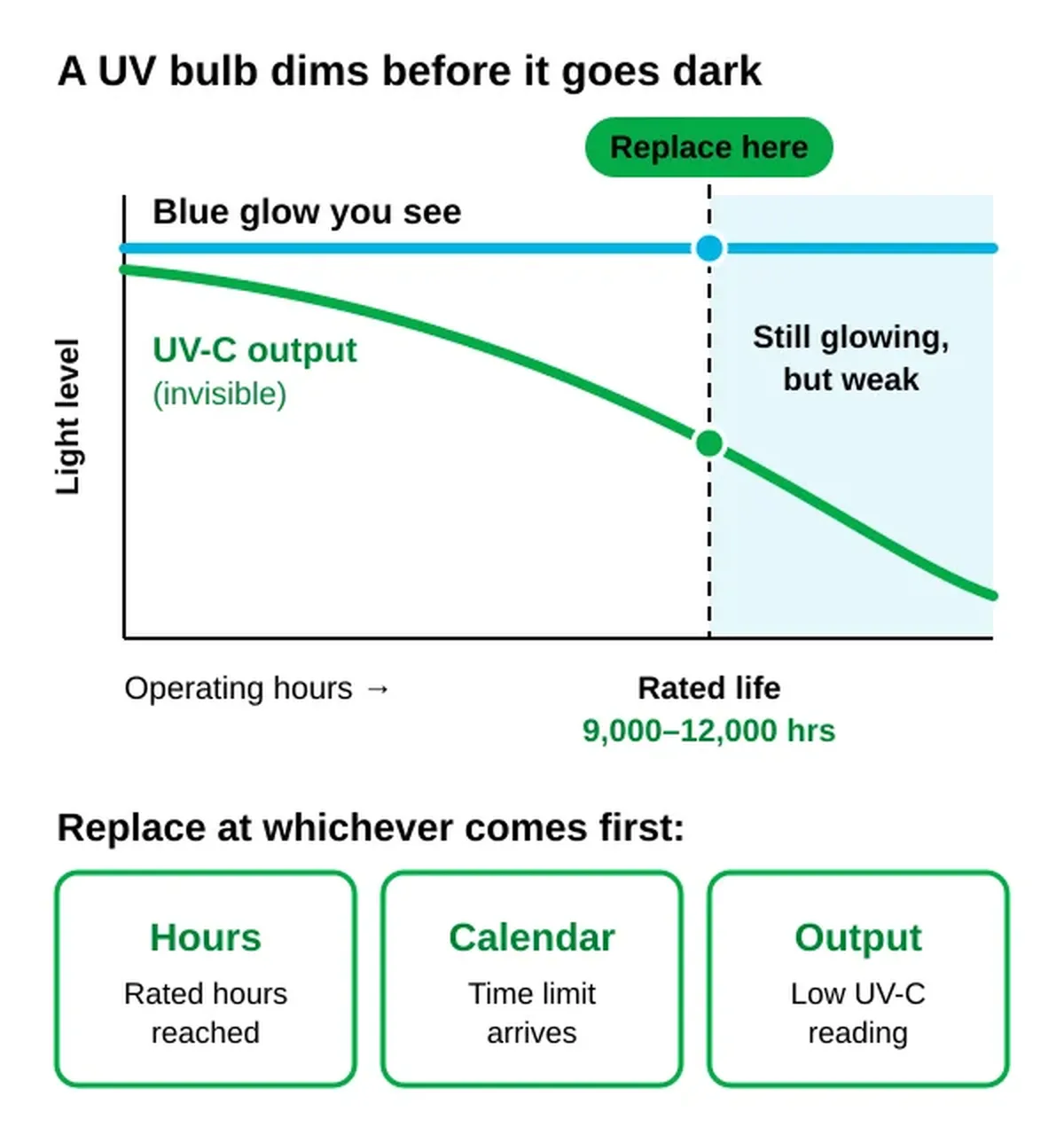
Most HVAC UV-C bulbs last 9,000 to 12,000 hours, about one year of nonstop use, or two years with a two-year bulb. A UV bulb dims long before it goes dark, so a glowing bulb isn't proof it's working.
Replace it at its rated hours, its calendar limit, or a low UV-C reading, whichever comes first. A clean air filter upstream helps keep dust off the lamp, and the quick quiz below matches you to yours.
Shop Air Filters Or find your match below
Answer a few quick questions and we'll match you to your perfect filter.
Most HVAC UV-C bulbs are rated for about 9,000 to 12,000 hours, or roughly a year of nonstop use. The catch is that a UV bulb dims long before it goes dark. At Filterbuy HVAC Solutions, where we install these lamps and replace their bulbs, the rule is simple: the hour count or the calendar decides when a lamp comes out, never the glow.
TL;DR
An HVAC UV bulb loses UV-C output gradually, and its rated life marks the point where that output has dropped by a set share. The bulb can keep glowing well past that point. Blower-wired lamps last more calendar months, but every start adds wear, so replace at the hour or calendar limit, whichever arrives first.
Key Takeaways
A UV replacement indicator usually counts time. Only a UV-C sensor or meter reads actual output.
Filterbuy's three-limit rule: replace an HVAC UV bulb at its rated hours, its calendar limit, or a low UV-C reading, whichever comes first.
Spent HVAC UV bulbs contain mercury, so they belong in a bulb recycling program.
How Many Hours Does An HVAC UV Bulb Last?
The typical HVAC UV bulb lifespan is 9,000 to 12,000 operating hours. ASHRAE's UVGI short course puts the nominal manufacturer range at 6,000 to 10,000 hours and advises replacing lamps at least once a year when they run continuously. Since a year holds 8,760 hours, a 9,000-hour lamp running nonstop reaches its rating around the 12-month mark.
Some lamps are sold as two-year bulbs, built to stay in spec for roughly twice as long. Our Filterbuy HVAC Solutions team recommends them wherever the fixture allows. They cost more up front, but fewer swaps mean fewer spent lamps sitting in service unnoticed, and our Performance Care Plan schedules UV bulb replacements ahead of time. New to these systems? Start with how UV lights work in HVAC systems.
What Does The Rated Hour Number Actually Measure?
A UV lamp's rated life is a statistical output threshold, not a burnout date. The National Institute for Occupational Safety and Health (NIOSH) defines effective lamp life as the hours after a roughly 100-hour break-in until half of a large test batch drops to a specified UV output level. NIOSH guidance on germicidal UV lamps cites a manufacturer rating of 9,000 hours at a 20% decline in UV output.
That definition has two consequences. First, the rating is a midpoint, so about half of all lamps hit the output threshold before the rated hour arrives. Second, manufacturers rate lamps under a fixed switching pattern, in NIOSH's example one start every three hours, so a lamp that starts more often can age faster than its label suggests.
ASHRAE's course material puts lifetime output loss at a minimum of about 15% and as high as 50%.
Why Does A UV Bulb Stay Lit But Stop Working?
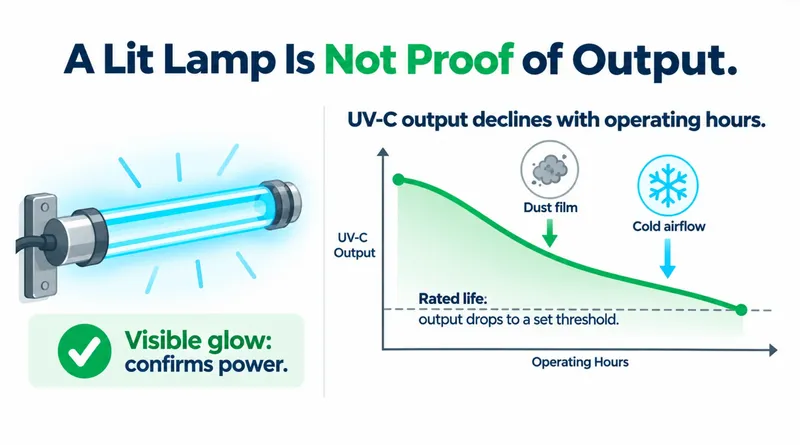
A UV bulb can be still on but not working because the blue light you see is a visible byproduct of the mercury discharge, while the germicidal wavelength near 254 nanometers is invisible. The glow confirms power and nothing more, as Filterbuy's guide to UV-C light and the 254nm wavelength explains.
Dust On The Lamp
Dust on the quartz tube blocks UV-C before it can reach the coil or airstream. ASHRAE inspection guidance calls for cleaning a dirty lamp with a lint-free cloth and glass cleaner or isopropyl alcohol, leaving no residue. A clean air filter upstream slows how quickly that film builds.
Cold Air Moving Past The Lamp
Low-pressure mercury lamps are temperature sensitive. ASHRAE notes that output peaks when the coldest spot on the tube sits near 40°C (104°F). In its worked example, a lamp with 20% age loss sitting in cool, moving air delivers about 44% of its maximum output. How much this matters depends on placement, as Filterbuy's comparison of coil-mounted vs. in-duct UV lights shows.
Whatever the cause, never judge a UV lamp by looking at it. The FDA warns that UV-C exposure may injure skin and eyes after a few seconds, so switch off power before opening any panel that houses a lamp. See the evidence on whether UV lights work in air ducts.
How Does Duty Cycling Change UV Bulb Replacement Timing?
Duty cycling stretches the calendar life of an HVAC UV bulb because rated life counts operating hours. A 9,000-hour lamp that runs only with the blower, 12 hours a day, takes roughly two years to reach its rating instead of one. Each start wears the electrodes, though, so a heavily cycled lamp may not deliver the full gain.
Calendar Months to Reach a UV Lamp's Rated Hours
Rated hours divided by (daily run hours x 30.4 days), rounded. Frequent starts and dust shorten real-world life.
Filterbuy built this table from published rating ranges, so treat each figure as a ceiling. Many coil-mounted lamps run around the clock because the coil and drain pan stay damp, the same conditions behind black mold in an AC unit, which puts them on the top row. A thermostat fan set to On puts a fan-linked lamp there too.
Worked example: a 9,000-hour lamp on a blower that averages 10 hours a day reaches its rating after about 30 months. Check its calendar limit and output well before then.
What Is A UV Bulb Replacement Indicator Counting?
Many HVAC UV replacement indicators count time, not light. Only a UV-C sensor responds to dust or lamp aging, so a timer that has not tripped is no proof the lamp still works. Filterbuy's take: treat a timer as a reminder and a UV-C reading as the verdict.
When Should You Replace An HVAC UV Bulb?
Filterbuy HVAC Solutions schedules every lamp swap by what we call the three-limit rule: replace an HVAC UV bulb at whichever of these limits arrives first. For an always-on lamp, that usually means yearly, or every two years with a two-year bulb.
The Three-Limit Rule
Hours: the run-hour count reaches the lamp's rating.
Calendar: the manufacturer's time limit arrives, or 12 months pass for an always-on one-year lamp.
Output: a UV-C meter reading falls below the manufacturer's threshold.
A lamp that flickers or will not light should come out right away.
Time the swap for spring. Coil lamps matter most in cooling season, when the coil stays wet, so start that season with a fresh lamp.
A two-year bulb lines up with every eighth filter change on a three-month schedule, so knowing how often to change your HVAC filter gives you a built-in reminder.
How Do You Replace An HVAC UV Bulb Safely?
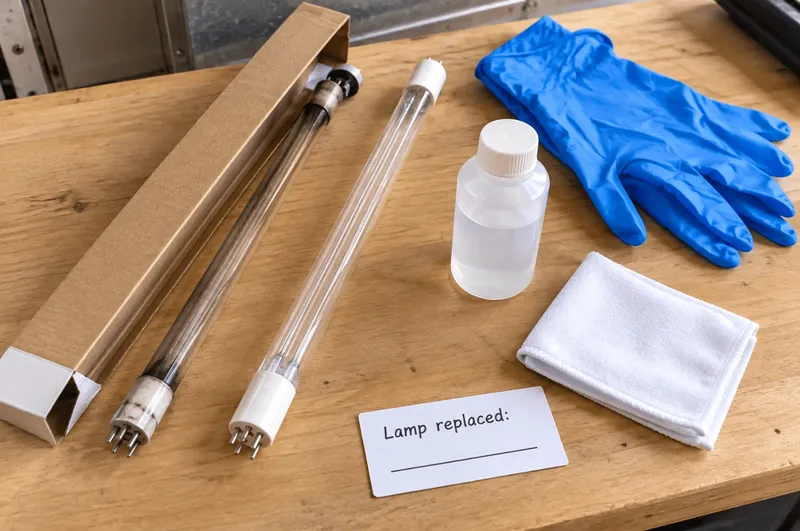
Replacing an HVAC UV bulb takes minutes, but UV-C and mercury make the order of steps matter: cut power, wear gloves, match the old part, and recycle the spent lamp.
Shut off power at the lamp switch and the air handler's service disconnect. Do not rely on a door safety switch.
Wear clean cotton or nitrile gloves. Skin oil left on the quartz can bake on and block UV-C.
Photograph the old lamp's label before you order, then match its part number and length and choose an ozone-free lamp. Because the California Air Resources Board's air cleaner rules require in-duct air cleaners using UVGI bulbs to pass ozone testing, a CARB-certified label is a good sign.
Seat the new lamp and restore power, then reset the indicator. Label the cabinet with the install date, rated hours, wiring (always-on or fan-linked), and next due date.
Recycle the old lamp. EPA guidance on recycling bulbs that contain mercury lists germicidal bulbs alongside fluorescent tubes.
For a lamp sealed deep inside an air handler, Filterbuy HVAC Solutions customers can schedule UV light installation and bulb replacement with a service visit.
Expert Insight
"Most lights last one to two years," says David Clark, Licensed HVAC Technician at Filterbuy HVAC Solutions. That range holds for the UV lamps in photocatalytic oxidation (PCO) systems too.
Supporting Statistics
15–34% UV-C loss in 500 hours
Two LED germicidal products lost 15–34% of UV-C output after 500 hours.
Both had implied lifetimes above 8,000 hours.
Source: PNNL's germicidal UV product testing (2024)
3 "UV-C" products emitted zero UV-C
The DOE CALiPER program tested 13 germicidal UV products.
Three LED products that claimed UV-C emitted only UV-A.
Source: DOE CALiPER germicidal UV test report (2023)
2% of household fluorescent lamps recycled
Lamp recyclers estimated households recycled only 2% of their mercury-containing lamps.
Source: Washington State Department of Ecology mercury lighting report (2012)
Frequently Asked Questions About HVAC UV Bulbs
How Often Should I Change The UV Bulb In My HVAC System?
Change a standard HVAC UV bulb about once a year if it runs continuously, or every two years if you use a two-year bulb.
Can I Tell If A UV Bulb Is Working By Looking At It?
No. UV-C light is invisible, so the blue glow only tells you the lamp has power. Only a UV-C sensor or meter reading confirms output.
Does Turning The UV Light Off With The AC Make The Bulb Last Longer?
Yes, in calendar months, because the rating counts operating hours. Each start adds electrode wear, though, so follow the fixture's wiring instructions.
Can I Throw An Old HVAC UV Bulb In The Trash?
No. Most HVAC UV bulbs are low-pressure mercury lamps, so take them to a bulb recycling drop-off.
Does A UV Light Replace My Air Filter?
No. An HVAC UV light treats the surfaces and air it shines on, while an air filter captures particles moving through the system at a level set by its MERV rating. As David Clark puts it, "The best filter is the highest rating your system can move air through, changed on schedule."
Glossary
Keep The Lamp And The Filter On The Same Schedule
Filterbuy makes the filters that sit upstream of these lamps in our own US plants, so we think of the lamp and the filter as one maintenance routine. A Filterbuy air filter subscription ships the right size with fast and free 2-day delivery to most US states, and each delivery is a reminder to check the lamp. Browse our UV light guides.