
How Much Does It Cost to Replace a Home Thermostat?
November 19, 2026
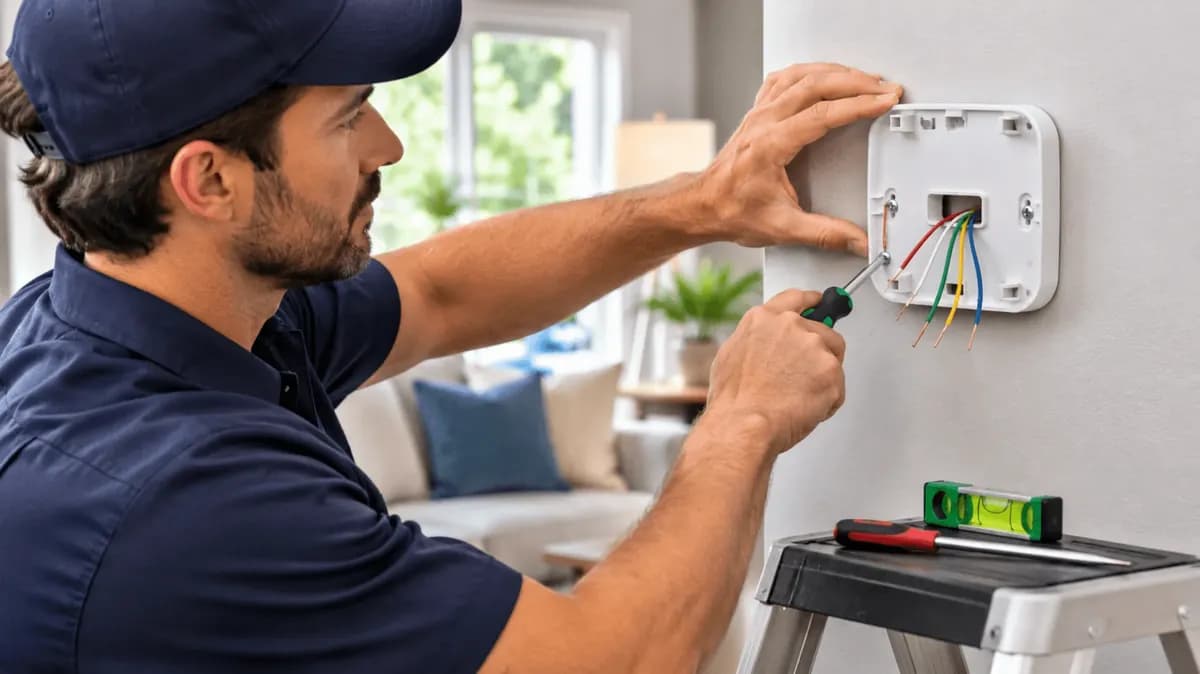
Not sure where your project lands in that range? Start with what's on your wall now. Swapping for the same type of thermostat keeps costs low, while moving to a smart model without a C-wire pushes them up.
Knowing your current thermostat type and wiring before you call for quotes helps you spot a fair price. It also tells you whether the job is one you can handle yourself.
Use the quick guide below to find your price range. Then take the match quiz, or shop air filters at Filterbuy.
Thermostat replacement cost at a glance
The more features your thermostat has, the more it costs to replace.
1 · INSTALLED COST BY THERMOSTAT TYPE
Manual
$50–$150
Non-programmable electronic
$85–$200
Programmable electronic
$100–$300
Smart / Wi-Fi
$185–$600
Ranges include the thermostat and professional installation. Your price depends on the brand, your local labor rates, and your HVAC system.
2 · WHAT CAN ADD TO THE BILL
Labor
$65–$100/hr
Most swaps take 1 to 2 hours. Big-city rates run higher.
New wiring
$90–$400
Needed when there's no usable wire, like a missing C-wire for a smart model.
Permits
$50+
Usually only for new installs or new wiring. A simple swap rarely needs one.
3 · DIY OR HIRE A PRO?
DIY can work when
- You're swapping for the same type of thermostat
- Your existing wiring works with the new model
- You don't need a new C-wire
You skip the labor charge
Call a pro when
- You're upgrading to a smart model without a C-wire
- The wiring is old or unfamiliar
- You're moving the thermostat or adding one for the first time
Wiring mistakes cost more than labor
Safety first: Turn off power to your HVAC system before removing the old thermostat. A wiring mistake can damage your equipment or void a warranty.
Cost ranges are 2026 U.S. national estimates from Fixr and Carrier. Get a local quote for exact pricing.
New thermostat? Check your air filter, too.
Your thermostat tells your HVAC system when to run. Your air filter keeps dust and debris out of it while it does. Answer a few quick questions and we'll match you to the right filter for your home.
Already know your size?
Most homeowners pay $100 to $500 to have a thermostat professionally replaced, and a simple like-for-like swap often comes in near $200. Smart thermostats, missing C wires (the wire that powers a smart thermostat), heat pumps, and zoned systems push the price higher. Since the thermostat itself is usually the smaller part of the bill, Filterbuy's advice starts with the wiring behind your current one.
TL;DR
Home thermostat replacement cost usually runs $100 to $500 installed, smart thermostat installation runs $200 to $500, and a new C wire adds about $120 to $200. Simple 24-volt (low-voltage) swaps are fine to DIY, but Filterbuy recommends a pro for heat pumps and zoned homes and an electrician for baseboard heat.
Key Takeaways
The average cost to replace a thermostat professionally is $100 to $500.
Smart thermostat installation cost typically runs $200 to $500.
C wire installation cost averages $120 to $200, or $20 to $80 for an adapter kit.
Heat pump thermostat replacement cost runs about $150 to $600.
Multi-zone thermostat installation cost is $150 to $500 per zone on an existing zoned system.
Thermostat Replacement Cost By Type
HVAC thermostat replacement cost starts with the type you choose. Non-programmable models are the cheapest, programmable models add scheduling for a little more, and smart thermostats cost the most because setup includes Wi-Fi and app pairing. Filterbuy compiled these ranges from 2026 national home-service cost guides.
Table 1: Thermostat Replacement Cost by Type (2026 National Ranges)
Installed costs include device and professional labor.
Electric baseboard heat runs on 120- or 240-volt thermostats, which belong with a licensed electrician, per Electrical Safety Foundation International's DIY electrical safety guidance. Mini splits usually skip wall thermostats, and Filterbuy's guide to smart thermostats for mini splits explains the alternatives.
Filterbuy's take: A smart thermostat earns its higher price when you'll use scheduling or your utility pays a rebate. Otherwise, a well-programmed programmable thermostat can do more for your bill than a smart one left on hold.
What Drives The Cost To Install A Thermostat?
The cost to install a thermostat rises once the job goes beyond a straight swap. A swap on existing wires takes under an hour, while new wiring or a new wall location can add one to three hours plus parts.
Wiring. Smart thermostats need steady power, which usually comes from a C wire.
Relocation. Moving the thermostat to a new wall typically costs $200 to $560.
Wall patching. If the old footprint shows, ask about a trim plate, a cover that hides old holes, or budget for touch-up paint.
Labor. HVAC technicians commonly bill $83 to $151 per hour.
C Wire Installation Cost And Power Options
C wire installation cost averages $120 to $200 when a technician runs new cable from the furnace or air handler to the thermostat. The C wire, short for common wire, gives a smart thermostat continuous 24-volt power, and a new wire run isn't always the cheapest way to get it.
Table 2: C Wire Installation Cost and Power Options
Wire distance and wall access drive the high end.
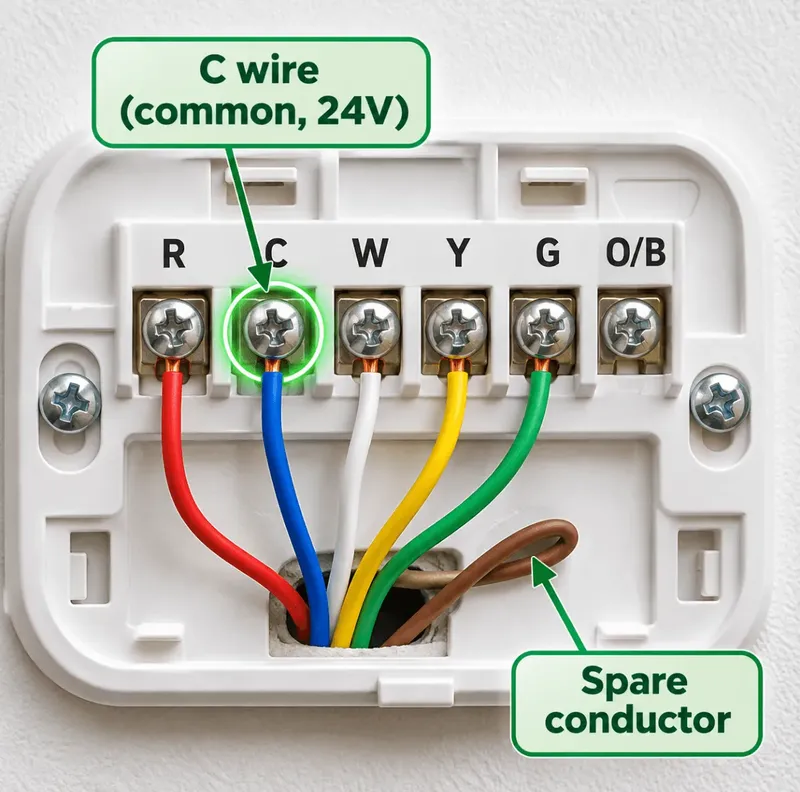
Filterbuy's faceplate budget check: Turn off HVAC power at the breaker, pull off the thermostat faceplate, and photograph the wiring. What you find points to your budget:
Thin wires with one on the C terminal: A DIY-friendly swap where the thermostat is your main cost.
No C wire, but a spare wire folded back: A technician can usually connect it for labor alone.
No C wire and no spare: Budget $20 to $80 for an adapter or $120 to $200 for a new wire.
Terminals marked O/B, AUX, or W2: These control a heat pump or backup heat. Plan on $150 to $600 with a pro.
Thick wires joined with wire nuts: Line voltage, which calls for a licensed electrician.
Heat Pump Thermostat Replacement Cost
Heat pump thermostat replacement cost usually runs $150 to $600 installed, more than a standard swap. A heat pump thermostat must control the reversing valve, which switches between heating and cooling, plus auxiliary heat, and a misconfigured unit can lean on costly backup heat.
The U.S. Department of Energy generally advises against standard programmable setbacks on heat pumps, since a deep setback can trigger backup heat. Look for heat pump support and an auxiliary heat limit, and see Filterbuy's guide to how auxiliary and emergency heat work on a heat pump.
Multi-Zone Thermostat Installation Cost
Multi-zone thermostat installation cost depends on whether your home already has a zone control panel and dampers, the motorized flaps inside the ducts. On an existing zoned system, replacing each zone thermostat typically costs $150 to $500. Homes without zoning need a new HVAC zoning system, a ductwork project that averages about $3,000.
Room sensors are no substitute, since only dampers send air to individual zones.
Is Professional Thermostat Installation Worth It?
Professional thermostat installation is worth it when the job involves new wiring, a heat pump, multiple zones, or line-voltage heat. For a like-for-like swap on a 24-volt system with a C wire, a careful homeowner can usually finish in under an hour and keep $75 to $250 in labor.
Before you accept a quote, ask:
Is the thermostat included, or is the price labor only?
Does it cover a C wire or adapter if needed?
Will they configure heat pump and auxiliary heat settings?
Does your rebate require pro installation, and will they handle the paperwork?
Will they take back the old thermostat, including mercury models?
A quick quote check: Labor above $250 for a same-spot swap with an existing C wire warrants a second quote.
Homeowners in Pompano Beach and the surrounding South Florida area can book smart thermostat installation in Pompano Beach through Filterbuy HVAC Solutions. Outside that area, ACCA's Quality Assured contractor directory lists licensed, insured HVAC contractors by ZIP code.
How Do I Recycle An Old Mercury Thermostat?
Take it to a household hazardous waste collection center. Some older non-digital thermostats hold a sealed mercury switch, so keep them out of the trash. The EPA's guidance on mercury in consumer products points homeowners to these centers, and the Thermostat Recycling Corporation's drop-off site locator lists drop-off sites.
Rule Out A Thermostat Problem Before You Replace It
Before paying for a replacement, confirm the old thermostat has actually failed. A thermostat that looks dead often has a power or airflow problem, or simply the wrong setting, and the six checks below are quick.
Replace the batteries if the display looks dim or blank.
Check the breaker, then the service switch at the furnace or air handler.
Confirm the mode with Filterbuy's guide to how heat, cool, and auto modes work, and clear any permanent hold on your thermostat.
Inspect the air filter. As a filter manufacturer, Filterbuy puts this check near the top, because a clogged filter can trip a furnace's high-limit safety switch or freeze an AC coil, and either looks like a failed thermostat. Find your size with Filterbuy's air filter size selector.
Look for false readings from direct sun, a lamp, a nearby vent, or a draft.
If the screen works but the system never responds, have a technician check the wiring and control board.
How To Lower Your Thermostat Replacement Cost
Utility rebates are the most direct way to reduce thermostat replacement cost. Many utilities run rebate programs for ENERGY STAR certified smart thermostats through online forms or instant discounts. Search your ZIP code in the DSIRE database of state and utility energy incentives.
Bundle the visit with a furnace or AC tune-up to avoid a separate trip fee.
Choose a model with a power kit in the box to skip a new wire run.
Treat filter reminders as a prompt to look. Many smart thermostats time filter reminders by run hours, so Filterbuy suggests checking the filter itself.
Set it up well using Filterbuy's season-by-season thermostat setting guide and fan Auto vs. On settings.
Expert Quote
"When someone asks me what a thermostat swap will cost, my first answer is a question: is there a wire on your C terminal? My second is to check the air filter before buying anything, because a clogged filter can make a working thermostat look broken."
Michelle Wan, Brand Manager and Air Quality Writer, Filterbuy
Supporting Statistics
About 1 in 9 thermostat homes had a smart model in 2020.
109.45 million U.S. homes had a thermostat.
12.78 million of those were smart or internet-connected.
Another 44.08 million, about 40%, were non-programmable.
Only 19.79 million let the thermostat adjust heating automatically.
Filterbuy's takeaway: Correct setup matters as much as the hardware.
ENERGY STAR smart thermostats cut heating and cooling bills about 8%, or $50 a year.
At $200 to $500 installed, payback runs about 4 to 10 years.
Takeaway: A utility rebate or DIY install shortens the payback.
HVAC mechanics and installers earned a median $29.33 per hour in May 2025.
Quoted rates run higher to cover insurance and travel time.
Takeaway: That's why short thermostat jobs often carry a flat fee.
Source: Heating, Air Conditioning, and Refrigeration Mechanics and Installers, Occupational Outlook Handbook
Frequently Asked Questions
What Is The Average Cost To Replace A Thermostat?
Professional thermostat replacement typically costs $100 to $500, and a simple swap often comes in around $200.
How Much Does It Cost To Add A C Wire?
A new C wire run averages $120 to $200, while a power adapter kit costs $20 to $80 in parts.
Can I Replace My Thermostat Myself?
Yes, if your system runs on 24-volt wiring and the new thermostat matches it. Turn off the power and photograph the wires first.
Do Smart Thermostats Work With Heat Pumps?
Most smart thermostats work with heat pumps, as long as they support the O/B terminal and auxiliary heat. Check the maker's compatibility tool before you buy.
Do I Need A New Thermostat When I Replace My HVAC System?
Often, yes. Heat pumps and variable-speed systems may need a compatible thermostat, so ask for one in the system quote.
Get Help With Your Thermostat Upgrade
Check your wiring and system type, then price the thermostat that fits. Want a technician to handle the wiring and setup? Explore Filterbuy HVAC Solutions' energy-saving HVAC services, which include smart thermostat installation in its Florida service area. Then use the Filterbuy smart thermostat resource library for setup help.
Glossary
C wire: The common wire that supplies a thermostat continuous 24-volt power.
Line-voltage thermostat: A 120- or 240-volt thermostat for electric baseboard heat.
Heat pump: A system that heats and cools by moving heat.
O/B terminal: The terminal that controls a heat pump's reversing valve.
Auxiliary heat: Backup heat a heat pump uses when it can't keep up.
HVAC zoning: Dampers that condition areas separately.
Power adapter kit: A device that powers a thermostat without a new C wire.
ENERGY STAR: The EPA's efficiency certification program.
DSIRE: A database of state and utility energy incentives.
EIA: The U.S. Energy Information Administration, a federal agency.
ACCA: Air Conditioning Contractors of America, an HVAC contractor association.