
How Does a Smart Thermostat Work? The Features That Actually Matter
November 26, 2026
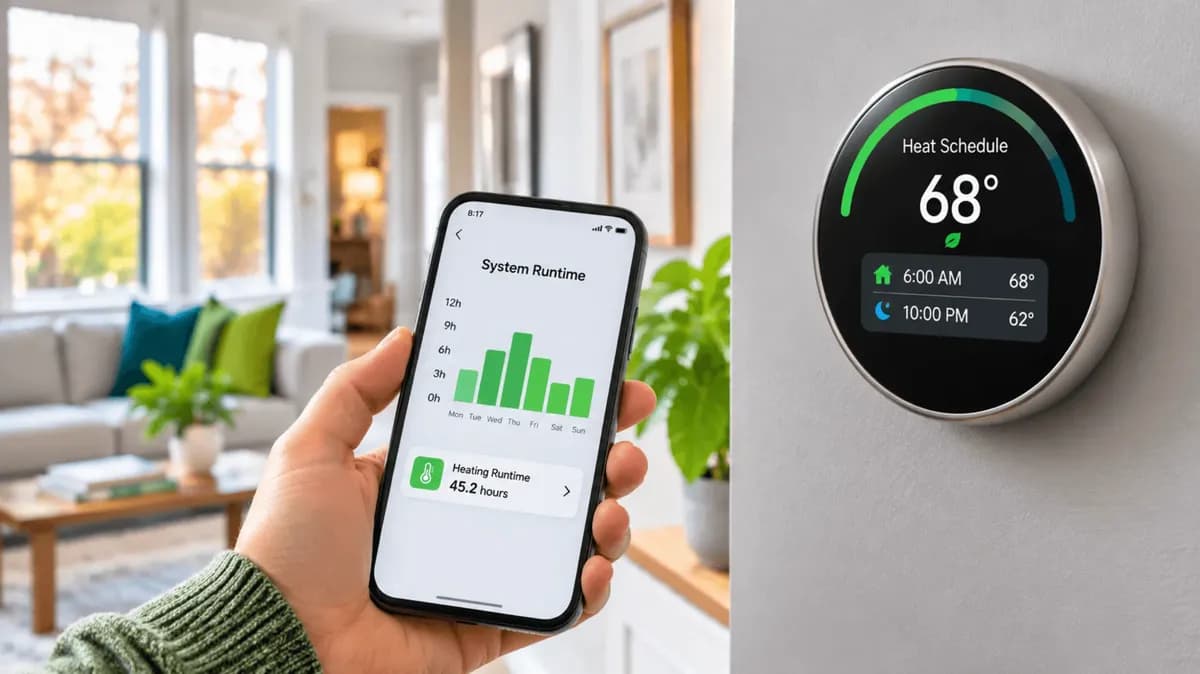
A smart thermostat reads your home with sensors, checks your schedule, and tells your furnace, AC, or heat pump when to run. It uses the same low-voltage wires as a basic thermostat, and Wi-Fi adds app control and a log of how long your system runs.
Here's the loop it repeats all day:
- Sense: it measures temperature, and often humidity and occupancy.
- Decide: software compares readings to your schedule, away mode, or learned habits.
- Signal: a relay closes the 24V circuit to start heating or cooling.
- Log: it counts run hours, which can flag when a filter is due.
ENERGY STAR says certified models cut heating and cooling bills by about 8% on average. Put that runtime data to work: take the quick quiz below to find your filter match.
How a smart thermostat works
One loop, repeated all day
1
Sense
Reads temperature, humidity, and occupancy
2
Decide
Compares readings to your schedule
3
Signal
Sends 24V over low-voltage wires
4
Run & log
HVAC runs; Wi-Fi logs runtime
↻ Back to step 1
Runtime hours → filter reminder
Set the alert by your filter's depth.
Find your filter match
Your thermostat tracks the hours. Answer 3 quick questions and we'll match you to the right filter.
Already know your size? Order the size printed on your old filter's frame. Custom sizes are available too.
A smart thermostat is a Wi-Fi-connected wall control that reads temperature, occupancy, and schedule data, then decides when your furnace, air conditioner, or heat pump should run. It signals over the same low-voltage wires a basic thermostat uses. The difference is software that adjusts itself and records how long your system runs. As an air filter manufacturer, Filterbuy pays closest attention to that runtime record.
TL;DR
A smart thermostat combines sensors, scheduling software, and Wi-Fi so your heating and cooling (HVAC) system runs when the home needs it. ENERGY STAR reports that certified models cut heating and cooling bills by about 8% on average. Scheduling and occupancy sensing do most of that work, and the same runtime data flags when your filter is due.
Key Takeaways
A smart thermostat is a programmable thermostat that connects to Wi-Fi and adjusts itself.
A learning thermostat builds its schedule from the adjustments you make.
Without Wi-Fi, most smart thermostats keep running, though you lose app control.
Schedules and away modes save energy. Voice control is a convenience.
Set runtime filter reminders by filter depth, and check the filter when the alert fires.
What Is A Smart Thermostat?
A smart thermostat is a connected HVAC control that pairs a programmable schedule with software that can change settings on its own. As ENERGY STAR puts it, a programmable thermostat holds your schedule until you change it, while a smart thermostat learns your habits or adjusts automatically.
How Does A Smart Thermostat Work?
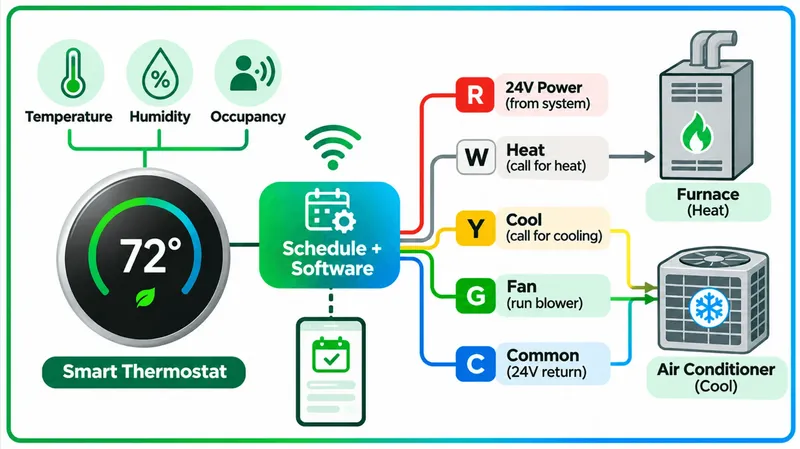
A smart thermostat runs in a loop. Sensors measure the room, the software checks those readings against your target and schedule, and a relay, a small electrical switch, closes the low-voltage circuit that starts heating, cooling, or the blower fan. Wi-Fi brings app commands in and sends runtime data out.
Sensors Read The Home
Smart thermostats measure temperature, and most track humidity and occupancy too. Models like ecobee and the Honeywell Home T9 add wireless room sensors to favor the rooms you use.
Software Decides When To Run
Geofencing uses your phone’s location to switch to an away setting once everyone leaves. Adaptive recovery, which Google Nest calls Early-On, starts heating or cooling early so the house reaches your target on time.
Low-Voltage Wires Send The Signal
The thermostat then closes a circuit on the 24-volt wiring to your furnace or air handler. R carries power, W calls for heat, Y calls for cooling, G runs the blower, and C keeps the thermostat powered. Heat pumps add an O/B wire, which switches between heating and cooling. Filterbuy’s guide to thermostat wiring colors covers each terminal.
What Does A Smart Thermostat Do? Smart Thermostat Features Explained
At Filterbuy, we sort smart thermostat features with one question: does it cut the hours your system runs? The table applies that test and notes what still works offline.
Offline behavior varies by brand and model.
What Is A Learning Thermostat?
A learning thermostat, like the Google Nest Learning Thermostat, builds its own schedule by watching when you adjust the temperature. Most other smart models follow a schedule you set.
For heat pumps, the Building America Solution Center thermostat controls guide from Pacific Northwest National Laboratory recommends adaptive recovery. A fast warm-up after a deep setback can trigger auxiliary heat, the backup electric heat that costs more to run.
Does A Smart Thermostat Need Wi-Fi?
A smart thermostat needs Wi-Fi for its connected features, and often for setup, but not to heat or cool your home. If the connection drops, most models keep their schedule and still respond at the wall, as Google’s Nest help pages confirm.
You lose anything that needs the internet: app control, geofencing, weather adjustments, alerts, and software updates.
Which Smart Thermostat Benefits Show Up On Your Energy Bill?
The smart thermostat benefits that lower bills come from cutting runtime you don’t need. Schedules, away modes, occupancy sensing, and geofencing do that work. Homes occupied all day usually save less because there are fewer empty hours to set back.
How Smart Thermostat Runtime Data Can Track Your Air Filter
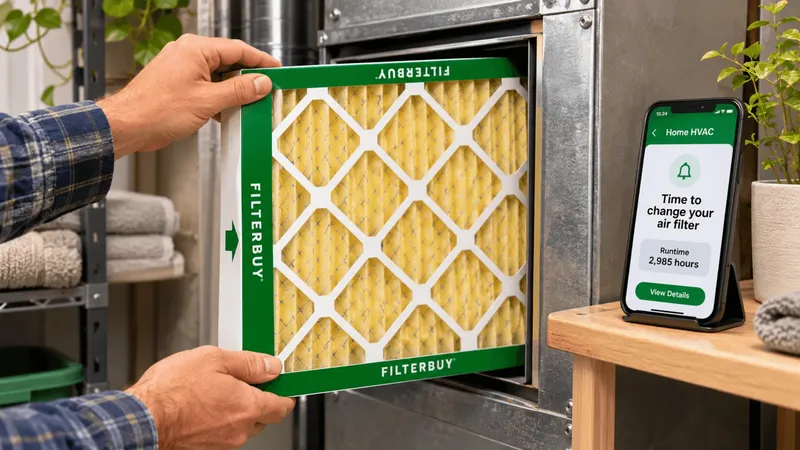
A smart thermostat tracks your air filter by counting the hours your system runs and alerting you when that total reaches the interval you set. Google Nest estimates reminders from runtime, ecobee lets you choose run-time hours or calendar months, and Copeland Sensi can count fan runtime. Because Filterbuy makes the filters these reminders point to, we read that count from the airflow side.
Our advice: treat the alert as a prompt to check, not proof the filter is dirty. Hold the filter up to a light. If light doesn’t pass through the pleats, replace it. Copeland Sensi starts at about 300 runtime hours, but filter depth matters more. A 4-inch filter holds far more dust than a 1-inch one, so it can go longer. Fan On hours count too. Learn how to reset the filter reminder on your thermostat and compare fan Auto vs. On settings.
When it’s time for a new one, choose by MERV rating, the 1 to 16 scale for how well a filter captures particles. MERV 8 air filters are the standard choice for most homes. MERV 11 air filters are built for allergy sufferers and homes with pets or pollen, and MERV 13 air filters are the pick for smoke. Whichever tier you choose, check your HVAC manual to confirm the fit, the same way you’d confirm the size.
Will A Smart Thermostat Work With Your HVAC System?
Most central forced-air furnaces, air conditioners, and heat pumps with 24-volt control wiring work with a smart thermostat. Most problems fall into four cases.
No C wire. An adapter or add-a-wire kit usually supplies the steady power it needs. Here is what a C wire is and how to add one.
Line voltage. Baseboard heaters run on 120 or 240 volts, so they need a smart thermostat rated for line voltage.
Ductless mini splits. Most take commands from their own remote or app, so compare smart thermostat options for mini splits.
Communicating systems. Some variable-speed Carrier, Trane, and Lennox systems use their own brand-specific controls, so check the equipment manual.
Brand names appear for compatibility only. Filterbuy isn’t affiliated with or endorsed by Google, ecobee, Honeywell Home, Copeland, Carrier, Trane, or Lennox.
Filterbuy’s step-by-step thermostat installation guide walks you through the swap, and what a thermostat replacement costs covers parts and labor. For line-voltage wiring or a heat pump setup you’re unsure about, call a licensed HVAC technician.
Five Smart Thermostat Settings To Change On Day One
These five changes fit a new thermostat to your home.
Confirm the system type (furnace, heat pump, or dual fuel) so the O/B wire and auxiliary heat behave correctly.
Turn on the runtime filter reminder, and set it to match your filter depth rather than the default.
Leave the fan on Auto unless you want extra filtration, since On mode adds filter hours.
Set one away setback and one sleep setback with our season-by-season temperature settings. If the schedule seems ignored, see permanent hold vs. temporary hold.
Turn on geofencing only for phones that leave home daily, and read the terms before joining a utility demand response program, which lets the utility adjust your thermostat at peak times.
What A Smart Thermostat Can’t Fix
A smart thermostat controls when your system runs, not how well it moves air. In Filterbuy’s view, the runtime report is the app’s most underused screen because it surfaces problems like these.
A clogged filter or blocked return. Runtime climbs until airflow is restored.
Leaky or undersized ductwork. Conditioned air escapes before it reaches the room.
Hot and cold rooms on one zone. Room sensors can favor a room, but only dampers or zoning send it more air.
An oversized system. Short, frequent cycles waste energy under any schedule.
Smart Thermostat Not Working Right? Start With These Checks
A blank screen or reboots usually point to weak C wire power, an offline app points to the router, and odd run times mean a learned schedule or an active hold. Filterbuy’s troubleshooting guides start with the filter, because many problems blamed on the thermostat turn out to be airflow problems. For fixes, see our full thermostat troubleshooting guide.
Expert Insight
“I treat the runtime screen on a smart thermostat like a check-engine light for airflow. When the hours climb faster than the weather explains, I check the air filter first, then the vents.”
Michelle Wan, Brand Manager and Air Quality Writer, Filterbuy
Supporting Statistics
8% Lower Heating and Cooling Bills
ENERGY STAR certified smart thermostats save about 8%, or roughly $50 a year.
Savings are measured as reduced HVAC runtime in real homes.
What it means: look for the ENERGY STAR label.
Only 12% of U.S. Homes Used a Programmed Thermostat for Central AC (EIA, 2015)
Over two-thirds of homes with central AC and a programmable thermostat adjust temperatures without programming it.
What it means: automatic features handle the scheduling most people skip.
Source: One in Eight U.S. Homes Uses a Programmed Thermostat With a Central Air Conditioning Unit
About 30% of U.S. and Canadian Homes Use Connected Thermostats (LBNL and EPA, 2022)
Connected thermostats also make up half of annual thermostat sales.
What it means: smart thermostats are now a mainstream upgrade.
Source: Long-Term Trends in Connected Thermostat Performance
Frequently Asked Questions
Is A Smart Thermostat The Same As A Programmable Thermostat?
No. A smart thermostat adds Wi-Fi and sensing, so it can adjust on its own and report runtime.
Can A Smart Thermostat Work Without A C Wire?
Some smart thermostats borrow power from other wires, which can cause reboots. A C wire or adapter is more reliable.
Do Smart Thermostats Work With Heat Pumps?
Yes. Most smart thermostats support heat pumps through the O/B wire and an auxiliary heat terminal.
Does A Smart Thermostat Save Money If Someone Is Home All Day?
A smart thermostat still can. Overnight setbacks save energy even when someone is home all day.
Can A Smart Thermostat Tell Me When To Change My Air Filter?
Yes. Most smart thermostats offer filter reminders based on runtime, a calendar interval, or both.
Put Your Thermostat’s Runtime Data To Work
When your thermostat says the filter is due, Filterbuy makes the replacement easy. We cut, pleat, and frame MERV 8, 11, and 13 air filters to order in our own US plants. Custom sizes are cut to the eighth of an inch, with fast and free 2-day delivery to most US states. Shop air filters by size, or browse Filterbuy’s full smart thermostat resource library.
Glossary
Smart thermostat: A Wi-Fi-connected thermostat that adjusts heating and cooling on its own.
Learning thermostat: A smart thermostat that learns its schedule from your adjustments.
Geofencing: Using a phone’s location to switch between home and away settings.
Adaptive recovery: Starting early to reach the target temperature on schedule.
C wire: The wire that gives a thermostat steady 24-volt power.
O/B wire: The heat pump wire that switches between heating and cooling.
ENERGY STAR: The EPA program that certifies energy-efficient products.
MERV: Minimum Efficiency Reporting Value, a 1 to 16 scale for air filter particle capture.