
The Best Thermostat Setting for Sleep (Summer and Winter)
November 10, 2026
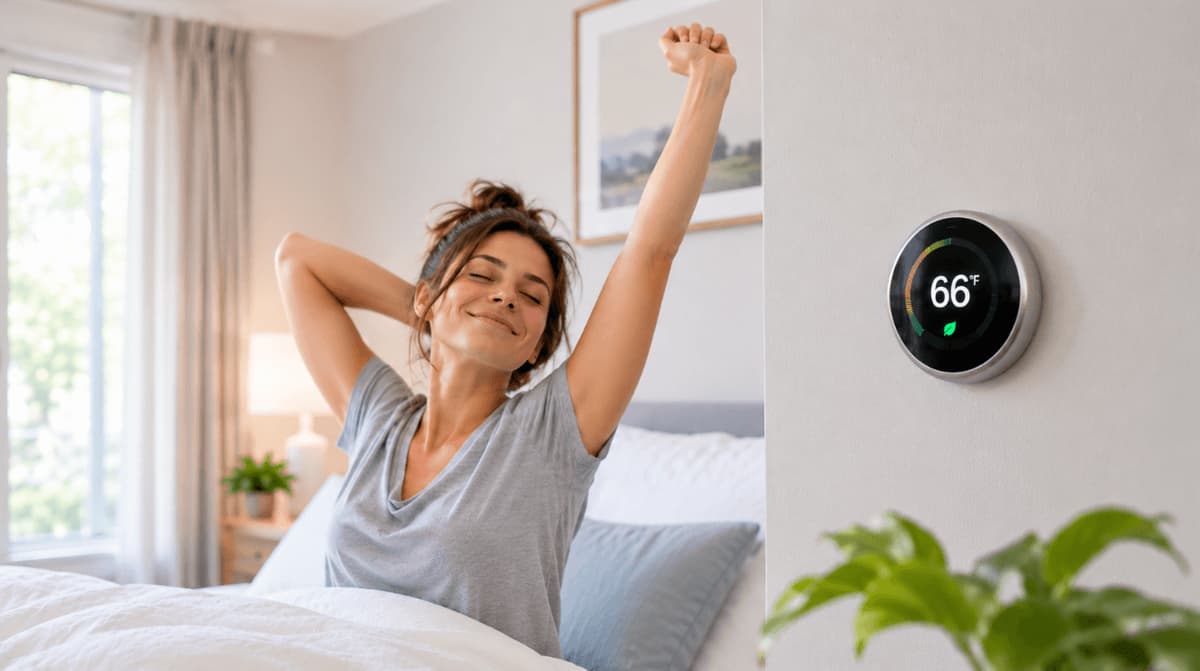
Set your thermostat so the bedroom itself lands in the mid-60s. Your thermostat reads the hallway, not the room where you sleep.
Leave a thermometer on your nightstand for a week. If it reads 3°F above the thermostat, set the thermostat 3°F lower.
Still can’t close the gap? A clogged filter can keep cool air from reaching rooms at the end of the duct run.
Shop Air Filters at FilterbuyWhere to set your thermostat at night
Measure at your bed, not the hallway
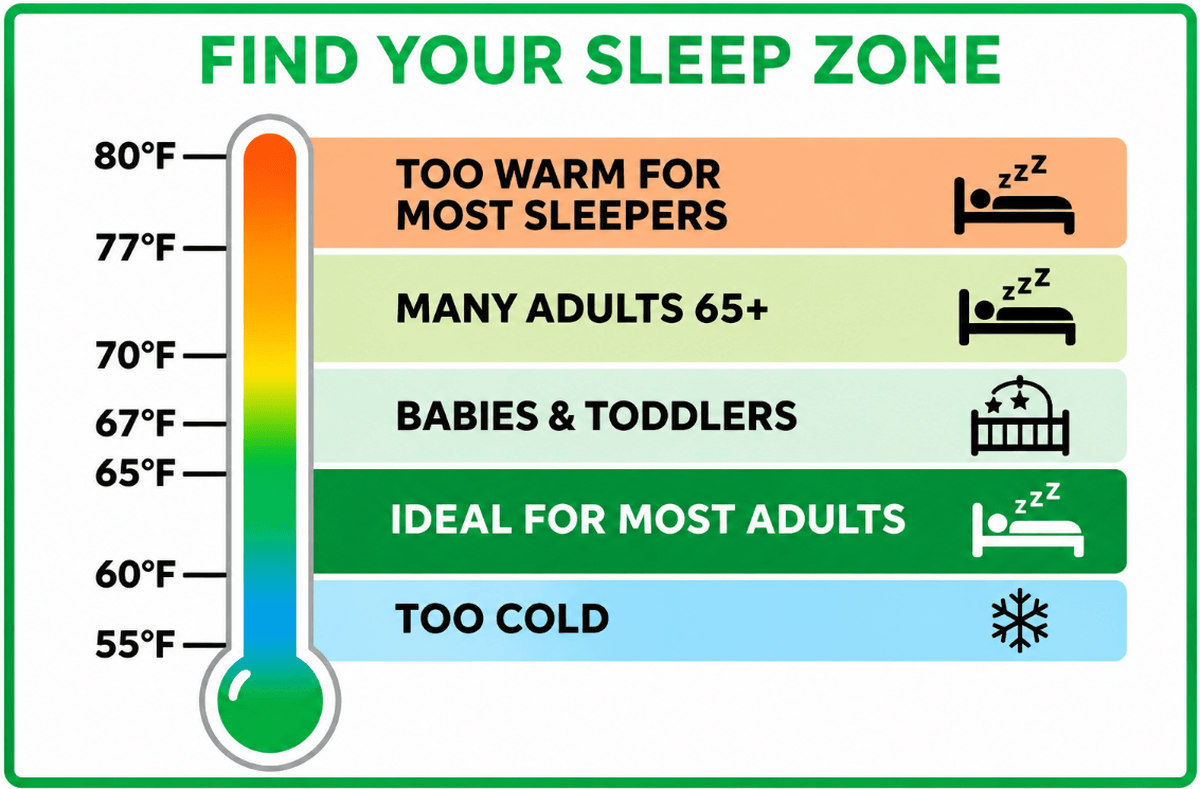
Below 60°F: Too cold. Can cut into REM sleep.
60–67°F: The sleep zone specialists recommend.
67–70°F: Leans warm. A ceiling fan feels about 4°F cooler.
Above 70°F: Too warm for most adults.
Find your number in three nights
1. Night one
Set 65°F and keep the same bedding.
2. Each morning
Woke hot? Drop 2°F. Woke cold? Raise 2°F.
3. After night three
Program the setting that worked.
Find the Right Filter for Your Home
Answer a few quick questions and we’ll match you to your filter.
TL;DR
For most adults, the best thermostat setting for sleeping is about 65°F, inside the 60–67°F range sleep specialists recommend. Lower the thermostat 30–60 minutes before bed and let it warm back up before you wake. Older adults and babies tend to sleep better a few degrees warmer, and heat pumps work best at a steady overnight setting.
Key Takeaways
Most adults sleep best between 60°F and 67°F. The Sleep Foundation puts the ideal bedroom temperature at about 65°F.
A nighttime setback can lower your energy bill. Turning the thermostat back 7–10°F for 8 hours a day can save up to 10% a year on heating and cooling, per federal estimates.
Older adults and babies sleep better a little warmer. Research points to 68–77°F for adults 65+ and 65–70°F for babies.
Heat pumps work best at a steady setting. ENERGY STAR advises picking a comfortable temperature and leaving it there.
Clean, balanced air helps you sleep. Filterbuy recommends 30–50% humidity and a fresh HVAC filter on schedule.
What Is the Best Thermostat Setting for Sleeping?
For most adults, the best thermostat setting for sleeping is around 65°F (18.3°C). Cleveland Clinic sleep specialists recommend keeping the bedroom between 60°F and 67°F, and the Sleep Foundation puts the sweet spot near 65°F.
One catch: your thermostat measures the hallway, not your bedroom. As a filter maker, Filterbuy sees how a clogged filter widens that gap by starving rooms at the end of the duct run.
Filterbuy tip: Leave a thermometer on your nightstand for a week. If it reads 3°F above the thermostat, set the thermostat 3°F lower and check your filter.
Find Your Number With Filterbuy’s Three-Night Test
Night 1: Set 65°F before bed, and keep the same bedding all three nights.
Each morning: Note whether you woke too hot or too cold.
Nights 2 and 3: Woke hot? Drop 2°F. Woke cold? Raise it 2°F. Slept through? Leave it.
After night 3: Program the setting that worked, and retest when the seasons change.
“A bedroom that doesn’t match the thermostat is one of the comfort complaints we hear most. The thermostat is rarely the problem. It’s usually a leaky duct, a closed supply vent, unbalanced airflow or a filter so dirty the air never makes it down the hall.” – David Clark, President of Filterbuy HVAC Solutions and EPA-certified technician
Why Does a Cool Bedroom Help You Sleep?
A cool bedroom helps because your body sheds heat to fall asleep. Core temperature drops about 2°F overnight as part of your circadian rhythm, your internal 24-hour clock, and a cooler room makes that easier.
Yet most bedrooms run warm. A study in the journal Sleep of 3.75 million nights from 34,096 U.S. adults found:
Bedrooms ran above 70°F on 69% of nights.
Every 1°F rise between 60°F and 85°F was linked to about 0.45 fewer minutes of total sleep and more time awake after falling asleep.
The best AC temperature for sleeping is the coolest you can afford, ideally 65–70°F. On a budget, set 72–75°F and run a ceiling fan, which University of Florida IFAS Extension says feels about 4°F cooler.
Schedule cooling to start 30–60 minutes before bed.
Skip the extra-low setting. Dropping the thermostat further won’t cool the house any faster. The system just runs longer.
Watch the humidity. Humid air feels warmer, so aim for 30–50% relative humidity.
Why Does ENERGY STAR Say 82°F at Night When Sleep Experts Say 65°F?
ENERGY STAR’s 82°F guidance made headlines in 2019, but it targets energy savings, not sleep. Most families land in between:
Filterbuy’s take: set for sleep first and savings second. A 10% energy saving isn’t worth an hour of lost sleep. In many bedrooms, the better fix isn’t a lower setpoint but clean airflow, so the setpoint you have actually reaches the room.
What Temperature Should You Set Your Thermostat at Night in Winter?
In winter, most adults with a furnace sleep well at 60–67°F overnight. Federal guidance, summarized by This Old House heating expert Richard Trethewey, suggests about 68°F while you’re awake and 7–10°F lower while you sleep. That can save up to 10% a year, about $90 for a household paying the ENERGY STAR average of more than $900, and the morning reheat uses less energy than the setback saves.
Recover before you wake. Time the warm-up to finish by your alarm. ENERGY STAR certified smart thermostats learn that timing and save about 8% on heating and cooling bills on average.
Stay above 60°F in bedrooms. Leaving town? See our thermostat setting when away in winter guide.
How Big Should Your Nighttime Setback Be for Your System?
Furnaces handle a big drop; heat pumps and radiant floors need a gentler one.
Heat pump guidance is from ENERGY STAR. Furnace and radiant guidance follows This Old House heating expert Richard Trethewey. Always check your equipment maker's guidance.
Heat pump owners can also learn what aux heat means and how to prep the system for winter.
Sample Sleep Schedule for a Programmable Thermostat
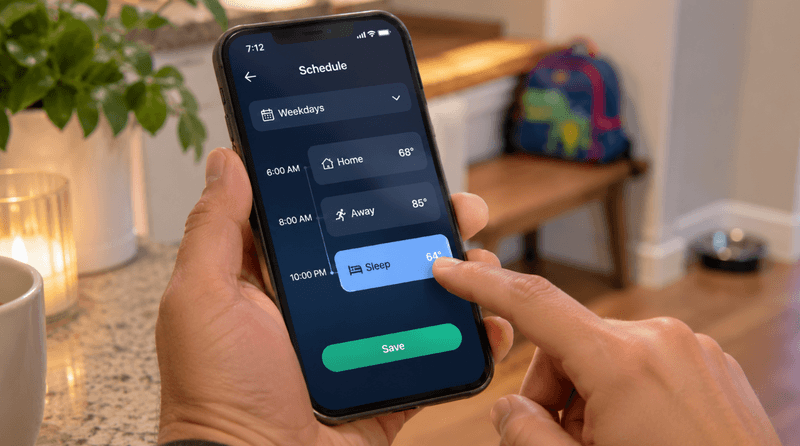
This Filterbuy sample schedule assumes a 10:30 p.m. bedtime and a gas furnace with central air.
Heat pump owners: ENERGY STAR recommends picking a comfortable temperature and leaving it there instead of using these setbacks.
Who Should Sleep in a Warmer Bedroom?
Adults 65 and older: A 2023 study in Science of the Total Environment tracked about 11,000 nights and found older adults slept best at 68–77°F.
Babies and toddlers: Cleveland Clinic suggests 65–70°F. Because overheating is the bigger risk, the American Academy of Pediatrics advises no more than one layer more than an adult wears, and watching for sweating or a hot chest.
Waking Up Too Hot or Too Cold? Filterbuy’s Symptom Guide
Body temperature bottoms out in the early morning, the Sleep Foundation notes, so a setback that runs too deep shows up as waking cold before the alarm.
How Do You Keep Bedroom Air Clean While You Sleep?
Clean bedroom air starts with a fresh HVAC filter and 30–50% humidity, because whatever the filter misses cycles past your pillow all night.
After more than a decade building filters in our own U.S. plants, Filterbuy recommends four habits:
Change your air filter on schedule. A clogged filter restricts airflow, so far-off bedrooms may never reach your setpoint. See how often to change your HVAC filter.
Match the MERV rating to your household. Filterbuy’s pleated MERV 8 handles everyday dust. If you have pets or allergies, step up to MERV 11; for finer particles like smoke, choose MERV 13. Our MERV rating chart compares them.
Control humidity. The EPA recommends 30–50% relative humidity to help limit mold and dust mites. In winter, as Michelle Wan puts it, humidity is “a moving target”; see our winter humidity guide.
Check outdoor air before opening a window. On smoky or high-pollen nights, check the live air quality map.
Filterbuy ships 600+ sizes plus custom filters free from the factory. Set up auto-delivery, and your next filter arrives when it’s due.
Supporting Statistics
1. More Than 1 in 3 U.S. Adults Don’t Get Enough Sleep
A Centers for Disease Control and Prevention study found more than a third of U.S. adults regularly sleep under 7 hours.
Source: CDC Newsroom, "1 in 3 adults don’t get enough sleep", February 2016.
2. Heating and Cooling Cost the Average Household More Than $900 a Year
ENERGY STAR reports that heating and cooling take almost half of the average household’s energy bill, more than $900 a year.
Source: ENERGY STAR, Smart Thermostats.
3. About 3,500 U.S. Babies Die Suddenly and Unexpectedly During Sleep Each Year
The American Academy of Pediatrics lists overheating as a risk factor for sudden infant death syndrome (SIDS).
Source: AAP, HealthyChildren.org, "How to Keep Your Sleeping Baby Safe", updated September 2026.
Frequently Asked Questions
Is 72°F too warm for sleeping?
For most adults, yes. Cleveland Clinic considers a bedroom above 70°F too hot; if 72°F is your budget limit, add a ceiling fan.
Should I turn the heat off at night?
No, lower it. Shutting the heat off risks a cold house and, in a hard freeze, frozen pipes.
Is it better to sleep in a cold room?
Yes, within limits. A 60–67°F bedroom supports deeper sleep, but going below 60°F can cut into REM sleep. The Sleep Foundation considers too cold less harmful than too warm, so lean cooler and add a blanket.
Should my HVAC fan be set to Auto or On at night?
Auto, in most homes. It runs the fan only while heating or cooling, and ENERGY STAR recommends it for heat pumps.
Can a dirty air filter make my bedroom warmer?
Yes. A clogged filter restricts airflow, so distant rooms may never reach your setpoint. Filterbuy recommends checking it monthly.
About the Author and Reviewer
Michelle Wan is Brand Manager at Filterbuy and works directly with its U.S. manufacturing team.
David Clark, a licensed, EPA-certified HVAC technician, is President of Filterbuy HVAC Solutions.
Glossary
Thermostat setback: Lowering the heating setpoint (or raising the cooling setpoint) for a set period, such as overnight, to save energy.
Auxiliary heat (aux heat): Backup electric resistance heat in a heat pump system; effective but costly to run.
REM sleep: The dreaming stage of sleep, when the body regulates temperature poorly.
MERV: Minimum Efficiency Reporting Value, a 1–16 scale rating how well an air filter captures airborne particles.
ENERGY STAR: The U.S. EPA program that certifies energy-efficient products.
Filterbuy: A family-owned U.S. manufacturer of HVAC air filters, made to order in 600+ sizes.
Sources
Sleep Foundation, Best Temperature for Sleep
Cleveland Clinic, What's the Best Temperature for Sleep? and Best Bedroom Temperature for Sleep (May 2026)
CDC Newsroom, 1 in 3 adults don’t get enough sleep (2016)
Raj A, et al. "Higher Bedroom Temperature Associated With Poorer Sleep: Data From Over 3.75 Million Nights." Sleep, 2020. doi:10.1093/sleep/zsaa056.1208
Baniassadi A, et al. "Nighttime ambient temperature and sleep in community-dwelling older adults." Science of the Total Environment, 2023. PubMed 37474050
ENERGY STAR, Air-Source Heat Pumps and Smart Thermostats
This Old House, How Thermostat Setbacks Save Money
American Academy of Pediatrics, How to Keep Your Sleeping Baby Safe
ABC7 News, 'Energy Star' thermostat recommendations spark debate (2019)
University of Florida IFAS Extension, Energy Efficient Homes: Ceiling Fans