How Many Watts Does a Mini Split Use in Heat Mode? (12k-24k BTU)
November 5, 2026
Expect roughly 1,100 to 2,340 watts in heat mode, with larger units at the top of that range. That spans 12,000 to 24,000 BTU systems at their rated 47°F point. At full speed, the largest can reach about 3,592 watts.
Cold weather changes the math. Each watt delivers less heat, and the unit runs longer. That’s why daily use can nearly quadruple between a mild day and a 5°F one.
Not sure what this means for your home this winter? Take the quick quiz below.
Looking for a mini split that heats down to 5°F?
Filterbuy mini splits ship free in 2 days to most U.S. states, with a published price and no quote form. Our 12,000 BTU unit is $749 and covers rooms up to 550 sq ft.
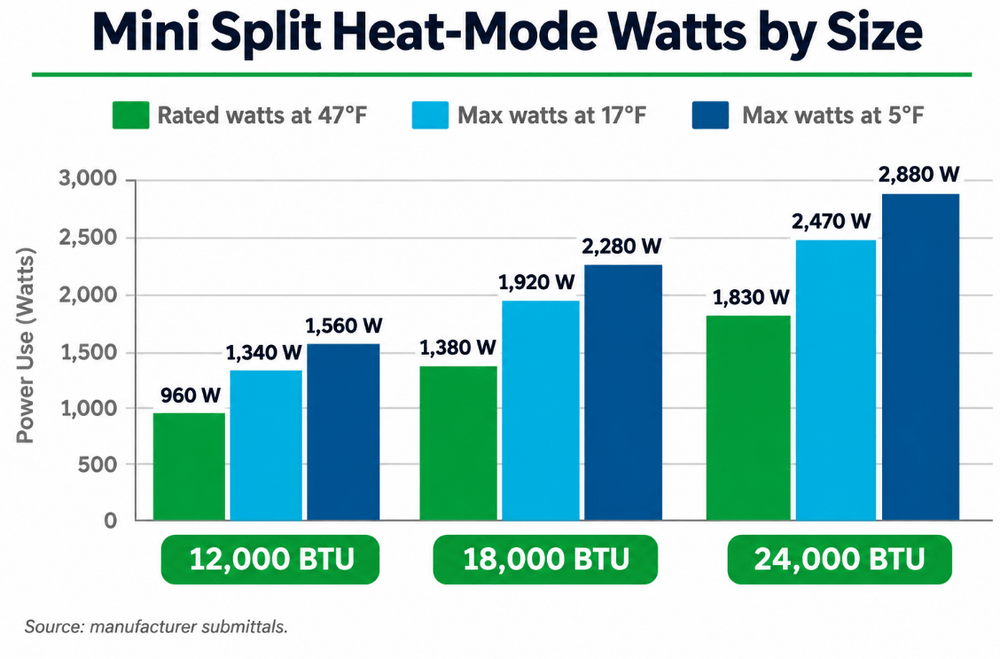
Shop Filterbuy Mini SplitsHeat-mode watts by mini split size
Rated watts at 47°F vs. maximum watts at full speed
12,000 BTU
About 9 to 25 kWh a day, mild day to 5°F day
18,000 BTU
About 13 to 45 kWh a day, mild day to 5°F day
24,000 BTU
About 19 to 72 kWh a day, mild day to 5°F day
Get ready for winter heating
Answer a few quick questions about how you heat your home, and we’ll match you to the right next step.
Quick Answer: Mini Split Heating Watts
In heat mode, a mini split uses about 1,100 watts at 12,000 BTU, 1,700 watts at 18,000 BTU, and 2,300 watts at 24,000 BTU at its rated 47°F test point. On a 5°F day, the same systems run between roughly 1,000 and 3,000 watts at full speed, yet each watt delivers less heat. That adds up to about 9 to 72 kWh a day, depending on size and weather. Filterbuy manufactures air filters in the USA and sells Filterbuy-brand mini splits, so we used another manufacturer's submittals and our own math to keep these numbers independent.
12,000 BTU: 1,100 W rated, up to 1,620 W
18,000 BTU: 1,680 W rated, up to 2,455 W
24,000 BTU: 2,340 W rated, up to 3,592 W
TL;DR
A 12,000 BTU mini split runs at about 1,100 watts on a 47°F day, and a 24,000 BTU unit at about 2,340 watts. As temperatures fall, each watt buys less heat while your home needs more of it, so daily kWh can nearly quadruple between a mild day and a 5°F one.
Key Takeaways
Even at 5°F, the 12,000 BTU system in our data uses about 64% less electricity than a space heater for the same heat.
At 5°F, the 24,000 BTU unit needs about 83% more electricity for the same heat than at 47°F, because its COP falls from 3.46 to 1.89.
In Filterbuy's worked example, one room used 6.5 kWh on a 47°F day and 25 kWh on a 5°F day, about $1.18 versus $4.56 at the 2026 U.S. average rate.
How Many Watts Does a Mini Split Use in Heat Mode by Size?
At its rated 47°F point, a mini split in heat mode draws about 1,100 watts at 12,000 BTU, 1,680 watts at 18,000 BTU, and 2,340 watts at 24,000 BTU. Maximum watts mark its ceiling when the inverter compressor runs flat out.
To compare sizes fairly, we lined up Mitsubishi Electric's submittals for one wall-mounted heat pump family, all tested under identical conditions (12K, 18K, 24K).
| Mini Split Size | Rated Watts at 47°F | Max Watts at 47°F | Max Watts at 17°F | Max Watts at 5°F | Heat Delivered at 5°F |
|---|---|---|---|---|---|
| 12,000 BTU | 1,100 W | 1,620 W | 1,240 W | 1,020 W | 9,790 BTU/h |
| 18,000 BTU | 1,680 W | 2,455 W | 2,105 W | 1,880 W | 14,900 BTU/h |
| 24,000 BTU | 2,340 W | 3,592 W | 3,232 W | 2,990 W | 19,320 BTU/h |
Source: Mitsubishi Electric Trane HVAC US submittals (2022 forms), AHRI rating conditions with 70°F indoor air. Heating output at 47°F is rated above the nameplate size: 14,400, 21,600, and 27,600 BTU/h. Filterbuy is not affiliated with or endorsed by Mitsubishi Electric.
Two things stood out when we lined up these sheets. The 12,000 BTU unit is actually rated at 14,400 BTU/h of heat at 47°F, and its maximum watts drop as the weather gets colder. Cold air holds less heat for the compressor to pull in, so winter costs you through efficiency and runtime rather than peak watts.
"Reading the submittals side by side changed how I look at cold-climate marketing. A unit rated to -22°F can still give up heat at 5°F, and a unit that keeps every BTU at 5°F can shut off at -13°F. Both numbers belong on every quote you get."
— Michelle Wan, Brand Manager & Copywriter, Filterbuy
How to Find Heating Watts on Any Mini Split
Look on the submittal or spec sheet for "Rated Power Input" under "Heating at 47°F." If the sheet lists only BTU and COP, this formula gets you there:
Watts = BTU/h ÷ (COP × 3.412)
A 12,000 BTU/h unit with a COP of 3.5, for example, draws about 1,005 watts. For cold-weather numbers, look the model up on NEEP's cold-climate air source heat pump product list, which reports capacity and COP at 5°F, and use Filterbuy's guide to the NEEP cold-climate heat pump list to read the listing.
How Many Amps Does a Mini Split Draw When Heating?
On a 230-volt circuit, a mini split draws about 4.8 amps at 12,000 BTU, 7.3 amps at 18,000 BTU, and 10.2 amps at 24,000 BTU at its rated heating output. Because running amps equal watts divided by voltage, the same unit pulls about 10% more current on 208-volt service.
| Mini Split Size | Rated Heating Amps (230V) | Max Heating Amps (230V) | Max Heating Amps (208V) | Recommended Breaker |
|---|---|---|---|---|
| 12,000 BTU | 4.8 A | 7.0 A | 7.8 A | 15 A |
| 18,000 BTU | 7.3 A | 10.7 A | 11.8 A | 15 A |
| 24,000 BTU | 10.2 A | 15.6 A | 17.3 A | 20 A |
Amps calculated from the submittal watt figures above (watts ÷ volts). Breaker sizes are Mitsubishi Electric's recommendations for these models. Power factor is 96% to 99%, so true current runs a hair higher.
Running amps differ from the nameplate MCA (minimum circuit ampacity), the higher figure electricians use to size wiring under local code.
How Many kWh Per Day Does a Mini Split Use for Heating?
For heating, expect roughly 9 to 25 kWh a day from a 12,000 BTU mini split, 13 to 45 kWh from an 18,000 BTU unit, and 19 to 72 kWh from a 24,000 BTU unit. Many calculators estimate heating by dividing BTU by SEER2, but SEER2 measures cooling, so we built this table from heat-mode watts instead.
| Mini Split Size | Mild Day (Rated Watts × 8 Hours) | Design-Cold Day (5°F Max Watts × 24 Hours) | Daily Cost Range at 18.2¢/kWh |
|---|---|---|---|
| 12,000 BTU | 8.8 kWh | 24.5 kWh | $1.60–$4.46 |
| 18,000 BTU | 13.4 kWh | 45.1 kWh | $2.45–$8.21 |
| 24,000 BTU | 18.7 kWh | 71.8 kWh | $3.41–$13.06 |
Cost uses the U.S. Energy Information Administration's projected 2026 average residential price of 18.2 cents per kWh. Multiply by your own utility rate for a local figure.
For your own number, track a week of heating kWh in your unit's app or with an energy monitor. For a monthly picture, see Filterbuy's guide to mini split running cost per month.
Why Does Mini Split Power Draw Climb as Outdoor Temperatures Drop?
Two things push a mini split's electricity use up in cold weather. The heat pump's COP (heat out per unit of electricity) falls, and your home loses heat faster, so the unit runs longer. Together, they can nearly quadruple daily heating kWh between 47°F and 5°F.
Every 10,000 BTU of heat costs the 24,000 BTU system about 848 watts at 47°F but about 1,548 watts at 5°F, while the 12,000 BTU system holds up better, climbing from about 764 to 1,042 watts. HSPF2 and other seasonal ratings average this out over a whole winter, which hides what a 5°F day really costs.
How that compares with a space heater: A baseboard heater or space heater needs about 2,930 watts for the same 10,000 BTU. By Filterbuy's math, even at 5°F the 12,000 BTU system uses about 64% less electricity for the same heat, and the 24,000 BTU system about 47% less.
Worked Example: One Room, Three Kinds of Days
We modeled a room that needs 10,000 BTU/h at 5°F, heated by the 12,000 BTU system above and using its published COPs.
| Outdoor Temperature | Heat the Room Needs | Unit COP | Average Watts | kWh per Day | Cost per Day |
|---|---|---|---|---|---|
| 47°F | 3,540 BTU/h | 3.84 | 270 W | 6.5 kWh | $1.18 |
| 17°F | 8,150 BTU/h | 3.10 | 771 W | 18.5 kWh | $3.37 |
| 5°F | 10,000 BTU/h | 2.81 | 1,043 W | 25.0 kWh | $4.56 |
Filterbuy calculation. Heat need assumes heat loss proportional to the indoor-outdoor temperature difference. COPs are from that unit's submittal. Cost at 18.2¢/kWh.
Filterbuy's rule of thumb: For a room like this, every 10°F drop outside adds roughly 4 to 5 kWh a day, or about 70 cents to $1 at the 2026 U.S. average rate.
Defrost Cycles Add a Little More
When it's cold and damp, frost builds up on the outdoor coil, and the unit briefly runs in reverse to melt it, using power without adding heat. Filterbuy's mini split defrost mode guide explains what's normal.
How Can You Lower Mini Split Electricity Use in Heat Mode?
To cut heating watts, help the unit move air freely and run steadily. According to the U.S. Department of Energy, a well-maintained heat pump can use 10% to 25% less energy than a severely neglected one. In the ductless systems Filterbuy's HVAC Solutions team services, the problem we find most often isn't a broken part. It's a filter nobody checked.
Clean the washable filters. Pacific Northwest National Laboratory notes that clogged ductless heat pump filters restrict airflow, which cuts performance and efficiency. Filterbuy recommends rinsing the mesh every 2 to 4 weeks during peak heating season, and Filterbuy's mini split filter cleaning guide shows how. The pre-filter protects the coil; your whole-home filter does the heavy lifting for air quality.
Hold a steady setpoint. Deep setbacks force long, high-speed recovery runs.
Keep the outdoor unit clear. Snow, leaves, and shrubs block airflow and slow down defrost.
Size it to the room. An undersized unit runs at maximum watts all day. Filterbuy's mini split sizing guide walks you through the math.
Choose a cold-climate model if winters reach 5°F. Units that keep more of their capacity at 5°F lean less on backup heat. See Filterbuy's best mini splits for cold climates ranking.

Where Filterbuy Mini Splits Fit
$749 with free 2-day delivery to most US states, a 7-year compressor and 3-year parts warranty, and a published price with no quote form. That is the Filterbuy 12,000 BTU single-zone mini split. It provides reliable heating down to 5°F with intelligent defrost and a chassis heating belt, runs on 115V or 230V, and uses R32 refrigerant. It suits rooms up to 550 sq ft. If your winter heat in a zone 6 home will come from this unit, choose a model from our cold-climate ranking instead; ours is rated to 5°F. Professional installation is required, and the warranty is void if self-installed. See the Filterbuy 12,000 BTU mini split.
Still running a furnace for backup heat? Find your furnace filter size and set up auto-delivery.
Supporting Statistics
Space heating is the largest energy use in U.S. homes, making up 42% of residential energy in 2020. Source: U.S. Energy Information Administration, 2020 Residential Energy Consumption Survey
Field-tested cold-climate heat pumps ran at a COP of about 3.5 at 45–55°F, but only 1.8 at -15°F. It was measured in occupied U.S. homes for a Department of Energy study. Source: Pacific Northwest National Laboratory, ACEEE 2024 Summer Study
ENERGY STAR certified mini splits use up to 60% less energy than standard home electric radiators. Source: ENERGY STAR (U.S. EPA), Ductless Heating & Cooling
Frequently Asked Questions
Does a mini split use more electricity in heat mode than cooling mode?
Per hour, usually yes. The 12,000 BTU system in our table draws 1,100 watts when heating and 920 watts when cooling, but it also puts out 14,400 BTU/h of heat compared with 12,000 BTU/h of cooling. At 47°F, the two modes are about equally efficient.
How many watts does a 12,000 BTU mini split use for heating?
At its rated 47°F heating point, a 12,000 BTU mini split uses about 1,100 watts, and at full speed it can reach about 1,600 watts.
How many watts does an 18,000 BTU mini split use for heating?
About 1,680 watts at its rated 47°F point, rising to about 2,455 watts at full speed.
Will a mini split trip a 15-amp breaker in heat mode?
Not on the breaker its maker specifies. At 230V in our data, the 12,000 and 18,000 BTU units call for 15 amps and peak at 7.0 and 10.7 amps. The 24,000 BTU unit calls for 20 amps and peaks at 15.6.
Should I turn my mini split down when I leave in winter?
Usually not. ENERGY STAR advises picking a comfortable temperature and leaving it there, since heat pumps don't save energy from setbacks the way furnaces do.
Glossary
COP (coefficient of performance): Heat delivered divided by electricity used. A COP of 3 means three units of heat per unit of electricity.
kWh (kilowatt-hour): The unit utilities bill for, equal to 1,000 watts used for one hour.
Filterbuy: A U.S. air filter manufacturer, headquartered in Talladega, Alabama, that also sells ductless mini splits.
Mini split: A ductless heat pump with a wall-mounted indoor unit connected to an outdoor condenser by refrigerant lines.
NEEP: Northeast Energy Efficiency Partnerships, the nonprofit that publishes cold-climate heat pump performance data at 5°F.
Sources
U.S. Energy Information Administration, Short-Term Energy Outlook, October 2026
U.S. Department of Energy, Operating and Maintaining Your Heat Pump
Pacific Northwest National Laboratory, Building America Solution Center, Clean Ductless Heat Pump Air Filters
Northeast Energy Efficiency Partnerships (NEEP), ccASHP Specification and Product List