Mini Split for a Mobile Home: Heating Costs, Sizing & Install Tips
November 5, 2026
Is a Mini Split a Good Way to Heat a Mobile Home?
Yes. For most mobile homes, a ductless mini split is a strong heating choice because it works without the leaky underfloor belly ducts.
In field tests, adding one to an electric-furnace home saved about 5,500 kWh a year, or roughly $1,000 at 2026 average U.S. rates.
Size it room by room, since most single-wides need two or three indoor heads to stay warm end to end.
Take the quick winter heating quiz below to find your next step.
Filterbuy’s single-zone systems come in 12,000, 18,000, and 24,000 BTU, rated 17 SEER2 with reliable heating down to 5°F.
Plan Your Winter Heating
Answer a few quick questions about your home, and we’ll help you find the right next step for staying warm this winter.
TL;DR
A ductless mini split is one of the most efficient ways to heat and cool a mobile home, and, zoned correctly, it warms the back bedroom. The U.S. Department of Energy says air-source heat pumps can use up to 75% less heating electricity than the electric furnaces in most older manufactured homes. Filterbuy recommends a head in every bedroom that stays closed at night, sized for your coldest week, with park and permit approval before you buy.
Key Takeaways
Most single-wides need two or three zones, not one, because closed bedrooms at each end need their own heads.
Plan on $1,200 to $5,500 installed for one zone and $4,000 to $11,000 for two or three, per Filterbuy's 2026 installation cost data.
Keep an old furnace as backup only, set a few degrees below the mini split; PNNL tested 72°F and 67°F.
The federal 25C credit was terminated for systems placed in service after December 31, 2025; confirm eligibility with a tax professional.
Many states treat an added heat pump as a manufactured home alteration that needs a permit.
Is a Mini Split a Good Heating Option for a Mobile Home?
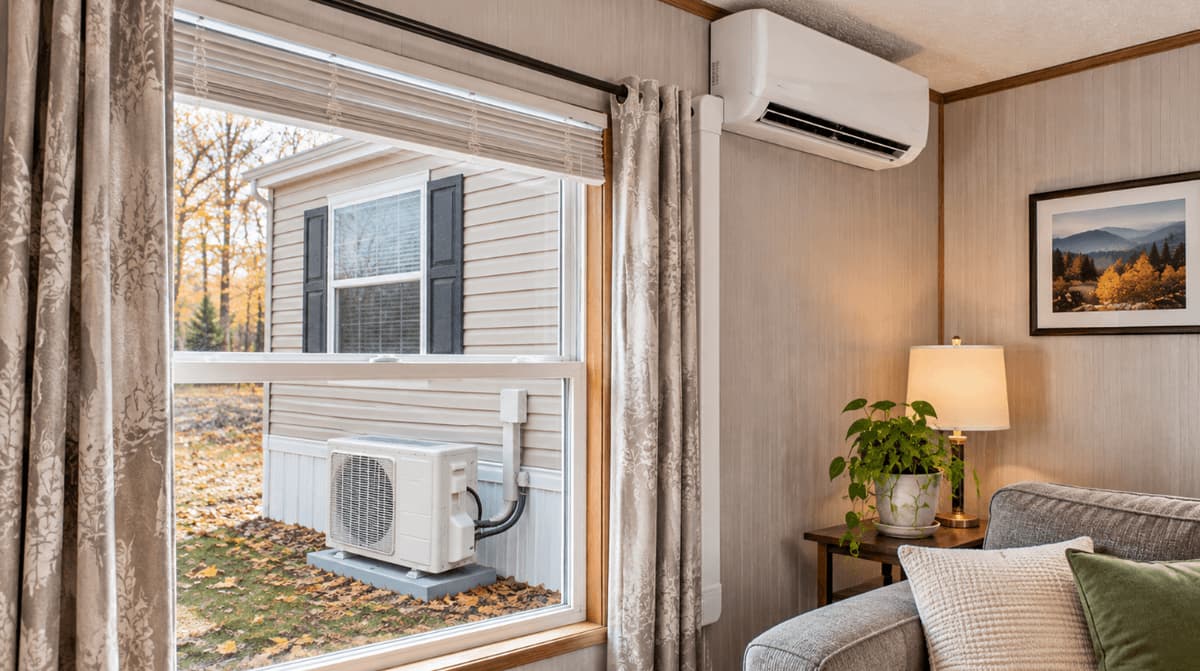
For most mobile homes, yes. Among heat pumps for mobile homes, a ductless mini split usually fits best because it skips the underfloor "belly" ducts, which leak and sag with age.
| Mobile Home Heating Option | Also Cools? | Uses Belly Ducts? | Relative Efficiency | Best Fit |
|---|---|---|---|---|
| Ductless mini split heat pump | Yes | No | Highest: moves 2–4 units of heat per unit of electricity | Most climates; homes with tired ducts |
| Ducted or packaged heat pump | Yes | Yes | High, minus duct losses | Homes with sound, sealed ducts |
| Electric furnace (resistance) | Only with add-on AC | Yes | Baseline: 1 unit of heat per unit of electricity | Low upfront cost; backup heat |
| Propane or gas furnace (manufactured-home listed) | Only with add-on AC | Yes | Depends on fuel prices | Very cold climates with cheap gas |
Filterbuy would replace the electric furnace first, since its ducts can waste over 30% of the heat, as our best mini split for a small home guide explains. To keep a furnace instead, see our electric furnace for a manufactured home guide.
How Much Can a Mini Split Cut Mobile Home Heating Costs?
In an all-electric mobile home, a mini split can cut the heating part of the bill in half or better. The U.S. Department of Energy puts the reduction in heating electricity at up to 75% versus electric furnaces and baseboard heaters.
Field data agrees. In Northwest single-family and manufactured homes with electric furnaces, adding a ductless heat pump saved an average of 5,500 kWh a year, per a 2020 Pacific Northwest National Laboratory and Florida Solar Energy Center study. At the 2026 U.S. average of 18.2 cents per kWh reported by the U.S. Energy Information Administration, that comes to roughly $1,000 a year.
There's one catch: an old furnace on a separate schedule can wipe out most of those savings. The researchers' fix, which Filterbuy recommends, is setting the furnace thermostat a few degrees below the mini split so it only runs as backup. In PNNL's manufactured-home tests, that meant 72°F on the mini split and 67°F on the furnace.
What Size Mini Split Does a Mobile Home Need?
Size room by room at 20–25 BTU per square foot. A typical single-wide needs 18,000–30,000 BTU across two or three indoor units.
Filterbuy calls this the "heat where you sleep" test: if a bedroom door stays closed at night, the room needs a dedicated head. ENERGY STAR points out that heated air can't get past a closed door.
| Home Type | Typical Size | Whole-Home Load (20–25 BTU/SQ FT) | Starting Zone Plan |
|---|---|---|---|
| Single-wide, bedrooms at one end | 14×60 to 14×70 (840–980 sq ft) | 17,000–24,500 BTU | 12,000–18,000 living/kitchen + 9,000 primary bedroom |
| Single-wide, split bedrooms | 16×72 to 16×80 (1,150–1,280 sq ft) | 23,000–32,000 BTU | 12,000–18,000 living/kitchen + 9,000 at each bedroom end |
| Double-wide | 24×48 to 28×60 (1,150–1,680 sq ft) | 23,000–42,000 BTU | 3–4 heads: living, kitchen/den, bedroom wing(s) |
Start with your data plate. Federal rules require every manufactured home to carry a data plate near the main electrical panel or in another visible spot. Photograph it. Size toward the high end if the home predates HUD's 1994 insulation updates, anchor the outdoor unit to the listed wind zone, and confirm with a Manual J load calculation.
Where our own line fits, and where it doesn't. Filterbuy's single-zone 12,000 BTU, 18,000 BTU, and 24,000 BTU systems come with a published price, free 2-day delivery on in-stock systems, and a 7-year compressor / 3-year parts warranty. They're 17 SEER2, which clears the federal minimum and is built for value rather than maximum efficiency, with reliable heating down to 5°F.
Small bedrooms: Our 12,000 BTU unit can oversize a small bedroom, where 9,000 BTU multi-zone heads from Mitsubishi Electric or Daikin fit better.
Older electrical service: Our 115V 12,000 BTU unit can spare an older home a new 230V circuit.
Very cold climates: If this unit would be your main winter heat and lows regularly fall below 5°F, choose a cold-climate model such as Mitsubishi Electric Hyper-Heat.
Because we also sell the filters, we see what oversizing does: the head short-cycles and never dries the coil, which leads to odors. Our mini split sizing guide has the math.
How Much Does a Mini Split Cost for a Mobile Home?
A mobile home mini split typically runs $1,200 to $5,500 installed for one zone and $4,000 to $11,000 for two or three, per Filterbuy's mini split installation cost guide. Before quotes, read our mini split electrical requirements guide and budget for these extras:
| Mobile Home Add-On | Why It Comes Up |
|---|---|
| Electrical panel check or upgrade | Older homes often have 100-amp service; 18,000+ BTU units need a 230V circuit |
| Ground pad or stand | The outdoor unit should not hang from thin exterior walls |
| Permit and inspection fees | Often required for manufactured home alterations |
| Line-set covers and skirting sealing | Keeps rodents and drafts out of new openings |
How long until it pays off? Using the research average of about $1,000 a year, a $4,000 to $11,000 system would take roughly 4 to 11 years to offset before rebates. Your rates and climate will change that.
Incentives look different in 2026. Under the One Big Beautiful Bill Act, the federal 25C heat pump credit was terminated for systems placed in service after December 31, 2025; confirm eligibility with a tax professional. Our heat pump tax credit update explains what's left. Ask your utility about rebates and your state energy office about federally funded Home Energy Rebates.
Mobile Home Mini Split Install Tips
Review these manufactured home mini split details with your installer:
Find the studs for the indoor unit. Mobile home walls are often 2×3 or 2×4 framing with thin paneling, so mount the bracket to studs or a plywood backer.
Run the line set through the wall, not the belly. The underbelly route means cutting the bottom board that holds the floor insulation and resealing every opening.
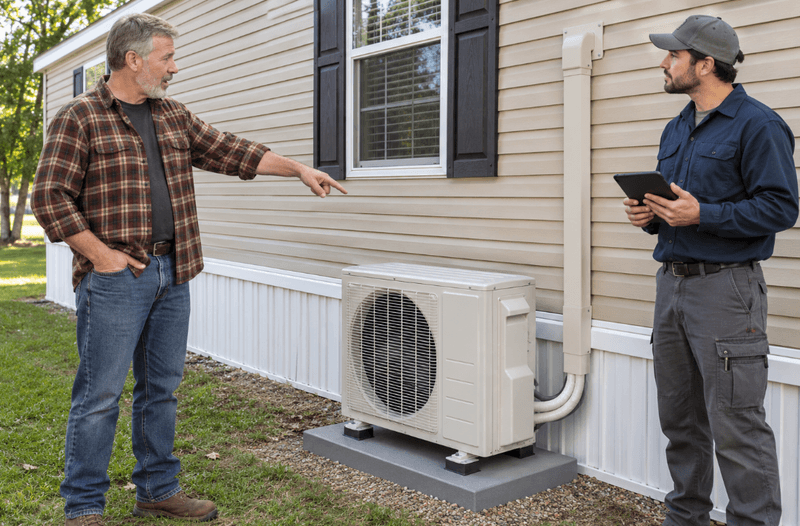
Set the outdoor unit on a separate ground pad, away from your steps. Raise it above snow depth, anchor it for your wind zone, and drain condensate away from the piers, since ENERGY STAR notes defrost water can freeze near doors.
Decide what to do with the old furnace. Many owners keep it as backup heat; if yours stays, keep changing its filter.
Pre-charged DIY kits from other brands still need electrical work, condensate drainage, a wall opening, and usually a permit; our DIY mini split installation guide explains the trade-offs. Filterbuy mini splits require professional installation, and the warranty is void if self-installed.
Mobile Home Park Rules, Permits, and Codes
Codes. Manufactured homes are built to HUD's Manufactured Home Construction and Safety Standards (24 CFR 3280). After sale, changes count as alterations, which states regulate differently. Oregon's administrative rules, for example, list heat pumps as site-installed equipment that must be inspected. Filterbuy HVAC Solutions pulls permits on its Florida and Texas installs; elsewhere, confirm your installer will.
Park rules. Renting your lot? Get written approval for the outdoor unit's spot and wall openings.
How to Keep a Mobile Home Mini Split Running Efficiently
Filters are where Filterbuy knows the most. Each indoor head's washable mesh pre-filter protects the coil; your whole-home filter does the heavy lifting for air quality. Rinse the pre-filter every two to four weeks in heavy use. Filterbuy's units add a 55°C self-cleaning cycle and filter reminder; our guide on how to maintain your mini split covers coil and drain care.
Run a mini split like a heat pump, not a furnace. ENERGY STAR suggests holding one temperature, since heat pumps don't save from nighttime setbacks, and choosing Heat instead of Auto.
If the furnace stays as backup, a steady change schedule for its filter matters more than the rating.
"I would rather you run MERV 11 on a real schedule than MERV 13 for eight months," says Michelle Wan , Brand Manager and Air Quality Writer at Filterbuy.
Before moving up to MERV 13, check that your furnace can handle the airflow; the EPA recommends MERV 13 or as high a rating as the system can accommodate. Filterbuy manufactures filters at company-run plants in Alabama, Florida, Pennsylvania, and Utah. On smoky days, check our live air quality map, since a mini split recirculates indoor air.

Why Filterbuy's Take on Mobile Home Mini Splits Is Different
Filterbuy manufactures air filters in the USA and also sells single-zone mini splits, so we see these systems from sizing day through years of filter changes. Filterbuy HVAC Solutions services ductless systems in Florida and Texas, and our custom air filters fit the odd sizes older mobile home furnaces take.
Supporting Statistics
About 57% of U.S. mobile homes heat mainly with electricity, compared with 34% of all U.S. homes.
Source: U.S. Energy Information Administration, 2020 Residential Energy Consumption Survey, Table HC6.1
Manufactured home residents carry energy burdens 71% higher than the average U.S. household.
Source: American Council for an Energy-Efficient Economy, 2020 national energy burden report
More than 150,000 ductless heat pumps were installed across the Northwest by 2021, in a program whose targets included manufactured homes.
Source: Northwest Energy Efficiency Alliance, Ductless Heat Pumps
Mini Split for a Mobile Home: FAQ
Will a 12,000 BTU mini split heat a whole single-wide?
Usually not; closed end bedrooms need their own zones.
Can a mini split replace the furnace in a mobile home?
In most climates, yes, if every closed room has a head. In very cold areas, many owners keep the furnace as backup.
Can I install a mini split myself in a mobile home?
DIY kits from other brands exist, but permits and park rules may call for a pro. Filterbuy's units require professional installation; the warranty is void if self-installed.
Will a mini split heat a mobile home through winter?
In most U.S. climates, yes. Filterbuy's units provide reliable heating down to 5°F; where lows regularly fall below that, use a cold-climate model or keep the furnace as backup.
Can a mini split run on 100-amp electrical service?
Often, but every mini split needs a dedicated circuit, and older 100-amp panels should get an electrician's check first. Filterbuy's 12,000 BTU unit also comes in 115V.
Glossary
Mini split (ductless heat pump): An outdoor compressor connected to wall-mounted indoor heads by refrigerant lines.
Manufactured home: A factory-built home built to the federal HUD Code since June 15, 1976. "Mobile home" usually refers to older ones.
Underbelly (belly): The sealed space under the floor that holds ducts and insulation.
Data plate: A required label listing a manufactured home's build date, wind zone, and thermal details.
Manual J: The Air Conditioning Contractors of America (ACCA) standard for calculating heating and cooling loads.
HEAR (HEEHR): Federally funded, state-run rebates DOE calls the High-Efficiency Electric Home Rebate program.
Sources
U.S. Department of Energy, Heat Pump Systems
ENERGY STAR, Ductless Heating & Cooling
Pacific Northwest National Laboratory and Florida Solar Energy Center, Who's Leading: The Dance Between Mini-Splits and Existing HVAC Systems (2020)
U.S. Energy Information Administration, Short-Term Energy Outlook: Electricity
eCFR, 24 CFR Part 3280, Manufactured Home Construction and Safety Standards
Oregon Secretary of State, OAR 918-500-0580, Alterations
U.S. Department of Energy, Home Energy Rebates Program
U.S. Energy Information Administration, 2020 RECS Table HC6.1, Space Heating by Housing Unit Type
American Council for an Energy-Efficient Economy, Low-Income Households Face High Energy Burden (2020)
Northwest Energy Efficiency Alliance, Ductless Heat Pumps Success Story
U.S. Environmental Protection Agency, Smoke Readiness Messages (HVAC filter guidance)