
Humidifier Vs. Air Purifier: Which One Helps When You're Sick?
November 23, 2026
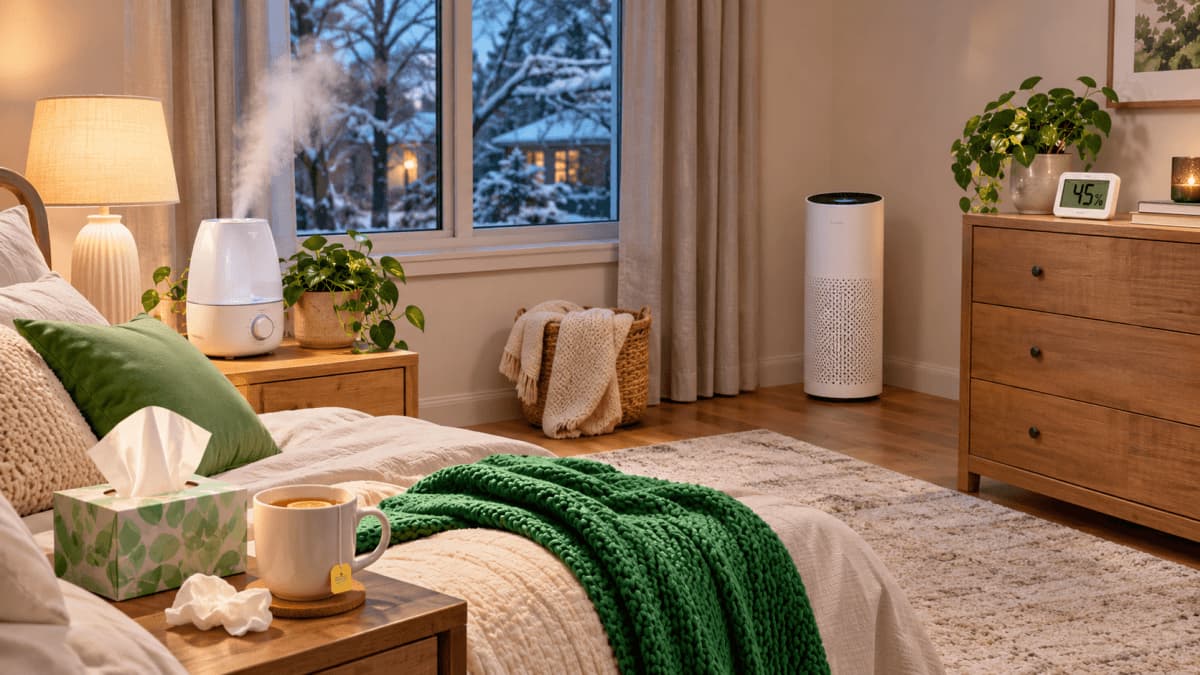
A humidifier and an air purifier solve two different problems. One adds water vapor to dry air, and the other pulls airborne particles like pet dander and pollen out of it. At Filterbuy, we make the filters that go inside HVAC systems and air purifiers, so we look at this choice from the filter's side.
TL;DR
A humidifier adds moisture, while an air purifier removes airborne particles. For a cold, reach for a clean cool mist humidifier and hold the room at 40% to 50% humidity. For allergies, a HEPA air purifier is the better buy, since extra moisture feeds dust mites and mold. You can run both in one room if humidity stays at or below 50%.
Key Takeaways
When the AQI is over 100, switch your HVAC to MERV 13 and run HEPA air purifiers in each room.
Mayo Clinic says a cool mist humidifier may ease a stuffy nose during a cold.
For allergies, a HEPA air purifier is the safer pick because dust mites and mold thrive in humid air.
For a baby, the American Academy of Pediatrics favors a cool mist humidifier kept out of reach and cleaned daily.
Filterbuy's two-device setup runs both in one room at 40% to 50% humidity with distilled water.
Humidifier Vs. Air Purifier: What Is The Difference?
A humidifier is an appliance that turns water into vapor or mist to raise the relative humidity in a room. An air purifier, also called a portable air cleaner, uses a fan to push room air through a filter, usually HEPA, to capture airborne particles.
More than a decade of making filters has taught Filterbuy one simple rule: a filter only catches what floats past it. Moisture isn't a particle, so no filter will raise your humidity, and no humidifier will pull pollen out of the air.
Air Purifier Or Humidifier For A Cold: Which Helps More?
For a cold, start with a humidifier. According to Mayo Clinic, a cool-mist humidifier may ease a stuffy nose during a cold. Filterbuy treats a cold as a moisture problem first, because an air purifier does nothing for cold symptoms.
Most colds clear up in about a week, and dry winter air makes that week harder. For the day-by-day picture, see how long a cold lasts. Our guide to dry air in your house in winter explains why heating dries a home out.
Air Purifier For Colds: What It Can And Cannot Do
An air purifier for colds is a particle-capture tool, and the CDC lists a portable HEPA cleaner as one step toward cleaner indoor air. Run it where the sick person rests, with the door closed, and pick one sized for that room. Particle size and fresh air decide how long the flu virus stays in the air, and cold viruses spread the same way.
Humidifier Vs. Air Purifier For Allergies
For allergies, an air purifier is the better tool. Pollen and pet dander float in the air along with fine dust, and a HEPA purifier captures them. A humidifier, though, can make allergies worse if humidity climbs too high, because dust mites and mold both need moisture.
Allergens are particles, which is the same reason Filterbuy builds MERV 11 filters for allergy homes. A humidifier can still soothe sore sinuses in those homes, as long as a hygrometer reads 50% or lower. To see where HEPA units fall short, read do air purifiers work. If you have asthma, check with your doctor before adding a humidifier.
Air Purifier Vs. Humidifier For A Baby's Room
When a baby has a stuffy nose, pediatricians point to a cool mist humidifier. The American Academy of Pediatrics tells parents to put a cool-mist humidifier in your child's room, close by but safely out of reach, and to clean and dry it every day. It also advises against hot-water vaporizers, which can burn a child.
Choose a cool mist model and skip steam vaporizers.
Fill it with distilled water to avoid white dust.
Empty and rinse the tank each day, then let it air dry.
Keep the room between 40% and 50% humidity.
If pets or allergies are a concern, add a HEPA purifier, but skip ozone generators and ionizers.
Can You Use A Humidifier And Air Purifier Together?
Yes, you can run a humidifier and an air purifier together. As filter makers, we know the catch: whatever enters the air ends up in a filter. The EPA says ultrasonic and impeller humidifiers generally disperse the most minerals and microorganisms from their tanks.
Filterbuy's Two-Device Sickroom Setup
Measure first. Check the hygrometer before turning anything on.
Use distilled water. Tap water minerals turn into fine dust that the purifier filter then has to catch, and evaporative models release far less.
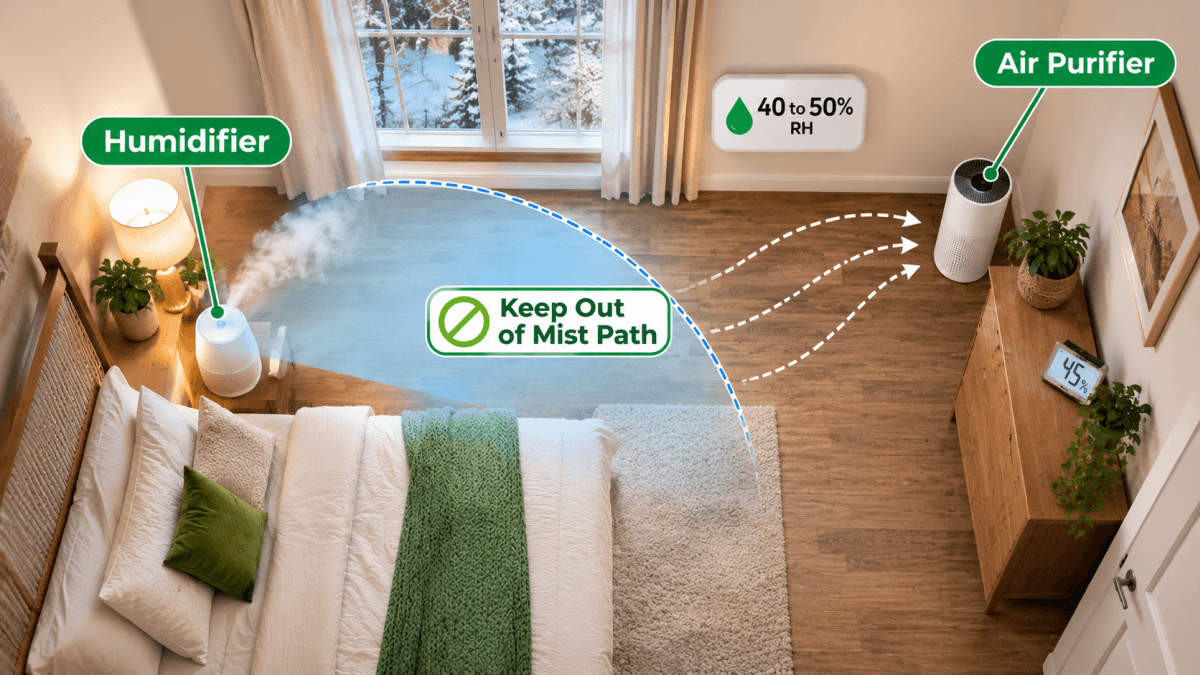
Separate the units. Place the purifier outside the mist path so its filter stays dry.
Set a ceiling. Hold humidity between 40% and 50%, and turn it down if windows fog.
Clean on schedule. Change the water daily, scrub the tank every third day, and replace the purifier filter when the maker says.
Check the HVAC filter. A dust-loaded furnace filter pushes more particles into every room.
Should You Buy A Humidifier And Air Purifier Combo?
A 2-in-1 unit saves floor space, but we lean toward two separate machines. The core rule of Filterbuy's setup is to keep the filter out of the mist. A combo also packs a water tank and a filter into one housing, so if either side fails or goes uncleaned, both jobs suffer.
Our humidifier filter replacement and cleaning guide covers when to swap an evaporative wick.
Do I Need A Humidifier, An Air Purifier, Or Both?
You need a humidifier if your hygrometer reads below 30% and your symptoms point to dryness, like cracked lips or nosebleeds. You need an air purifier if symptoms flare around dust, pets, pollen, or smoke. And if a dry winter home has someone with allergies or a cold, you likely need both.
For a seasonal target, our ideal indoor humidity in winter chart lowers the goal as outdoor temperatures drop so windows don't sweat.
Where Does Your HVAC Filter Fit In?
As an HVAC filter maker, Filterbuy sees the furnace filter as the whole-house layer behind both devices. A portable air purifier cleans a single room, while the furnace or AC filter cleans air from every room each time the blower runs.
For most homes, MERV 8 air filters are the standard choice. MERV 11 air filters suit homes with allergies, asthma, pets, or heavy pollen, and MERV 13 air filters are the pick for smoke. The EPA recommends HVAC filters rated MERV 13 or higher to cut smoke indoors. Filterbuy's rule: when the AQI is over 100, switch to MERV 13 if you have an HVAC system, and run HEPA air purifiers in each room. Before moving up a tier, check your HVAC system's manual, since some systems are built for a specific filter range. See air filters vs. air purifiers for how the two split the work, and the best air filter for viruses for cold and flu season.
If you own a GermGuardian purifier, Filterbuy makes air purifier replacement filters for Filter B, C, and E models, each pairing a HEPA-style layer with activated carbon. We don't make filters for every purifier brand yet, so watch our expanding line.
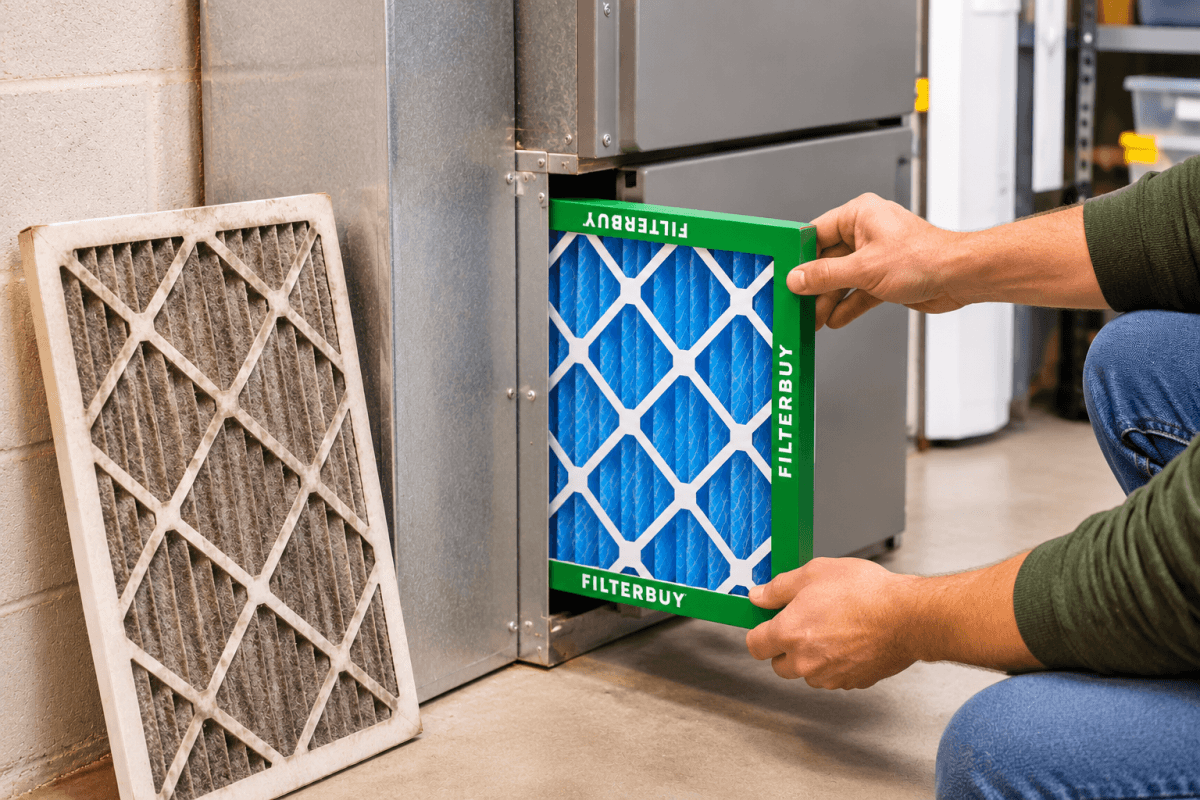
Every filter we make teaches the same lesson. A filter can only catch what's floating in the air, and moisture isn't one of those things. So check your humidity before you buy anything, then decide what the room needs.
Supporting Statistics
Colds peak during heating season.
More than 200 respiratory viruses cause colds.
Adults average 2 to 3 colds a year, mostly September to May.
Filterbuy's take: dry heated air makes those weeks harder.
Source: Facts About the Common Cold
High humidity feeds the top indoor allergen.
The American Academy of Allergy, Asthma and Immunology (AAAAI) ranks the dust mite the number one indoor allergen.
It advises keeping home humidity at 40% to 50%.
Filterbuy's take: that is why this page caps humidity at 50%.
Source: Humidifiers and Indoor Allergies
Hot steam remedies burn children.
Shriners Children's Boston treated 4 to 5 children for second-degree burns from at-home steam remedies in the 2025–2026 cold and flu season.
Many of these burns take 2 to 4 weeks to heal.
The hospital recommends store-bought cool-mist humidifiers instead.
Source: Shriners Children's Boston Warns Parents After Spike in Burn Injuries Linked to DIY 'Humidifiers'
Frequently Asked Questions
Is An Air Purifier Or Humidifier Better For A Cold?
A humidifier. A clean cool mist model may ease a dry, stuffy nose, while an air purifier does nothing for cold symptoms.
Can You Use A Humidifier And Air Purifier In The Same Room?
Yes. Keep the purifier out of the mist, fill the humidifier with distilled water, and hold humidity between 40% and 50%.
Do I Need A Humidifier Or Air Purifier For My Baby?
Start with a cool mist humidifier for a stuffy nose or dry nursery air. If the nursery has pet dander or smoke, add a HEPA purifier.
Can A Humidifier Make Allergies Worse?
Yes, if it pushes humidity above 50% or the tank isn't cleaned.
Does An Air Purifier Dry Out The Air?
No. An air purifier moves air through a filter without adding or removing moisture.
Clean Up The Whole-House Layer
Your humidifier and purifier cover one room, and your HVAC filter covers the rest. Find your size, choose MERV 8, 11, or 13, and get fast and free 2-day delivery to most US states. Set up auto-delivery and save 5% on every order.
Glossary
Humidifier: An appliance that adds moisture to indoor air.
Air Purifier: A portable air cleaner that filters particles from room air.
Relative Humidity (RH): Water vapor in the air as a share of the most it can hold.
Hygrometer: A gauge that measures indoor relative humidity.
HEPA: High-efficiency particulate air, a filter standard capturing at least 99.97% of 0.3-micron particles.
MERV: Minimum Efficiency Reporting Value, an HVAC filter's particle capture rating.
Steam Vaporizer: A warm mist humidifier that boils water and can burn children.
Ultrasonic Humidifier: A cool mist humidifier that vibrates water into fine mist.
Evaporative Humidifier: A cool mist humidifier that blows air through a wet wick.
White Dust: Tap water minerals that some humidifiers release onto surfaces.
HVAC: Heating, ventilation, and air conditioning, a home's central heating and cooling system.
EPA: U.S. Environmental Protection Agency, publisher of home humidifier care guidance.
CDC: U.S. Centers for Disease Control and Prevention, the national public health agency.
AQI: Air Quality Index, the EPA's 0–500 scale for daily outdoor air pollution.
Ozone Generator: An air cleaner that intentionally produces ozone, a lung irritant.