
How Long Does a Cold Last? The Stages, Day by Day
November 22, 2026

Most colds last seven to ten days, with the worst of it on days two and three. Because Filterbuy makes air filters, we follow a cold through the air your household shares and pair each stage with something you can do at home.
TL;DR
A common cold usually lasts seven to ten days in adults, and symptoms peak around days two and three. A cough can linger three to eight weeks after the rest clears. If you are not better after 10 days, or you improve and then slide backward, call your doctor. Sinusitis, allergies, or another illness may be behind it.
Key Takeaways
Symptoms typically peak within two to three days and fade over about a week.
A cold is most contagious in the first two to three days and rarely contagious after the first week.
A post-infectious cough can last three to eight weeks after a cold.
The CDC advises seeing a provider for symptoms lasting more than 10 days without improvement.
An HVAC filter captures airborne particles but adds no moisture to dry winter air.
How Long Does a Cold Last?
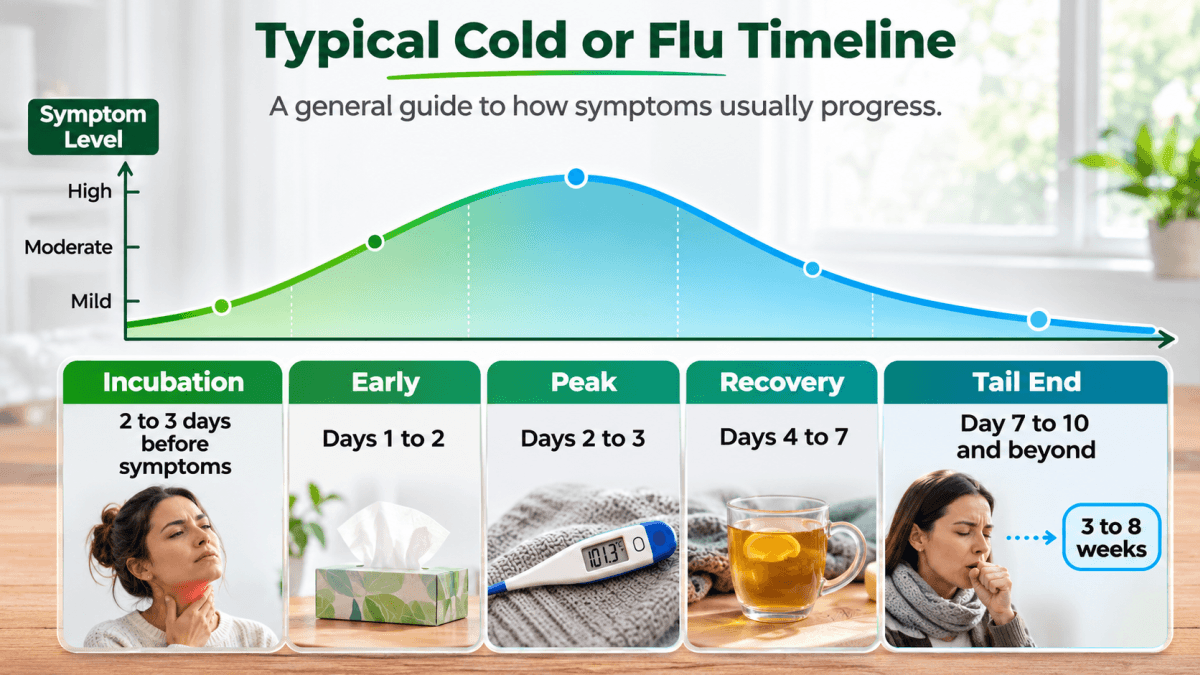
A common cold lasts about a week, and most adults recover within seven to ten days. Symptoms peak in the first two to three days of feeling sick, then taper off. A stuffy nose or dry cough often outlasts everything else, which is why many colds seem to drag past one week.
More than 200 viruses cause colds, and rhinoviruses are the most common, according to the CDC. The MedlinePlus overview of the common cold adds that symptoms usually start two or three days after exposure, though it can take up to a week.
Cold Stages Day by Day
A cold moves through four rough stages: incubation, early symptoms, peak, and recovery, followed for some people by a lingering cough.
The worst symptoms and the contagious peak land on the same two days, so Filterbuy focuses a household's effort there: stay home and keep used tissues out of shared rooms. By days four to seven, energy returns. Mucus may turn yellow or green, which MedlinePlus describes as normal for a cold.
Map Your Own Cold: A Worked Example
Count day 1 as the first day you notice symptoms. Say a scratchy throat starts on a Monday:
Monday to Wednesday (days 1 to 3): you are most contagious, and Tuesday and Wednesday usually feel the worst.
Thursday to Sunday (days 4 to 7): recovery begins, often in time to return to work or school (see the FAQ).
Next Monday to Wednesday (days 8 to 10): most people feel close to normal. Wednesday is your Day 10 Check.
Around day 18: the average acute cough ends.
How Long Does a Cold Last in Adults?
In healthy adults, a cold usually lasts seven to ten days. Young children, older adults, and people in poorer health tend to stay sick longer.
For babies and toddlers, compare symptoms in Filterbuy's guide on RSV vs. a cold. If a fever and body aches come on suddenly, read how to tell a cold from the flu.
How Long Does a Cough Last After a Cold?
A cough is often the last cold symptom to leave, and for some adults it lasts three to eight weeks. Doctors call this a post-infectious, or postviral, cough. According to the Cleveland Clinic guide to postinfectious cough, it comes from lingering airway inflammation and mucus, along with cough nerves that stay extra sensitive.
Research puts the average acute cough at nearly 18 days, roughly double what adults expect, so we treat a slowly fading cough at day 14 as normal. Still, the Cleveland Clinic advises seeing a provider after a couple of weeks, and sooner for blood, fever, or severe trouble breathing.
Why Won't My Cold Go Away?
A cold lasting more than 10 days is often no longer a simple cold. The usual culprits are a post-viral cough, sinusitis, allergies, or a second virus.
The AAAAI comparison of colds, allergies, and sinusitis offers clues. Allergies last as long as the exposure and often bring itchy, watery eyes, while sinusitis brings thick, colored mucus and pain around the forehead, eyes, and cheeks. If allergies seem likely, see how air filters help winter allergies.
Filterbuy's Day 10 Check
We built this check around the CDC's 10-day guidance because direction matters more than the day count. On day 10, compare how you feel with day five:
Better: you are in the normal tail end, so give any leftover cough time.
About the same: ten days without improvement is your cue to contact a provider.
Worse after improving: call a provider soon.
Any trouble breathing: seek care now.
When to See a Doctor About a Cold
Most colds get better on their own, but some symptoms mean it is time to call a doctor. The CDC's common cold treatment guidance recommends seeking care for:
Trouble breathing or fast breathing
Dehydration
Fever that lasts longer than four days
Symptoms that last more than 10 days without getting better
Symptoms, such as fever or cough, that improve and then return or worsen
Chronic medical conditions that get worse
The CDC also notes that antibiotics do not work against cold viruses.
How Your Home's Air Fits Into a Cold
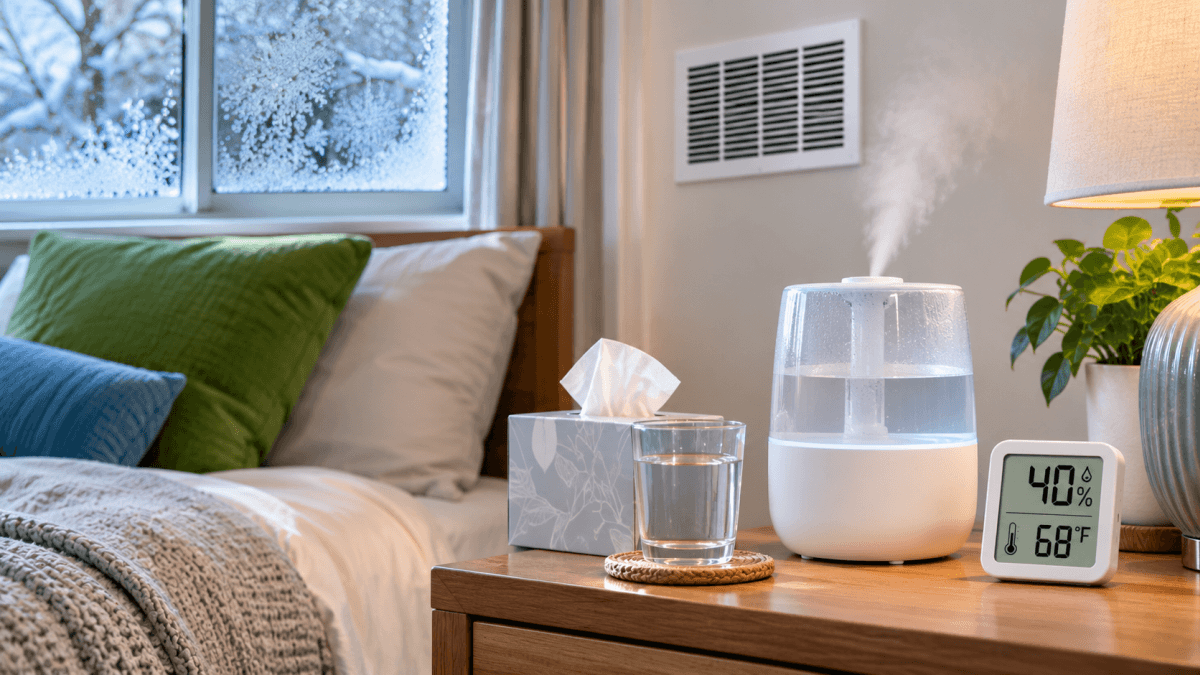
Your home's air will not shorten a cold, but it shapes how comfortable a week at home feels. You control two things here: indoor humidity, which handles moisture, and your HVAC filter, which handles airborne particles.
Keep Humidity in a Comfortable Range
A clean humidifier or cool-mist vaporizer is part of the CDC's self-care advice for colds, and for parched rooms, start with dry air in your house in winter. The EPA's guide to mold and moisture recommends keeping indoor relative humidity below 60 percent, ideally between 30 and 50 percent, and Filterbuy's chart on ideal indoor humidity in winter shows how to aim lower in very cold weather.
Check the Filter Your Furnace Is Running Through
All winter, your furnace pulls the same indoor air through the HVAC filter, which captures airborne particles while the blower runs. A filter cannot stop a cold from spreading on its own, so pair it with handwashing. Read where an HVAC filter fits during cold season, or see whether air purifiers really work for one room.
For most homes, Filterbuy's MERV 8 air filters are the standard choice, while MERV 11 air filters suit homes managing allergies, pets, and pollen. Check your HVAC manual for the highest MERV rating your system handles.
Filterbuy's Sick-Week Air Routine
This is the routine we recommend for a sick week. It will not speed recovery, but it keeps the air comfortable.
Day 1: pull the filter and replace it if it looks gray or dusty.
Every day: read the hygrometer and keep humidity between 30 and 50 percent.
Every day: clean the humidifier and refill it with fresh water.
After recovery: note your next change date, then check the filter monthly through heating season.
For the rest of the season, see Filterbuy's winter indoor air quality tips and health and wellness air guides.
“A cold runs its course no matter what you do to the air. What you can control is the room someone recovers in, so my advice is to check the humidity and look at the filter on day one, then let rest do the rest.”
Michelle Wan
Brand Manager and Air Quality Writer, Filterbuy
Supporting Statistics
2–3 colds a year for the average adult.
Most colds hit between September and May.
Filterbuy's take: that window is heating season, when the same indoor air cycles through your filter all day.
Source: Facts About the Common Cold
About 6 colds a year for healthy children.
A runny nose can last up to 2 weeks.
A cough can last up to 3 weeks.
Our take: judge a child's cold by these ranges, not the adult 7–10 day rule.
Source: Colds
17.8 days: the average length of an acute cough.
Figure from a systematic review of published studies.
Surveyed adults expected only 7–9 days.
Our take: expect the cough to outlast the cold.
Frequently Asked Questions
How Long Does a Cold Last in Adults?
A healthy adult's cold usually lasts seven to ten days and peaks in the first two to three. Steady improvement means it is on track, even if a cough lingers.
When Can I Go Back to Work or School With a Cold?
CDC guidance for respiratory viruses says you can return to normal activities once symptoms are clearly improving and you have gone 24 hours without a fever or fever-reducing medicine. For the next five days, take added precautions such as a well-fitted mask or distancing.
Is a Cold Contagious After 7 Days?
Usually not. A cold spreads most easily in the first two to three days and is rarely contagious after the first week. Suspect the flu instead? See how long the flu stays contagious.
Why Won't My Cold Go Away After Two Weeks?
A two-week cold may be a post-viral cough, sinusitis, allergies, or a second virus. Either way, symptoms lasting more than 10 days without improving mean it is time to contact a provider.
How Long Does a Cough Last After a Cold?
It can last three to eight weeks, because airways stay inflamed after the virus clears. See a provider sooner if the cough brings blood, fever, or trouble breathing.
Breathe Easier at Home This Cold Season
A week at home with a cold is a good time to check your air filter. Filterbuy makes pleated MERV 8, MERV 11, and MERV 13 filters in hundreds of sizes, with fast and free 2-day delivery to most US states. Shop Filterbuy air filters to find the right fit for your system.
Shop Filterbuy Air FiltersGlossary
A mild viral infection of the nose and throat.
A cough lasting three to eight weeks after a cold or other respiratory infection.
Sinus swelling that blocks mucus drainage, often after a cold or allergies.
Moisture in the air compared with the most the air can hold at that temperature.
The filter in a heating, ventilation, and air conditioning system that captures airborne particles.
Minimum Efficiency Reporting Value, a 1 to 16 scale rating how well a filter captures particles.
American Academy of Allergy, Asthma and Immunology, a professional organization of allergists.