
Flu Vs. COVID: How The Two Compare And How To Tell Them Apart
November 22, 2026
Flu and COVID-19 are both contagious respiratory illnesses, but different viruses cause them. Influenza viruses cause the flu, while a coronavirus called SARS-CoV-2 causes COVID-19. Because both bring fever, cough, aches, and fatigue, most people can't tell them apart by feel. At Filterbuy, we make air filters, so we look at both illnesses from inside the home. A test tells you which virus you have, and the air in your house shapes how easily it reaches everyone else.
TL;DR
Flu and COVID look alike, so a test is the only way to tell them apart. Flu tends to hit suddenly, 1 to 4 days after exposure. COVID can take 2 to 14 days and is more likely to cause a new loss of taste or smell. COVID also stays contagious a little longer, and you can catch both at once. Both spread through indoor air.
Key Takeaways
Symptoms alone can't tell flu and COVID apart.
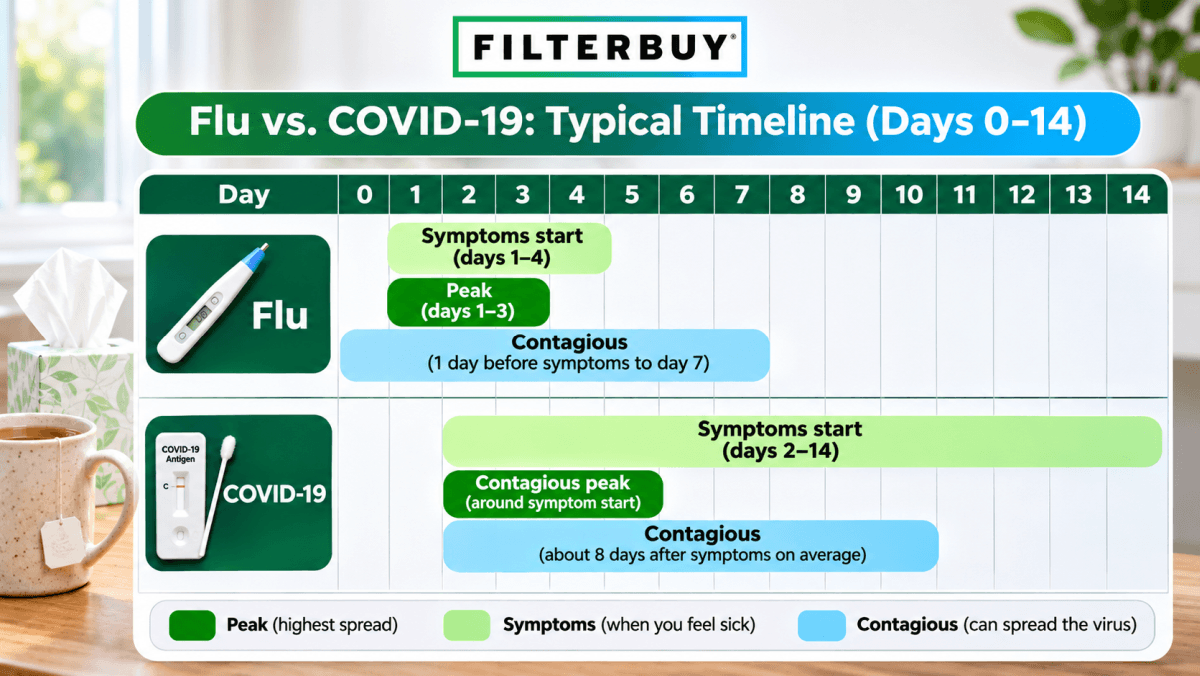
Flu symptoms usually appear within 1 to 4 days of infection, and COVID symptoms within 2 to 14.
COVID usually stays contagious longer than flu, about 8 days after symptoms start versus up to 5 to 7.
You can have flu and COVID at the same time, though CDC calls it uncommon.
Both viruses spread mainly through particles in the air, which build up more indoors than outdoors.
What Is The Difference Between Flu And COVID?
The core difference is the virus behind each illness. Flu comes from influenza viruses that circulate every fall and winter, while COVID-19 comes from SARS-CoV-2, which can circulate year-round.
According to the CDC comparison of flu and COVID-19, COVID is more likely to change your sense of taste or smell. It can also lead to Long COVID, with symptoms that last for weeks or months.
Flu Vs. COVID Symptoms Side By Side
Flu and COVID symptoms overlap almost completely. Either one can cause fever or chills, cough, shortness of breath, fatigue, sore throat, a runny or stuffy nose, muscle aches, and headache. Children especially may also have vomiting or diarrhea.
Sources: CDC, Mayo Clinic. Only a test can confirm which virus is present.
How To Tell Flu From COVID
Timing and a few telltale symptoms can offer clues, but only a test can confirm which virus you have. A combination test checks one nasal swab for both and gives the clearest answer, at home or at a clinic. Filterbuy's rule: even if a clue points one way, test anyway.
Clues That Point Toward Flu
Flu often arrives fast. A high fever and strong body aches can hit within hours.
Clues That Point Toward COVID
A new loss of taste or smell is the strongest clue for COVID, and the Mayo Clinic guide to COVID-19 vs. flu notes that it's rare with flu. Symptoms by day 4 after exposure fit either virus, but symptoms that start on day 5 or later point toward COVID, because flu usually shows up within 1 to 4 days.
When To Test
Test as soon as symptoms start, especially if you're 65 or older, pregnant, or living with a chronic condition, since antivirals work best early. If you notice emergency warning signs such as trouble breathing, chest pain or pressure, confusion, or bluish lips, get care right away instead of waiting on a test.
What To Do After Your Test Result
Here's how we'd handle each test result, using CDC and FDA guidance.
Positive for flu: If you're at higher risk, call a provider the same day. CDC says flu antivirals work best when they start within 2 days of symptoms.
Positive for COVID: Ask a provider about treatment right away, since COVID antivirals need to start within 5 to 7 days.
Positive for both: Let your provider know, because each virus has its own antiviral.
Negative but still sick: Test again in 48 hours. For anyone with symptoms, FDA advises at least two home COVID antigen tests taken 48 hours apart.
Can You Have Flu And COVID At The Same Time?
Yes. CDC calls it uncommon, but it happens. CDC also notes that having both at once can make people sicker than either one alone.
That's why Filterbuy favors combination tests for sick households. Someone who tests positive for COVID and stops there could miss the flu, or the reverse, and lose time for the right antiviral.
COVID Vs. Flu Contagious Period
Flu is most contagious in the first 3 days of illness, while COVID stays contagious for about 8 days after symptoms start, on average. Both viruses can spread before symptoms show up. Because of that early window, Filterbuy's plan starts clean air steps at the first symptom, without waiting for a test result.
Source: CDC. Times vary from person to person.
Whichever virus it is, CDC says to stay home until you've gone 24 hours without a fever (and without fever-reducing medicine) and your symptoms are improving. Then take extra precautions for 5 more days. For the full flu timeline, see how long the flu stays contagious.
How Flu And COVID Spread Indoors
Flu and COVID spread mainly through particles in the air. When a sick person coughs or sneezes, larger droplets fall quickly, but smaller particles can linger. Those particles build up more indoors than outside, especially in rooms that get little fresh air.
Winter makes things worse, because windows stay shut and the same air keeps recirculating, as we explain in why winter indoor air quality is worse. Surfaces play a smaller role. It also helps to know the signs of RSV versus a cold.
Home Steps That Help Against Both
Filterbuy's sick-day plan covers three jobs that work against both viruses: test, separate, and circulate clean air.
Test at the first sign of symptoms.
Keep the sick person in one room, ideally with their own bathroom.
Bring in fresh air by cracking a window or running a bathroom or kitchen exhaust fan.
Set the thermostat fan to "On" so air keeps moving through your HVAC filter between heating cycles.
Run a portable air purifier with a True HEPA filter in the sick room.
Wash hands often and clean high-touch surfaces like doorknobs and remotes.
Stay up to date on vaccines. CDC recommends a yearly flu shot for everyone 6 months and older and a 2026 to 2027 COVID-19 vaccine for adults.
For a room-by-room plan, see how to set up a flu recovery room at home.
Where Your HVAC Filter Fits
The EPA guidance on air cleaners, HVAC filters, and respiratory viruses says HVAC filters and air cleaners can help reduce airborne viruses, though they aren't enough on their own. EPA also points to filters rated MERV 13 or higher.
If wildfire smoke pushes your local AQI over 100, switch to an EPA-recommended MERV 13 filter if you have an HVAC system, and run HEPA air purifiers in each room.
At Filterbuy, we think of the thermostat fan as your filter's on switch. A filter only cleans the air that passes through it, and on Auto, the blower runs only while the system heats or cools. MERV 13 captures more fine particles than MERV 8 or MERV 11, but check your HVAC manual or ask a technician first. Since MERV 13 isn't True HEPA, a portable purifier adds a closer layer in the sick room. Learn what True HEPA labels really mean before you buy.
Filterbuy Pro Tip: Write the install date on the filter frame. Our support team shares this tip because a filter running on "On" through a sick week gets dirty faster than the calendar suggests.
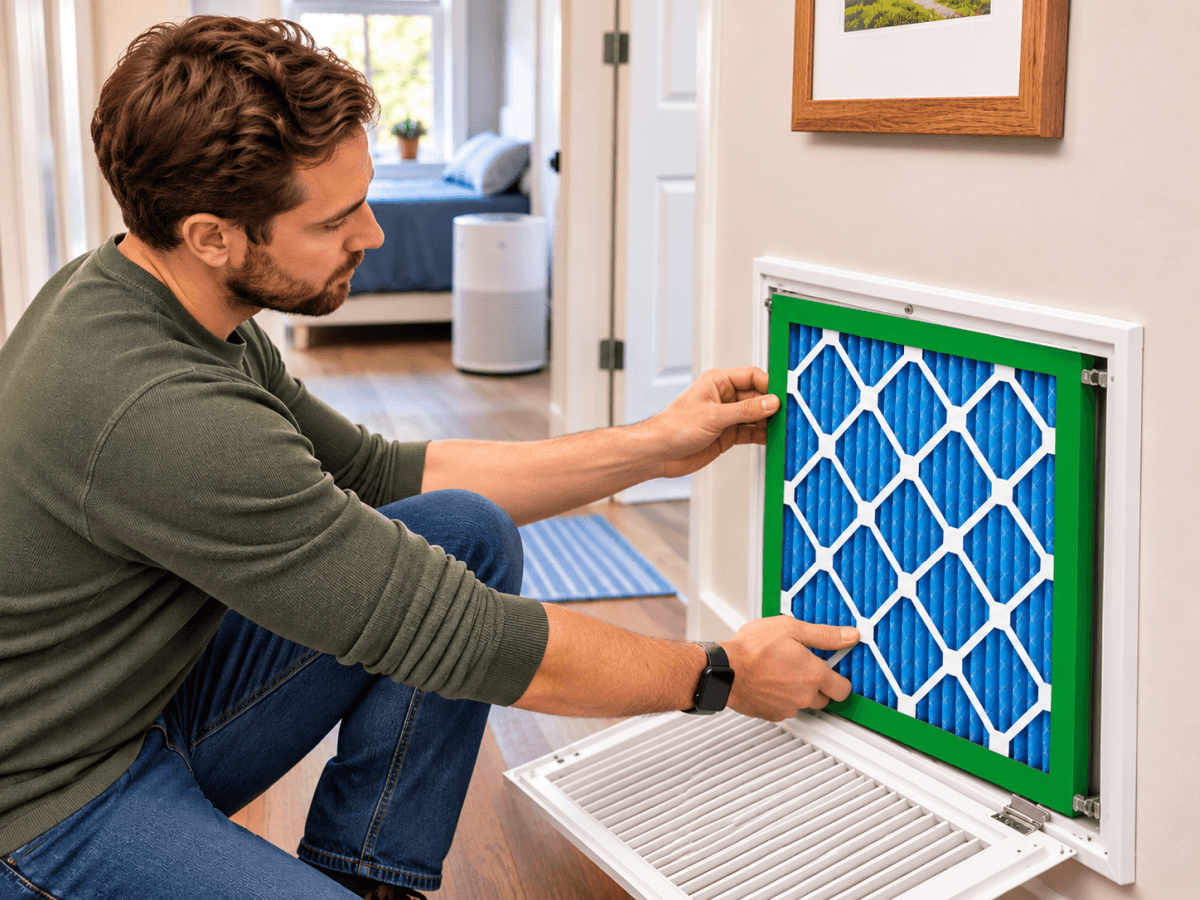
“We make air filters, and we'll be the first to tell you a filter can't say whether it's flu or COVID. Only a test can. What a filter can do is clean the air moving through it. So when someone gets sick, put in a fresh filter that fits, set the fan to On, and step up to MERV 13 if your system allows.”
Supporting Statistics
COVID-19 hits adults over 75 hardest
290,000 to 450,000 US hospitalizations from July 2024 to June 2025.
34,000 to 53,000 deaths in the same period.
Highest rate: adults over 75, at 933 hospitalizations per 100,000.
Why it matters: Older adults should test on day one so there's time for treatment.
Flu set a record for child deaths
289 pediatric flu deaths in the 2024 to 2025 season.
The previous record was 288, set during the 2009 to 2010 pandemic.
Why it matters: Flu remains the bigger threat to young children.
Source: 2024-2025 Pediatric Flu Deaths Surpass Previous Record
Home combination tests catch most cases
92% of positive COVID-19 samples correctly identified.
92.5% of positive flu A samples correctly identified.
Why it matters: A negative test with ongoing symptoms still needs follow-up.
Source: FDA Authorizes Marketing of First Home Flu and COVID-19 Combination Test
Frequently Asked Questions
Is It COVID Or Flu If I Lost My Sense Of Smell?
It points toward COVID, since a new loss of taste or smell is rare with flu. A test will confirm it.
Which Is More Contagious, Flu Or COVID?
COVID, usually by a few days: about 8 days after symptoms start on average, versus up to 5 to 7 for flu.
Is COVID Worse Than The Flu?
It depends on who gets sick. Both can lead to pneumonia and hospitalization, especially in adults 65 and older. Flu tends to hit young children harder, while COVID can lead to Long COVID.
Can A Flu Shot Protect Against COVID?
No. A flu vaccine protects only against influenza, and a COVID-19 vaccine protects only against COVID.
Can An Air Filter Stop Flu Or COVID?
No, and as a filter maker, Filterbuy won't claim otherwise. EPA says filtration can help reduce airborne viruses but isn't enough on its own. Testing, staying home, fresh air, and handwashing do the most, with a compatible MERV 13 filter as a supporting layer.
Breathe Easier This Flu And COVID Season
Clean indoor air is one part of protecting your household, and it's the part we know best. Filterbuy makes MERV 13 air filters in hundreds of standard and custom sizes, with fast and free 2-day delivery to most US states. Set a reminder so a fresh filter is in place before sick season peaks.
Shop MERV 13 Air Filters →Glossary
- Influenza (Flu)
- A respiratory illness caused by influenza A and B viruses.
- COVID-19
- A contagious respiratory illness caused by the coronavirus SARS-CoV-2.
- Co-Infection
- Having flu and COVID at the same time, sometimes called "flurona."
- Combination Test
- One test that checks a swab for both flu and COVID-19.
- Long COVID
- Symptoms that last weeks or longer after a COVID-19 infection.
- AQI (Air Quality Index)
- EPA's 0 to 500 scale for reporting outdoor air pollution.
- MERV (Minimum Efficiency Reporting Value)
- A 1 to 16 rating of how well an HVAC filter captures airborne particles.
- True HEPA
- A standard requiring capture of at least 99.97% of 0.3-micron particles, common in portable air purifiers.