
Can a Cabin Air Filter Reduce Smoke and Wildfire Particles?
November 3, 2026
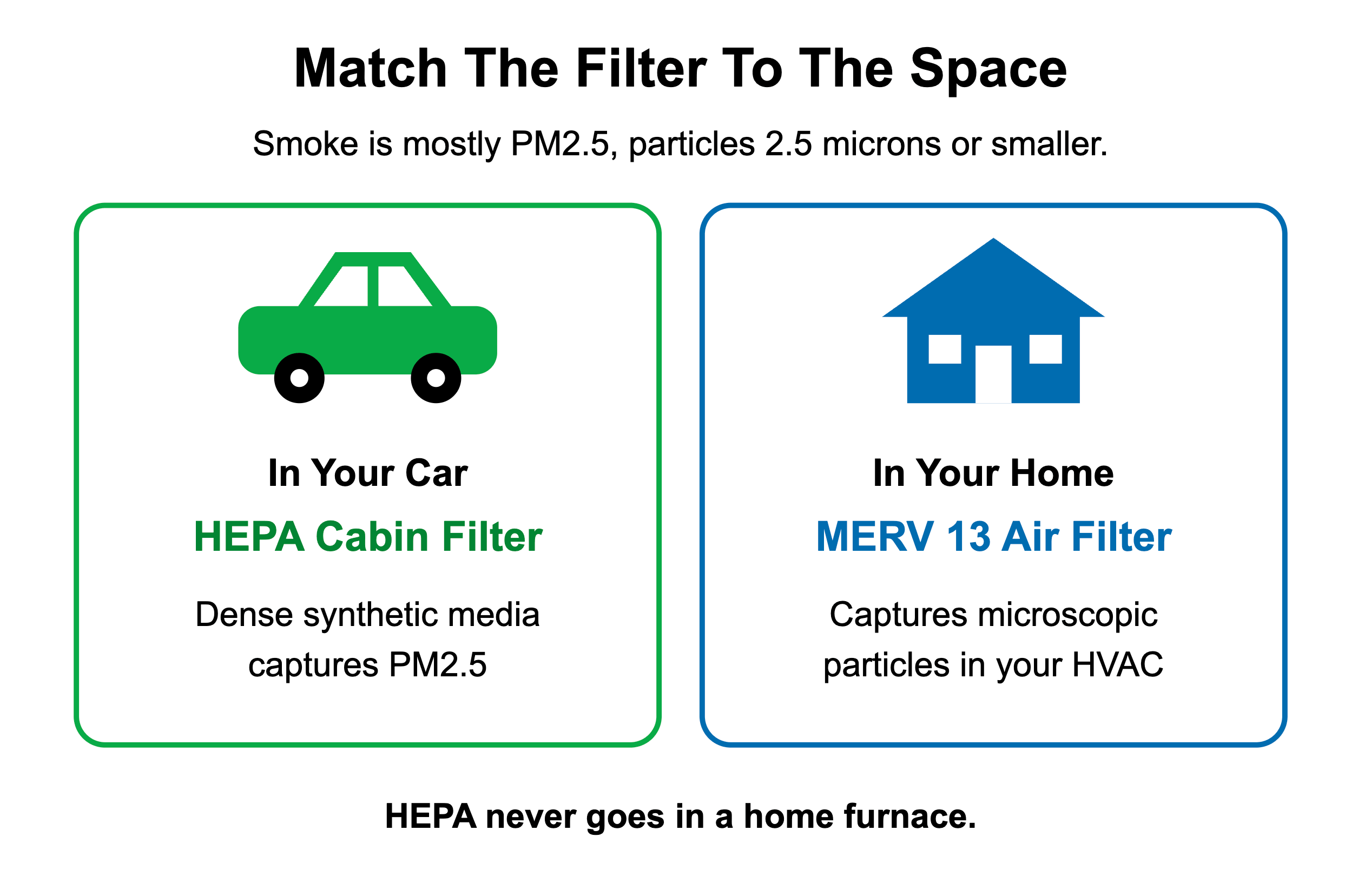
Yes, if the filter media is dense enough to capture PM2.5, the fine particles that make up wildfire smoke. A HEPA or electrostatic cabin air filter traps them. The standard paper filter most cars ship with captures almost none. During a smoke event, check your filter often and replace it when it looks dark.
Smoke reaches your home, too. HEPA media never belongs in a home furnace. For your HVAC system, MERV 13 is the tier to choose. It captures microscopic particles and offers the highest residential filtration.
Find Your Perfect Filter Match
Answer a few quick questions and we’ll match you to the right filter.
TL;DR
A HEPA or electrostatic cabin air filter is the best cabin air filter for wildfire smoke, because both use dense synthetic media that captures PM2.5, the fine particles that make up smoke, while standard OEM paper does not. Pair it with recirculation and closed windows to cut in-car air pollution. Check the filter during a smoke event and replace it when it looks dirty, which can be well before the normal interval.
Key Takeaways
Standard OEM paper cabin filters capture almost no PM2.5.
A new cabin filter at 70 percent recirculation cut in-cabin PM2.5 by 55 percent in one study. Aged, it managed 39 percent.
Smoke loads a cabin filter far faster than road dust, so one that lasts a year in clean air can clog in weeks.
Match your response to the AQI. Above 150, postpone non-essential trips and check the cabin filter more often than usual.
Drivers who stop constantly get less from recirculation, since each door opening swaps cabin air.
Can A Cabin Air Filter Actually Reduce Wildfire Smoke?
Yes, as long as the media is dense enough to capture fine particulate matter. A HEPA or electrostatic cabin air filter traps PM2.5, while the standard paper filter most cars ship with does not, and measured studies put the difference at 30 to 55 percent.
Wildfire smoke is mostly PM2.5, fine particulate matter 2.5 microns across or smaller. A human hair is roughly 70 microns thick, so these particles pass through paper media like sand through a net.
The CDC lists the groups at highest risk from wildfire smoke as people with asthma, COPD, heart disease, diabetes, or kidney disease, plus pregnant people and children. Anyone in those groups should follow their clinician and local air agency guidance.
Fit matters as much as media, which is why Filterbuy builds to exact OEM tolerances. Bypass air, the air that slips around a filter instead of passing through it, reaches the cabin unfiltered, so a filter can rate well on paper and still underperform once it sits loose in the housing.
How Bad Does In-Car Air Quality Get During Smoke Season?
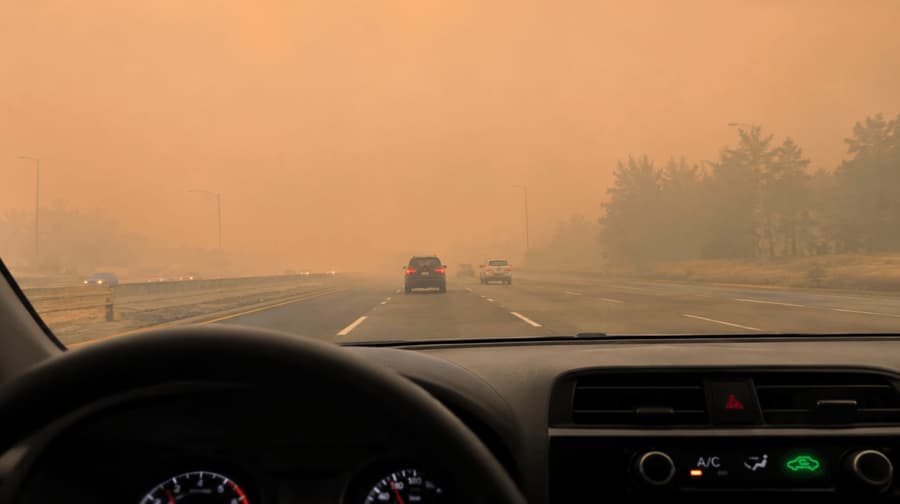
In-car air quality tracks outdoor air quality whenever the climate system is set to fresh air. Vehicles ventilate by pulling outside air through the dashboard vents, so car cabin pollution levels rise with the smoke outside, and traffic worsens driving air quality.
Leakage is the second route in, since air enters around the door and window seals. That is why how dirty the air inside your car gets is a year-round question, not a fire season one.
Researchers have measured this inside real cabins.
Full citations appear in the Sources section. Figures are as reported by each study.
The gap between the new filter and the aged one is the number Filterbuy keeps returning to. At the same setting under the same conditions, the aged filter managed 39 percent against 55 percent. That makes filter age as decisive as filter grade.
Which Cabin Air Filter Is Best For Smoke?
The best cabin air filter for smoke combines HEPA-grade particulate media with an activated carbon layer, because the HEPA media traps fine smoke particles while the carbon adsorbs the gases and VOCs that carry the odor. A wildfire smoke cabin filter doing only one of those jobs leaves the other threat unaddressed.
Capture figures reflect media class, not a single tested product. Fitment and bypass air also affect results.
Activated carbon does not improve particle capture. It works on gas-phase compounds, on top of whatever base media sits underneath, so a carbon filter built on thin paper is still a poor choice for PM2.5. The Filterbuy guide to how to choose a cabin air filter covers fitment and media type.
How Should You Drive In Wildfire Smoke?
Four habits matter most when you are driving in wildfire smoke. Check the Air Quality Index before you leave, close every window and the sunroof, run recirculation, and shorten the trip. EPA guidance on reducing smoke exposure is to close windows and run the air conditioner in recirculate mode when smoke is high, then return to fresh air as conditions improve.
The table maps each AQI band to an action and a filter action. Check conditions on the AirNow Fire and Smoke Map before longer drives, since concentrations shift quickly.
AQI categories follow the EPA scale. Filter actions are Filterbuy guidance for smoke conditions.
What Recirculation Cannot Do
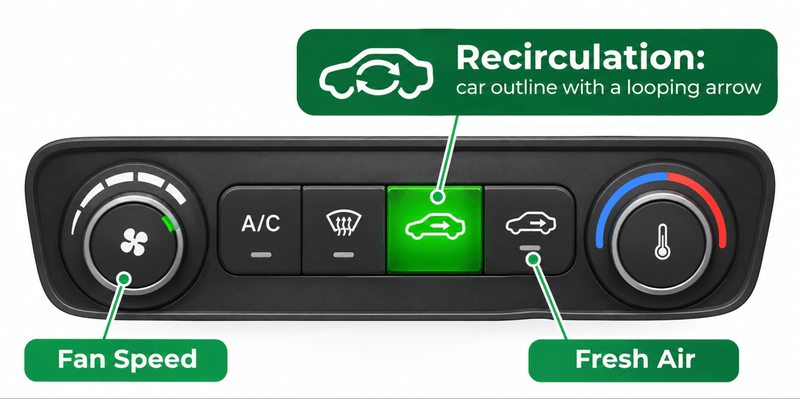
Many vehicles cancel recirculation automatically to manage fogging, so check it every five to ten minutes and switch it back on if it reverts. It also cycles the same air, so carbon dioxide builds with several people aboard. On drives over an hour with a full car, switch to fresh air briefly on a cleaner stretch.
Heavy smoke also cuts visibility, and the EPA advises slowing down. Turn headlights on manually and use low beams, since high beams reflect off particles.
What If You Drive For Work During Smoke Season?
Drivers who stop often get less out of recirculation than commuters do, because every door opening swaps the cabin air. Rideshare, delivery, and trades drivers need a different protocol. Use the highest filter grade the vehicle accepts, run the fan high after stops, and replace in weeks.
Recirculation works by not admitting outside air, so every door opening admits all of it in seconds. A commuter opens a door twice a trip. A delivery driver may open one two hundred times a shift, leaving the filter to clear the cabin over and over.
Run the fan high for two to three minutes after each stop
Keep windows up between stops
Check the filter after heavy-exposure days and keep a spare on hand
There is an honest limit. When doors open every ninety seconds a cabin filter cannot keep up, and NIOSH-approved N95 respirators are what public health agencies point to for that situation. The filter reduces what reaches the cabin between stops. It does not do the same job.
How Often Should You Change A Cabin Air Filter During Fire Season?
Check your cabin air filter during a smoke event and replace it when it looks dirty, meaning dark brown or black. That can come well before the normal interval. Filterbuy publishes twelve months or twelve thousand miles for normal driving, and smoke is not normal driving. Keep a spare on hand.
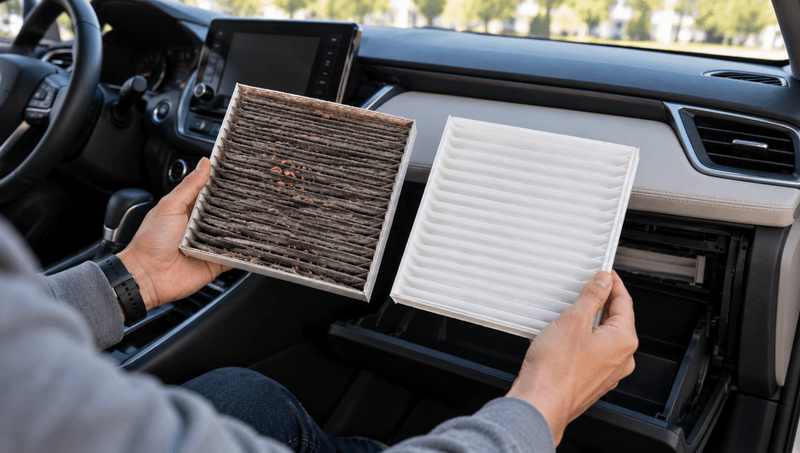
Timing matters as much as frequency, since a filter changed in spring is already mid-life when smoke arrives. Replace ahead of fire season, not during it. Once loaded, a filter fails two ways. Airflow drops so the cabin clears slowly, and soot saturation pushes odor back through the vents.
Activated carbon runs on its own clock. Once its pores fill, odor control declines even while particle capture continues. See how often to change a cabin air filter for normal intervals.
How Filterbuy HEPA Cabin Air Filters Handle Smoke
Filterbuy auto cabin filters use HEPA-certified synthetic media that traps 99.97 percent of airborne particles down to 0.3 microns. That media is the tier we point drivers to for smoke. Each filter is made in the United States to exact OEM tolerances, reducing the bypass air a loose fit allows.
One caution worth stating plainly. HEPA media belongs in a vehicle cabin housing or a portable room air cleaner, never in a home furnace, where the resistance far exceeds what a household blower is built for. For a house during smoke, the tier is MERV 13.
Filterbuy is an American air filter manufacturer headquartered in Talladega, Alabama. Because Filterbuy builds the media instead of sourcing it, we can be specific about the trade-off in a car. Hydrocharging magnetizes every fiber, raising capture without the resistance a small blower struggles against.
Use the vehicle selector on Filterbuy auto cabin air filters to confirm fitment by year, make, and model. The difference between OEM and aftermarket cabin air filters comes down to media density and tolerance.
Reduced airflow at the same fan speed is the clearest sign of overload.
A campfire odor lingers after the air clears
Fine ash settles on the dashboard
The defroster takes longer to clear the glass
They overlap with the signs a cabin air filter needs replacing too.
Supporting Statistics
Three federal and public health sources set the scale. Wildfire is a routine seasonal condition, tens of millions live where particle pollution fails federal standards, and the average driver spends close to an hour a day in a car.
77,850 wildfires burned 5,131,474 acres in 2025. That ran above the five-year and ten-year averages in National Interagency Fire Center wildfire records.
About 61.5 million people live in counties failing for short-term particle spikes. Smoke produces those spikes. The American Lung Association State of the Air 2026 report puts 44 percent of Americans in failing areas.
The mean one-way commute was 27.2 minutes in 2024, and 69.2 percent of workers drove alone. U.S. Census Bureau commuting estimates put a typical commuter in a car about an hour a workday.
Frequently Asked Questions
What Is the Best Cabin Air Filter for Wildfire Smoke?
The best cabin air filter for wildfire smoke uses HEPA-grade synthetic media to trap PM2.5, paired with activated carbon for gas-phase compounds. Standard paper captures very little of either.
Do Cabin Air Filters Help Rideshare and Delivery Drivers?
Less than they help commuters, because every door opening swaps the cabin air and the filter starts over. Run the fan high after stops, check the filter often, and wear a fitted N95.
OPTIONAL TABLE VERSION OF THE FAQ. This is an alternative format for the same four questions, not additional copy. It is excluded from the body word count because only one of the two formats ships.