
Do N95 Masks Work For Wildfire Smoke?
June 18, 2026
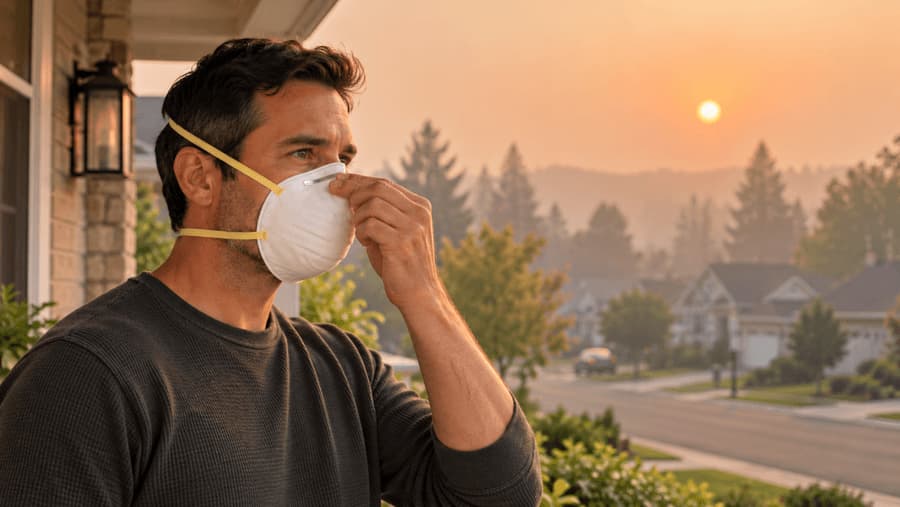
Yes. An N95 respirator is a NIOSH-approved filtering facepiece that captures at least 95% of 0.3-micron airborne particles, including PM2.5, the fine particles that make up most of wildfire smoke. In Colorado State University testing a properly sealed N95 cut smoke exposure by a factor of 16, while a loosely worn one did far less. Fit decides your protection more than the brand does.
Find Your Filter Match
Not sure which filter fits your system? Answer a few quick questions and we’ll match you to the right one.
TL;DR
A NIOSH-approved N95 is the right wildfire smoke mask for most adults, and the 3M 8210 and 3M Aura 9205+ are the most widely stocked U.S. models. When those sell out a KN95 is a reasonable backup, though cloth and surgical masks are not. The mask covers your minutes outdoors, your filter the other twenty-three hours.
Key Takeaways
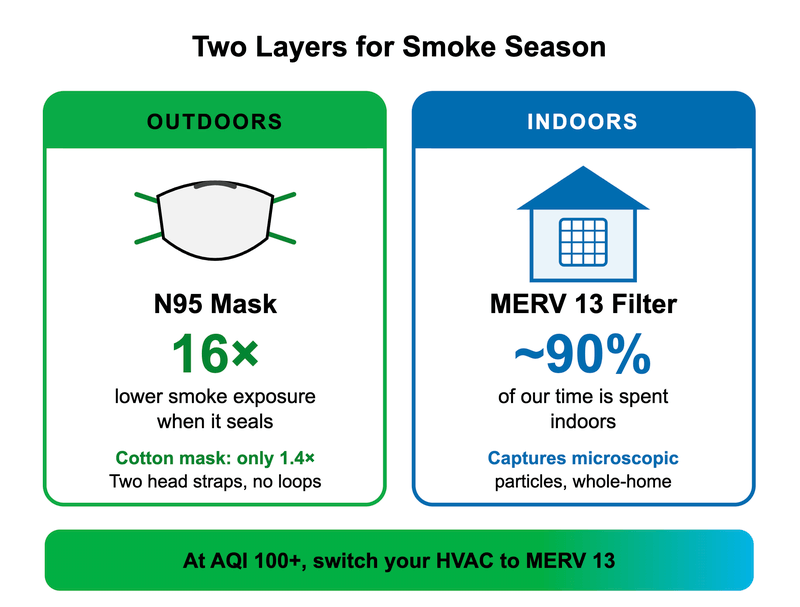
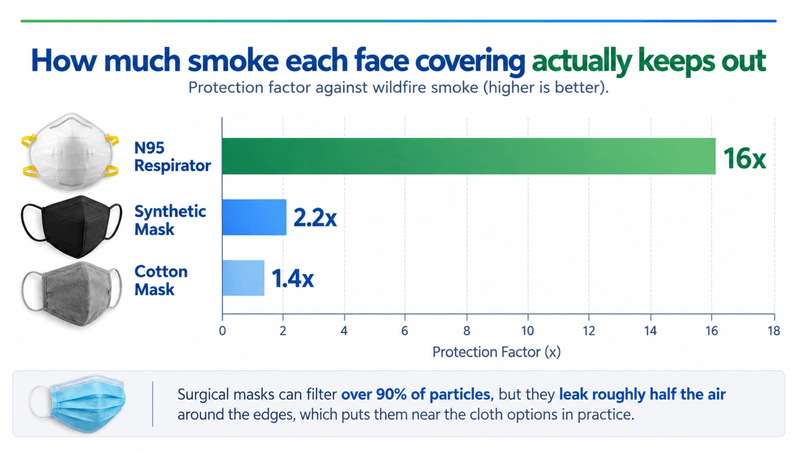
A properly fitted N95 cut wildfire smoke exposure by a factor of 16 in Colorado State University testing. Cotton managed 1.4.
Two head straps, never ear loops. The EPA states masks with one strap or ear loops are not built to seal.
No NIOSH-approved respirator is made in young children's sizes. For kids, clean indoor air beats any mask.
Do N95 Masks Work for Wildfire Smoke?
Yes. A NIOSH-approved N95 that seals to your face captures at least 95% of the fine PM2.5 in wildfire smoke. In lab testing by Colorado State University and the Colorado School of Public Health, published in the AGU journal GeoHealth, N95 respirators cut smoke exposure by a factor of 16, while cotton masks managed only 1.4.
Source: Kodros et al., GeoHealth (American Geophysical Union), 2021. Colorado State University and the Colorado School of Public Health.
Lead author Jack Kodros and his team went on to model the 2012 Washington State fire season, where N95 use at two-thirds compliance would have cut smoke-attributable respiratory hospitalizations by 22% to 39%. NIOSH sets a more conservative floor of a minimum tenfold reduction, and every one of these numbers assumes a seal.
Which N95 Mask Is Best for Wildfire Smoke?
The best N95 for wildfire smoke is a NIOSH-approved model with two head straps, an adjustable metal nose clip, and a shape that seals on your face. Filterbuy makes air filters rather than respirators, so we have nothing to sell you here. Every model below is approved and widely stocked.
Every model listed is NIOSH approved. Confirm the TC number printed on the respirator itself against the NIOSH Certified Equipment List at wwwn.cdc.gov/niosh-cel.
Two head straps beat ear loops every time, and the EPA is explicit: masks with a single strap or two ear loops are not designed to seal. A valve is a comfort feature rather than a protective one, since it changes the air you breathe out, never what the mask filters coming in.
Buy two different models rather than twenty of one, because face shapes vary more than mask shapes do. No NIOSH-approved respirator is made in young children's sizes, and facial hair breaks the seal the same way, so for anyone who can't seal one, the real answer is clean indoor air.
Before You Buy, Check What Is Already in Your Drawer
Most U.S. households still have masks left over from 2020 to 2022, and some are worth keeping for smoke. Three checks settle it: the TC number, the tension left in the straps, and the date on the box. A sealed N95 inside its five-year shelf life works as well as one bought today, so plenty of people reading this don't need to buy anything.
Keep: any NIOSH-approved N95 with snap left in the straps and a TC number that checks out.
Keep as backup: a KN95 or KF94 that still seals on your face.
Retire: cloth and surgical masks, plus anything stiff or stretched.
As for how long one lasts, 3M's instruction for its 8210 and Aura lines is to replace it once it is dirty, damaged, or hard to breathe through, often within a single day of heavy smoke. A NIOSH-approved N95 runs $1 to $3 in a box of twenty, so stocking two per person is cheap insurance.
If smoke is already here and all you have is cloth, the mask isn't the move. Close the windows, set the thermostat fan to On, cut your time outside, and put the effort into the air indoors instead. It's the better trade, and it costs nothing.
KN95 vs N95 for Wildfire Smoke: Which Should You Wear?
N95 and KN95 respirators target the same 95% filtration threshold, but different bodies certify them and they seal differently in practice. N95 is approved by NIOSH under 42 CFR Part 84, while KN95 is certified to China's GB 2626 standard with no NIOSH oversight, and most KN95s hang from loose-sealing ear loops. For the three-way comparison including P100, see the best mask for wildfire smoke: N95 vs KN95 vs P100.
KN95 filtration reflects the labeled GB 2626 claim. MIT Lincoln Laboratory found only about half the KN95 models it tested met the 95% mark.
The quality gap is measurable rather than theoretical. MIT Lincoln Laboratory found that only about half the KN95 models it tested met the 95% mark, and NIOSH found many non-approved imports below 95%. The California Air Resources Board (CARB) blames the loose ear-loop fit. None of that means going without one when N95s are gone.
KF94 makes a reasonable third option. South Korea's standard requires at least 94% filtration at 0.4 microns, and while it is not a NIOSH approval and usually uses ear loops, a well-fitting KF94 is a sound backup. Cloth and surgical masks aren't. CDC/NIOSH lists cloth masks, surgical masks, and bandanas, wet or dry among the coverings that don't filter smoke.
How Do You Wear an N95 So It Protects You?
An N95 mask for wildfire smoke only delivers its rated protection when it seals against your skin. Setting both straps, shaping the nose clip, and running a user seal check takes under a minute, and that minute decides whether you get real protection or just the look of it.
Set both straps, one above the ears and one below.
Shape the nose clip, pinching the metal strip to the line of your face.
Clear the seal line by shaving any stubble where the mask meets skin.
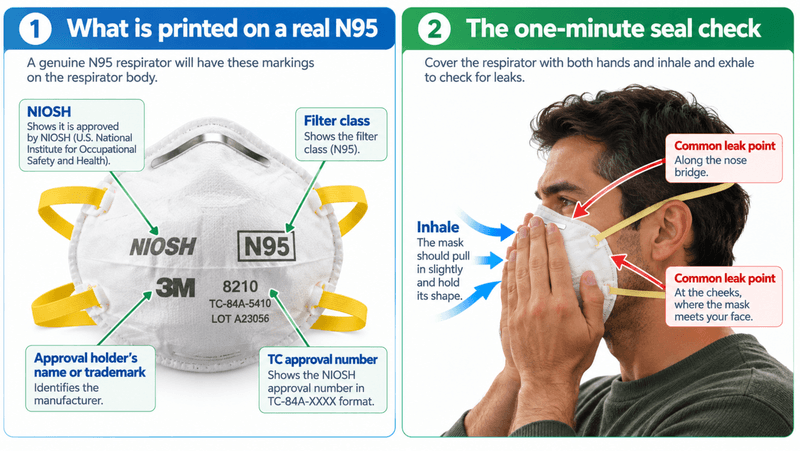
Run the seal check. Cup both hands over the mask and breathe in hard; it should pull inward.
Re-seat and repeat until it tugs inward on every breath.
The number that reframed this piece for me was the nose clip. Seventy-one percent of people never tightened it. Not the wrong mask, not a counterfeit one. One unpinched strip of metal, and most of a respirator's protection walks out around the edges.
Michelle Wan, Brand Manager and Air Quality Writer, Filterbuy
How Do You Spot a Counterfeit N95?
Every genuine NIOSH-approved respirator carries a TC approval number printed on the mask itself, in the format TC-84A-XXXX. Look it up on the NIOSH Certified Equipment List. No number, or a number not on the list, means the respirator isn't approved.
The red flags all live on the mask rather than the box: no TC approval number, no NIOSH markings or NIOSH misspelled, and ear loops with no fastener behind the head.
At What AQI Should You Wear a Smoke Mask?
No single federal AQI threshold triggers masking. General practice puts sensitive groups (children, older adults, pregnant people, anyone with heart or lung disease) in a mask outdoors above AQI 100, and healthy adults above 150. AQI 100 is our action line indoors too: it's when we'd switch the HVAC to MERV 13, set the thermostat fan to On, and run a portable HEPA air cleaner in each occupied room. Check your local air quality before you decide.
Category names and ranges are the EPA’s. Masking thresholds are general practice, not regulation. AQI 100 is Filterbuy’s action line for switching to MERV 13.
A Mask Is Half of Wildfire Smoke Protection
Americans spend roughly 90% of their time indoors, so a mask covers only a small share of your exposure. The EPA recommends a high-efficiency filter rated MERV 13 or higher in a central system during smoke events, and notes that most furnaces and HVAC systems accommodate one without equipment problems, provided the filter is replaced often.
At AQI 100 we'd do four things, and they work together rather than instead of each other.
Put a MERV 13 filter in the HVAC. It's the whole-home layer, because the central system moves far more air than any portable unit can.
Set the thermostat fan to On. On Auto it only filters while the system is heating or cooling. On On, it filters continuously.
Run a portable HEPA air cleaner in each occupied room, bedrooms first. EPA sizes a clean room by smoke CADR at two-thirds of the room's square footage, so a 300 square foot bedroom wants a CADR of about 200. Avoid anything that produces ozone.
Close the house up. Windows and doors shut, and don't add to the problem indoors: no candles, no frying, no vacuuming without a sealed unit.
No ductwork? Apartments, window units, and older homes without a central system have no whole-home layer, so portable HEPA cleaners are your primary defense rather than a supplement. Size them the same way and put one wherever people actually sit and sleep.
Check the filter during a smoke event and replace it when it looks dirty, dark brown or black, which can be well before the manufacturer's normal interval. Keep spares on hand so you can swap one the day you notice.
Here's something we watch happen from the Filterbuy factory floor every season. People see a dark filter and read it as proof the thing is working hard. It's the opposite. A loaded filter has finished its job, and leaving it in costs you the protection you upgraded for.
Above AQI 200, this page isn't the last word. Check the AirNow Fire and Smoke Map and your local air agency first, and follow their guidance on staying in or leaving. Filtration reduces what's in the air. It doesn't make the air safe, and it doesn't touch the gas half of smoke at all.
This is general guidance, not medical advice. A respirator makes breathing harder, so if you have asthma, a heart condition, or any lung condition, talk to your doctor and follow official guidance rather than this page.
Supporting Statistics
Three federal findings shaped the guidance above.
1. Only 24% of People Put an N95 on Correctly
The number: Of 538 members of the public observed putting on an N95, only 129, or 24%, did it properly. The most common error, in 71%, was an untightened nose clip.
Why it matters: It maps onto what Filterbuy sees on the HVAC side, where the gap around a filter frame ruins more filters than bad media does.
Source: Cummings et al., CDC Emerging Infectious Diseases, 2007, by NIOSH.
2. Wildland Fires Produce Half of U.S. Fine Particle Pollution
The number: The EPA's 2020 National Emissions Inventory attributes 52% of all PM2.5 emitted in the U.S. to wildland fires.
Why it matters: Smoke is now the largest single source of the pollutant an N95 is built to stop, which makes a respirator ordinary preparedness.
Source: U.S. EPA, Wildland Fire Research.
3. Smoke Reaches Far Beyond the Fire Line
The number: Between 2007 and 2018, wildfire smoke contributed over 25% of daily PM2.5 at roughly 40% of EPA regulatory monitors for over a month each year. People beyond 5 km of a monitor saw 36% more smoke days.
Why it matters: You do not need to live near a fire to need a plan, and rural households are least likely to have a monitor telling them so.
Source: Wildland Fires Worsened Population Exposure to PM2.5, National Library of Medicine.
Frequently Asked Questions
Do N95 Masks Block the Smell of Smoke?
No. An N95 captures particles, not gases. Smelling smoke through a sealed respirator is the gas half of smoke, which no particulate filter catches. Indoors that job belongs to a Filterbuy activated carbon filter.
Are N95 Masks Safe for Kids?
No NIOSH-approved respirator is made in young children's sizes, so a reliable seal is hard to get. CDC states children aged 2 and older can wear one, but the stronger protection for kids is clean indoor air.
Glossary
KN95: a respirator certified to China's GB 2626 standard, usually ear loops. Not NIOSH-approved.
MERV: Minimum Efficiency Reporting Value, the ASHRAE 52.2 scale for HVAC filters. MERV 13 is the smoke rating.
N95: a NIOSH-approved filtering facepiece capturing at least 95% of 0.3-micron non-oil particles.
NIOSH: the U.S. National Institute for Occupational Safety and Health, which approves respirators under 42 CFR Part 84.
PM2.5: particulate matter 2.5 microns or smaller, the main hazard in wildfire smoke.