Shop by
Written by Michelle Wan, Brand Manager & Air Quality Writer, Filterbuy | Reviewed by David Clark, Licensed HVAC Technician | Published August 27, 2026 | Last updated August 27, 2026
“Every number below comes from Mitsubishi's and Daikin's own documentation, not retailer listings. Three things surprised me: the cold-weather specs tie, Mitsubishi's headline efficiency figure belongs to one 6,000 BTU model, and Daikin lists two different numbers for the same AURORA series.”
Michelle Wan, Brand Manager and Air Quality Writer, Filterbuy
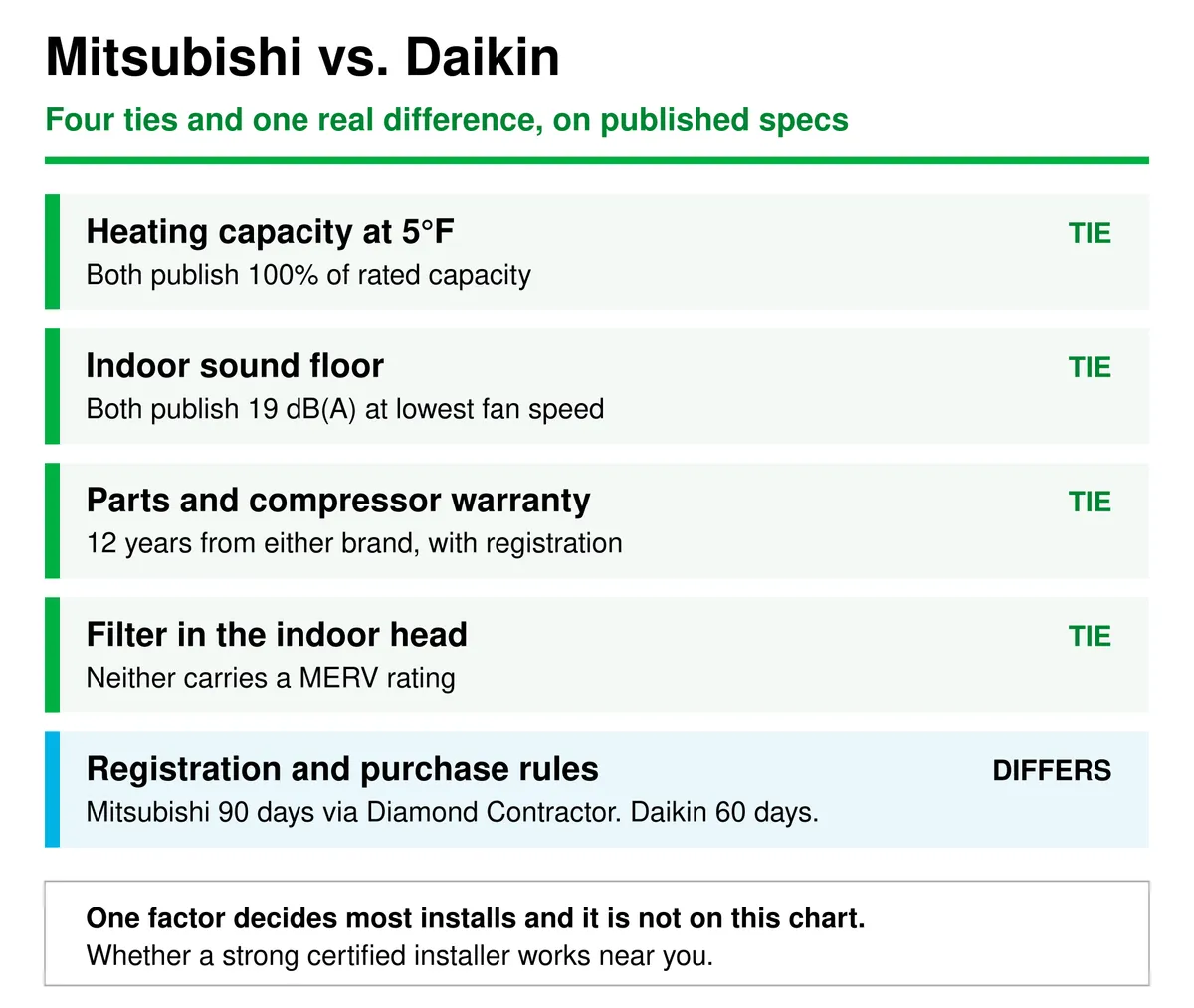
On the specifications each brand publishes, Mitsubishi and Daikin tie, so the installer near you decides this purchase more than the badge does. Both hold 100% of rated heating capacity at 5°F, both publish a 19 dB(A) indoor sound floor, and both cover parts and compressor for 12 years when the system is registered on time. The differences sit in the paperwork.
The quiz below sorts out which of those differences actually applies to your install.
Answer a few quick questions and we will point you to the mini split setup that fits your room.
Filterbuy makes its own single-zone ductless line, and it answers a different question than either brand above. It covers a garage, workshop, or room addition at 17 SEER2, rated to 5°F, with a 7-year compressor warranty, 3-year parts coverage, and free 2-day delivery at a published price. Professional installation is required, and the warranty is void if the system is self-installed.
Mitsubishi Electric and Daikin are the two most reliable premium mini split brands sold in the United States, and on the specs either advertises they finish within a rounding error of each other. Both hold full heating capacity at 5°F, both publish a 19 dB(A) sound floor, and both cover equipment for 12 years with on-time registration. What decides the purchase is whether a strong certified installer works nearby.
Twelve-year coverage comes from either brand, but only with registration: Mitsubishi wants a Diamond Contractor and 90 days, Daikin 60.
Cold-weather headlines match at 100% rated heating capacity at 5°F and operation to roughly -13°F, though some Mitsubishi H2i units go further.
Sound floors match too, at 19 dB(A) indoors and 46 dB(A) outdoors.
Multi-zone systems run every head in the same mode, so heating one room while cooling another is impossible.
Mitsubishi voids coverage on equipment bought through internet or resale channels.
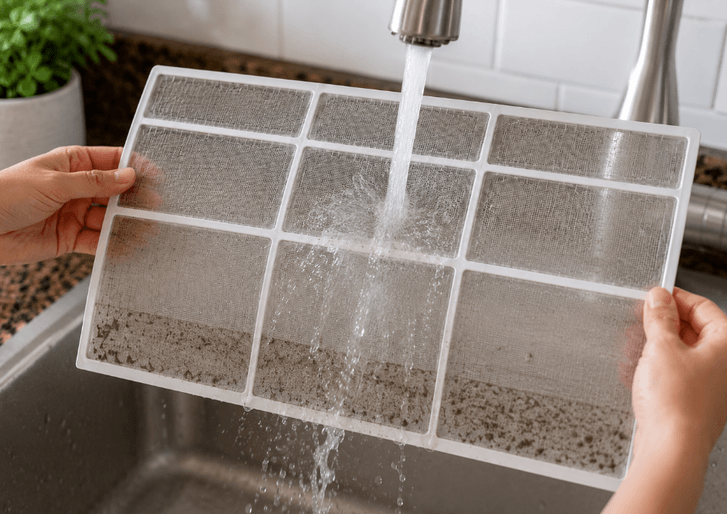
Neither brand's filter carries a MERV rating. The screen guards the coil rather than cleaning the air.
Neither brand wins outright, and most rows in a head-to-head end in a tie. Both have decades in the U.S. ductless market, both use inverter-driven compressors, and both routinely last 15 to 20 years. Mitsubishi equipment is sold and warrantied here by Mitsubishi Electric Trane HVAC US, or METUS.
Distribution is where they diverge. Daikin owns Goodman and Amana, so its parts reach nearly every supply house, while Mitsubishi runs a tighter, factory-trained Diamond Contractor channel. Price rarely separates them: our Mitsubishi review found installs from $1,200 to $8,000.
Peak SEER2 always belongs to the smallest unit in a lineup, which is what makes headline numbers misleading. Mitsubishi reaches 35 SEER2 in its smallest FX-Series capacities while mainstream models land between 18 and 22, and Daikin publishes up to 21 SEER2 on its AURORA R-32 wall-mount line. Ratings fall as capacity rises, so compare only the figure for your size.
Daikin publishes two different AURORA figures across its own product pages: up to 19.8 SEER2 on one, up to 21 SEER2 on the R-32 page. We found both while sourcing this comparison and have yet to see another flag. Ask your contractor for the certified AHRI rating of your pairing, since rebates verify the certificate, not marketing.
Chasing the highest SEER2 can quietly cost you comfort, and neither brand prints this on a brochure. PNNL notes that ductless systems dehumidify worse than ducted ones, and that the more efficient the unit, the worse it gets. It is worst in models built for high efficiency or cold climates, the exact ones a spec comparison steers you toward.
The metric is sensible heat ratio (SHR), where lower is better, and it sits in manufacturer performance data, not the spec sheet. In a humid climate ask for your pairing's SHR first, because a high-SEER2 head can hold temperature and still leave a room clammy.
On the published specs, this one is a tie. Mitsubishi's H2i models deliver up to 100% heating capacity at 5°F and keep heating to roughly -13°F, and Daikin AURORA matches both. They separate model by model, since certain Mitsubishi H2i units work past that floor. If winter output is why you are buying, check your model against the NEEP cold-climate list incentive programs use.
Neither brand carries a systemic failure mode that separates it from the other. The failures technicians get called out for trace back to installation and neglect: a shallow vacuum, a sloppy flare, an uncleaned blower wheel.
Warranty is where they part company. Mitsubishi gives 12 years on parts and compressor only when a Diamond Contractor installs and registers within 90 days; any other licensed contractor drops that to 10 years, and no registration leaves five on parts, seven on the compressor. Daikin asks for registration within 60 days, though several states prohibit conditioning coverage on registration.
One trap belongs to Mitsubishi alone. METUS states that warranty protection is not available on resale purchases, meaning internet, auction, or any resale channel, even unopened. Buying online to skip the markup is common advice, and here it voids coverage.
The expensive mistake is not the wrong brand. It is losing coverage to a missed deadline or the wrong purchase channel. Confirm in writing who sources and registers the equipment, and when.

Both brands require professional installation, and that is not a formality: a mini split is assembled in the field, so your contractor matters more than either brand's engineering. Flare connections, vacuum depth, and refrigerant charge get set by hand, and a badly charged system underperforms whatever the badge says. Daikin parts sit on shelves nationwide though Comfort Pro coverage is uneven, while Mitsubishi's Diamond Contractor network is smaller and factory-trained.
Ask any bidder three questions in writing. Are you certified, and at what tier? Who registers the warranty, and when? Will you run a room-by-room load calculation? Those are the ones our HVAC Solutions team wishes homeowners had asked, because nobody fixes them two years later.
Mitsubishi and Daikin publish identical sound floors, so neither is quieter on paper: 19 dB(A) indoors and 46 dB(A) outdoors. Both figures come from the quietest model at its lowest fan speed, so anyone calling one brand the quiet one is comparing models, not manufacturers.
Put several heads on one outdoor unit and a constraint applies to both brands equally, though almost no comparison mentions it: on a standard multi-zone system, every indoor head has to run in the same mode. Cooling the sunroom while heating the bedroom is impossible, and PNNL warns that mixing modes causes extreme efficiency loss.
Shutting heads off saves less than expected, since refrigerant still flows to an idle head and the system cycles once load falls below minimum capacity. PNNL advises against more than three heads per outdoor unit, so two smaller condensers often beat one. Filterbuy makes single-zone systems only and does not compete in multi-zone, so treat a multi-zone quote as a design question, not a brand one.
Neither Mitsubishi nor Daikin puts a MERV-rated filter in a ductless indoor head, so on filtration the two tie, and neither does what buyers often assume. The screen behind the front panel is a coil guard, and the U.S. EPA states directly that ductless heat pumps generally do not filter fine particles.
Both sell a step up with the same limit: Daikin, a Titanium Apatite Photocatalytic Air Purifying Filter, Mitsubishi media such as Nano Platinum. PNNL documented why neither closes the gap: a clip-in filter covers part of the screen, so most airflow bypasses it.
Filtration is the part of this comparison we work on directly. Filterbuy manufactures air filters in the United States and services ductless heads in the field, so we see what these screens look like three years after install. We also sell a competing single-zone line, so read the paragraph above knowing we had every reason to overstate a rival's filtration and did not.
An air quality plan needs its own budget line. If ductwork serves any part of your home, the EPA's threshold for fine-particle capture is a MERV 13 pleated filter at that return; check your system is rated for MERV 13 airflow first, since not every air handler is. For ductless rooms, a portable air cleaner sized by Clean Air Delivery Rate handles the fine fraction, and our air purifier guide covers sizing. PNNL also recommends a professional blower-wheel clean every one to three years, which is not a DIY job.
“The Mitsubishi units I get called out rarely have a bad compressor. They have a blower wheel nobody has touched in six years and an owner who never knew the mesh came out. The equipment held up. The maintenance did not.”
David Clark, Licensed HVAC Technician
Choose Mitsubishi if your winter design temperature drops well below 0°F, if you need unusual head styles, or if a Diamond Contractor works in your area. Choose Daikin if your climate is moderate or a Comfort Pro gives the stronger quote. If neither has a strong certified installer nearby, buy the brand that does: a correctly installed mid-tier system beats a premium one charged badly. Our own line answers a different question: a published price, free 2-day delivery, and a 7-year compressor warranty on a value single-zone unit for a garage, workshop, or room addition. It requires professional installation, and the warranty is void if self-installed. Settle sizing with how to choose a mini split system, then most reliable mini split brands and replacement filters by brand.
Sourcing and review: Every specification here comes from each manufacturer's own published documentation, and we published the rows where they beat our own ductless line. Michelle Wan works with Filterbuy's U.S. filter manufacturing team in Alabama, Florida, Pennsylvania, and Utah. David Clark, Licensed HVAC Technician, reviewed this page.
NIST tested seven common installation faults and found improper installation could raise heating and cooling energy use on the order of 30%, with leaky ducts dominant, then refrigerant undercharge and incorrect airflow.
Source: NIST, Technical Note 1848
The ENERGY STAR Cold Climate designation requires at least 70% of 47°F heating capacity at 5°F and a COP of 1.75. Mitsubishi H2i and Daikin AURORA both published 100%, clearing it by 30 points.
Source: Heat Pump Key Product Criteria (ENERGY STAR, U.S. EPA)
EPA reports Americans spend approximately 90 percent of their time indoors, where some pollutants run 2 to 5 times higher than outdoors. A ductless head addresses none of it.
They tie on published specs: both deliver up to 100% rated heating capacity at 5°F with operation to roughly -13°F. Certain Mitsubishi H2i units go below that floor, so the advantage is model-specific.
Yes. Daikin uses R-32; Mitsubishi has moved to R-454B. Both are low-GWP A2L refrigerants that replaced R-410A, and the difference in a home is negligible. Our refrigerant guide covers the transition.
No. Ductless heads use a thin washable screen with no housing for pleated media. Handle MERV 13 filtration at your whole-home return or with a portable air cleaner.
Rinse the mesh screen every two to four weeks, more often with pets or a smoker, plus a professional blower-wheel clean every one to three years.
Neither is reliably cheaper. A comparable tier lands in a similar range on both, and the spread between two local quotes is usually wider than the spread between nameplates.
SEER2: the federal cooling efficiency metric. Higher is better.
SHR: sensible heat ratio, which measures dehumidification. Lower is better.
H2i (Hyper-Heating INVERTER): Mitsubishi's cold-climate tier, holding rated heating capacity at low temperatures.
METUS: Mitsubishi Electric Trane HVAC US, the joint venture warranting Mitsubishi ductless equipment.
AHRI reference number: confirms an indoor and outdoor pair is certified together as a matched system.
MERV: the 1-to-16 filter capture scale. Ductless screens carry none.
Disclosure: Filterbuy sells its own single-zone ductless systems, which makes Mitsubishi and Daikin direct competitors of ours. We do not recommend our own line anywhere on this page, and we cede the two categories this comparison is about: our units are rated to 5°F and 17 SEER2, so for cold-climate heating or maximum efficiency, buy Mitsubishi or Daikin. Filterbuy is not affiliated with or endorsed by either brand.