Shop by
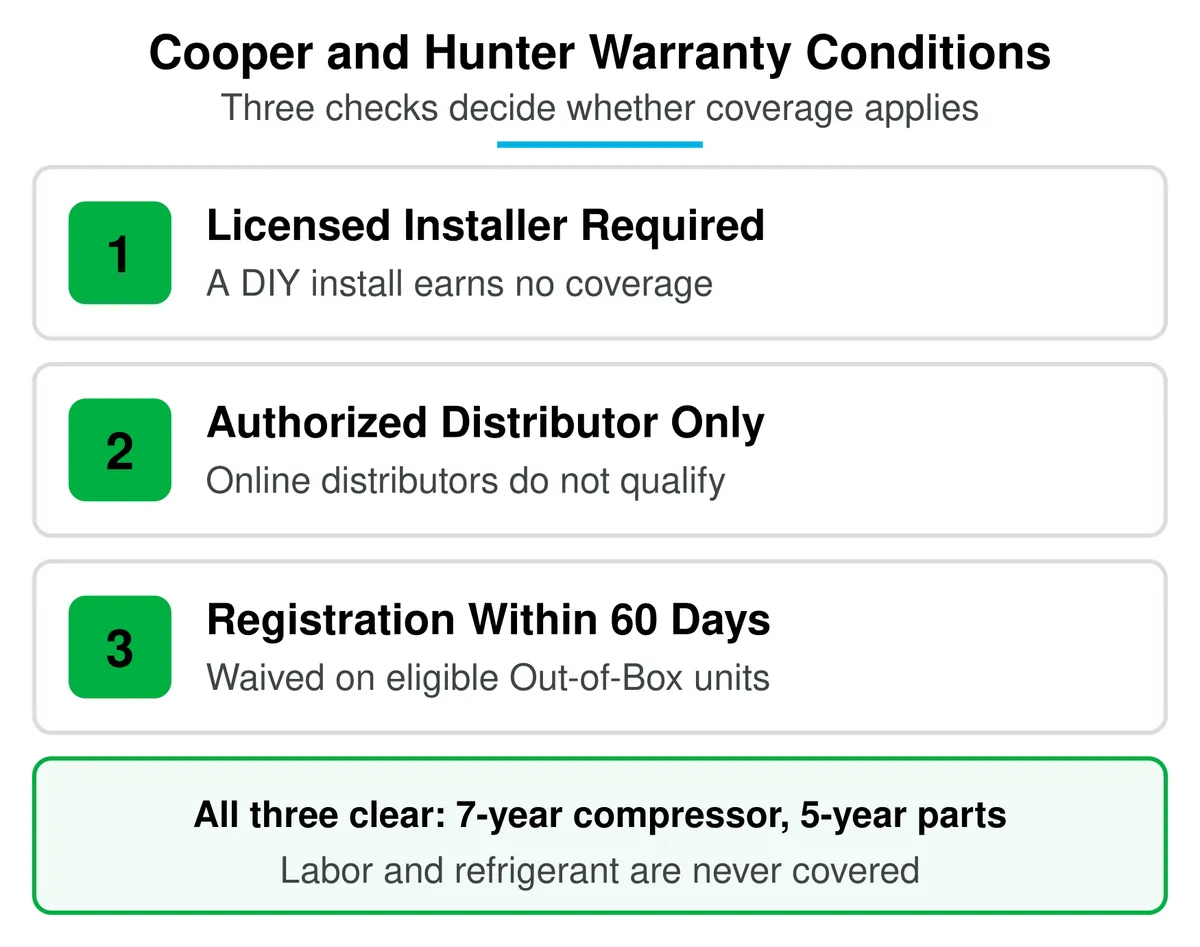
Cooper & Hunter is worth buying if a licensed contractor installs it and you source it from an authorized distributor. The brand rates up to 26.4 SEER2 at a mid-tier price, backed by a 7-year compressor and 5-year parts warranty. Three conditions decide whether that warranty actually applies, and the graphic below shows all three. Labor and refrigerant are never covered, and coverage does not transfer to a new owner.
Which series fits your space:
Shopping rather than researching? Answer a few quick questions and we will point you to the mini split size that fits your space.
Filterbuy builds its own ductless line in 12,000, 18,000, and 24,000 BTU, rated 17 SEER2, with a 7-year compressor and 3-year parts warranty and free 2-day delivery.
Compare Filterbuy Mini Split Systems
Disclosure: Filterbuy sells mini split systems that compete with the brand reviewed on this page.
Cooper & Hunter is a hidden gem on efficiency and a mixed bag on coverage. The Florida-headquartered brand sells ductless mini splits rated up to 26.4 SEER2, matching premium systems at a mid-tier price. Its 7-year compressor and 5-year parts warranty sits mid-pack, but the conditions rule out DIY installs and the online marketplaces where many of its systems sell.
Olivia is rated up to 26.4 SEER2 and Sophia up to 25 SEER2, and the same model sells in both R-410A and R-454B. Only R-454B and R-32 units qualify for the registration-free Out-of-Box Warranty.
The warranty runs 7 years on the compressor and 5 on parts, and labor and refrigerant are never covered.
It excludes damage from poor maintenance and names air filter cleaning specifically, making a neglected filter a coverage risk, not only an efficient one.
The federal 25C tax credit expired December 31, 2025, so listings still advertising it are out of date.
Cooper & Hunter is a U.S.-headquartered HVAC brand, founded in 1996, that manufactures overseas and sells ductless systems in more than 50 countries. Per the company profile, its U.S. operation runs from Doral, Florida, and it entered a manufacturing partnership with Zhuhai Vino in 2017. That arrangement sits behind most of the value-tier ductless market, and it answers the rebadge question honestly: a real brand, one that answers its own phones on weekdays in five languages.
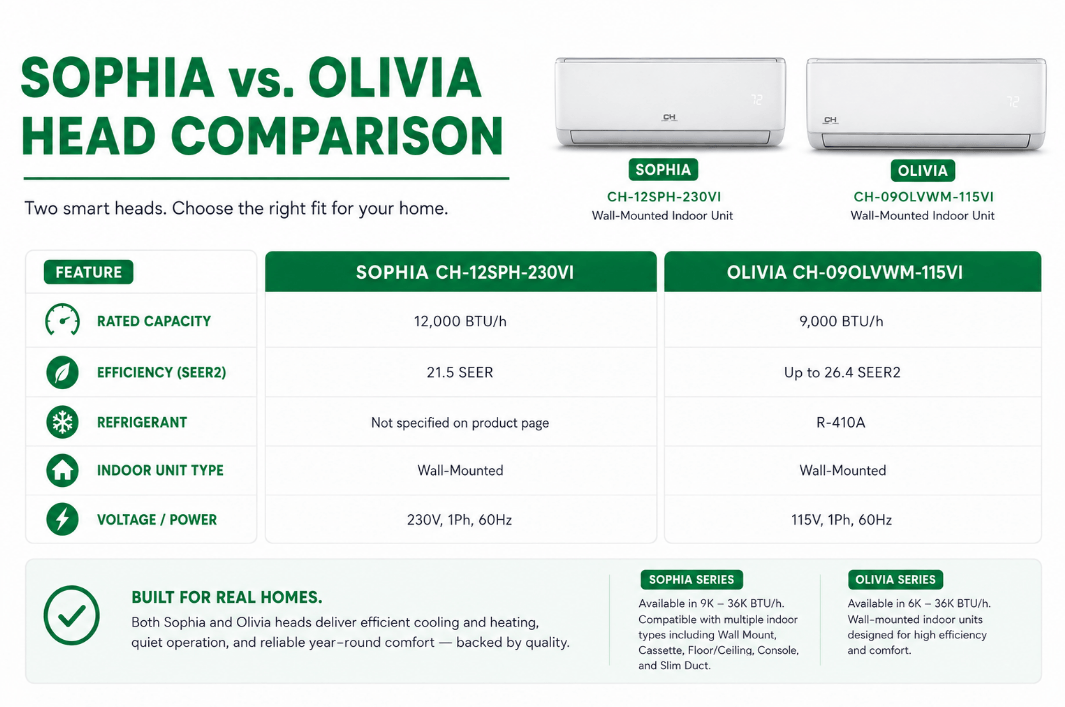
Buy Sophia for flexibility and Olivia for efficiency: Sophia supports cassettes, floor consoles, and slim ducts at up to 25 SEER2, while Olivia is wall-mount only and reaches 26.4 SEER2. Sophia covers 9,000 to 36,000 BTU/h single-zone and matches every indoor style the brand makes. Olivia spans 6,000 to 36,000 BTU/h, and Cooper & Hunter credits its efficiency to Genius Core Technology letting the compressor idle to 12 Hz instead of cycling off. Both include Follow Me mode, sleep mode, timers, and 46°F freeze protection, and Olivia Midnight is the same unit in matte black.
Cooper & Hunter rates the Olivia heads as low as 25 dB(A), roughly a quiet library, though that trails the quietest Fujitsu and Mitsubishi heads. Our own line is 28 dB in Mute Mode, so quiet isn’t a category we claim.
In cold climates a different split matters more: standard units are rated to -13°F, while Hyper Heat models reach -22°F and add a base pan heater. Confirm any model in the ENERGY STAR ductless database and ask your installer for the AHRI certificate, where a SEER2 number gets independently verified rather than marketed.
A single-zone system typically runs $700 to $2,000 for equipment and $2,000 to $4,800 installed, with three- to five-zone systems listing $4,900 to $7,000 for equipment alone. At comparable capacity, Cooper & Hunter lands a few hundred to a couple thousand below Mitsubishi or Daikin, and that gap is the whole argument for it.
Headline warranty numbers are misleading here, because the conditions decide what you get. Mitsubishi and Daikin publish 10- and 12-year terms gated behind certified-contractor installation and registration, and Daikin drops to 5 years without them, while MRCOOL’s DIY line publishes 7/5 with self-installation allowed. Cooper & Hunter sits between them, asking only for a licensed installer, but its registration-free path excludes online distributors, exactly where a large share of its systems sell. The brand’s most convenient warranty path rules out its most common sales channel.
Standard coverage is a 7-year compressor and 5-year parts warranty, conditional in ways that catch homeowners out. These terms in the published warranty policy deserve attention first.
Professional installation is mandatory. Coverage applies only to systems installed by a state-certified or licensed HVAC contractor, and a DIY install doesn’t earn partial credit. It earns none. Our guide to verifying an HVAC contractor has state lookups.
Registration has a 60-day clock. The technician must register within 60 days of installation, and Cooper & Hunter states plainly that unregistered products aren’t covered.
The 2026 Out-of-Box Warranty removes registration but adds a sourcing rule. Eligible units from authorized distributors get automatic 7/5 coverage with no registration, and online distributors don’t qualify.
Labor and refrigerant are never covered. Cooper & Hunter supplies the part; you pay the technician, shipping, and refrigerant. On a year-six compressor failure, that’s a free part versus a four-figure bill, and coverage doesn’t transfer to a new owner.
Check the refrigerant before you pay. Cooper & Hunter sells both generations side by side, and only R-454B and R-32 units qualify for the Out-of-Box path. Older R-410A stock is still legal to install, since EPA’s May 2026 rule removed the deadline for units built before January 1, 2025 and legacy inventory can still go in. It just arrives on the harder path.
Check that the model is still in production. The warranty refuses coverage for any unit discontinued more than five years, “without exception,” and end-of-life stock surfaces exactly where deal-hunters look. A clearance price there buys a system with no warranty behind it.
One upside: technicians in the Pro-Tech Dealer Program can access extended coverage of up to 10/10 or 12/12 by tier, so asking whether your contractor is one is the highest-leverage question available. Keep the invoice either way, since a claim requires proof of purchase, the model and serial number, the install date, and the installer’s EPA license number.
The question we get asked most: What Actually Fails First On A Value-Tier Ductless System?
Not the compressor. It's the blower wheel and the coil, and by the time a technician is called out the filter has usually been dirty for two or three seasons. A neglected filter and an unregistered install are also what most denied claims come down to. — David Clark, Licensed HVAC Technician
Clean the washable mesh filters every two to four weeks during heavy use, and every two weeks with pets or year-round operation. Cooper & Hunter includes a long-life washable filter as standard, so this is cleaning rather than replacing.
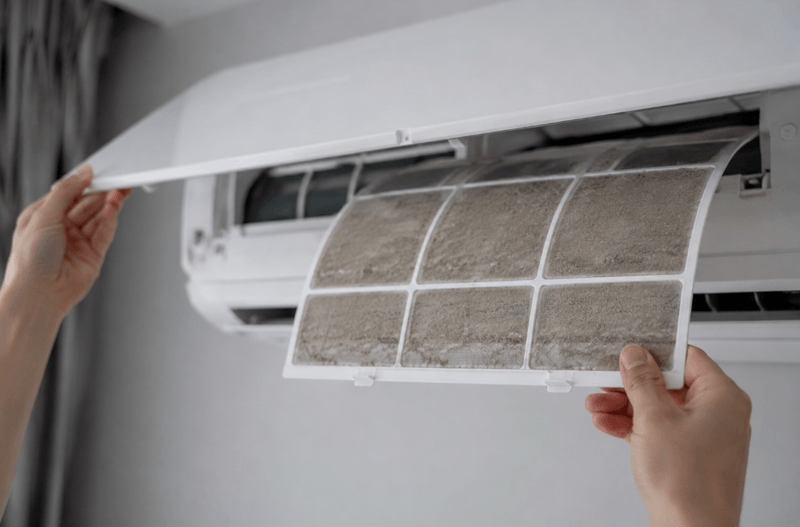
Here’s why that deserves its own section. The warranty excludes damage from poor maintenance, naming air filter, heat exchanger, fan, and blower cleaning. A ductless head pulls all of its room air through thin plastic mesh at the wall, so when the mesh clogs, dust reaches the blower wheel and coil and the compressor strains. That’s the exact failure the exclusion covers, which makes filter neglect on a Cooper & Hunter system a warranty risk and not just an efficient one. It’s also what our HVAC Solutions team sees most on ductless calls, because the mesh looks clean right up until the coil behind it is loaded.
The routine takes ten minutes: power off, lift the panel, slide the filters out, vacuum, rinse in warm water with mild soap, and dry them fully before reseating. Never reinstall a damp filter, because that’s how the musty smell starts. Our filter cleaning guide has the full version.
One honest note from a company that makes filters: a ductless head’s mesh protects the equipment more than it cleans your air, and it isn’t MERV-rated. The EPA’s guidance on air cleaners in the home is blunt that filtration supplements source control and ventilation rather than replacing either. See how mini splits affect air quality for more.
Cooper & Hunter is worth buying if you’re hiring a licensed installer, sourcing through an authorized distributor, and want high efficiency at a mid-tier price. The uncomfortable part, plainly: its headline SEER2 numbers beat our own line, which is rated 17 SEER2. We sell against this brand and still think it’s underrated on hardware.
It’s the wrong choice for a DIY install, a marketplace purchase, or a house you’ll sell soon, because the warranty either doesn’t apply or doesn’t follow you. See our best mini split brands guide for the wider field.
One last check before signing. The 25C credit was terminated for systems placed in service after December 31, 2025, as the IRS’s Energy Efficient Home Improvement Credit page confirms, so listings advertising “§25C eligible” or credits through 2032 are wrong for a 2026 install. Confirm eligibility with a tax professional. Our guide to heat pump tax credits after Section 25C expired covers the state and utility programs still running.
Three U.S. government findings behind this page:
Improper installation raises heating and cooling energy use by roughly 30%. NIST’s three-year study was the first to quantify common installation faults, and found most field equipment ran below rated efficiency.
Source: NIST, Energy Efficiency of HVAC Equipment Suffers Due to Poor Installation
Ductless heads need a deep clean every 1 to 3 years. The U.S. Department of Energy states ductless mesh filters have very low particulate capture by design, and that moisture on the blower wheel makes dust stick and can feed fungal growth.
Source: U.S. DOE Building America Solution Center, Ductless (Mini-Split) Heat Pumps
ENERGY STAR certification is voluntary, and tests cold-climate performance down to 5°F. A system can be sold without it, so verifying the model rather than the brand confirms a rating like Hyper Heat’s -22°F was tested rather than advertised.
Source: ENERGY STAR (U.S. EPA), Ductless Heating & Cooling
Yes, with conditions. It’s a legitimate value-tier brand with competitive efficiency, U.S.-based phone support, and a 7-year compressor / 5-year parts warranty. Its weakness is warranty conditionality, not build quality.
It’s headquartered in Doral, Florida, and manufactures overseas via its Zhuhai Vino partnership.
Doing so voids the warranty, which covers only systems installed by a state-certified or licensed HVAC contractor. Anyone opening a refrigerant circuit also needs EPA Section 608 certification.
Every two to four weeks during heavy use, and every two weeks with pets or continuous operation. The filters are washable rather than replaceable.
Well-maintained systems in this tier run 12 to 15 years, against 15 to 20 for premium brands. Filter and coil maintenance is the largest variable.
Cooper & Hunter (C&H): An HVAC brand founded in 1996, headquartered in Doral, Florida, selling ductless mini splits, heat pumps, and VRF systems in 50+ countries.
SEER2: The U.S. cooling-efficiency standard; higher numbers mean less electricity per unit of cooling.
Sophia series: Cooper & Hunter’s volume single-zone line, 9,000–36,000 BTU/h, up to 25 SEER2.
Olivia series: Cooper & Hunter’s high-efficiency wall-mount line, 6,000–36,000 BTU/h, up to 26.4 SEER2. Olivia Midnight is the black-panel variant.
Hyper Heat: Cooper & Hunter’s cold-climate outdoor unit, rated to -22°F versus -13°F for standard units.
Out-of-Box Warranty: Registration-free 7-year compressor / 5-year parts coverage, effective January 1, 2026, on eligible R-454B and R-32 units from authorized distributors only.
Michelle Wan is Filterbuy’s Brand Manager and air quality writer, working with Filterbuy’s U.S. manufacturing team. Reviewed for technical accuracy by David Clark, licensed HVAC technician. Product specifications reflect Cooper & Hunter’s published documentation as of August 2026.
Disclosure: Filterbuy sells its own mini split systems, which compete with the brand reviewed here. Where Cooper & Hunter has stronger published specifications, we’ve called those differences out. Filterbuy is not affiliated with or endorsed by Cooper & Hunter, Mitsubishi Electric, Daikin, or MRCOOL.