
Ottawa, ON Live Wildfire Smoke Map
Get Alerts For Wildfires In Your Area
The moment a wildfire starts near you, you'll get an instant alert and simple tips to reduce your smoke exposure.
What's In The Smoke
30xSmaller than a human hair
Fine enough to reach deep into the lungs. A MERV 13 is built to capture it.
How Far It Travels


It Doesn't Stay Local
Smoke rides the wind far downwind — you can get smoky air with no fire nearby.
What To Do During A Smoke Event
Simple steps to reduce indoor exposure.
- Stay In, Close UpShut windows and doors to keep smoke out.
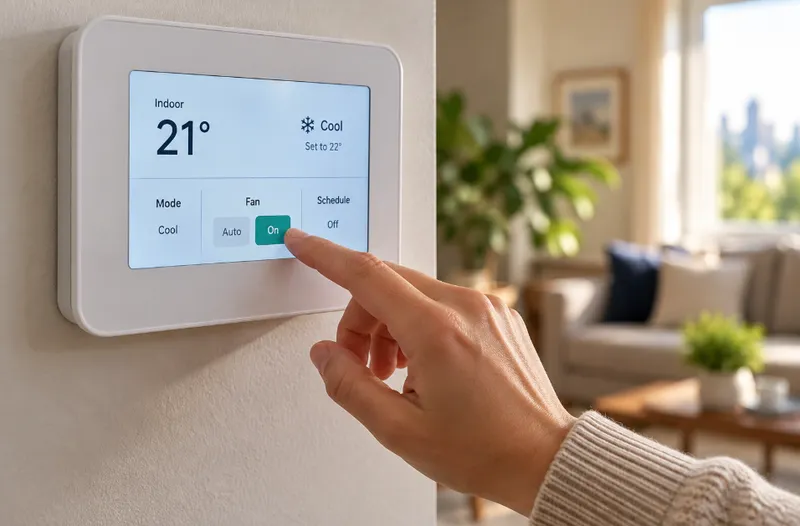
- Set Fan To "On"Keeps air cycling through your filter, not just when heating or cooling.
- Recirculate AirSwitch off fresh-air intake so you're not pulling smoke in.
- Run A MERV 13Built to capture the fine PM2.5 in smoke.
- Add A PurifierExtra filtration for the room you use most.
- Wear an N95 if OutsideFits snug to block fine particles — a cloth mask won't.


The Best Air Filter For Wildfire Smoke
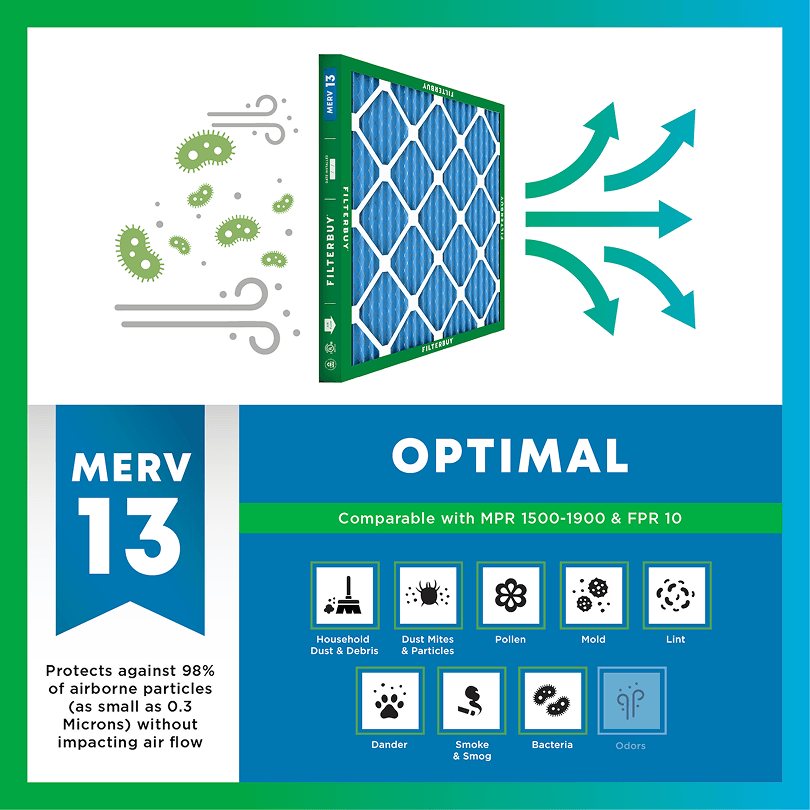
During smoke events, the EPA recommends upgrading to a MERV 13 filter — or the highest-rated filter your system can handle — to help reduce the fine particles smoke brings indoors. MERV 13 is the level most home HVAC systems can run while still capturing PM2.5, the fine particulate that makes up the bulk of wildfire smoke.
- Captures PM2.5 particles
- Blocks ash, soot, and smoke odor
- Keeps your indoor air safe—even when the outdoor air is dangerous
- Meets the EPA's recommended rating for filtering fine wildfire smoke particles.

Wildfire Smoke FAQs
Facts About Wildfires
Over 70,000 wildfires burn in the U.S. every year.
Wildfire smoke can travel 1,000+ miles, affecting states that aren't even near the blaze.
Exposure to wildfire smoke can worsen asthma, trigger heart issues, and lead to ER visits.
Indoor air can hold more fine particles during wildfire events unless it's properly filtered.
The EPA advises using MERV 13 filters or portable HEPA air cleaners during wildfire smoke events.
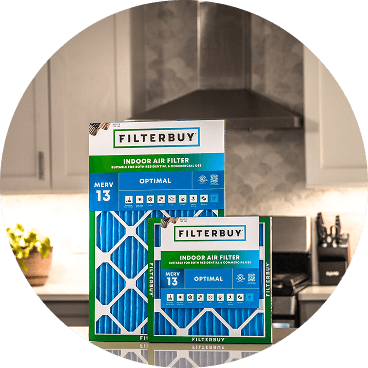
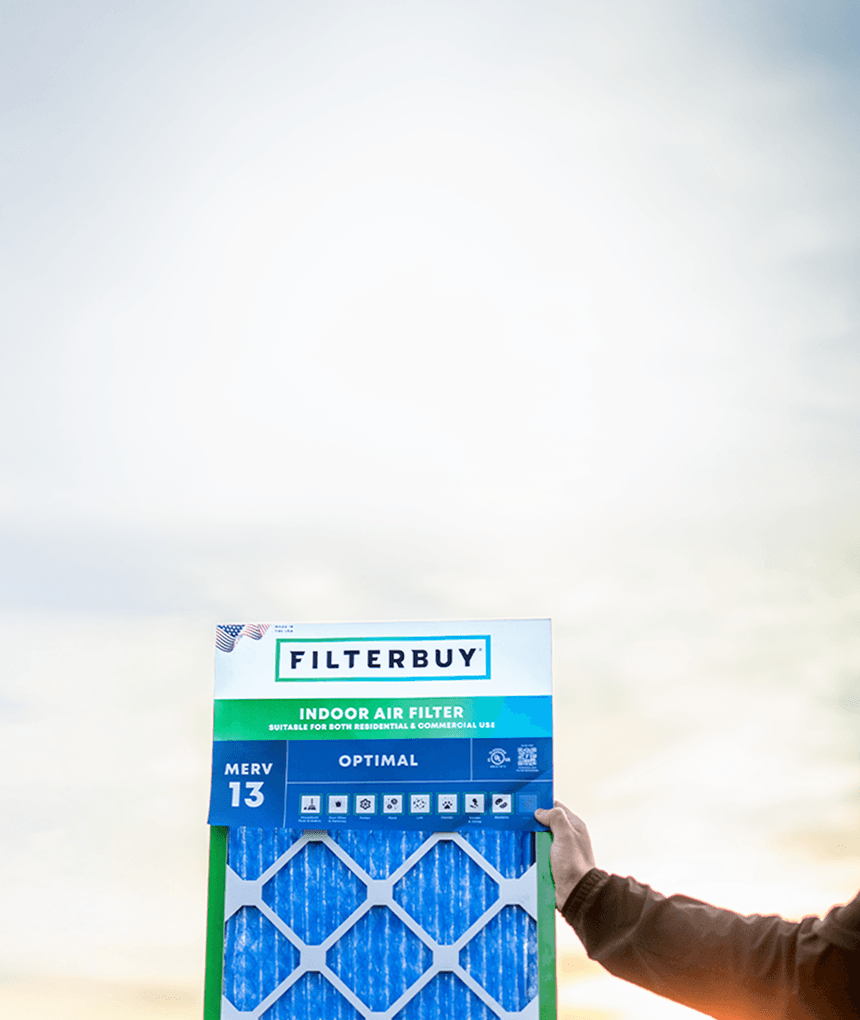
Don't Wait Until The Smoke's Inside.
Use the live wildfire smoke tracker and upgrade your air filters today to protect your lungs and your home.
Shop Filters For Smoke Protection
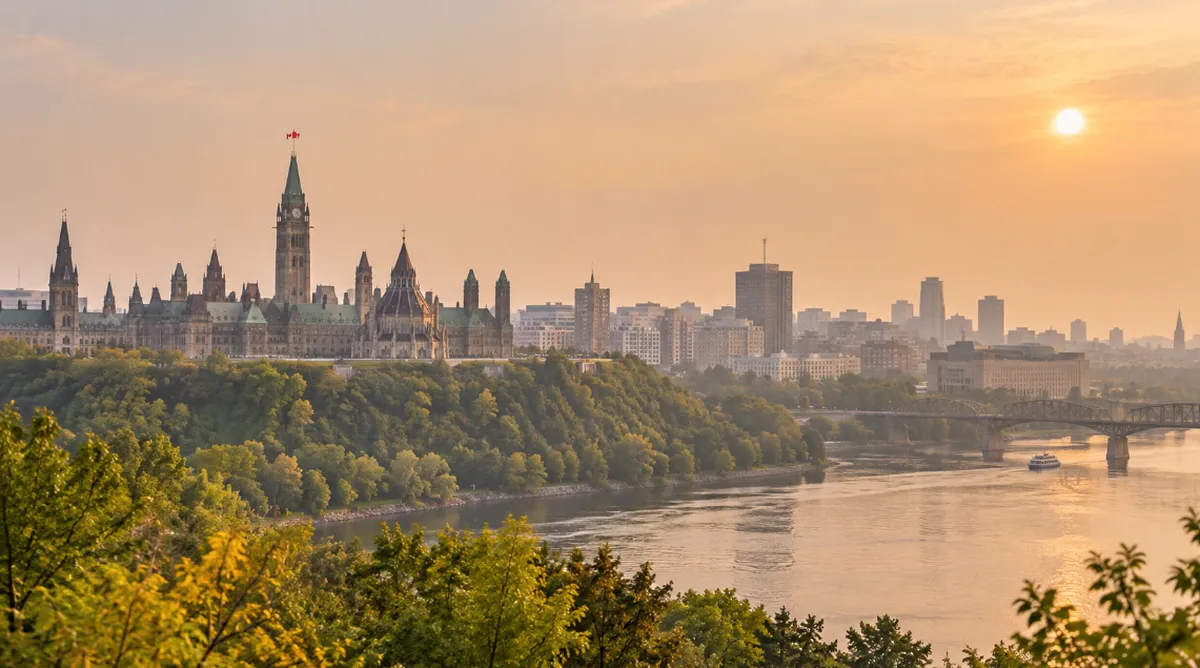
Live Ottawa, ON Forest Wildfire & Smoke Map Today: Local Air Quality Tracking & Indoor Protection Solutions
TL;DR
Ottawa’s air is shaped far more by smoke drifting in from distant wildfires than by anything burning near the city, so the number to check is the Air Quality Health Index, not the fire map. When it climbs, close the windows, set the HVAC blower to run continuously, and fit a MERV 13 filter, which is the minimum Health Canada recommends for fine particulate matter.
Key Takeaways
The AQHI is the number that matters. It runs from 1 to 10+, and during smoke events Environment and Climate Change Canada recalculates it hourly from fine particulate matter alone.
Ottawa needs two fire maps, not one. Ontario’s map stops at the Ottawa River, so fires in Gatineau and the Outaouais show up only on Quebec’s SOPFEU map.
On 6 June 2023 Ottawa’s AQHI hit 10+, the highest among Canada’s major cities, with fine particulate matter at 267 micrograms per cubic metre. ECCC issues air quality statements above 60.
A filter only cleans the air that reaches it. Smoke season falls in summer, when the furnace is idle, so the thermostat fan setting matters as much as the MERV rating.
Where to Check Ottawa Fire and Smoke Conditions Right Now
Four official Canadian sources cover Ottawa, and each answers a different question. The AQHI tells you what the air is like now, FireWork tells you what is coming, and the two provincial fire maps tell you what is burning. You need both of the latter, because Ottawa sits on the Ontario–Quebec border.
Published by Environment and Climate Change Canada (AQHI, FireWork), Ontario Aviation, Forest Fire and Emergency Services, and the Société de protection des forêts contre le feu. AQHI readings are measurements. FireWork is a forecast model.
Open the official maps:
FireWork wildfire smoke forecast, covering the next 72 hours.
Ontario Forest Fire Information Map, for the Ontario side.
SOPFEU interactive map, for the Quebec side, including the Outaouais.
CWFIS interactive map from Natural Resources Canada, a national view spanning both.
Filterbuy’s wider live map coverage:
One distinction matters throughout. AQHI readings are measurements taken at a monitoring station, while FireWork and FireSmoke are forecast models. A forecast with no colour over Ottawa does not guarantee clean air at ground level, and when the models disagree with each other, plan on the higher value.
Why Ottawa’s Fire Map Is Usually the Wrong Map
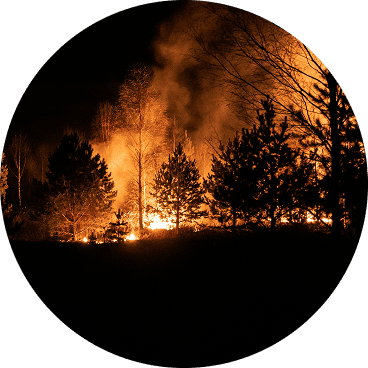
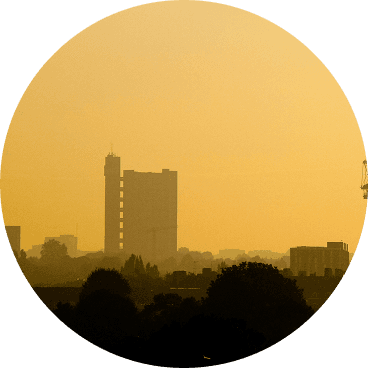
Checking the fire map to judge whether Ottawa’s air is safe will mislead you, because the city rarely has wildfires nearby and routinely has wildfire smoke. Fine particulate matter travels thousands of kilometres in the upper atmosphere and settles far from whatever produced it. NASA tracked exactly that in 2023, with plumes from Alberta and Quebec fires carried across the continent.
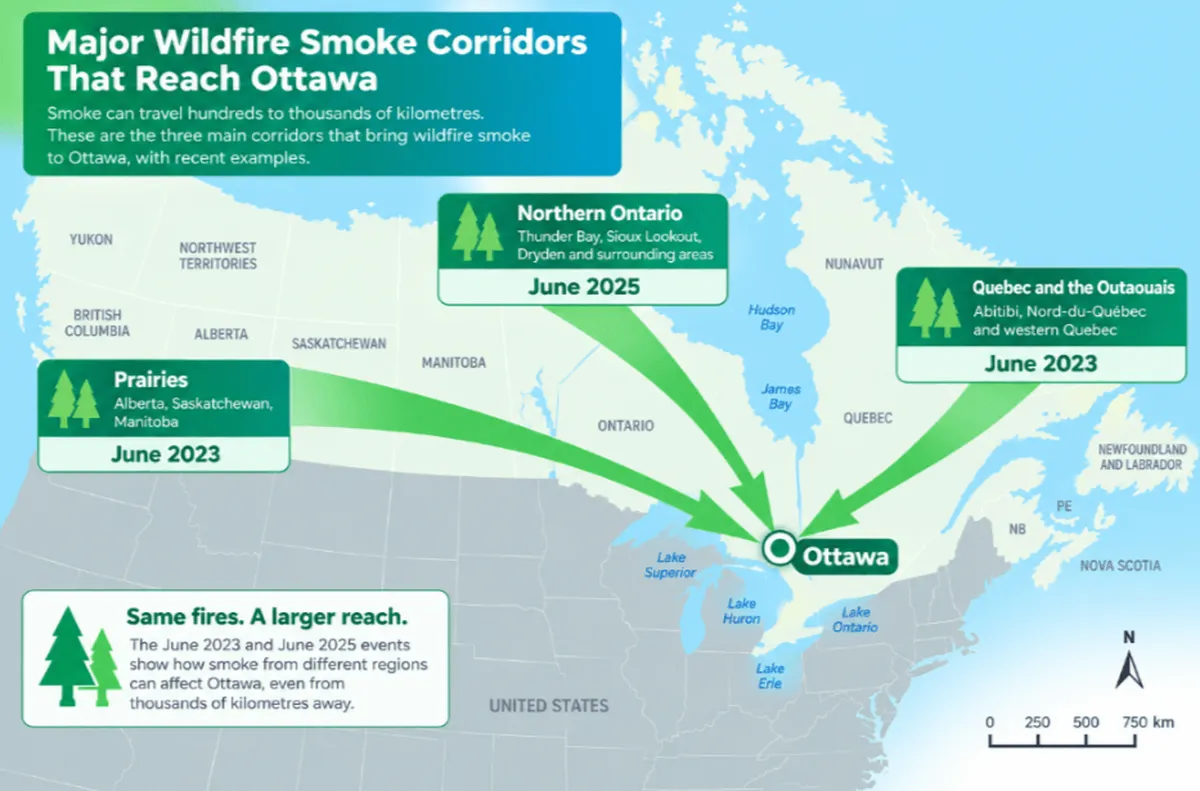
June 2023 remains the clearest illustration. Ottawa’s AQHI broke through the top of the scale to 10+ on 6 June, the worst reading among Canada’s major cities that morning, with fine particulate matter at 267 micrograms per cubic metre. ECCC meteorologist Monica Vaswani told CBC News that Ottawa touched 14 on an internal scale, and that northerly and northeasterly winds were pushing plumes down from Quebec. None of those fires were in Ottawa. Two years later the pattern repeated from the opposite direction, with June 2025 smoke reaching eastern Ontario from fires in Alberta, Saskatchewan, Manitoba and northern Ontario.
There is a second problem with the fire map, and it is particular to Ottawa. Ontario’s Forest Fire Information Map stops at the Ottawa River, so fires in Gatineau, Pontiac and the wider Outaouais appear only on SOPFEU’s map. A resident watching haze build over the Gatineau Hills could check the Ontario map and see nothing at all. The CWFIS national map spans both provinces and is useful for a quick look, though it is not the authoritative record for either one.
So check the AQHI first, then use the fire maps to understand where the smoke is coming from and how long it might last.
How to Read the AQHI in Ottawa
The AQHI is a health-risk scale from 1 to 10+, developed by Environment and Climate Change Canada with Health Canada. The published banding:
Scale published by Environment and Climate Change Canada with Health Canada. During smoky conditions the AQHI is calculated hourly using fine particulate matter alone.
Two details make the scale easier to read. During smoky conditions, fine particulate matter (PM2.5, the smoke particles small enough to reach deep into the lungs) can override the combined risk of the three pollutants normally used, so the index is calculated hourly from PM2.5 alone. And once readings reach 10+, the health risk can keep climbing even though the number cannot. Health Canada identifies seniors, young children, pregnant people and those with heart or lung conditions as higher-risk, while noting that during heavy smoke everyone is affected. Sources: Wildfire smoke, air quality and your health and AQHI health risks.
What to Do When the AQHI Climbs
Four actions, in this order. Fit a MERV 13 filter in the HVAC, set the thermostat fan to On so it filters continuously, put a portable HEPA air cleaner in each occupied room starting with bedrooms, and close the house up. Each is expanded in the next section.
At the top of the scale, when readings reach 10+ or Environment and Climate Change Canada issues an air quality warning, official guidance comes first. Follow ECCC and Ottawa Public Health on whether to stay indoors or relocate, and treat filtration as one layer of the response rather than the answer to it.
One Station Covers the Whole City
Worth knowing before you lean on that number: Ontario runs a single AQHI monitoring station for Ottawa, downtown. The former Ottawa Central site was relocated in 2017 and became it. Air Quality Ontario also notes that its live readings are automatically polled and have not had final verification.
Ottawa covers roughly 2,800 square kilometres, from Kanata across to Orléans and south through Osgoode, so one downtown monitor is a reasonable city-wide indicator rather than a reading at your address. When the number sits in the moderate band, trust your eyes and nose alongside it. If the far side of the street looks hazy or the air smells like a campfire, treat conditions as worse than the index suggests.
What to Do Indoors When Smoke Reaches Ottawa
Your forced-air system is the largest air cleaner you own, moving far more air than any portable unit, but only while the blower is actually running. That is the step most Ottawa homeowners miss, because our smoke season falls in summer when the furnace sits idle.
“The thing we correct most often on a smoke-season call is the fan setting. People see Auto and assume the system is always filtering. It is not. On Auto the blower runs only when there is a call for heat or cooling, which on a mild, smoky Ottawa afternoon can be a few minutes an hour. The filter is fine. It is just sitting in still air.”
— Filterbuy Canada Team
Fit a MERV 13 filter in the HVAC. This is the whole-home layer, because the central system moves far more air than any portable unit. The US EPA recommends a high-efficiency filter rated MERV 13 or higher during smoke events, and notes that most furnaces and HVAC systems accommodate one without equipment problems provided the filter is replaced often. Confirm the fit the same way you would confirm a size.
Set the thermostat fan to “On,” not “Auto.” On Auto the blower runs only during a heating or cooling call, which on a hazy 19°C August day in Ottawa can be a few minutes an hour. On means the system filters continuously.
Put a portable HEPA air cleaner in each occupied room, bedrooms first. This is the room-level layer and it does a different job from the filter in your furnace, treating one room harder than the central system can. The two work together rather than being alternatives. Size each unit by EPA’s clean-room rule: a smoke CADR of at least two-thirds of the room’s floor area, so a 300 square foot bedroom wants a smoke CADR of roughly 200. Avoid air cleaners that produce ozone, including ionizers and ozone generators, which EPA advises against. Filterbuy does not sell portable air cleaners, and we are recommending them anyway because the guidance calls for them.
Close the house up. Windows and doors shut, HVAC set to recirculate rather than drawing in outdoor air, and no adding to the indoor load while smoke is in: no candles, no frying, and no vacuuming unless the machine is sealed. Ottawa Public Health and ECCC advise the same.
Check your HRV or ERV. Common in newer Canadian homes and easy to overlook, these work by pulling outdoor air inside, which is exactly what you do not want mid-smoke-event. Switch to recirculate or shut it off, then restore normal operation once the air clears.
Inspect the filter during the event rather than working from a schedule. Smoke loads a filter far faster than household dust does, and because we manufacture the media we will say plainly what a 90-day rating assumes: dust, not PM2.5. Replace it when it looks dirty, dark brown or black, which can be well before the manufacturer’s normal interval. Keep spares on hand.
For the filter itself, shop MERV 13 air filters, compare MERV 13 against true HEPA if you are weighing a portable unit as well, or read the seasonal filter swap on running a higher rating only while smoke is around. For ordinary replacement intervals, see how often to change your HVAC filter, or where to find yours if you have never located it. Filterbuy auto-delivery can be set to arrive more often through June to September and stretched back out for winter.
We have been manufacturing filters for over a decade and shipping them into Canadian homes through real smoke seasons. The pattern is the same every summer: people upgrade the filter and stop there. But a filter only cleans the air that reaches it, and in July the furnace is not running. Because we make the media ourselves, we can tell you the rating on the box matters less than whether the blower is moving air through it.
— Filterbuy
One limit worth stating plainly. A pleated filter captures particles, not gases, so if a smoky odour lingers after the particulate has cleared, that is a carbon-filtration question rather than a MERV one. The Odour Eliminator carbon filters are built for it, and how activated carbon works explains why. If a certified air cleaner is out of reach, EPA research found that a box fan paired with MERV 13 filters reduces smoke indoors, and how to build a Corsi-Rosenthal box walks through it. EPA’s conditions come with it: use a certified fan made in 2012 or later, and do not leave the unit running unattended. Treat it as a reasonable stopgap rather than a replacement for a certified cleaner.
If Your Home Has No Ductwork
We sell furnace filters, so we should be straight about who this does not help. If your home runs on hot-water radiators or electric baseboards, as many houses in Ottawa’s older central neighbourhoods and plenty of low-rise apartments do, there is no ductwork and no filter slot, and everything above about MERV ratings and fan settings simply does not apply. For you, portable HEPA air cleaners are the primary defence rather than a supplement to anything. Size them the same way, by smoke CADR at two-thirds of the room’s floor area, and start with the room you sleep in. If you have a window air conditioner, its filter is a dust screen and will not capture PM2.5, so seal the gaps around the unit rather than relying on it. Air filters for apartments and condos covers the rest.
Choosing a Filter for Ottawa’s Smoke Season
For Ottawa’s smoke season, MERV 13 is the rating to run if your system supports it, with MERV 11 as the fallback and an Odour Eliminator alongside if the smell lingers. Filterbuy filters carry a plain-language label next to the MERV number, and the media is colour-coded so you can tell which rating is in the slot at a glance. All of them sit in the same signature green frame, which is the quickest way to check that the filter in your furnace is the one you meant to buy.
Health Canada recommends MERV 13 or higher to remove the fine particulate matter in wildfire smoke. Check your equipment manual before fitting a higher-MERV filter.
Every Filterbuy filter ships free to Canada with no minimum, in over 600 sizes including custom, priced in CAD, across MERV 8, MERV 11 and MERV 13, and in depths up to four inches, which hold more before they load up. If you are between ratings, the MERV 8 vs 11 vs 13 comparison lays out the trade-offs, and all about MERV ratings covers how the scale works.
Shop MERV 13 air filters
Order a custom size for older Ottawa homes with non-standard returns, or check air filter sizes first.
Browse the wildfire and smoke resources if you have arrived mid-season.
Supporting Statistics
Three findings from US federal agencies on Canadian wildfire smoke, and what each one supports.
Smoke from Alberta and Quebec crossed thousands of kilometres in 2023. NASA modelling shows a stalled low off Maine, turning against a high over central Canada, funnelling those plumes southeast into record-breaking poor air quality. Ottawa sits under that corridor. NASA Scientific Visualization Studio. Supports: why the fire map is the wrong map.
Asthma emergency visits ran 17% above expected. The CDC found this across the 19 wildfire smoke days between 30 April and 4 August 2023, with the sharpest rises among ages 5 to 17 and 18 to 64. CDC, Morbidity and Mortality Weekly Report. Supports: why acting indoors matters.
A portable air cleaner needs a smoke CADR of at least two-thirds of the room’s floor area. That is EPA’s clean-room sizing rule, which works out at roughly 200 for a 300 square foot bedroom. US EPA, Strategies to Reduce Exposure Indoors. Supports: the room-level layer.
Frequently Asked Questions
Glossary
AQHI (Air Quality Health Index): Canada’s health-risk scale for outdoor air, from 1 to 10+, published by Environment and Climate Change Canada with Health Canada.
PM2.5: Fine particulate matter 2.5 micrometres in diameter or smaller. The fraction of wildfire smoke that penetrates deep into the lungs.
MERV (Minimum Efficiency Reporting Value): The scale rating how effectively a filter captures particles, running 1 to 16 for residential filters under ASHRAE Standard 52.2. Higher numbers capture smaller particles.
CADR (Clean Air Delivery Rate): How much filtered air a portable air cleaner delivers. EPA’s clean-room rule is a smoke CADR of at least two-thirds of the room’s floor area.
HRV / ERV: Heat or energy recovery ventilator. A system common in newer Canadian homes that exchanges indoor and outdoor air for ventilation.
Sources: Environment and Climate Change Canada (AQHI, FireWork); Health Canada, Guidance for Cleaner Air Spaces during Wildfire Smoke Events; US EPA; Ottawa Public Health; Ontario Ministry of the Environment, Conservation and Parks; Ontario AFFES; SOPFEU; Natural Resources Canada (CWFIS); FireSmoke.ca (BlueSky Canada, University of British Columbia); NASA; CDC; CBC News, 5 to 6 June 2023 and 3 June 2025.
Reviewed for technical accuracy by David Clark, Licensed HVAC Technician. This page provides general information about air filtration and publicly reported air quality data. It is not medical advice. For health guidance, consult Ottawa Public Health or a health professional.