
Where Is My HVAC Air Filter? Return Vents, Air Handlers, and Furnace Locations
June 26, 2026
Written by Michelle Wan | Reviewed by David Clark, Licensed HVAC Technician, Filterbuy HVAC Solutions | Updated August 27, 2026
Where Is My HVAC Air Filter Located?
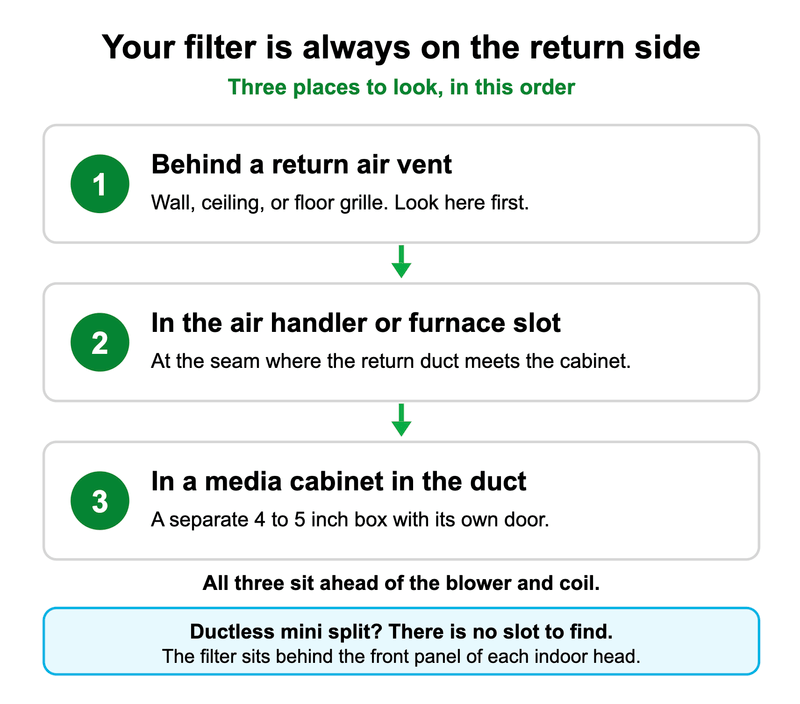
Your air filter sits on the return side of your system, in one of three places: behind a return air vent grille, in a slot on your air handler or furnace, or in a media cabinet built into the return duct. Start at your largest return grille, then check the seam where the return duct meets the equipment. Larger homes often have more than one filter, so count every return vent before you stop looking.
Return air vent grille – on a wall, ceiling, or floor. This is where most homes keep it.
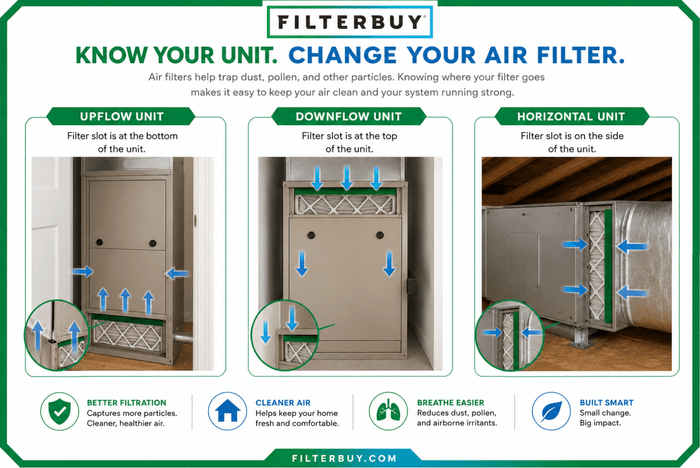
Air handler or furnace slot – at the bottom on upflow units, the top on downflow units, and the intake end on horizontal ones.
Media cabinet in the ductwork – a separate 4 to 5 inch box with its own door.
A ductless mini split works differently: there is no slot and no ductwork, so the filter sits behind the front panel of each indoor head. Not sure which system you have? The quiz below sorts it out in about a minute.
Ductless Mini-Split, or Thinking About One?
Answer a few quick questions and we will match you to the right system for your space.
The short answer
Your filter is in one of two places: behind a return air vent grille (on a wall, ceiling, or floor), or in a slot on your air handler or furnace where the return duct connects. Check the return vents first — that is where most homes keep them.
Larger homes often have more than one. Count your return vents before you stop looking.
How to spot it
- Find the returns, not the supplies. Run your system and hold your hand up to each vent. Returns pull air in. Supplies blow air out. Filters sit behind returns.
- Return grilles open. Look for latches along the edge or a hinge that lets the cover swing down. The filter slot is directly behind it.
- At the unit, check the seam. Filters slide into a slot at the bottom or side of the air handler or furnace. Horizontal units in attics and crawl spaces may have one at either end.
- The size is already printed on it. Look along the cardboard frame for three numbers, like 20x25x1. Snap a photo before you throw it out.
- Never run the system without one. An empty slot lets dust straight into your ductwork and equipment.
Found it? Shop your replacement.
Start with the size printed on your old filter frame, then pick the rating that matches what you want to capture.
Need a size we don’t stock? · Compare MERV ratings · How to measure your filter
TL;DR
Your HVAC air filter will be in one of three places: behind a return air grille, in a slot on the air handler or furnace cabinet, or inside a media cabinet built into the ductwork. Start at your largest return grille, then check the seam where the return duct meets the air handler. If your equipment sits in an attic or crawlspace, expect several filters rather than one.
Key Takeaways
The filter always sits on the return side of the system, somewhere between a return grille and the blower.
Air handler filter slots sit at the bottom on upflow units, at the top on downflow units, and at the intake end on horizontal ones.
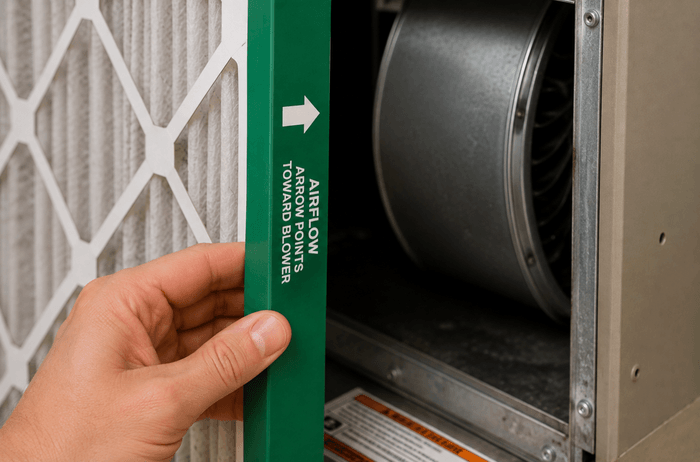
The arrow on the filter frame points toward the blower, which means into the wall, the ceiling or the air handler cabinet.
A heat pump air handler runs for both heating and cooling, so its filter loads faster than the same filter in a furnace-and-AC home.
No slot at the equipment means the filters are behind the return grilles instead, so count every return before you stop looking.
Where Is the HVAC Air Filter Located?
Every forced-air system filters on the return side, so the filter always sits somewhere between a return grille and the blower. That narrows the search to three spots: behind the grille itself, in a slot on the air handler or furnace cabinet where the return duct connects, or inside a media cabinet fitted into the ductwork. Which one you have was decided at installation.
The American Lung Association describes the same arrangement, placing a one-inch filter in the return ducts either at the base of the air handling unit or upstream in the return grilles. Wherever yours sits, it is cleaning the air before that air reaches the blower and the coil, which is why an empty slot does more damage than a dirty filter.
Filter location varies by installation. If a slot is empty, check every return grille before running the system.
Where Is the Filter in an Air Handler?
The air handler is the indoor cabinet that houses your blower and evaporator coil, and it usually lives in a basement, attic, garage or utility closet. Its filter slides into a slot on the return side of that cabinet. Where the slot sits depends on how the unit is oriented: at the bottom on upflow units, at the top on downflow units, and at the intake end on horizontal ones.
Trane, Carrier, Goodman, Rheem, Lennox and American Standard all build to the same basic layout: a return opening, then a blower, then a coil, then the supply plenum. Your filter goes in that first return opening, and a gas furnace cabinet works the same way. Filterbuy manufactures to those openings in more than 600 sizes plus custom cuts, which is why this guide can be specific about where slots sit.
There is a rule behind this, and it explains why some homes have one filter at the equipment while others have three scattered around the house. Department of Energy guidance through the Building America program says that when the air handler is easy to reach, the filter belongs in a media frame at the return plenum. When it is not, the filters go into the return grilles instead. That single decision is why your neighbor changes one 20x25x4 and you change three 14x20x1. And if your home has a ducted fresh-air intake, it needs a filter of its own, which almost everyone forgets.
People assume finding the filter is the easy part and choosing it is the hard part. It is the other way round. Once you know whether your equipment is reachable, you know where the installer put the filter, and everything after that is just reading three numbers off a frame.
Michelle Wan, Brand Manager and Air Quality Writer, Filterbuy
Author
How Do You Find the Air Handler Filter Slot?
Start at the seam where the return duct meets the air handler cabinet. The filter slot is a gap between one and five inches wide, covered by a removable or hinged panel held on with clips, thumbscrews or a single screw. You will usually feel the edge of that cover before you see it, so run your hand along the seam.
Find the cabinet first. It is a large metal box, roughly water-heater sized, with ductwork connected at both ends.
Work out which duct is the return. With the system running, it is the one connected to the grille that pulls air in.
Feel along that seam for a gap with a lip to it rather than a welded joint, and look for a stamped arrow or the word FILTER on the panel.
On horizontal units, check both ends of the cabinet before you decide there is only one.
If there is no slot at all, which happens often enough on older installs, your filters are behind the return grilles instead. When they are not there either, the answer is a filter grille at the return. Filterbuy cuts custom sizes for exactly this reason: builders frame these compartments to the ductwork rather than to a catalog, and older homes, renovations and mobile homes are where that turns up most.
Where Is the Heat Pump Air Handler Filter?
On a heat pump, the air handler is the entire indoor unit, so the heat pump air handler filter sits either in a slot on that cabinet or behind the return grilles. There is no furnace section to look for, although most of these cabinets hold electric backup heat strips downstream of the filter. Check the return side of the cabinet first.
Because a heat pump moves heat in both directions, it runs through the shoulder seasons as well as the peaks, and its filter sees far more hours of airflow each year than the same filter would in a furnace-and-AC home. If you switched from gas heat and kept your old schedule, you are almost certainly changing it too late.
How Do You Tell a Return Vent From a Supply Vent?
Turn the system on and hold your hand up to each vent in turn. Return vents pull air in, supply vents blow it out, and the HVAC return filter location is always behind a return. Returns also tend to be the largest grilles in the house, and they usually have a hinged cover rather than the adjustable louvers you see on a supply register.
If the airflow is too gentle to feel, hold a sheet of tissue paper flat against the grille. It sticks to a return and blows away from a supply. Most homes have many supply registers and only one or two returns, which is why the return is usually the big grille in the hallway.
How to Change an Air Handler Filter
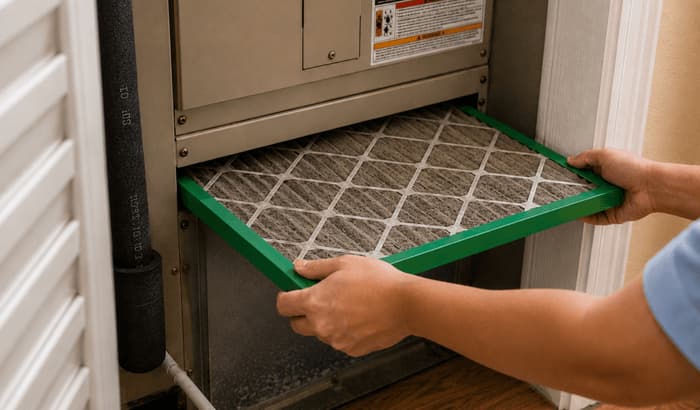
Changing an air handler filter takes about five minutes from start to finish. Turn the thermostat off, open the compartment, slide the old filter out, note the size and arrow direction printed on its frame, then slide the new one in with that arrow pointing toward the blower and close everything back up.
Set the thermostat to Off so the blower is not pulling against an open compartment.
Open the compartment. HVAC system filter access is normally a thumbscrew, a clip, a single screw, or a return grille that swings down on a hinge.
Slide the old filter straight out and keep it flat, so the dust stays on the filter rather than in the cabinet.
Write the size down before you throw it away. It is printed on the frame as three numbers, such as 20x25x1.
Look at the arrow on the old filter. It points the way the air flows, toward the blower.
Slide the new filter in facing the same way. It should sit flat with no gaps at the edges, and if it bows, the size is wrong.
Close the panel so it seals and turn the thermostat back on. The Department of Energy notes the cover should fit tightly but should not be taped or caulked, so the next change stays easy.
If the equipment is in an attic or crawlspace, take a flashlight and stay on the joists. If you cannot reach it safely, this is a fair job to hand to a technician.
Which Way Does the Filter Arrow Point?
The arrow printed on the filter frame points in the direction the air flows, which means it should point toward the blower: into the wall, into the ceiling, or into the air handler cabinet. It should never point back out at the room. If your filter has no arrow but does have a wire mesh backing, that mesh goes on the downstream side.
Installed backwards, the pleats collapse under the airflow they were built to resist, and the air moving through your system drops off with them.
How Do You Know If You Have More Than One Filter?
Start by counting your return grilles. If two or more of them pull air in and there is no filter at the air handler, each return almost certainly holds one of its own. Then count your indoor units, because that is a different question altogether: a house with two air handlers has two separate systems, and each one has its own filter.
Those two situations get mixed up constantly, and they are not the same. Several return grilles feeding a single air handler means one system with its filtration split across several openings, and those filters are usually the same size. Two air handlers, typically one in the attic for upstairs and one below for downstairs, means two independent systems. Their filters are often different sizes, and changing one does nothing for the other.
The quickest way to tell them apart is the thermostat. One thermostat means one system; two thermostats, or a thermostat labeled by floor, means two.
What If You Rent, or Live in an Apartment?
In an apartment or a rental, the filter is usually the one part of the HVAC system a tenant is expected to maintain, while the equipment itself is not. Look behind the hallway return grille first, then in the utility closet, where the air handler often sits beside the water heater. If reaching a slot means opening the equipment cabinet, treat that as a maintenance request.
Leases differ on who buys the filter, so read yours once instead of guessing. The physical boundary is consistent, though. A return grille and a filter slot are built to be opened by whoever lives there. The blower compartment, the electrical panel and anything behind a screwed-on service door are not.
Two things are worth photographing on move-in day: the size printed on the frame, and where the slot is. Both are easier to find while you are standing in front of them than a year later.
If you find no filter and no slot you can reach, report it. A system running unfiltered is putting dust onto a coil the landlord owns, and that framing tends to get things fixed faster than a comfort complaint. When the filter is yours to buy and there is no hardware store nearby, Filterbuy ships free to any US mailing address, which beats hunting an odd size locally.
What Size Filter Does an Air Handler Take?
The size is printed on your existing filter as three numbers, such as 20x25x1, which read as length by width by depth. That is the nominal size, and the filter itself measures about half an inch smaller so that it slides into the rack without binding. If there is no old filter to read, measure the rack opening and round to the nearest inch.
There is a shortcut most guides miss, and it works in reverse: the size you are already holding tells you what kind of slot you are looking for. Filterbuy labels its size chart by where each size tends to turn up, because Filterbuy is the one cutting them. 20x22x1, 20x24x1 and 20x25x1 are air handler sizes. 16x25x1 is the most common furnace slot, and 20x20x1 is the most common size in American homes. A true fraction like 17.5 or 22.25 is not a label error. It means the compartment was framed to the ductwork on site, which puts your filter at the equipment rather than behind a grille.
Intervals assume normal household conditions. Pets, allergies, smoke, or construction dust shorten every interval.
When the rack is not a standard size, a custom filter beats forcing a near-fit into place, because air that travels around a filter has not been filtered at all.
How Often Does an Air Handler Filter Need Replacing?
Check the filter every 30 days and you will not be caught out. Air handler filter replacement runs roughly every 60 to 90 days for a 1-inch filter, and every 6 to 12 months for a 4-inch or 5-inch media filter. Shorten those intervals if you have pets, allergies, smoke or construction dust, and shorten them again on a heat pump.
ENERGY STAR advises checking monthly and changing at minimum every three months, while the American Lung Association suggests judging a dirty filter against a white sheet of paper. If the hard part is remembering rather than changing, Filterbuy auto-delivery ships on a 30, 60 or 90 day cycle and can be paused or canceled at any time.
Four conditions override the calendar. Department of Energy guidance says to replace a filter immediately if it is clogged with debris, if its pleats have collapsed, if the system bangs when it starts, or if the filter is damp or moldy. That last one deserves attention, because a damp filter means water is reaching the return side, and putting it back circulates whatever has grown on it.
A filter that does not fill its rack is doing less than the homeowner thinks. Air will always take the gap over the media. When I pull a panel and find a clean filter sitting next to a dirty coil, that gap is almost always why.
David Clark, Licensed HVAC Technician, Filterbuy HVAC Solutions
Air Handler Maintenance Tips Beyond the Filter
Most air handler problems trace back to one of three things: a loaded filter, a blocked condensate drain, or a dirty coil. A homeowner can comfortably handle the first two. These air handler maintenance tips cover what is safe to do yourself and where the line sits for calling a technician.
Seal the filter slot. This is the failure Filterbuy hears about most often: the right filter, installed correctly, sitting in a rack it does not quite fill. Air takes the gap, skips the media entirely and lands dust on the coil.
Clear the condensate drain line each spring. A slow drain backs water into the pan and trips the float switch, which shuts the system down. The Department of Energy suggests passing a stiff wire through the drain channels to prevent clogs, while ENERGY STAR puts a fuller condensate inspection on the list for your annual contractor visit.
Keep the area around the cabinet clear so the service panels open, and look at the coil while the filter is out. Gray felt on the fins means it needs professional cleaning, and ice on the coil or refrigerant lines means low airflow or low refrigerant, so shut the system off and call a technician.
Never run the system without a filter in place, even for a day.
Why This Guide Comes From Filterbuy
Filterbuy manufactures every filter it sells, in more than 600 sizes plus custom cuts, at plants in Alabama, Pennsylvania, Texas and Utah. That is the vantage point this page is written from: a company that cuts to the slot rather than one that only describes it. It is also why our size chart is labeled by where each size turns up, why we publish actual dimensions alongside the nominal ones, and why the custom line exists at all.
Supporting Statistics
Three findings from federal statistical agencies on why filter location and upkeep matter. Each was read at the source, not repeated from a secondary blog.
1. Two-thirds of US households run central AC or a central heat pump, so most homes have at least one filter to find.
The 2020 Residential Energy Consumption Survey found 88% of US households use air conditioning, and two-thirds use central AC or a central heat pump as their main equipment. Central systems are ducted, which is what puts a filter behind a return grille or in the air handler cabinet. The survey sampled 18,496 households.
Source: U.S. Energy Information Administration, Residential Energy Consumption Survey (2020)
Supports: Where is the HVAC air filter located? and Where is the heat pump air handler filter?
2. Replacing a clogged filter can lower an air conditioner's energy use by 5 to 15 percent.
The Department of Energy's Energy Saver program lists routine filter replacement first among annual maintenance steps and puts the saving at 5 to 15 percent of an air conditioner's energy use. DOE publishes the range without methodology, so treat it as a directional federal estimate, not a guarantee for a specific house.
Source: U.S. Department of Energy, Energy Saver 101: Home Cooling
Supports: How often does an air handler filter need replacing?
3. Airflow problems alone can cut HVAC efficiency by up to 15 percent.
ENERGY STAR, the joint EPA and Department of Energy program, puts blower and airflow problems at up to 15 percent of system efficiency on its annual maintenance checklist, and assigns the homeowner one task: inspect or change the filter monthly. That is the number behind our own bypass point above.
Source: ENERGY STAR (U.S. EPA and U.S. DOE), Maintenance Checklist
Supports: Air handler maintenance tips beyond the filter
The American Lung Association, a national .org health authority, is cited inline in the body copy rather than repeated here, on filter location and on the white-paper test for a dirty filter.
Frequently Asked Questions
Where is the Air Handler Filter in an Attic?
Attic air handlers are usually horizontal units lying on their side, with the filter in a rack at the intake end of the cabinet, so check both ends before you give up. If the attic has no staircase, the installer has most likely put filters behind each return grille instead.
Does a Heat Pump Have an Air Filter?
Yes. A heat pump uses an indoor air handler with a filter on the return side, either in the cabinet slot or behind the return grilles. Because the system runs for both heating and cooling, that filter needs replacing more often than the same one would in a furnace-and-AC home.
What if My Air Handler Has No Filter Slot?
Then your filters are behind the return grilles. If they are not there either, the system has been running unfiltered, and the fix is a filter grille fitted at the return.
Glossary
Air handler - The indoor cabinet of a split HVAC system, holding the blower and the evaporator coil. On a heat pump it is the entire indoor unit, while on a gas system a furnace cabinet fills the same role. Ductless mini split systems have no air handler at all, filtering instead behind the panel of each indoor head.
Return duct and return grille - The ductwork and the vent that pull room air back into the system. Filters are installed on the return side, ahead of the blower.
Upflow, downflow, horizontal - The three orientations a residential air handler or furnace can take, discharging air upward, downward or sideways from a unit lying on its side.
Evaporator coil - The finned heat-exchange component inside the air handler. Keeping this coil clean is the filter's main mechanical job.
Return plenum - The boxed section where return ductwork meets the air handler. A filter media frame is usually fitted here when the equipment is reachable.
Media cabinet - A separate filter housing fitted into the ductwork ahead of the air handler, holding a 4-inch or 5-inch filter behind its own door.
MERV - Minimum Efficiency Reporting Value, the ASHRAE scale for particulate capture between 0.3 and 10 microns. The EPA recommends MERV 13, or as high as your system fan and slot will accommodate. Filterbuy makes MERV 8, MERV 11 and MERV 13 in every standard size.
Filter grille - A return grille built to hold a standard filter behind a hinged cover, used when the equipment itself has no slot.
About the Author
Michelle Wan is Brand Manager and Air Quality Writer at Filterbuy, where she turns MERV ratings, filtration and HVAC efficiency into plain-English advice and fronts much of the brand's educational video content (B.A., University of California, Santa Cruz). Working directly with Filterbuy's manufacturing teams, she writes from how filters are built and used, not from spec sheets. Reviewed by David Clark, Licensed HVAC Technician, Filterbuy HVAC Solutions.
Filterbuy is a second-generation, family-owned American manufacturer. It began in the 1950s as Talladega Machinery and Supply, became Filterbuy in 2012 and sold its first filter in 2013. Filterbuy makes 100% of its products in the USA, in Alabama, Pennsylvania, Texas and Utah, in 600+ sizes plus custom, shipped factory-direct.
Sources
Cite these inline where the claim appears rather than as a bibliography block, so each claim and its evidence stay in the same chunk. Do not link to Trane or Today's Homeowner: both outrank this page for the target queries, and Trane's air handler filter page promotes a competing filter subscription.
Supports: Accessible vs. inaccessible equipment rule; fresh-air intake filter; cover should fit tightly but not be taped or caulked
Air Cleaning - American Lung Association
Supports: Independent confirmation of both filter locations; white-paper test for a dirty filter; roughly two-month replacement
What is a MERV rating? - U.S. Environmental Protection Agency
Supports: MERV scale 0.3-10 microns; MERV 13 recommendation subject to fan and slot capacity
Heat & Cool Efficiently - ENERGY STAR (EPA and DOE)
Supports: Check monthly, change at minimum every three months
Maintenance Checklist - ENERGY STAR (EPA and DOE)
Supports: Condensate drain and coil inspection on the annual checklist