
Guelph, ON Live Wildfire Smoke Map
Get Alerts For Wildfires In Your Area
The moment a wildfire starts near you, you'll get an instant alert and simple tips to reduce your smoke exposure.
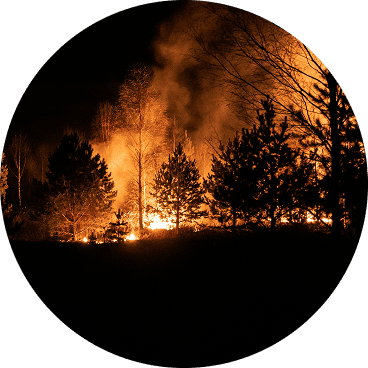
What's In The Smoke
30xSmaller than a human hair
Fine enough to reach deep into the lungs. A MERV 13 is built to capture it.
How Far It Travels


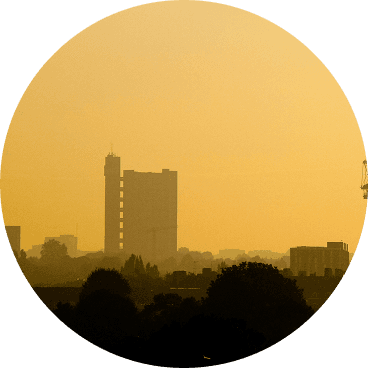
It Doesn't Stay Local
Smoke rides the wind far downwind — you can get smoky air with no fire nearby.
What To Do During A Smoke Event
Simple steps to reduce indoor exposure.
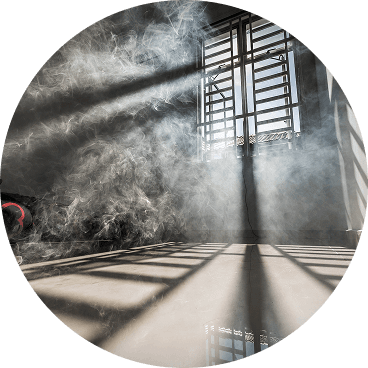
- Stay In, Close UpShut windows and doors to keep smoke out.
- Set Fan To "On"Keeps air cycling through your filter, not just when heating or cooling.
- Recirculate AirSwitch off fresh-air intake so you're not pulling smoke in.
- Run A MERV 13Built to capture the fine PM2.5 in smoke.
- Add A PurifierExtra filtration for the room you use most.
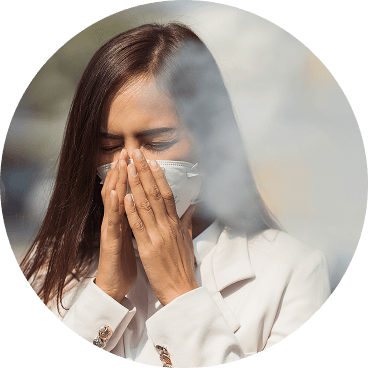
- Wear an N95 if OutsideFits snug to block fine particles — a cloth mask won't.


The Best Air Filter For Wildfire Smoke
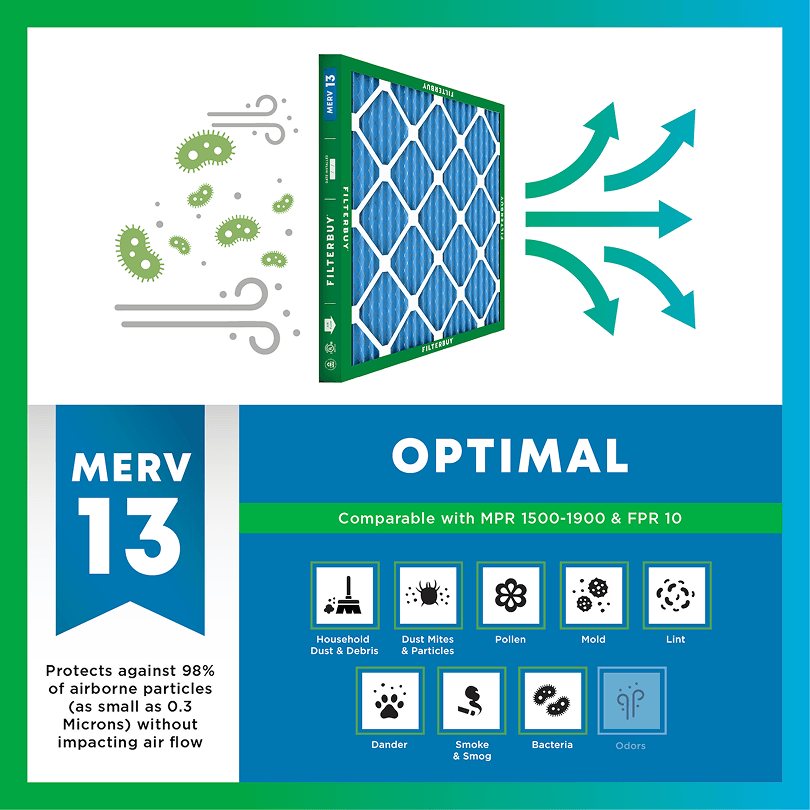
During smoke events, the EPA recommends upgrading to a MERV 13 filter — or the highest-rated filter your system can handle — to help reduce the fine particles smoke brings indoors. MERV 13 is the level most home HVAC systems can run while still capturing PM2.5, the fine particulate that makes up the bulk of wildfire smoke.
- Captures PM2.5 particles
- Blocks ash, soot, and smoke odor
- Keeps your indoor air safe—even when the outdoor air is dangerous
- Meets the EPA's recommended rating for filtering fine wildfire smoke particles.

Wildfire Smoke FAQs
Facts About Wildfires
Over 70,000 wildfires burn in the U.S. every year.
Wildfire smoke can travel 1,000+ miles, affecting states that aren't even near the blaze.
Exposure to wildfire smoke can worsen asthma, trigger heart issues, and lead to ER visits.
Indoor air can hold more fine particles during wildfire events unless it's properly filtered.
The EPA advises using MERV 13 filters or portable HEPA air cleaners during wildfire smoke events.
Don't Wait Until The Smoke's Inside.
Use the live wildfire smoke tracker and upgrade your air filters today to protect your lungs and your home.
Shop Filters For Smoke Protection
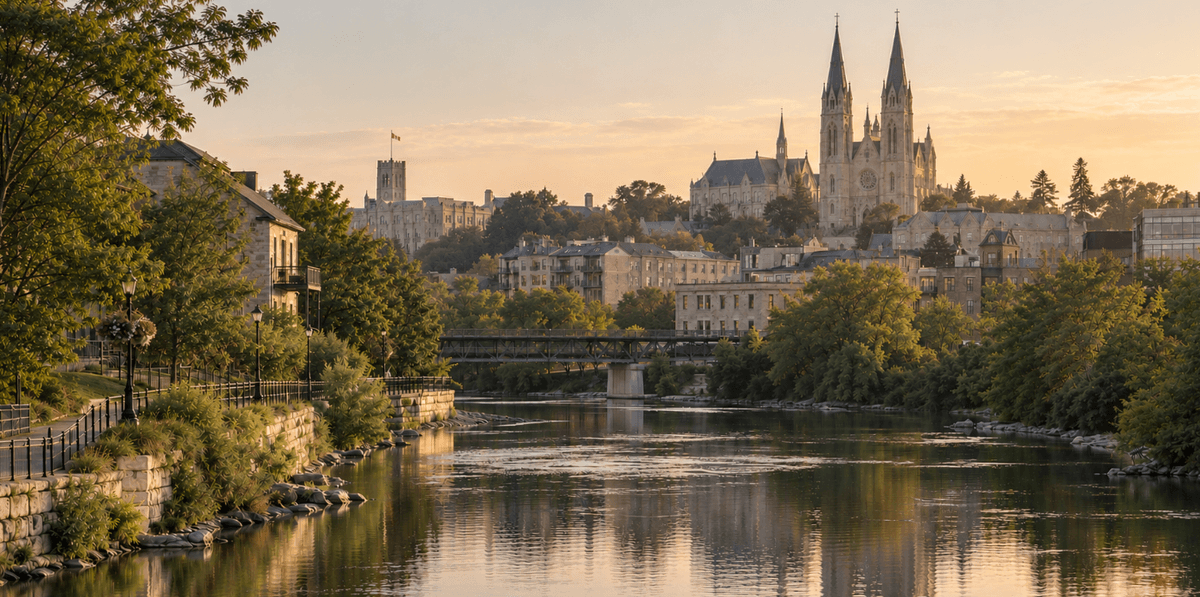
Live Guelph, ON Forest Wildfire & Smoke Map Today
Local Air Quality Tracking & Indoor Protection Solutions
TL;DR
Guelph, ON sits about 280 km south of Ontario's forest fire region, so a hazy day here almost always means smoke drifting in from fires hundreds or thousands of kilometres away. Filterbuy's live wildfire map at the top of this page shows active fires and satellite-detected smoke, and Guelph's Air Quality Ontario station tells you what is reaching the ground. When smoke arrives, close up the house and switch to a MERV 13 furnace filter.
Key Takeaways
Guelph is outside Ontario's fire region, so report any grass, brush or forest fire in or near the city to 911.
Guelph has a dedicated provincial air monitoring station at Exhibition Street and Clark Street West, with AQHI readings every hour.
Filterbuy's live map shows fires and smoke; Guelph's station shows ground-level air.
The July 2026 orange warning came from fires 865 km or more away.
Where Can I See a Live Wildfire and Smoke Map for Guelph, ON Today?
Start with the live Filterbuy wildfire map at the top of this page. It combines active fires from Natural Resources Canada's CWFIS, new fires from the past 24 hours, watches and warnings, and smoke plumes from NOAA's Hazard Mapping System. For forecasts and second opinions, use the finder below.
Guelph Wildfire and Smoke Map Finder
One habit we picked up building Filterbuy's pages across Ontario: read the map's smoke layer next to the Guelph station. Satellites see smoke from above, and a plume can pass high overhead without ever reaching the ground. The station tells you whether it has. Guelph is lucky to have one; Waterloo borrows Kitchener's.
Is There a Forest Fire Near Guelph Right Now?
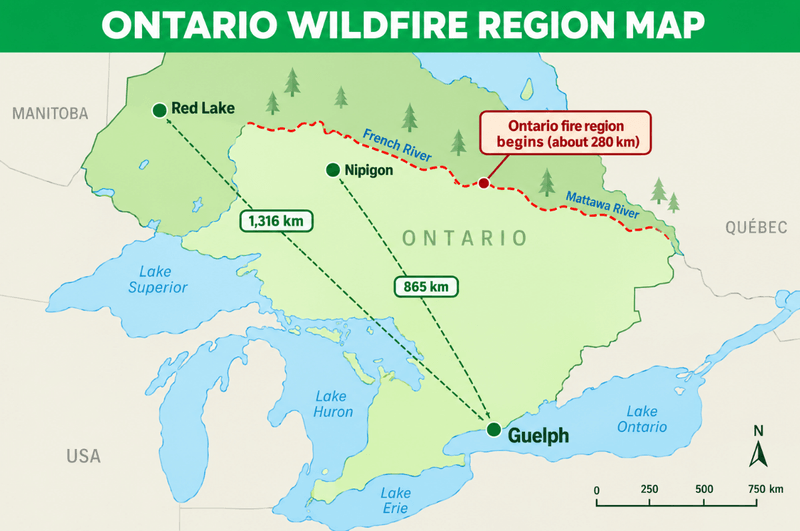
The live map above shows any active fire near Guelph, but a forest fire here is unlikely. Ontario's forest fire region begins north of the French and Mattawa rivers, about 280 km away in a straight line. South of that line, local fire departments respond, and residents call 911.
The ministry's 24 September 2026 update listed no active wildland fires in the Northeast Region and 27 in the Northwest Region, none near southern Ontario (Ontario forest fires update).
Closer to home, the City of Guelph prohibits outdoor recreational fires such as fire pits (City of Guelph outdoor fire safety).
Why Is It Smoky in Guelph When There Is No Fire Nearby?
Wildfire smoke can travel thousands of kilometres, so Guelph's smoky days are almost always imported. We measured the straight-line distance from Guelph to the fire districts behind recent smoke events and sorted them into three bands.
How Far Away Is the Fire? A Distance Guide for Guelph
By mid-July 2026, over 180 fires were burning in Ontario, and on 13 and 14 July eight in the northwest grew sharply as winds carried the smoke southeast (NASA Earth Observatory). Environment Canada raised the local alert from yellow to orange and expected the haze to last until Friday (CBC Kitchener-Waterloo). The fires behind it were burning from Nipigon to Red Lake, 865 to 1,316 km away.
June 2023 showed something else: smoke can come back. Fires in Quebec and northeastern Ontario pushed Guelph's AQHI to 7, the start of the high risk band, on 7 June (CTV News Kitchener). Three weeks later, public health forecast a 10 for 28 and 29 June (Wellington Advertiser). Filterbuy's takeaway: one smoky week does not end the season, so replace a smoke-loaded filter early.
How Do I Read Guelph Air Quality During Smoke?
Guelph's air quality is reported on Canada's Air Quality Health Index (AQHI), a 1 to 10+ scale measured at a provincial station in the city. Readings fall into four risk bands:
Low risk (1 to 3): Ideal air quality for outdoor activities.
Moderate risk (4 to 6): Most people can continue outdoor activities; people at higher risk should consider reducing strenuous activity if they feel symptoms.
High risk (7 to 10): People at higher risk should reduce or reschedule strenuous outdoor activity. Others should consider doing the same if they have symptoms such as coughing or throat irritation.
Very high risk (10+): People at higher risk should avoid strenuous outdoor activity, and everyone should reduce or reschedule it.
Environment Canada issues colour-coded air quality alerts, and Guelph's alerts cover the wider Waterloo-Wellington forecast region rather than the city alone. Many weather apps show the U.S. Air Quality Index (AQI) instead, a 0 to 500 scale, so the app number and the AQHI will not match.
What Should I Do Indoors When Smoke Reaches Guelph?
These steps follow Health Canada guidance and EPA's cleaner air room advice:
If you have an HVAC system, set it to recirculate and switch to a MERV 13 filter.
Set the thermostat fan to On, so the system filters continuously rather than only while heating or cooling.
Run certified HEPA air purifiers in each occupied room, bedrooms first, and skip ozone generators, which Health Canada advises against.
Close the house up. Keep windows and doors shut, and avoid candles, frying, smoking and vacuuming without a HEPA vacuum. If extreme heat arrives with the smoke, keeping cool comes first.
Limit exhaust fans to cooking, and keep at least one working carbon monoxide alarm.
For sizing, EPA advises a smoke CADR of at least two-thirds of the room's square footage, so a 28 m2 (300 sq ft) bedroom needs about 200 (EPA cleaner air room). In an apartment or a home without ductwork, portable HEPA air purifiers are your main defence, not a backup.
Many Canadian homes also have an HRV or ERV that brings in outdoor air, so check the manufacturer's instructions for recirculation or a temporary shut-off during heavy smoke. Wellington-Dufferin-Guelph Public Health's ClimateSafe Map lists nearby cooling and clean air spaces.
If you must be outdoors, a well-fitted N95 or equivalent respirator can reduce exposure to fine particles but does not block the gases in smoke (Health Canada). Anyone with symptoms such as shortness of breath or chest pain should seek medical care.
Choosing a Furnace Filter for Guelph Smoke Season
In Guelph, the furnace filter works from autumn to spring, then catches smoke in summer. Filterbuy Canada's rule of thumb, after official alerts: once the U.S. AQI in your weather app reaches 100, switch to a MERV 13 filter if you have an HVAC system, set the thermostat fan to On, run a HEPA air purifier in each occupied room, and close the house up. The EPA and Health Canada both recommend MERV 13 or higher in a central system during smoke (EPA, Health Canada), and the EPA notes most furnaces can take one without problems when the filter is replaced often.
Filterbuy Canada carries pleated furnace filters in over 600 sizes, including custom dimensions, with free shipping across Canada and prices in CAD:
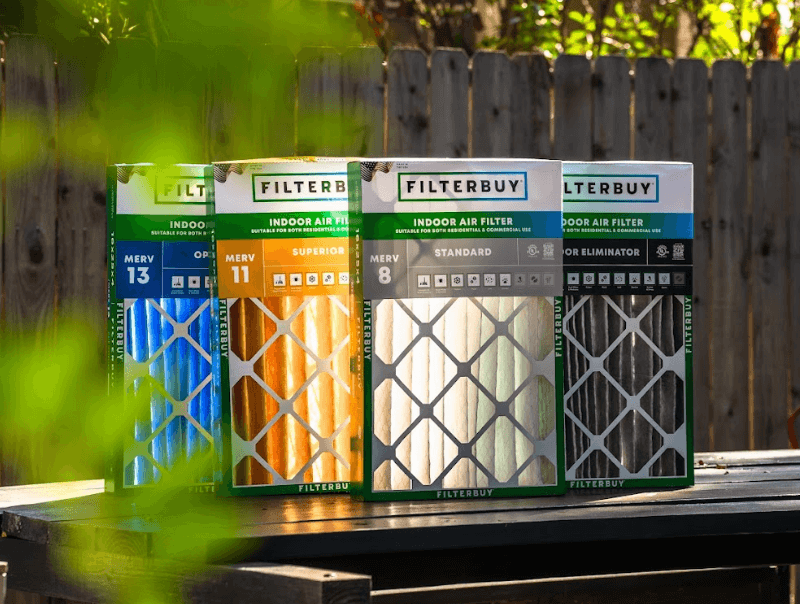
Standard (MERV 8) for everyday dust, lint and pollen.
Superior (MERV 11) for pets and spring allergy season.
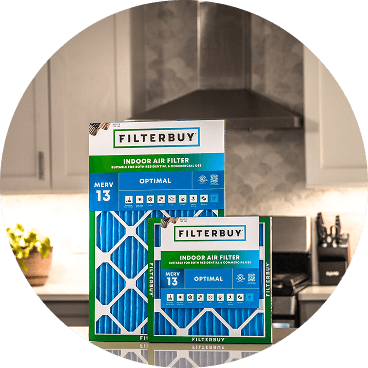
Optimal (MERV 13) for fine particles, including wildfire smoke.
Odour Eliminator, carbon-infused, for cooking, pet and lingering smoke odours. Pleated filters capture particles, not the gases in smoke.
Confirm the fit the same way you confirm your size, using the owner's manual or air handler label. Our guide to MERV ratings and MERV 13 versus HEPA comparison for wildfire smoke go deeper, and our live Ontario air quality map covers day-to-day readings.
We suggest late September, before Thanksgiving weekend, as Guelph's filter checkpoint: smoke season is winding down just as the furnace starts its long heating run. A Filterbuy Canada subscription delivers replacements on your schedule, and you can edit, skip or cancel anytime.
"One number sums up Guelph's smoke risk for us: 865 kilometres. That is how far the nearest July 2026 fire district was from the city, and Guelph still sat under an orange warning. The better question is whether smoke has reached the ground, and whether your filter is ready."
— Filterbuy Canada
"When Guelph turns hazy, I check the smoke layer on our live map first, then the Guelph station, because a plume overhead does not always mean smoke at street level. If the station reading climbs, my furnace filter comes out for a look."
— Michelle Wan, Brand Manager and Air Quality Writer, Filterbuy Canada
"Treat a MERV 13 upgrade like any filter change: match the size printed on your old filter, and it should slide into the slot without forcing. During smoke, set the thermostat fan to On so the system filters all day, and put an HRV or ERV into recirculation or pause it as the manufacturer directs. Then check the filter often while the smoke lasts, and swap it once it looks dark." — David Clark, Licensed HVAC Technician
Supporting Statistics: What U.S. Federal Research Shows
1. The June 2023 Smoke Followed a Record Start
By 8 June 2023, Canada had logged more than 2,200 wildfires, including 54 active in Ontario, against a 10-year average of 1,624 for that date.
Source: NOAA NESDIS
2. Closed Homes Still Let Smoke In
With windows shut, indoor PM2.5 (fine particles) during smoke typically runs 55% to 60% of outdoor levels.
Source: U.S. EPA
3. Most Time Is Spent Indoors
Americans spend about 90% of their time indoors, and people most sensitive to pollution spend even more.
Source: U.S. EPA
Frequently Asked Questions
Is there a forest fire near Guelph today?
Very unlikely, since Guelph sits about 280 km south of Ontario's forest fire region. Check the live map above, and report any uncontrolled local fire to 911.
Why does Guelph smell like smoke when no fire is nearby?
Wildfire smoke travels far. In July 2026, smoke from northwestern Ontario fires more than 850 km away brought an orange air quality warning to Guelph.
What is the best live smoke map for Guelph today?
Start with Filterbuy's live map at the top of this page for current smoke plumes. Environment Canada's FireWork forecast shows where the smoke is heading, and Guelph's Air Quality Ontario station shows what is reaching the ground.
When is wildfire smoke season in Guelph?
Ontario's fire season runs from 1 April to 31 October (Ontario forest fires), but Guelph's documented smoke events came in June and July, so watch the live map closely through summer.
How often should I change my furnace filter during wildfire smoke?
More often than usual. The EPA advises checking it during smoke and replacing it once it looks dark brown or black (EPA), which can be well before the normal interval. Keep spares on hand.
Glossary
AQHI (Air Quality Health Index): Canada's 1 to 10+ scale for the health risk from air pollution, reported hourly for Guelph.
U.S. AQI (Air Quality Index): The U.S. Environmental Protection Agency's 0 to 500 scale, often shown in weather apps.
PM2.5: Fine particulate matter 2.5 micrometres in diameter or smaller, the main health concern in wildfire smoke.
Hazard Mapping System (HMS): NOAA's satellite analysis of fire and smoke, which supplies the smoke layer on Filterbuy's live map above.
MERV (Minimum Efficiency Reporting Value): A 1 to 16 rating of how well an air filter captures particles.