Shop by
September 17, 2026

By Michelle Wan, Brand Manager & Air Quality Writer, Filterbuy | Technically reviewed by David Clark, Licensed HVAC Technician and CEO of Filterbuy HVAC Solutions
Published: September 17, 2026 | Updated: September 17, 2026
Yes, bad air quality can cause a sore throat, and no virus has to be involved. Wildfire smoke, ozone, gas-stove fumes, and dry indoor air can all irritate your throat's lining.
When the air is to blame, you'll usually notice stinging eyes but no fever. Your throat eases in cleaner air. A fever points to an infection instead.
Indoors, your HVAC filter captures particles, not gases. Take the quick quiz below to find the filter that fits your system.
Find my filter match Shop air filters at Filterbuy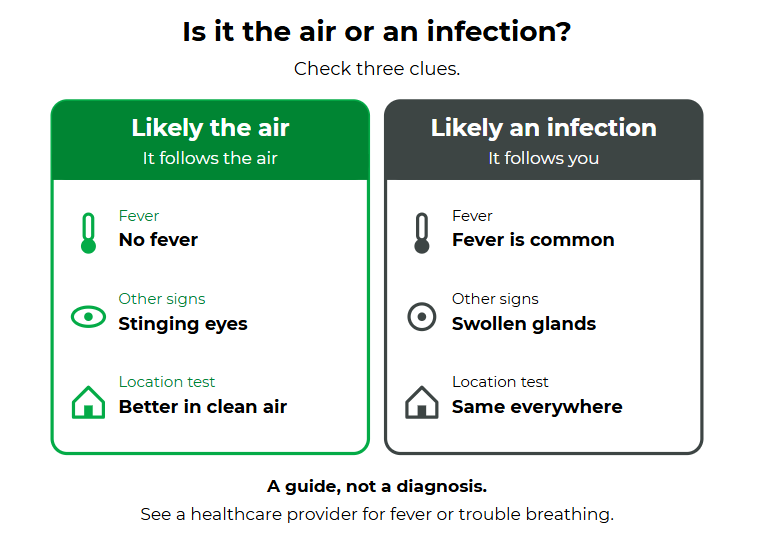
Answer a few quick questions and we'll match you to the right filter.
Yes, bad air quality can cause a sore throat. Wildfire smoke, ground-level ozone, gas-stove fumes, and very dry indoor air can all irritate your throat's lining. When pollution is to blame, you'll usually notice stinging eyes but no fever, and your throat eases in cleaner air. A fever points to an infection instead.
An air quality sore throat follows the air, while an infection follows you everywhere.
Where it hurts is a clue. Kitchen soreness points to gas-stove fumes; morning soreness often means dry air.
At AQI 100, Filterbuy says act: MERV 13 in your HVAC, fan on On, a HEPA air cleaner in each occupied room, and windows shut.
Standard pleated filters trap particles, not gases, so vent your stove and keep humidity at 30–50%.
See a healthcare provider for trouble breathing or swallowing, or symptoms lasting more than a few days.
Yes, and no virus has to be involved. Your throat is one of the first places polluted air touches. Fine particles settle on its moist lining, while gases like ozone and nitrogen dioxide irritate it chemically, and the inflammation that follows feels scratchy or sore.
The CDC lists a scratchy throat among the ways breathing wildfire smoke can affect you right away, and the EPA confirms that ozone can cause coughing and a sore or scratchy throat. Also see whether bad air quality can make you sick.
Filterbuy has built air filters in the U.S. since 2013, and we've seen this firsthand. When wildfire haze reached the Upper Midwest, questions from Minnesota customers on smoke-rated filters climbed within days, before the forecasts caught up.
The good news is that you can change the air indoors, where Americans spend about 90 percent of their time and some pollutants run 2 to 5 times higher than typical outdoor levels, according to the EPA.
Six common culprits irritate the throat: fine particles (PM2.5) from smoke, ground-level ozone, nitrogen dioxide from gas appliances, volatile organic compounds (VOCs), tobacco smoke, and overly dry indoor air.
| Pollutant | Common source | Worst when | Throat clue | What helps indoors |
|---|---|---|---|---|
| Fine particles (PM2.5) | Wildfire smoke, traffic, wood stoves | Hazy days, AQI 100 or higher | Scratchy throat, stinging eyes | MERV 13, fan On, HEPA air cleaner |
| Ground-level ozone | Sunlight plus vehicle emissions | Hot, sunny afternoons | Pain on deep breaths after time outside | Stay in at peak; ozone runs lower indoors |
| Nitrogen dioxide (NO2) | Gas stoves, heaters, fireplaces | During and after cooking | Worse in the kitchen | Vented range hood, blue burner flame |
| VOCs | Paint, cleaners, fragrances | During and after projects | Chemical smell, headache | Ventilate on good-air days |
| Tobacco smoke | Smoking indoors or nearby | Whenever someone smokes | Ongoing irritation, cough | No smoking inside |
| Dry indoor air | Heating season, humidity under 30% | First thing in the morning | Raw on waking, eases with water | Humidity at 30–50% |
Sources: U.S. EPA and CDC. HVAC filters capture particles, not gases like ozone or nitrogen dioxide.
The EPA's Care for Your Air guide confirms that nitrogen dioxide and VOCs irritate the throat, and our guides to ground-level ozone health effects and nitrogen dioxide sources and indoor steps go deeper.
“The most common misconception I run into is that a higher MERV rating automatically helps with gases like NO2. It doesn't. MERV measures how well a filter catches particles, full stop.”
For odors, Filterbuy's Odor Eliminator filters add an activated carbon layer to pleated media.
Dry air follows the calendar. Every winter, Filterbuy's customer notes fill with the same few complaints, and dry sinuses sit near the top.
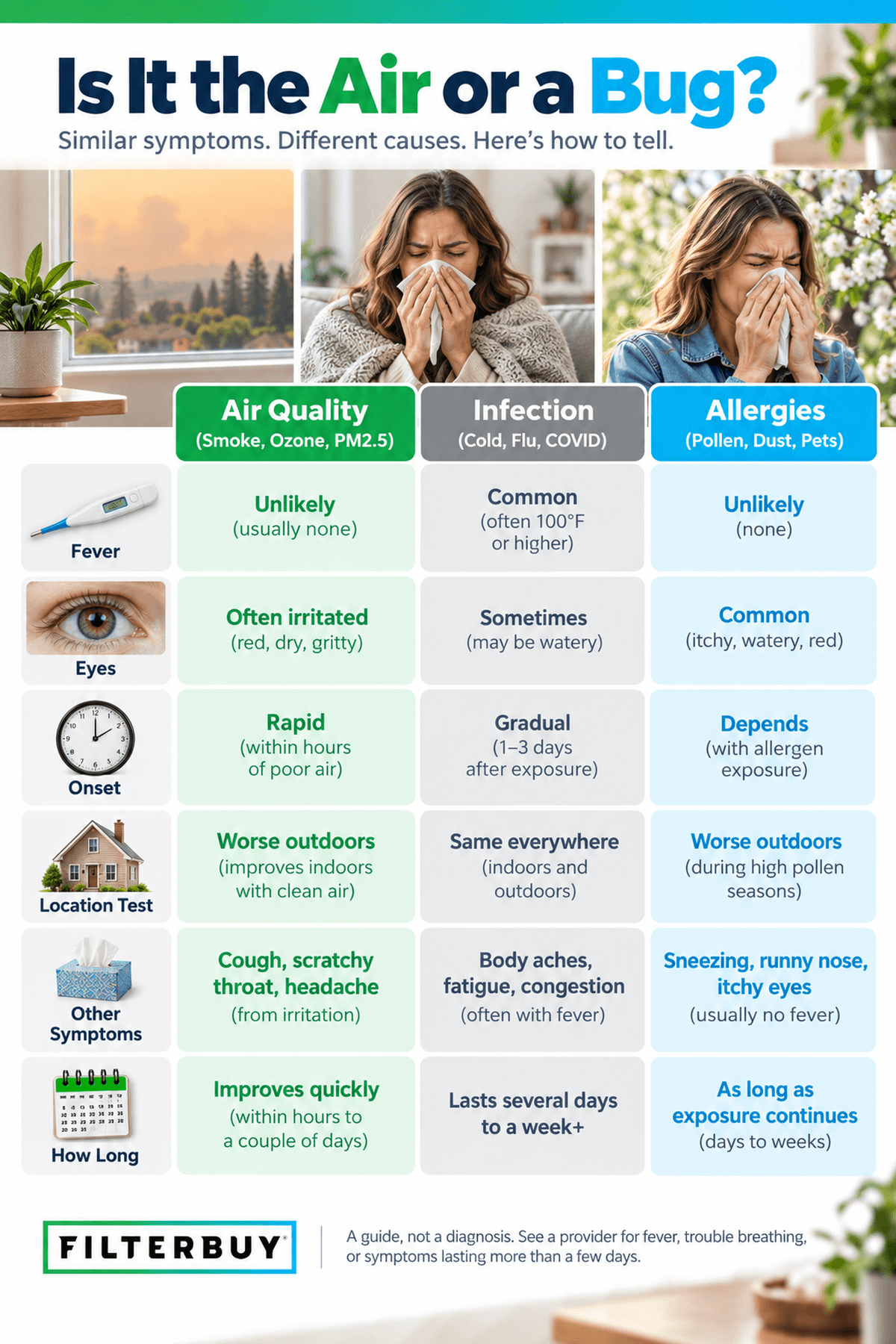
A pollution sore throat usually brings stinging eyes but no fever, and it eases in cleaner air. An infection builds over a day or two wherever you go and often brings fever, aches, or swollen neck glands. Allergies tend to itch rather than burn and come with sneezing.
Filterbuy built the Throat Clue Test to make that comparison quick.
| Clue | Air quality | Infection | Allergies |
|---|---|---|---|
| Fever | None | Common | None |
| Eyes | Stinging or burning | Sometimes pink eye | Itchy and watery |
| Onset | Hazy air or a certain room | Gradual, anywhere | Near pollen, pets, or dust |
| Location test | Better in cleaner air | Same everywhere | Better away from the trigger |
| Other symptoms | Cough, smoky or chemical smell | Painful swallowing, swollen glands | Sneezing, itchy nose |
| How long | Eases as the air clears | Most improve within a week | As long as exposure lasts |
A guide, not a diagnosis. See a healthcare provider for fever, trouble breathing, or symptoms that do not improve within a few days.
Since the CDC notes most sore throats are caused by viruses, use this table as a guide, not a diagnosis.
Still unsure? Try a 24-hour check:
Look up your live AQI on the Filterbuy live USA AQI map.
Notice where and when it hurts:
Kitchen, during or after cooking: likely gas-stove nitrogen dioxide.
Bedroom, right after waking: likely dry air or smoke that seeped in overnight.
Outdoors on a hot afternoon: likely ozone.
Everywhere on a hazy day: likely wildfire smoke.
Reduce what's in your indoor air with the steps below.
Reassess the next day. Feeling better suggests the air was involved; fever or worsening pain means call your provider.
When the AQI reaches 100, Filterbuy recommends four steps: put a MERV 13 filter in your HVAC, set the thermostat fan to On, run a portable HEPA air cleaner in each occupied room (bedrooms first), and close up the house. That's the top of the Moderate range, and it's where Filterbuy tells customers to act.
Before anything else, check AirNow's smoke guidance and your local air agency. If officials tell you to stay indoors, relocate, or evacuate, follow them first. Filtration is one layer, not the whole answer.
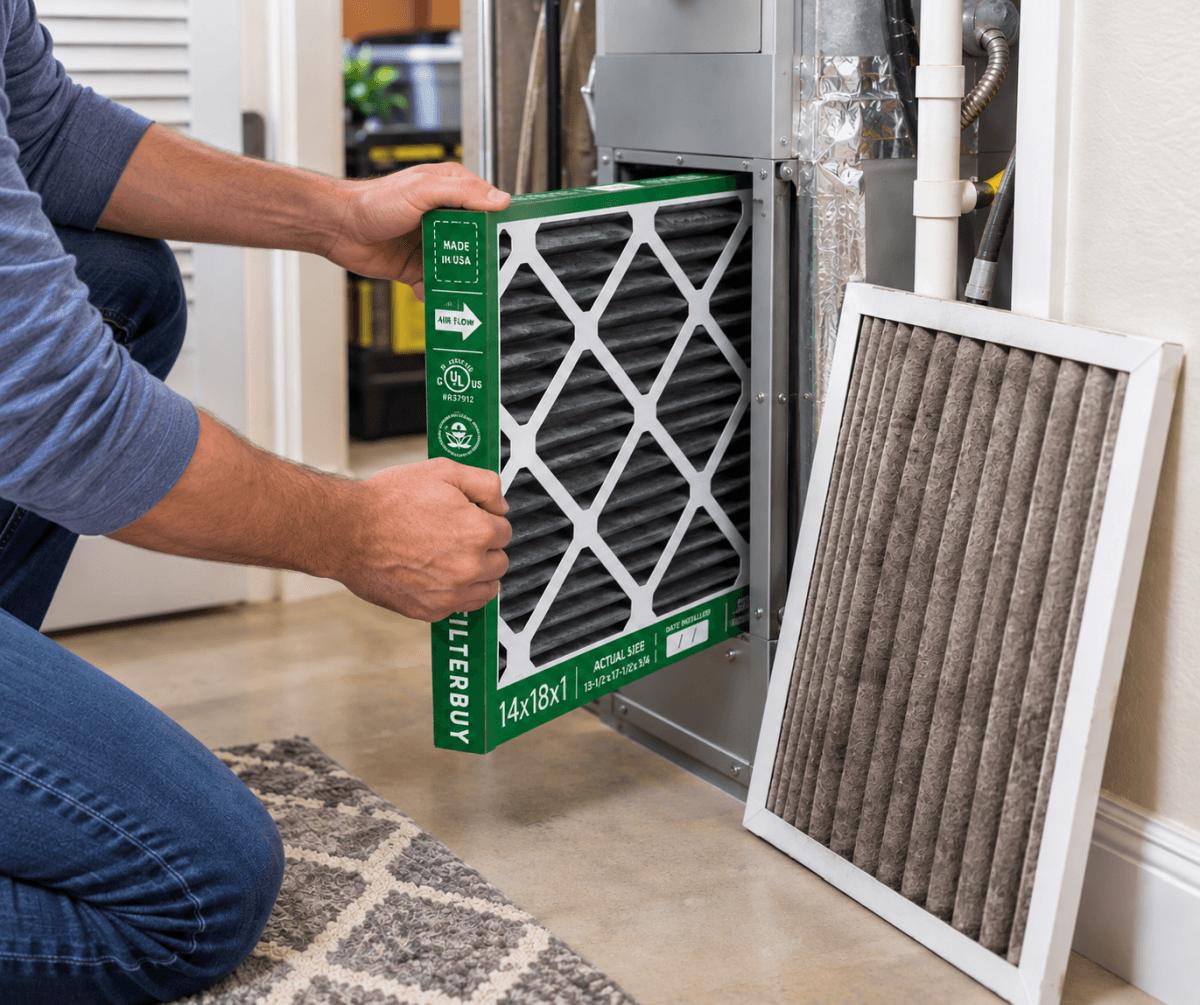
Put a MERV 13 filter in your HVAC. The EPA recommends a filter rated MERV 13 or higher in central systems during smoke events, and it notes that most furnaces and HVAC systems can use one without problems when the filter is replaced often (EPA smoke guidance). Confirm your size, then shop Filterbuy MERV 13 air filters or compare the right MERV rating for high-AQI days.
Set the thermostat fan to On. Auto only moves air through the filter while the system heats or cools, while On filters continuously. Skip single-hose portable ACs and swamp coolers, which the EPA warns can pull in smoky air. Learn whether air conditioners filter wildfire smoke.
Run a portable HEPA air cleaner in each occupied room, bedrooms first. The HVAC filter treats the whole house and a portable unit treats one room harder, so use both. For sizing, EPA guidance says a unit's smoke CADR should be at least two-thirds of the room's square footage, so a 300-square-foot bedroom needs a smoke CADR of about 200. Pick one that doesn't produce ozone, since the EPA advises against ozone-generating air cleaners. HEPA never goes in the furnace slot; see MERV 13 vs. HEPA for wildfire smoke.
Close up the house. Shut windows, doors, and any HVAC fresh-air intake. While smoke is in, AirNow advises skipping candles, gas stoves, fireplaces, and vacuuming, and don't fry food or smoke indoors.
No central HVAC? In apartments, homes with window units, or houses without ductwork, portable HEPA air cleaners are your primary defense, not a backup.
“Most homeowners have no idea whether they even have a fresh-air intake until they go looking for one. If you cannot identify it, that is the moment to call a technician.”
Pro Tip: During a smoke event, check your filter often and replace it when it looks dirty, dark brown or black, which can be well before its normal interval. Keep spares on hand, and consider air filter auto-delivery. Here's more on how often to change your air filter when AQI is high.
Get into cleaner air first, then keep your throat moist. The CDC recommends water, warm drinks, salt-water gargles, lozenges, and a clean cool-mist humidifier. Don't give lozenges to children under 4 or honey to babies under 1.
See a healthcare provider for difficulty breathing or swallowing, blood in your saliva, a rash, dehydration, or symptoms that don't improve within a few days. Call 911 for severe trouble breathing. Children, pregnant people, and anyone with asthma, COPD, or heart disease face higher risk from wildfire smoke and should follow their doctor's advice and official guidance. This article is educational, not medical advice.
Smoke sends people to the ER.
Asthma ER visits rose 17% above expected on 2023 wildfire smoke days.
The CDC tracked 4,317 emergency departments over 19 smoke days.
Unhealthy air is widespread.
152.3 million Americans (44%), including 33.5 million children, live where ozone or particle pollution gets a failing grade.
Gas stoves raise indoor nitrogen dioxide.
Homes that cook with gas have 50%–400% higher NO2 than homes with electric stoves, per EPA estimates.
Source: American Public Health Association, Gas Stove Emissions
Yes. The CDC notes that wildfire smoke can reach far away from where fires burn, so check the AQI on hazy days before assuming it's a cold.
MERV 13. The EPA recommends MERV 13 or higher in central HVAC systems during smoke events. Filterbuy tells customers to switch when the AQI reaches 100.
Filterbuy makes filters, so here's the honest answer. A pleated HVAC filter captures fine particles from the air that passes through it. It won't treat a sore throat or remove gases like ozone, so talk to a healthcare provider about symptoms.
Morning soreness often comes from dry bedroom air or mouth breathing at night. Keep humidity between 30 and 50 percent (see Filterbuy's guide to fixing dry winter air), and see a provider if it comes with a fever.
Air Quality Index (AQI): The EPA's 0–500 scale for outdoor air pollution. Readings above 100 are unhealthy for sensitive groups.
PM2.5: Airborne particles 2.5 micrometers or smaller, the main harmful part of smoke.
Ground-level ozone: A smog-forming gas created when sunlight reacts with emissions.
Nitrogen dioxide (NO2): An irritant gas produced by combustion, including gas stoves.
VOCs (volatile organic compounds): Gases released by paints, cleaners, and fragrances.
MERV (Minimum Efficiency Reporting Value): ASHRAE's rating for how well an HVAC filter captures particles.
CADR (Clean Air Delivery Rate): How much filtered air a portable purifier delivers.
HEPA filter: A high-efficiency particulate air filter, usually found in portable purifiers.
Fresh-air intake: A duct that pulls outdoor air into an HVAC system.
About the author: Michelle Wan is Brand Manager and Air Quality Writer at Filterbuy. She works directly with Filterbuy's U.S. manufacturing teams. Read more from Michelle Wan.
More resources: See Filterbuy's air quality resource library.
