
The AQI Scale Explained: What 0 to 500 Actually Measures
July 8, 2026
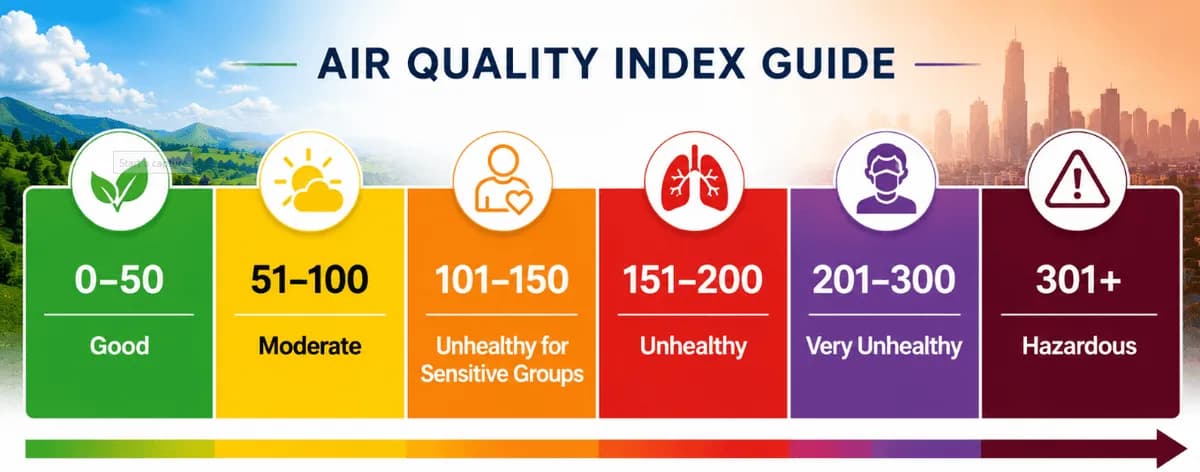
The Air Quality Index (AQI) runs from 0 to 500. The lower the number, the cleaner the air — higher numbers mean more health risk. Each range maps to a color, from green (Good) to maroon (Hazardous), so you can read the risk at a glance. On any given day, the worst pollutant sets the score.
- 0–50 · Green · Good
- 51–100 · Yellow · Moderate
- 101–150 · Orange · Unhealthy for Sensitive Groups
- 151–200 · Red · Unhealthy
- 201–300 · Purple · Very Unhealthy
- 301–500 · Maroon · Hazardous
Once you know today's number, the next step is making sure your home filter is ready for it. Take the quick match below, or shop filters at Filterbuy.
Answer 3 quick questions and we'll match you to your perfect filter.
You open your weather app. Right there next to the temperature, there's a number: 87. Or 142. Or 301. That number is the Air Quality Index, and it tells you exactly how much health risk is tied to the air outside right now.
AQI is the shorthand most Americans see when checking outdoor air quality. But a lot of people aren't sure what it actually means. Is 100 bad? Does 0 mean the air is perfect? What's the difference between orange and red?
This post breaks down the AQI scale from 0 to 500: what the number means, what colors signal, which pollutants drive the score, and what to do at home when the number climbs.
Key Takeaways
AQI Numbers Matter: The Air Quality Index (AQI) ranges from 0 to 500, with lower numbers indicating better air quality and higher numbers signaling greater health risks.
Color Coding Simplifies it: Each AQI range corresponds to a color, from green for good air quality to maroon for hazardous conditions. Knowing these colors helps you quickly assess outdoor air quality.
Pollutants Influence AQI: Common contributors to AQI values include particulate matter (PM2.5 and PM10), ground-level ozone, carbon monoxide, sulfur dioxide, and nitrogen dioxide.
Health Precautions Needed: Monitor AQI levels and adjust activities accordingly, especially if you're in a sensitive group, such as children, the elderly, or individuals with respiratory or heart conditions.
Stay Prepared: Keep an eye on local air quality reports, close windows, use air purifiers as needed, and limit outdoor exposure during periods of high AQI.
What Does AQI Actually Measure?
AQI measures the risk of outdoor air pollution to human health, not the total amount of "dirt" in the air. According to the EPA, the U.S. AQI converts pollutant concentrations into a uniform 0–500 scale, where higher numbers mean more pollution and greater health risk.
The U.S. AQI tracks six pollutants: ozone, PM2.5, PM10, carbon monoxide, sulfur dioxide, and nitrogen dioxide. This is a federally standardized system, not a scale created by any single brand or company. It's defined under [40 CFR Appendix G to Part 58].
AQI Is Not a Percentage
AQI 100 does not mean the air is "100% polluted." That's one of the most common misconceptions.
Instead, AQI 100 roughly aligns with the short-term national air quality standard for whichever pollutant is highest that day. Values at or below 100 are generally considered satisfactory. Above 100, air quality starts becoming unhealthy, first for sensitive groups, then for everyone as the number rises.
The Worst Pollutant Sets the Score
Here's how the AQI number gets calculated in plain English. Each pollutant gets its own index value. The highest one becomes the reported AQI.
So if ozone is at 65, PM2.5 is at 118, and carbon monoxide is at 20, the reported AQI is 118. PM2.5 wins because it's the highest. Federal AQI reporting rules require that the driving pollutant (the one with the highest index value) be identified alongside the number.
The AQI Scale From 0 to 500
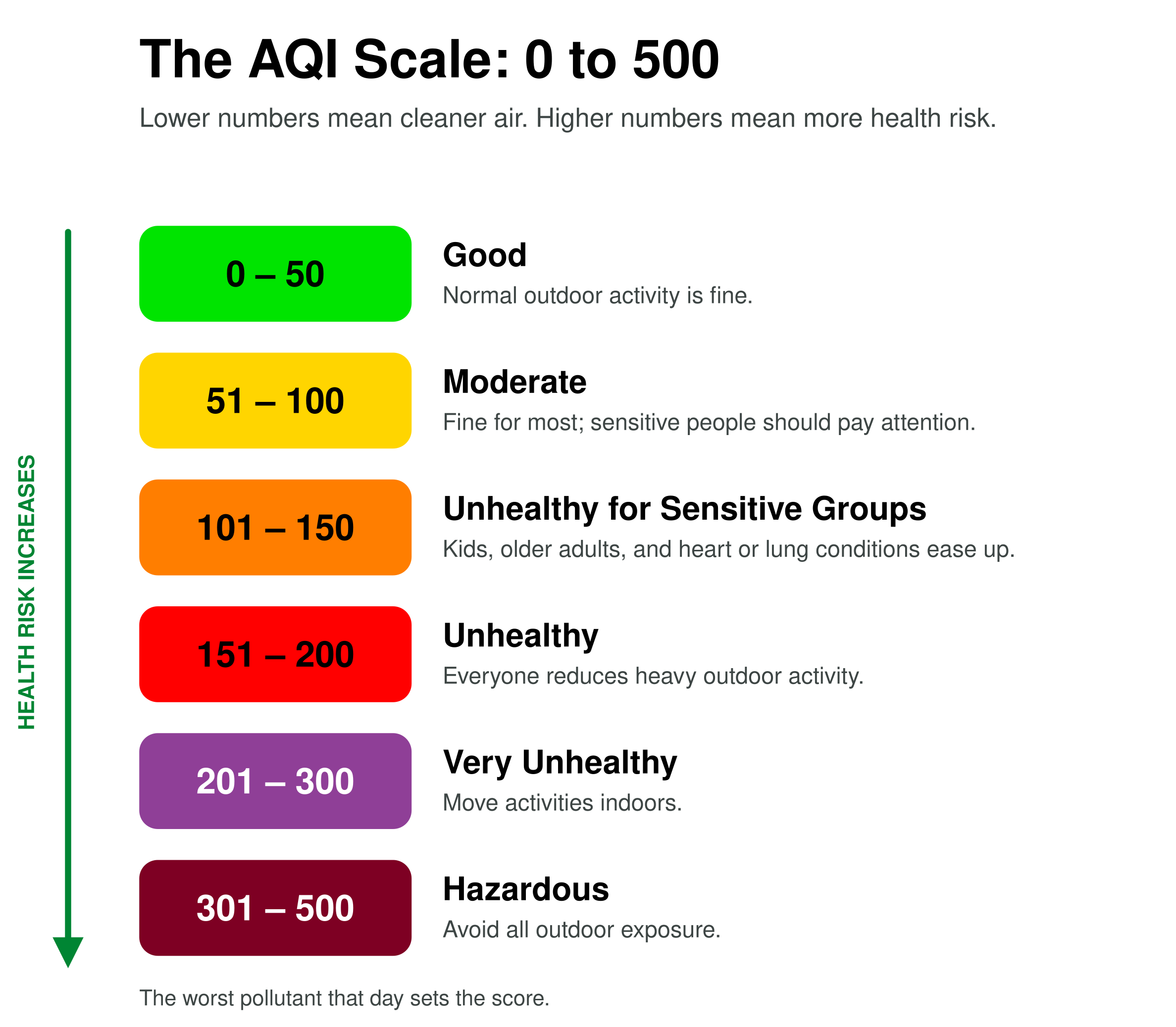
This table reflects the six official AQI categories defined by the EPA and [AirNow]:
| AQI Range | Color | Meaning | Simple Action |
|---|---|---|---|
| 0–50 | Green | Good | Normal outdoor activities are fine. |
| 51–100 | Yellow | Moderate | Most people are fine; unusually sensitive people should pay attention. |
| 101–150 | Orange | Unhealthy for Sensitive Groups | Children, older adults, and people with heart or lung conditions should reduce prolonged outdoor exertion. |
| 151–200 | Red | Unhealthy | Everyone should reduce prolonged or heavy outdoor activity. |
| 201–300 | Purple | Very Unhealthy | Avoid long outdoor exposure; move activities indoors. |
| 301+ | Maroon | Hazardous | Health emergency conditions: avoid all outdoor exposure. |
Think of AQI like a thermometer for air pollution risk. A higher number means the air is more likely to affect your lungs, heart, or breathing, especially if you have asthma, COPD, heart disease, or if you have children or older adults at home.
Which Pollutants Can Drive the AQI?
Particle Pollution: PM2.5 and PM10
PM2.5 refers to fine particles (2.5 micrometers in diameter or smaller). These come from wildfire smoke, vehicle exhaust, combustion, and other sources. PM2.5 is the pollutant most people hear about during smoke events because the particles are small enough to travel deep into the lungs.
PM10 covers larger particles, like dust and pollen. Both are tracked separately in the AQI system, and either can drive the reported score on a given day.
Ground-Level Ozone
Ground-level ozone is the main ingredient in smog. It forms when sunlight reacts with emissions from cars and industrial sources, which is why ozone levels tend to spike on hot, sunny summer afternoons. Ozone AQI often improves as the sun goes down.
Carbon Monoxide, Sulfur Dioxide, and Nitrogen Dioxide
These three gases round out the U.S. AQI system. Carbon monoxide comes primarily from vehicle exhaust and combustion. Sulfur dioxide is linked to industrial activity and fossil fuel burning. Nitrogen dioxide comes from traffic and power plants. Each gets its own index value; if any one of them is the highest, it drives the day's AQI.
Why AQI Can Change Hour by Hour
Air quality is local, and it moves. Wind, traffic patterns, wildfire smoke drifting from hundreds of miles away, morning temperature inversions: all of these can push the AQI up or down within hours.
To provide more current particle pollution readings, the EPA uses a system that calculates a weighted average of recent hourly measurements. During fast-moving events like wildfire smoke, this system responds more quickly, so the number you see reflects what's happening outside right now, not just a 24-hour average.
What Changed With PM2.5 AQI in 2024?
In 2024, the EPA lowered the annual health-based PM2.5 standard from 12.0 µg/m³ to 9.0 µg/m³ and finalized AQI revisions tied to particulate matter.
Because science continues to show health risks at lower concentrations of fine particle pollution, some AQI readings may now look worse than they would have under older breakpoints. That doesn't mean the air suddenly changed overnight. It means the health-risk scale became more protective for PM2.5.
Why Outdoor AQI Matters Inside Your Home
Here's something most people don't think about: outdoor air doesn't stay outside.
Outdoor pollution enters your home through windows, doors, gaps in the building envelope, and your HVAC system. According to the EPA, Americans spend about 90% of their time indoors, and concentrations of some pollutants indoors can be 2 to 5 times higher than typical outdoor levels.
What you do at home depends on where the AQI sits.
When AQI Is Green or Yellow (0–100)
A standard home filter (like a MERV 8) is generally enough for routine dust and pollen control. Most people won't need to change their daily routine on green or yellow days. Check your filter on a regular schedule so it's clean and ready when conditions worsen.
When AQI Is Orange or Red (101–200)
This is when your home's filtration setup starts to matter more. Close windows. Run your HVAC fan or recirculation setting if you have one. Check that your filter isn't overdue for a replacement, because a clogged filter can't protect your home the way a clean one can.
Filterbuy tip: Before a smoke or smog event, check that your current filter is clean and properly fitted. A filter that's past its replacement date can't do its job, no matter the MERV rating.
If your HVAC system can handle it, upgrading to a MERV 11 or 13 filter improves your ability to capture fine particles such as PM2.5. Filterbuy's MERV 13 filters trap and block 98% of airborne particles, making them a strong choice for high-pollution days.
When AQI Is Purple or Maroon (201+)
Stay indoors as much as possible. Choose the cleanest room in your home, reduce indoor pollution sources (no candles, no frying, no wood burning), and run the best filtration your system supports. EPA research has shown that DIY air cleaners made with a box fan and a [MERV 13 filter] can meaningfully reduce indoor smoke concentrations, with appropriate safety precautions for the fan.
If smoke odors are an issue, Filterbuy's carbon and odor eliminator filters can help address VOCs and gas-phase pollutants that standard filters don't capture.
How to Use the AQI Scale Before You Go Outside
Using the AQI scale is a four-step habit worth building:
Check your local AQI by ZIP code before heading out, especially for early morning exercise, outdoor work, or time with kids.
Look at the number and color to know the overall risk level.
See which pollutant is driving the score, because that tells you whether ozone (time of day matters) or particle pollution (think smoke or dust) is the issue.
Adjust your plans and your home filtration based on the level.
Check today's air near you with Filterbuy's Live AQI Map.
You can enter your ZIP code or share your location to see current conditions, hourly trends, and tomorrow's forecast, all in one place.
Know the Number, Take the Right Step With Filterbuy
The AQI scale is a straightforward tool, once you know how to read it. Green and yellow mean the air is safe. Orange through maroon means it's time to adjust. And your home's filtration is one of the most practical levers you have when the number climbs.
Now that you understand what the AQI number means, take the next step: check the live AQI in your area and make sure your home filter is clean, properly fitted, and rated for the air you're actually facing today.
Use Filterbuy's Live AQI Map to check your local air quality.
Frequently Asked Questions
What is a good AQI?
A good AQI is 0–50. At this level, air quality poses little to no risk for the general public.
Is 100 AQI bad?
AQI 100 is the upper end of the Moderate range. Above 100, air quality becomes unhealthy first for sensitive groups, including children, older adults, and people with heart or lung conditions.
What AQI level is unsafe?
AQI above 100 can be unsafe for sensitive groups. AQI above 150 is considered unhealthy for everyone, regardless of health status.
What does AQI 500 mean?
AQI 500 is the top of the standard scale. It indicates hazardous air quality: health emergency conditions where everyone should avoid outdoor exposure entirely.
Does AQI measure indoor air quality?
No. AQI is a measure of outdoor air quality only. However, outdoor pollution can and does affect indoor air, especially in homes without strong filtration or proper sealing.
What Should I Do When AQI Is High?
Check your local AQI, limit outdoor exertion, close windows and doors, reduce indoor pollution sources, and make sure your HVAC filter is clean and appropriately rated for the conditions. On high-particle days, a MERV 13 filter from Filterbuy offers the strongest whole-home protection.