
Does Outdoor AQI Affect Indoor Air Quality?
October 22, 2026

Your home isn’t airtight, so outdoor pollution doesn’t stay outside. On high-AQI days, keep windows and doors closed to limit how much gets in. Then run your system through a clean air filter so it can capture the particles that slip inside.
Find the right filter for your home with the quick quiz below, or shop air filters at Filterbuy.
Answer a few quick questions and we’ll match you to your filter.
Already know your filter size?
Shop Air FiltersYes. Outdoor air quality directly affects the air inside your home. Fine particles from wildfire smoke, traffic and industrial haze get in through open windows, HVAC systems and gaps in the building envelope, a process the U.S. EPA calls infiltration. In a study of more than 1,400 California buildings, indoor PM2.5 nearly tripled during wildfire events even with homes closed up.
TL;DR
Outdoor pollution reaches your indoor air whether or not your windows are open. Roughly 20% to 45% of outdoor fine particles work their way in during a smoke event. Most guides stop there. What they leave out is that by the time the AQI spikes, the only lever left is the filter you installed weeks earlier. Outdoor AQI is a forecast; your filter is a decision you already made.
Key Takeaways
Outdoor air enters homes three ways, per the EPA: natural ventilation, mechanical ventilation through fans and HVAC, and infiltration through cracks. Only the first is a choice.
Indoor air is not automatically cleaner. The EPA reports some pollutants run two to five times higher indoors, where Americans spend 90% of their time.
AQI 100 is the line. Close the windows, switch the fan to On, run an EPA-recommended MERV 13 filter if you have ducted HVAC, and add a HEPA purifier in each occupied room.
How Does Outdoor Air Get Inside Your Home?
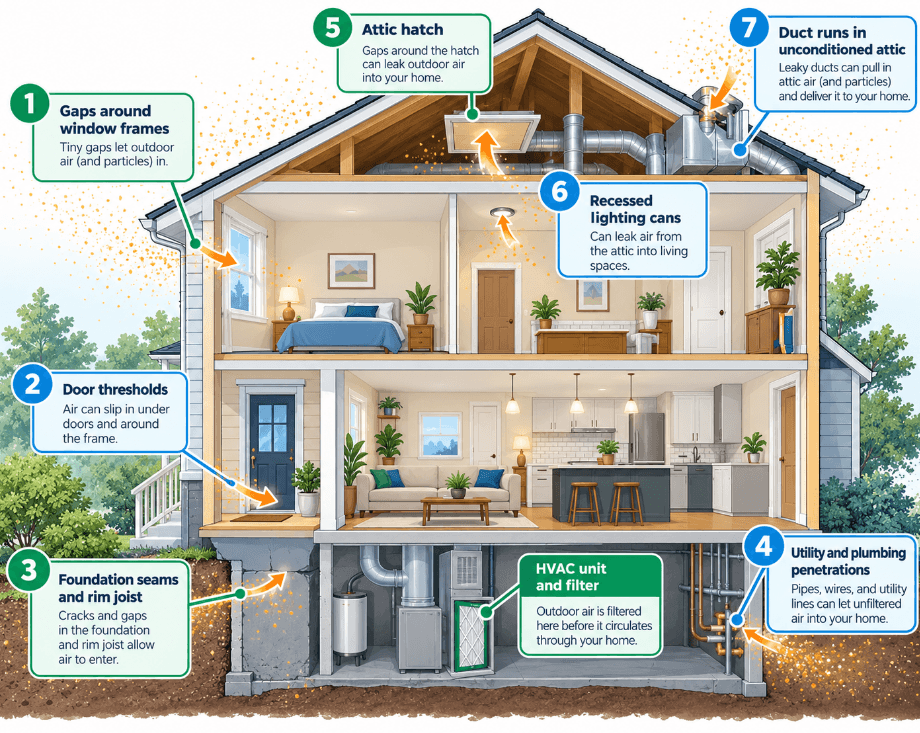
Outdoor air gets inside three ways: unintentional leaks in the building envelope, open windows and doors, and your HVAC system. Leaks run constantly and cannot be switched off, open windows are the fastest route and the only one you choose, and HVAC sits in between. Which dominates tells you which fix does the most.
Infiltration: The Leaks You Can't See
Infiltration is outdoor air entering through openings nobody designed: gaps around window and door frames, utility penetrations, attic hatches, foundation seams. PM2.5, particulate matter 2.5 microns and smaller, slips through openings that stop ordinary dust, which is why a home smells smoky with windows shut and why older houses fare worse than tight construction.
Open Windows And Doors
Natural ventilation swaps indoor air for outdoor air in minutes. On a clean-air day that flushes out cooking particulate, CO2 and VOCs; during smoke it erases the protection the building was giving you, which is why knowing when to close your windows matters most.
Your HVAC System
Residential systems mostly recirculate, but they are not sealed loops: ductwork in unconditioned attics leaks, and the blower pulls outdoor air through envelope gaps. Running the fan during smoke is still right, since it passes your whole indoor volume through the filter repeatedly. EPA guidance: set the fan to "On," not "Auto."
How Much Outdoor Pollution Actually Gets Inside?
Between roughly 20% and 45% of outdoor fine particles infiltrate a home and stay airborne during smoke events, the share researchers call the infiltration factor. Counting indoor sources too, the EPA puts typical indoor PM2.5 at 55% to 60% of outdoor levels with windows closed, 30% to 100% across homes.
Infiltration Research Findings
Sources: PNAS, NCCEH, University of Utah.
The first row is the counterintuitive one. Infiltration ratios drop during wildfire days, not because the house performs better but because people close windows and add filtration. It works and still is not enough: with infiltration halved, indoor PM2.5 nearly tripled, since outdoor levels climbed faster than the ratio.
"The question I get has changed. It used to be what the number means. Now it's why a house still smells smoky a day after the map turns green. That gap is almost always the filter. Not the one you order during the smoke event. The one that was already in the system when it started." Michelle Wan, Brand Manager and Air Quality Writer, Filterbuy
Is Indoor Air Worse Than Outdoor Air?
Sometimes, yes. Indoor air is not automatically cleaner, and treating it as a safe default is the most common mistake on this topic. It carries everything that infiltrated from outside plus what the household generates: cooking particulate, cleaning-product VOCs, pet dander, off-gassing. With windows shut under clear skies indoor air is usually worse; during a wildfire outdoor air is far worse and even a leaky house protects you. Indoor air is the one you can control.
At What AQI Should You Close Your Windows?
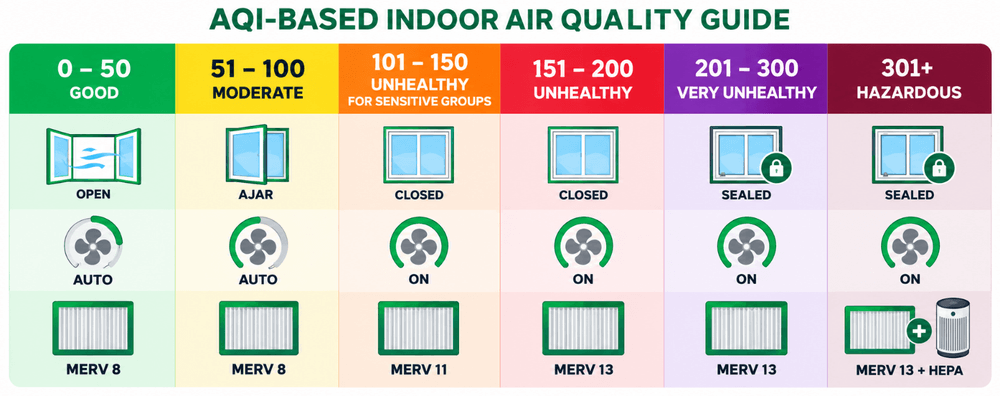
Close your windows once the AQI passes 100. Below 50 the air is Good and opening up is actively beneficial, since it flushes out what the house generates. Between 51 and 100, use judgment about who is inside; a household with a child, an older adult or anyone asthmatic should limit long openings before triple digits.
AQI Action Table
One caution: the EPA revised its PM2.5 breakpoints on May 6, 2024, dropping the Good ceiling from 12.0 to 9.0 µg/m³ and rescaling the upper bands, so older charts are wrong. Check yours on Filterbuy's live AQI map or AirNow.gov.
Which Air Filter Stops Outdoor Pollution Indoors?
MERV 13 is the EPA's recommended minimum for wildfire smoke. It captures at least half the particles in the 0.3 to 1.0 micron range, where most smoke particulate sits, while MERV 8 and MERV 11 carry no rating there. The American College of Allergy, Asthma & Immunology agrees, calling a disposable MERV 11 to 13 the most cost-efficient choice.
MERV Comparison
Shop MERV 8, MERV 11, MERV 13, or see how MERV ratings work.
Above AQI 100, run both layers. An EPA-recommended MERV 13 in a ducted HVAC system cleans the whole house each time the blower cycles; a HEPA purifier in every occupied room cleans the air you sit in between cycles. The EPA notes the two work together, since pairing a portable cleaner with a higher-efficiency central filter maximizes particle reduction. Size each purifier to its room and avoid models producing ozone. With no ducted system, room purifiers become the whole strategy.
Two limits. Pleated media captures particles, not gases, so smoke odor and VOCs pass through unless the filter includes carbon, which is what Filterbuy's Odor Eliminator filters are for. A clogged MERV 13 also restricts airflow more than the MERV 8 it replaced, so check your documentation, then see MERV 13 vs. HEPA.
Filterbuy has manufactured air filters in the United States since 2013, across four factories, and tests media in-house rather than trusting a spec sheet. That vantage point surfaces an uncomfortable pattern: every fire season, orders climb in the days after a smoke advisory, and a filter ordered on day three spends two in a truck. Filterbuy builds MERV 13 in 600+ sizes, plus custom air filters.
Your Plan For A High-AQI Day
When the AQI climbs past 100, four steps protect your indoor air, in order of impact.
Check the number on AirNow.gov or Filterbuy's live AQI map, then again later, since air quality shifts hourly.
Close up and switch the fan to On. Shut windows and doors, close any fresh-air intake, and move the fan off Auto.
Look at your filter weekly, not monthly, while the smoke lasts. See which MERV rating fits a smoke event.
Stop adding to the load and run HEPA in every occupied room. No candles, fireplaces or high-heat frying. If you can manage only one purifier, make it the bedroom and shut the door (EPA guide).
Do this in April, not August. That is the argument for a Filterbuy air filter subscription in wildfire country.
What Quietly Makes Indoor Air Worse
Some equipment people run to stay cool pulls outdoor air in by design, undoing the windows they just closed. Nearly every guide tells you to shut the house and stops there.
Evaporative ("swamp") coolers draw outdoor air across wet pads. Cover the outside intakes with 4-inch MERV 13 filters, which Filterbuy cuts to order since intakes are rarely a stock size.
Single-hose portable air conditioners vent out a window, so replacement air comes from outside. Two-hose models are fine if sealed.
Window air conditioners with the outdoor damper open do the same. Close it or leave the unit off.
Vacuuming returns settled particles to the air unless the vacuum has HEPA.
One reverse most guidance skips: when outdoor air improves, even for an hour, open up and flush the house. Sealing is right during smoke, not after.
Supporting Statistics
A high-efficiency HVAC filter with the fan on continuously cuts indoor PM2.5 by about 50%, against 24% with a low-efficiency filter. (EPA)
Wildland fires produce 52% of all PM2.5 emitted in the U.S. (EPA, 2020 National Emissions Inventory)
44% of Americans, 152.3 million people, live in counties graded F for ozone or particle pollution. (American Lung Association, State of the Air 2026)
Frequently Asked Questions
Does outdoor air pollution affect indoor air quality?
Yes, through open windows, HVAC systems and gaps in the building envelope. Research across more than 1,400 California buildings found indoor PM2.5 nearly tripled during wildfire events, even with homes shut.
What AQI is dangerous?
Above 150 is unhealthy for everyone. From 101 to 150 it is unhealthy for sensitive groups: children, older adults and people with asthma or heart conditions. Above 200 is very unhealthy; above 300, hazardous.
How often should I change my filter during a smoke event?
Far more often than the box says. The EPA advises every few weeks, sometimes every few days in heavy smoke, and swapping one as soon as it looks dirty or smells smoky. An overdue MERV 13 performs worse than a clean MERV 8.
Should I run my air conditioner when the AQI is high?
Central air conditioning, yes: recirculate, run the fan continuously, and pair it with HEPA purifiers in the rooms you occupy. Evaporative coolers, single-hose portables and window units with an open damper are the exceptions, since all three draw outdoor air in.
What are the signs of bad air quality in my home, and how do I test air quality at home?
Three signs need no monitor: a smoke smell lingering after the AQI drops, haze in a sunbeam, and a filter darkening in ten days when it normally lasts a month. For numbers, an indoor monitor reads PM2.5 in µg/m³ against the EPA breakpoints above; Filterbuy's testing guide covers monitors and kits.
Glossary
AQI (Air Quality Index): The EPA's 0-to-500 outdoor air quality scale, calculated from up to six pollutants and reported as the worst single score.
PM2.5: Fine particulate 2.5 microns or smaller, small enough to reach deep into the lungs; the main component of smoke.
MERV: Minimum Efficiency Reporting Value, the ASHRAE 52.2 scale for how well a filter captures particles from 0.3 to 10 microns.