
The Best Air Filter for Dust in Your Home (and When You Need an Air Purifier)
October 7, 2026
What's the Best Air Filter for Dust in Your Home?
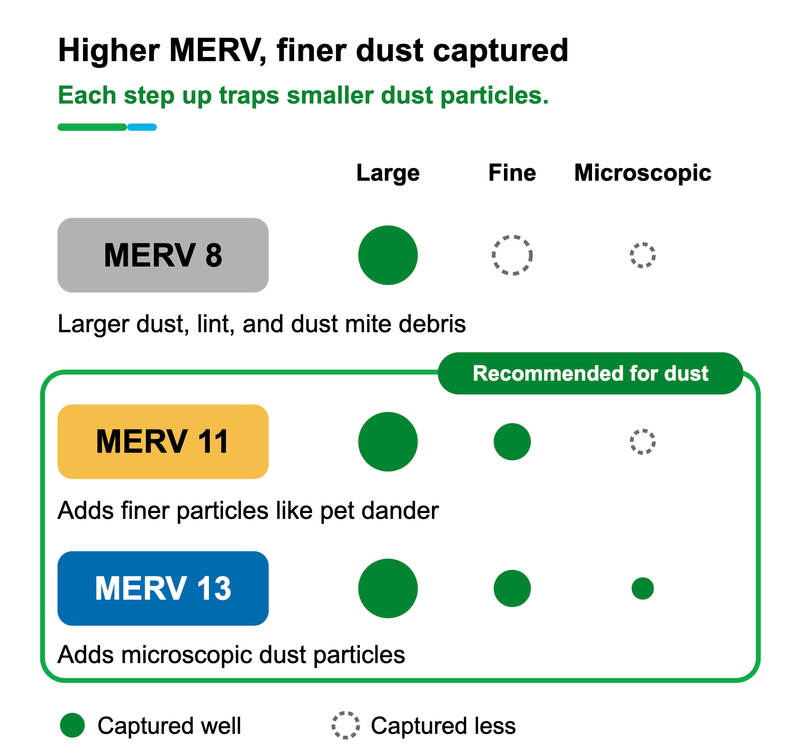
For most homes, a pleated MERV 11 to MERV 13 HVAC filter is the right choice for dust. It cleans the air in every ducted room whenever your system runs. The EPA recommends at least MERV 13 if your system can handle it. Get a snug fit and change it every 60 to 90 days.
MERV 8: larger dust, lint, and dust mite debris
MERV 11: adds finer particles like pet dander
MERV 13: adds microscopic dust; highest residential filtration
Not sure which rating your system can handle? Take the quick match quiz below.
Find Your Filter Match
Answer a few quick questions and we'll match you to the right filter for your home.
Already know your size? Shop air filters at Filterbuy
TL;DR
For most homes, the best air filter for dust is a pleated MERV 11 to MERV 13 HVAC filter that fits snugly and gets changed every 60 to 90 days. It cleans every ducted room, while a HEPA air purifier cleans one room around the clock. With dust allergies, use both.
Key Takeaways
Pleated MERV 11–13 filters are the best home air filters for dust, and MERV 13 captures the most fine dust.
The U.S. Environmental Protection Agency (EPA) recommends at least MERV 13 when you upgrade, if your system can handle it.
A MERV 13 filter captures at least 50% of 0.3–1 micron particles and at least 90% of 3–10 micron particles under ASHRAE Standard 52.2.
The best air purifiers for dust use a true HEPA filter, with a CADR of at least two-thirds of the room's square footage.
No filter removes all dust. Heavier particles settle first, so cleaning still matters
What Is the Best Air Filter for Dust Removal?
The best air filter for dust removal is a pleated HVAC filter rated MERV 11 to MERV 13. Filterbuy has built pleated filters in its U.S. factories since 2013, and the pleats do the work: folding the media packs far more surface area into the frame than flat fiberglass, so the filter traps fine dust, pet dander, pollen and dust mite debris without choking airflow.
I don't want anyone to feel like they need an HVAC license just to pick the right filter. My job is to give you the straight answer, explain why it matters, and let you get back to your day.
Michelle Wan, Filterbuy Brand Manager
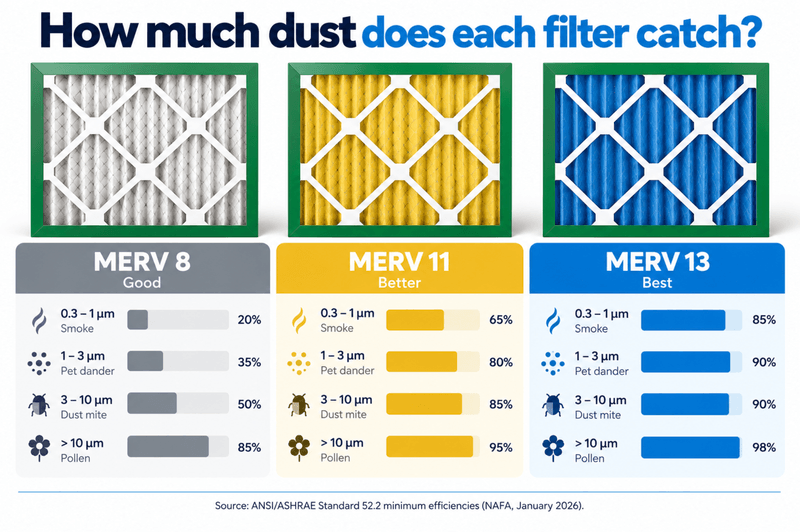
Use this chart to find the best dust filter for your home:
Shop MERV 8 air filters, MERV 11 air filters or MERV 13 air filters.
Which MERV Rating Is Best for Dust?
MERV 13 is the best MERV rating for dust, as long as your system can support it. MERV stands for Minimum Efficiency Reporting Value. It's the 1–16 scale from ASHRAE Standard 52.2 that grades how well a filter captures particles between 0.3 and 10 microns.
Minimum capture rates per ANSI/ASHRAE Standard 52.2, from the National Air Filtration Association's guide (January 2026).
That's why the EPA's Guide to Air Cleaners in the Home recommends at least MERV 13, or the highest rating your system fan and filter slot can handle. See Filterbuy's MERV rating chart for every rating.
HVAC Filter vs. Air Purifier: Which Is Better for Dust?
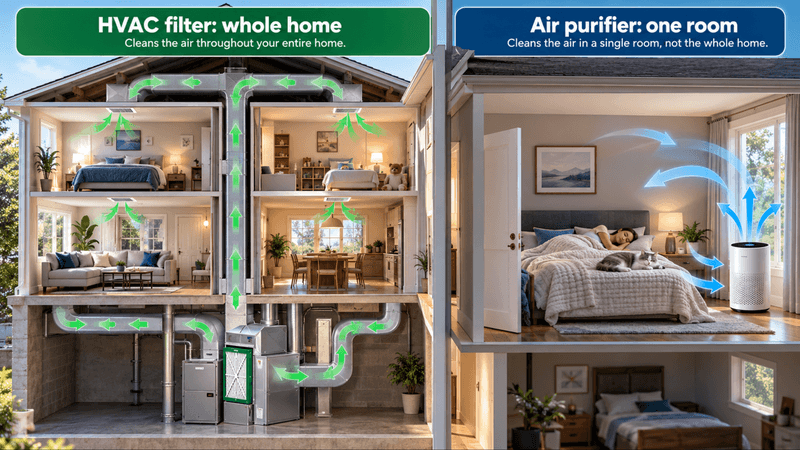
An HVAC filter is better for whole-home dust control, and a portable air purifier is better for round-the-clock cleaning in one room. Your furnace or AC filter cleans every ducted room whenever the blower runs; a HEPA air purifier captures more per pass, but only in its room.
The catch is run time. According to the EPA, home systems usually run less than 25% of the time in heating and cooling seasons, and the filter only works while air moves. So the best air purifier for home use is an add-on, not a replacement.
What each option costs per year. At Filterbuy's September 2026 prices, a 20x20x1 MERV 13 filter costs about $48 a year on a 90-day schedule, or $58 on a 60-day schedule, for the whole house. Consumer Reports estimates that its top-rated purifiers cost $53 to $343 a year each in filters and electricity when run around the clock, for one room.
More detail: air filters vs. air purifiers.
How to Choose the Best Air Purifier for Dust and Allergies
The best air purifier for dust and allergies pairs a true HEPA filter with enough cleaning power for the room. A true HEPA filter captures at least 99.97% of 0.3-micron particles. Size it by CADR, or clean air delivery rate: the AHAM 2/3 rule (from the Association of Home Appliance Manufacturers) says CADR should equal at least two-thirds of the room's square footage.
The best air purifiers for dust share five traits:
True HEPA filtration. Skip anything labeled "HEPA-type" or "HEPA-like."
A CADR sized to the room. Per the EPA's sizing chart, a 300-square-foot bedroom needs a CADR of at least 195.
Independent verification, such as the AHAM Verifide seal or Asthma and Allergy Foundation of America (AAFA) certification.
Low or no ozone. Look for a model on the California Air Resources Board (CARB) certified list and avoid ozone generators.
Affordable replacement filters.
Whether you want the best air purifier for allergies or a general-purpose unit, run it continuously where you spend the most time, usually the bedroom. Already own one? Filterbuy makes replacement air purifier filters for many popular models.
Can Your HVAC System Handle a MERV 13 Filter?
Most home HVAC systems can use a MERV 13 filter without equipment problems, as long as you replace it on schedule, according to the EPA. Denser media adds some airflow resistance, called pressure drop, so check your manual for a maximum MERV rating or ask a licensed HVAC technician to measure static pressure.
Signs of a too-restrictive filter include whistling at the return, slow heating or cooling, a bowing filter or higher energy bills.
Most systems I test are not struggling because the filter is too efficient. They are struggling because it has been in there since spring.
David Clark, Licensed HVAC Technician, Filterbuy HVAC Solutions
Filterbuy's product guidance agrees: a clogged MERV 8 restricts airflow more than a clean MERV 13. If a 1-inch slot still struggles, a Filterbuy 4-inch filter holds about four times the media surface area, so it can reach MERV 13 with less resistance.
Budget Option: How to Make a DIY Air Purifier for Dust
A box fan with a MERV 13 filter attached makes an effective, low-cost air purifier for dust. According to the EPA's DIY air cleaner guidance, a well-built DIY unit can perform about as well as a commercial air cleaner.
Use a box fan made in 2012 or later with a UL or ETL safety mark.
Choose a 20x20 MERV 13 filter, ideally 2 or 4 inches thick.
Tape the filter to the fan's intake side, arrows pointing toward the fan.
Seal every edge so air can't sneak around the filter.
Replace the filter once it turns gray.
The EPA treats DIY units as a stopgap, not a replacement for a tested purifier.
How to Reduce Dust in Your House: 7 Everyday Habits
The fastest way to cut household dust is to pair better filtration with fewer dust sources. No air cleaner removes every pollutant, the EPA notes, so these habits matter.
Switch the thermostat fan from Auto to On on high-dust days. Since most systems run less than 25% of the time, this can give your filter about four times as much run time, though it uses more electricity.
Change filters on schedule. Set up Filterbuy auto-delivery so one arrives on time.
Measure the slot, not the label. Sizing is the question Filterbuy's customer service team hears most. Filters are cut slightly smaller than their nominal size (a Filterbuy 20x20x1 measures 19.5 x 19.5 x 0.75 inches), and any gap lets dust slip past.
Vacuum weekly with a HEPA vacuum.
Dust with a damp microfiber cloth, not a dry duster.
Wash bedding weekly in water of at least 130°F to kill dust mites.
Keep indoor humidity between 30% and 50%.
More tips: how to allergy-proof your home.
Supporting Statistics: Why Household Dust Control Matters
About 90% of our time is spent indoors, mostly at home. That figure from the U.S. EPA means most of your dust exposure happens at home.
73% of U.S. homes had at least one allergen at elevated levels. In the National Institutes of Health's largest study of U.S. homes, researchers tested bedrooms in nearly 7,000 homes for eight common allergens, two of them from dust mites.
More than 106 million Americans have asthma and/or allergies, including about 82 million (1 in 4) with nasal allergies, according to the Asthma and Allergy Foundation of America, citing 2024 CDC survey data.
Frequently Asked Questions
Is MERV 11 or MERV 13 Better for Dust?
MERV 13 is better for fine dust. It must capture at least 50% of particles between 0.3 and 1 micron, compared with 20% for MERV 11. MERV 11 is still the better home air filter for dust if your system can't handle denser media.
Why Is My House So Dusty Even After Cleaning?
Dust returns when particles build up faster than you remove them. The usual culprits are a low-efficiency or overdue HVAC filter, gaps around the filter, leaky ducts, pets, carpets and dry air.
Is a MERV 13 Filter as Good as a HEPA Filter?
Per pass, no. A HEPA filter captures at least 99.97% of 0.3-micron particles, while a MERV 13 filter captures at least 50% of particles from 0.3 to 1 micron, but it cleans air from the whole house.
How Often Should I Change My Air Filter if My House Is Dusty?
Filterbuy's baseline for a 1-inch filter is every 90 days. Shorten that to 60 days with pets, 45 if someone has asthma or allergies, and 30 during wildfire smoke or renovation. In a dusty home, check the filter monthly.
Glossary
Find the Right Dust Filter for Your Home
Filterbuy has made air filters in the USA since 2013, in 600+ sizes plus custom air filters, all with free shipping. If a filter doesn't fit, we'll exchange it. Find your filter size and choose MERV 8, 11 or 13. For allergies, see the best air filters for allergies.
About the Author and Reviewer
Michelle Wan is Filterbuy's Brand Manager and Air Quality Writer (B.A., University of California, Santa Cruz). She works directly with Filterbuy's U.S. manufacturing team across factories in Alabama, Florida, Pennsylvania and Utah. Read more from Michelle
Reviewed by David Clark, Licensed HVAC Technician, Filterbuy HVAC Solutions.
Sources
U.S. EPA, Guide to Air Cleaners in the Home
U.S. EPA, DIY air cleaner guidance
National Air Filtration Association, Understanding MERV: User's Guide for ANSI/ASHRAE Standard 52.2