
Yukon Live Wildfire Smoke Map
Get Alerts For Wildfires In Your Area
The moment a wildfire starts near you, you'll get an instant alert and simple tips to reduce your smoke exposure.
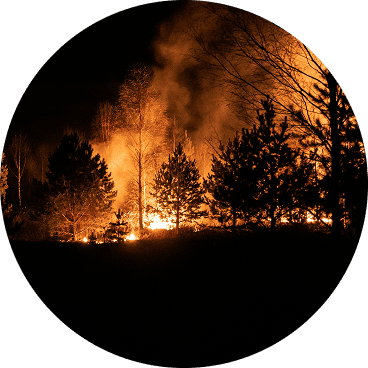
What's In The Smoke
30xSmaller than a human hair
Fine enough to reach deep into the lungs. A MERV 13 is built to capture it.
How Far It Travels


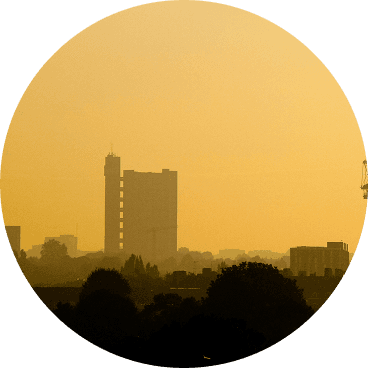
It Doesn't Stay Local
Smoke rides the wind far downwind — you can get smoky air with no fire nearby.
What To Do During A Smoke Event
Simple steps to reduce indoor exposure.
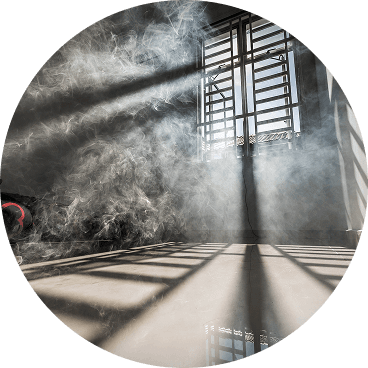
- Stay In, Close UpShut windows and doors to keep smoke out.
- Set Fan To "On"Keeps air cycling through your filter, not just when heating or cooling.
- Recirculate AirSwitch off fresh-air intake so you're not pulling smoke in.
- Run A MERV 13Built to capture the fine PM2.5 in smoke.
- Add A PurifierExtra filtration for the room you use most.
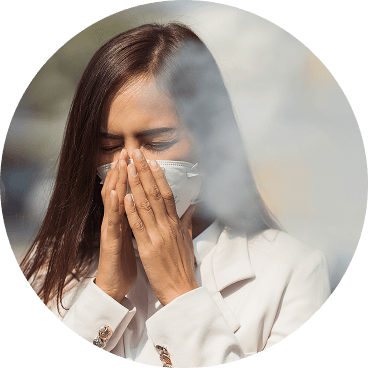
- Wear an N95 if OutsideFits snug to block fine particles — a cloth mask won't.


The Best Air Filter For Wildfire Smoke
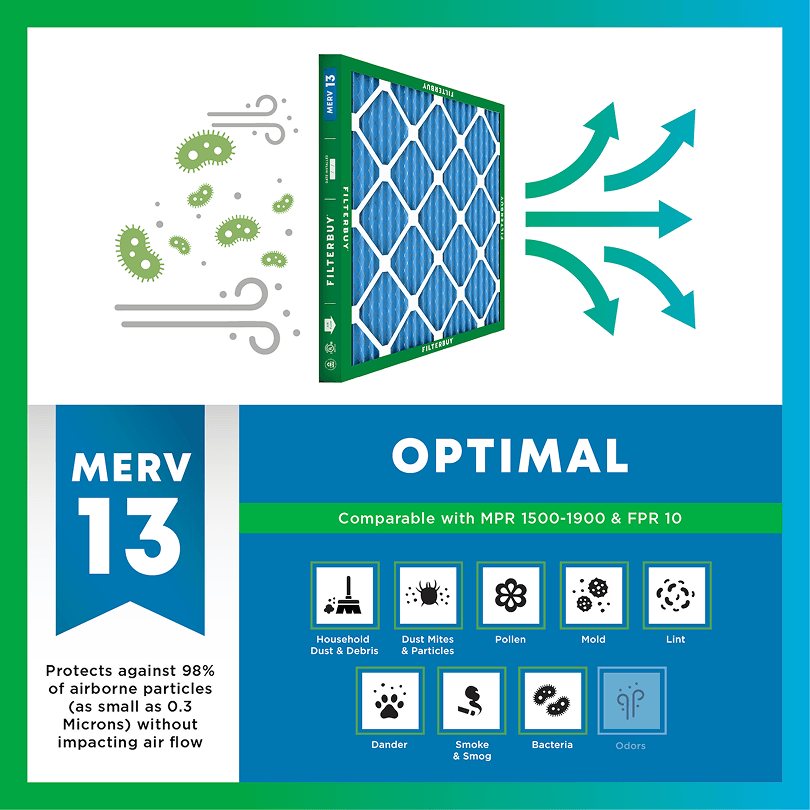
During smoke events, the EPA recommends upgrading to a MERV 13 filter — or the highest-rated filter your system can handle — to help reduce the fine particles smoke brings indoors. MERV 13 is the level most home HVAC systems can run while still capturing PM2.5, the fine particulate that makes up the bulk of wildfire smoke.
- Captures PM2.5 particles
- Blocks ash, soot, and smoke odor
- Keeps your indoor air safe—even when the outdoor air is dangerous
- Meets the EPA's recommended rating for filtering fine wildfire smoke particles.

Wildfire Smoke FAQs
Facts About Wildfires
Over 70,000 wildfires burn in the U.S. every year.
Wildfire smoke can travel 1,000+ miles, affecting states that aren't even near the blaze.
Exposure to wildfire smoke can worsen asthma, trigger heart issues, and lead to ER visits.
Indoor air can hold more fine particles during wildfire events unless it's properly filtered.
The EPA advises using MERV 13 filters or portable HEPA air cleaners during wildfire smoke events.
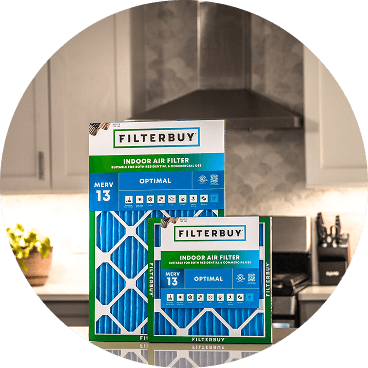
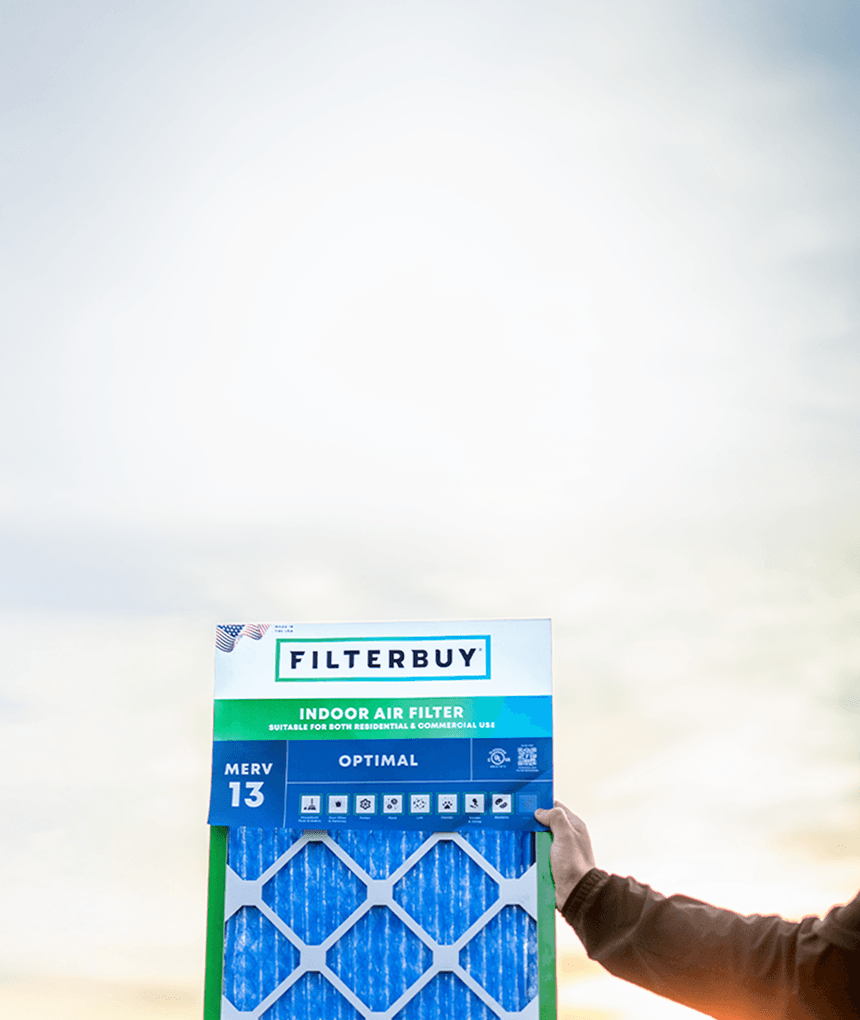
Don't Wait Until The Smoke's Inside.
Use the live wildfire smoke tracker and upgrade your air filters today to protect your lungs and your home.
Shop Filters For Smoke Protection
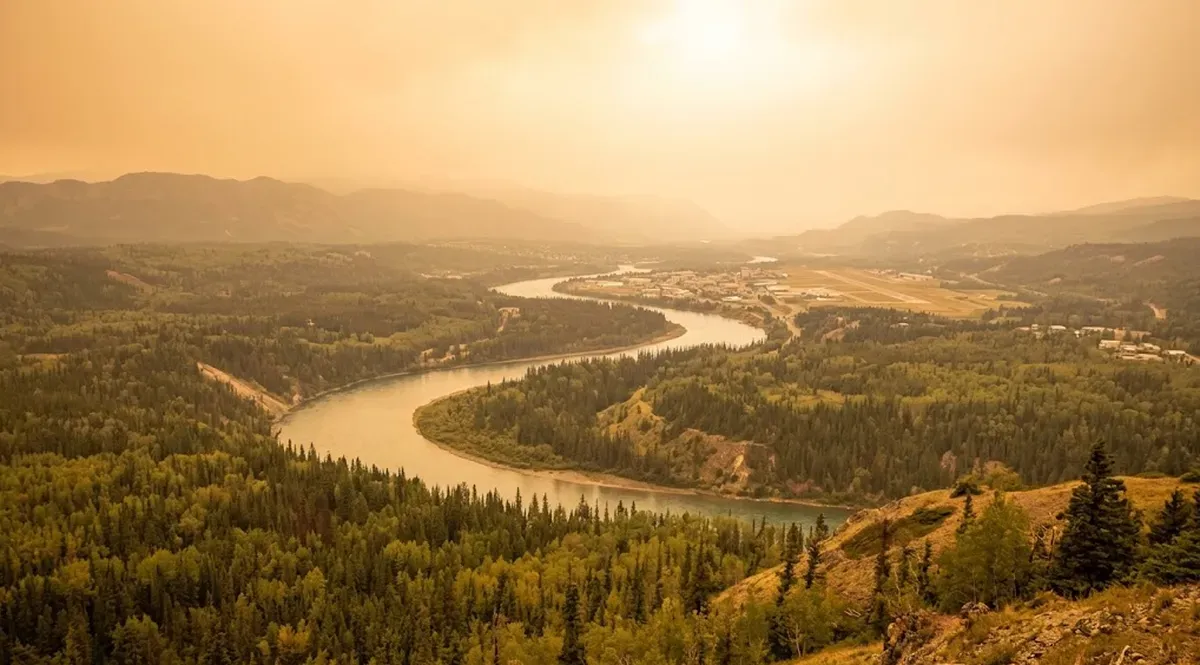
Live Yukon Forest Wildfire & Smoke Map Today: Territorial Air Quality Tracking & Indoor Protection Solutions
TL;DR
Yukon's official live wildfire map is the Yukon Wildfires Hub, showing active fires, the response assigned to each, and current fire danger ratings. Smoke is tracked separately, through FireSmoke.ca for ground-level PM2.5 forecasts and Environment and Climate Change Canada for the Air Quality Health Index. That separation matters, because smoke crosses borders freely and Yukon air can turn hazy on days when no Yukon fire is burning anywhere near you. For the indoor side, Health Canada recommends a filter rated MERV 13 or higher to capture the fine particles in smoke. Filterbuy makes that grade in over 600 sizes and ships free across Canada.
Key Takeaways
Yukon has one official wildfire map: the Yukon Wildfires Hub, with a text-only list by fire district for weak-signal areas.
The fire map and the smoke map answer different questions. A fire map shows where fuel is burning. A smoke forecast shows where the particles land, often hundreds of kilometres downwind.
As of 1 September 2026, Whitehorse is the only Yukon location with a published AQHI reading. Environment and Climate Change Canada's Yukon summary lists no other reporting community.
A big fire on the map is not automatically a threat. Yukon assigns each fire a response under a five-zone system, and many remote fires are monitored rather than fought.
Nearly half of Yukon homes heat with oil and a quarter with electricity, so many have no filter slot at all. There is a section below for those households.
Health Canada recommends MERV 13 or higher during smoke events, and notes smoke loads filters far faster than household dust.
Where to Check the Live Yukon Fire Map and Smoke Map Right Now
One note on wording first. In Yukon, "forest fire" and "wildfire" mean the same thing, so a search for a forest fire map and a search for a live fire map land in the same place. Every official Yukon source files it under wildfire. Four sources cover fire and smoke between them, each answering a different question.
Yukon Wildland Fire Management's Wildfires Hub. The authoritative territorial fire map, listing active fires and prescribed burns with a size, status, and response type, plus fire danger ratings. A text-only list by fire district serves anyone on slow service.
FireSmoke.ca (BlueSky Canada). From the University of British Columbia's Weather Forecast Research Team, it models ground-level PM2.5 roughly two days ahead. It is experimental and locates fires by satellite, so smoke from fires under cloud can be under-represented.
Environment and Climate Change Canada. The Yukon AQHI summary converts pollution into a health-risk number, and FireWork maps smoke and PM2.5 for the next 72 hours.
Canadian Wildland Fire Information System (CWFIS). Natural Resources Canada's national view, useful for spotting fires in the N.W.T., northern B.C., and Alaska that may be sending smoke your way.
For any decision affecting life or property, follow Yukon's official wildfire updates and your local emergency authority rather than a third-party map, this one included. To report a fire, call the Yukon Fire Line at 1-888-798-3473.
Why the Yukon Fire Map Can Look Quiet While the Air Smells Like Smoke
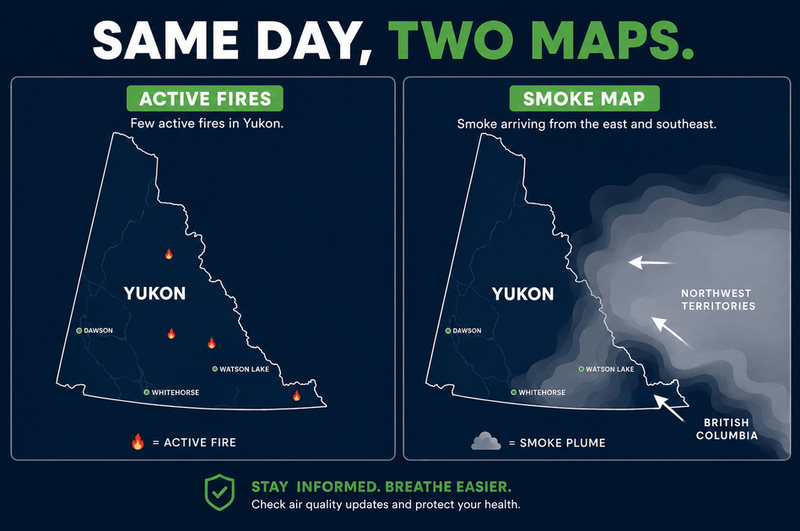
Wildfire smoke travels much further than wildfire itself. Fine particles drift for days and settle over territory that has no fire of its own, which is why the two maps so often disagree.
The 2026 season showed this plainly. Yukon's own fire year was quiet enough that roughly 48 per cent of Wildland Fire Management's firefighters were deployed to B.C. and the Northwest Territories, with about 1,600 hectares burned inside the territory by late July. Over that same period, the N.W.T. had burned more than 1,285,400 hectares.
So an empty fire map near your community does not mean clean air. When Yukoners smell smoke on a day the territorial map looks calm, the source is usually the N.W.T., northern B.C., or interior Alaska. The same pattern drives smoke seasons in British Columbia and Alberta. Check the smoke forecast before you open the windows, even when the fire map looks clear.
How to Read the Yukon Fire Map Without Misjudging the Risk
Yukon does not fight every fire the same way, and that changes how the map should be read. The territory is divided into five response zones under a zonation policy developed with community input in 2003: critical, full, strategic, transitional, and wilderness. Where a fire starts largely determines what happens to it.
Wildland Fire Management then assigns one of three responses. Full response means aggressive initial attack. Modified response means crews run a wildland fire analysis and use a range of techniques to protect property and infrastructure. Monitored response means officials track the fire for potential disruption while it fulfils its ecological role in the boreal forest.
Response type explains the Yukon fire map's biggest surprise. A 950-hectare fire listed as "out of control" in a wilderness zone may be entirely expected and deliberately unsuppressed, while a fire a fraction of that size in a critical zone near Whitehorse is attacked immediately. Size and status are not the same as threat. Fire danger ratings sit apart again, describing how readily new fires would start rather than the ones already burning.
The Yukon AQHI Blind Spot, and the Three-Map Check That Closes It
There is a gap here that most air quality coverage misses. As of 1 September 2026, ECCC's Yukon AQHI summary lists exactly one reporting location: Whitehorse. Dawson City, Watson Lake, Haines Junction, Mayo, Carmacks, Faro, Teslin, Old Crow, Beaver Creek, Ross River, and Pelly Crossing have no published AQHI value of their own.
A single monitoring station leaves most of Yukon without the one number Canadians are told to check, and it is the same problem we hear from Filterbuy customers across the Prairies and northern B.C. Outside Whitehorse, use the three-step check we give them.
One: check the current fire map at the Yukon Wildfires Hub for fires within roughly 100 km, and note the wind direction in your forecast. That tells you whether a nearby source is even plausible.
Two: check the current smoke map on FireSmoke.ca or FireWork for modelled PM2.5 over your community across the next 24 to 48 hours. This is the step that catches long-range smoke from outside Yukon, which the fire map cannot show you.
Three: check your own eyes. Visibility is a usable proxy when no monitor exists. If a ridge across the valley or the far shore of a familiar lake has flattened into grey, particle levels are up whatever the maps say.
What We Have Learned Building Filters for Yukon Smoke Seasons
Once you know the air is bad, the question becomes what to do indoors. Filterbuy manufactures every filter it sells rather than reselling someone else's, so what follows comes off our own production line. Three things matter more in a smoke season than the MERV number on the box.
Depth buys time. Our 1-inch carries 14 pleats per foot, while our 4-inch carries only eight, because each pleat is far deeper. That extra media is why a 4-inch runs three to six months where a 1-inch runs 60 to 90 days, and across a long smoke episode it is the difference between one filter change and three.
A filter that does not seal is not filtering. Air takes the easy route. If it slips around the frame it never passes through the media at all, so a poorly fitted MERV 13 can perform like no filter. We cut each filter slightly under its nominal size for exactly that reason, so it seats in the slot instead of binding.
Read the filter against white paper, not a lamp. Holding a filter up to a light is the most repeated tip on the internet and the least useful. A new pleated filter already blocks plenty of light, and a loaded one still passes light between the pleats. Against a white sheet the colour shift is obvious. It is the check Filterbuy gives customers who ask how to tell, and in a territory with one air monitor it is the closest thing most households have to a measurement.
"I don't want anyone to feel like they need an HVAC licence just to pick the right filter. My job is to give you the straight answer, explain why it matters, and let you get back to your day."
— Michelle Wan, Brand Manager and Air Quality Writer, Filterbuy
Protecting Your Indoor Air During a Yukon Smoke Event
Health Canada's guidance for cleaner air spaces is direct: use filters rated MERV 13 or higher, keep replacements on hand, and change them as required. It also notes that odour-removing filters may help with comfort, and that recirculating indoor air during heavy smoke limits how much gets inside.
Four things make the biggest difference in a Yukon home:
Install a MERV 13 before smoke season, not during it. Once the air turns, filters sell out and northern shipping takes longer.
Run the furnace fan on recirculate so household air keeps passing through the filter, and close outdoor intakes if your system allows.
Check the filter weekly. A filter that would normally run 60 to 90 days can grey out in a fortnight during a sustained event.
Stock spares. Health Canada advises keeping replacements on hand because smoke loading is episodic and intense.
One caution before you upgrade: not every older furnace tolerates the added pressure drop of a higher-MERV filter. If you are unsure yours can handle MERV 13, check the manual or ask a licensed HVAC technician first.
What If Your Home Has No Filter Slot?
Most smoke advice, including most of this page, assumes a forced-air furnace with a filter slot. In Yukon that assumption breaks for a great many households. Of the territory's 20,248 dwellings in 2024, 49.3% used oil-based heating and 24.3% used electricity. Electric baseboard has no ductwork, and a hydronic oil boiler does not move air either, so if that describes your home a MERV 13 furnace filter has nowhere to go.
Here is what helps instead:
Clean one room, not the house. Pick a bedroom with few windows and no fireplace, and shut the door.
Run a portable air cleaner sized to that room. Check its filter as often as you would a furnace filter.
Or build a box-fan cleaner. EPA found a single 4-inch MERV 13 on a box fan raised clean air delivery by 123%. Use a 2012-or-newer fan with modern safety features.
Turn down your HRV or ERV. Tightly built northern homes often run heat-recovery ventilators that pull outdoor air in by design. Reduce the intake during heavy smoke, then restore normal ventilation once it clears.
Hold off on the wood stove if you have another heat source.
Filterbuy would rather say that plainly than sell you a filter that will not fit your house. Without a slot, our pleated filters are useful inside a box-fan cleaner and not much else.
Which Filterbuy Filter Suits a Yukon Smoke Season
For homes that do have a filter slot, we make pleated filters in over 600 sizes, including custom dimensions, and ship free across Canada with no minimum. Prices display in CAD.
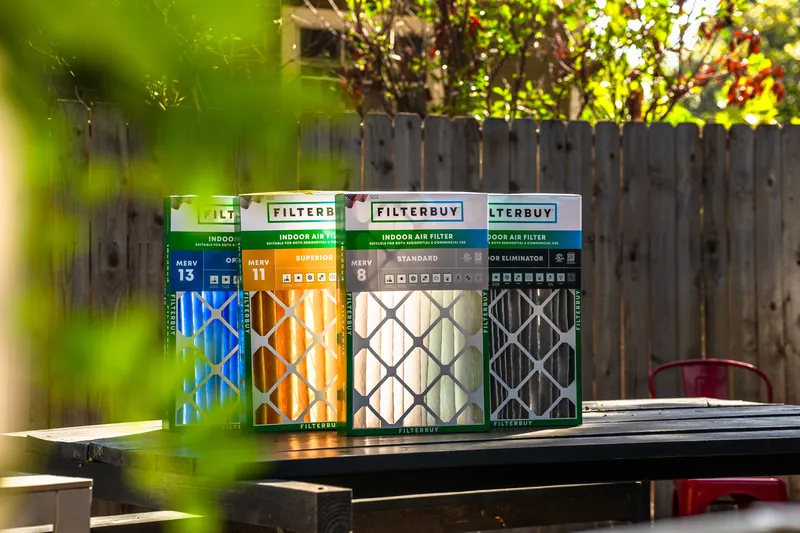
MERV 13 — Optimal matches Health Canada's recommendation and captures 98% of airborne particles. It is the sensible default for a Yukon household heading into a smoky August.
Odour Eliminator filters are carbon-infused and go after the smell of smoke rather than the particles. Their particle capture sits below MERV 13, so treat them as a comfort layer alongside one rather than a replacement for it.
MERV 11 — Superior handles dust mites, mould spores, and pet dander, and stays a solid year-round choice wherever a system cannot take MERV 13. Our MERV ratings guide and best MERV filter for wildfire smoke go deeper.
The households we see cope best are the ones that fit a fresh MERV 13 before the haze arrives rather than after, usually on a subscribe-and-save schedule they can edit, skip, or cancel anytime.
Supporting Statistics
The territorial detail above comes from Canadian sources. The filtration research below comes from U.S. agencies, and it matches what Filterbuy sees in its own testing.
1. The fan setting matters as much as the filter.
High-efficiency filter, fan running continuously: about 50% less indoor PM2.5.
Typical low-efficiency filter, fan running continuously: about 24%.
Takeaway: run both. Neither alone does the job.
Source: U.S. EPA, Strategies to Reduce Exposure Indoors, citing Fisk and Chan (2017).
2. Wildland fire is the largest source of fine particles in the U.S.
52% of total U.S. PM2.5 emissions came from wildland fires (EPA 2020 National Emissions Inventory).
EPA infiltration research found indoor PM2.5 varied widely between buildings.
Two factors explained most of that gap: filter MERV rating and HVAC maintenance.
Takeaway: smoke now dominates the particle picture. Indoor results depend on your filter.
Source: U.S. EPA, Wildland Fire Research: Reducing Exposures.
3. The worst U.S. city for short-term particle pollution is subarctic.
Fairbanks, Alaska now ranks worst in the nation, displacing Bakersfield, California.
The same report ties the 2023 Canadian wildfire season to higher pollution across dozens of central and eastern states.
Takeaway: Fairbanks is the closest large analogue to Whitehorse in climate and forest type. Boreal smoke travels far beyond the fire.
Source: American Lung Association, State of the Air 2026, Key Findings, 27th edition, 2022 to 2024 data.
Frequently Asked Questions
Glossary
AQHI: Air Quality Health Index, a Canadian scale showing health risk from air pollution.
PM2.5: Fine airborne particles 2.5 micrometres or smaller, including particles found in wildfire smoke.
MERV: Minimum Efficiency Reporting Value, a rating used to describe how effectively an air filter captures particles.
Related reading: Canada wildfire and smoke map · Live Canada AQI map · British Columbia wildfire and smoke map · Best MERV filter for wildfire smoke
About the Author
Michelle Wan is Brand Manager and Air Quality Writer at Filterbuy, where she works directly with the company's U.S. manufacturing team. She earned her B.A. from the University of California, Santa Cruz, and writes from how filters are built, tested, and used in real homes. She also fronts much of Filterbuy's educational video content.
Technically reviewed by David Clark, a Licensed HVAC Technician with Filterbuy HVAC Solutions, who reviews Filterbuy's maintenance and system-compatibility guidance for accuracy.