
Township Of Langley, BC Live Wildfire Smoke Map
Get Alerts For Wildfires In Your Area
The moment a wildfire starts near you, you'll get an instant alert and simple tips to reduce your smoke exposure.
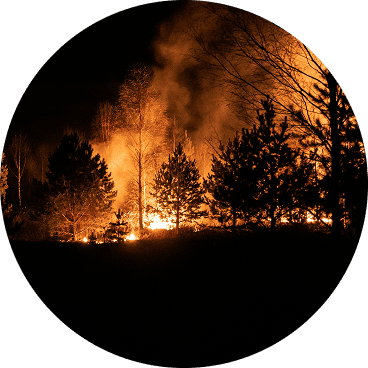
What's In The Smoke
30xSmaller than a human hair
Fine enough to reach deep into the lungs. A MERV 13 is built to capture it.
How Far It Travels


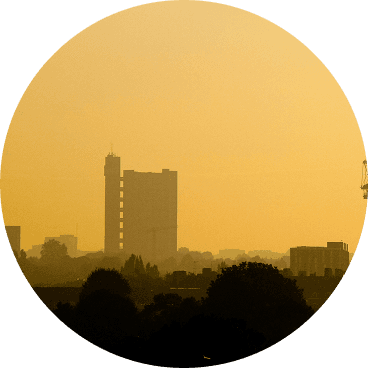
It Doesn't Stay Local
Smoke rides the wind far downwind — you can get smoky air with no fire nearby.
What To Do During A Smoke Event
Simple steps to reduce indoor exposure.
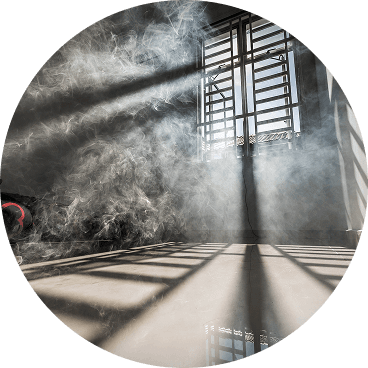
- Stay In, Close UpShut windows and doors to keep smoke out.
- Set Fan To "On"Keeps air cycling through your filter, not just when heating or cooling.
- Recirculate AirSwitch off fresh-air intake so you're not pulling smoke in.
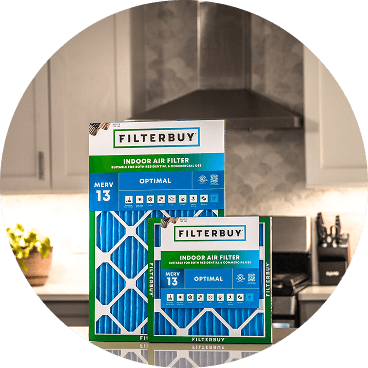
- Run A MERV 13Built to capture the fine PM2.5 in smoke.
- Add A PurifierExtra filtration for the room you use most.
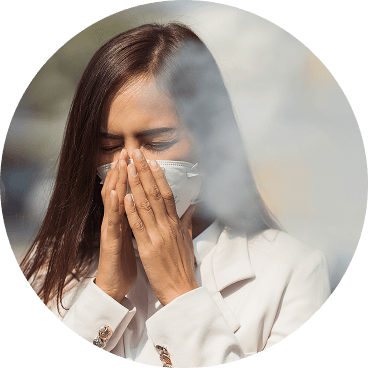
- Wear an N95 if OutsideFits snug to block fine particles — a cloth mask won't.


The Best Air Filter For Wildfire Smoke
During smoke events, the EPA recommends upgrading to a MERV 13 filter — or the highest-rated filter your system can handle — to help reduce the fine particles smoke brings indoors. MERV 13 is the level most home HVAC systems can run while still capturing PM2.5, the fine particulate that makes up the bulk of wildfire smoke.
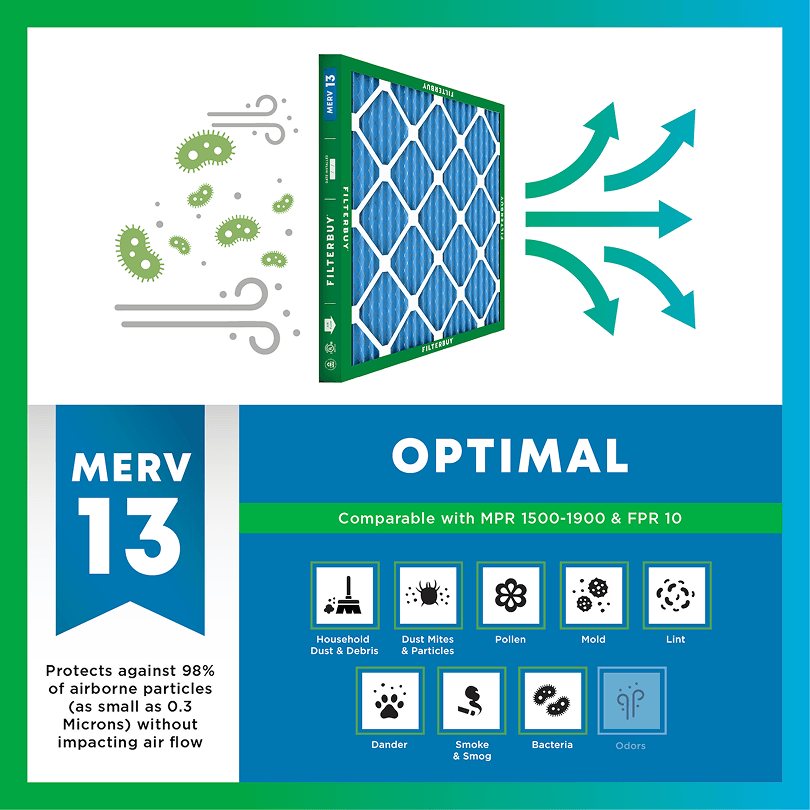
- Captures PM2.5 particles
- Blocks ash, soot, and smoke odor
- Keeps your indoor air safe—even when the outdoor air is dangerous
- Meets the EPA's recommended rating for filtering fine wildfire smoke particles.

Wildfire Smoke FAQs
Facts About Wildfires
Over 70,000 wildfires burn in the U.S. every year.
Wildfire smoke can travel 1,000+ miles, affecting states that aren't even near the blaze.
Exposure to wildfire smoke can worsen asthma, trigger heart issues, and lead to ER visits.
Indoor air can hold more fine particles during wildfire events unless it's properly filtered.
The EPA advises using MERV 13 filters or portable HEPA air cleaners during wildfire smoke events.
Don't Wait Until The Smoke's Inside.
Use the live wildfire smoke tracker and upgrade your air filters today to protect your lungs and your home.
Shop Filters For Smoke Protection
Live Township of Langley, BC Forest Wildfire & Smoke Map Today
Local Air Quality Tracking & Indoor Protection Solutions
TL;DR
The Township of Langley, BC rarely burns: no recorded wildfire here has passed one hectare since the 1950s. The real risk is smoke from distant fires, as in August 2026. Check the live map at the top of this page, Metro Vancouver's AirMap for air quality, and the FireWork forecast for incoming smoke, and filter indoor air on smoky days.
Key Takeaways
The Township of Langley shares the Metro Vancouver Southeast Air Quality Health Index (AQHI) zone with the City of Langley, Surrey, and White Rock.
The Township's 2023 wildfire plan counts 47 recorded local wildfires since the 1950s, none larger than one hectare and all human-caused.
In August 2026, smoke from wildfires near Boston Bar, roughly 114 to 117 km away by our calculation, brought air quality warnings to the Township.
Where Can I See a Live Wildfire and Smoke Map for the Township of Langley Today?
The live map at the top of this page tracks active and new wildfires and smoke plumes on both sides of the U.S. border.
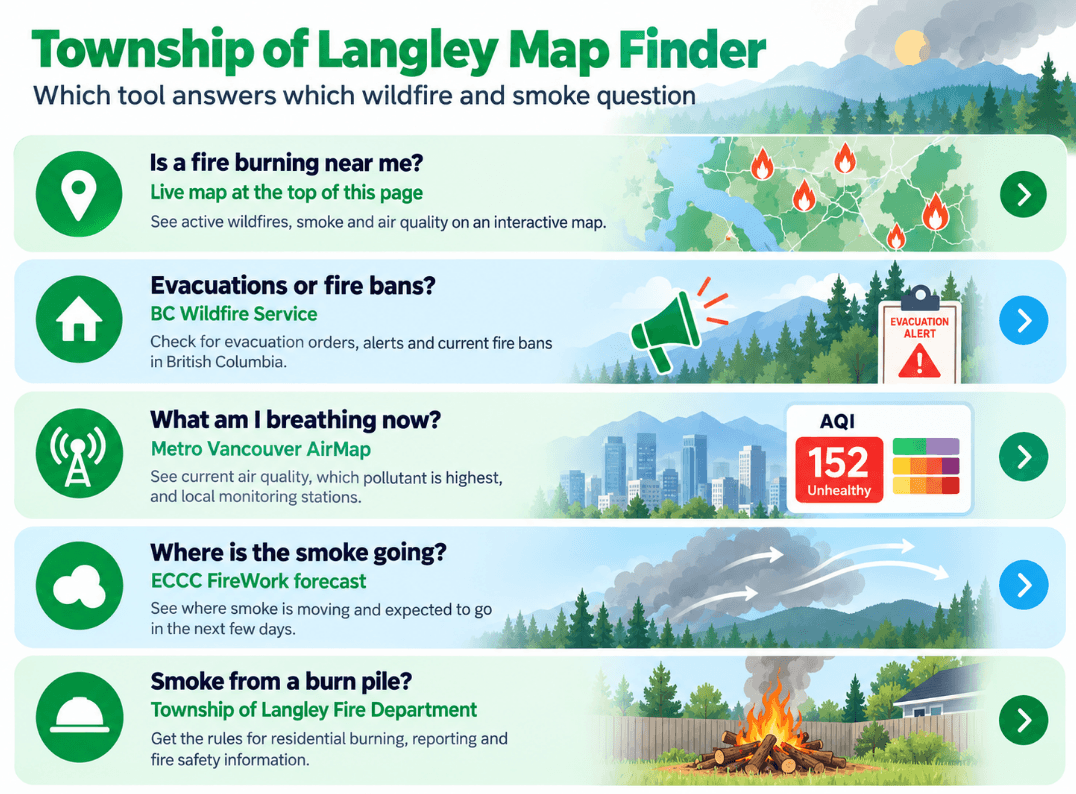
When the Filterbuy.ca team matched Township searches to official tools, "fire map" and "smoke map" proved to be different questions. The Map Finder below, checked in September 2026, pairs each search with the right source.
Township of Langley Map Finder
For a wider view, see our British Columbia wildfire and smoke map, the Surrey, BC map, or our Canada live wildfire and smoke map.
Which Air Quality Zone Covers the Township of Langley?
The Township shares the Metro Vancouver Southeast AQHI zone with the City of Langley, but it is a separate municipality of 316 square kilometres, according to its Community Wildfire Resiliency Plan.
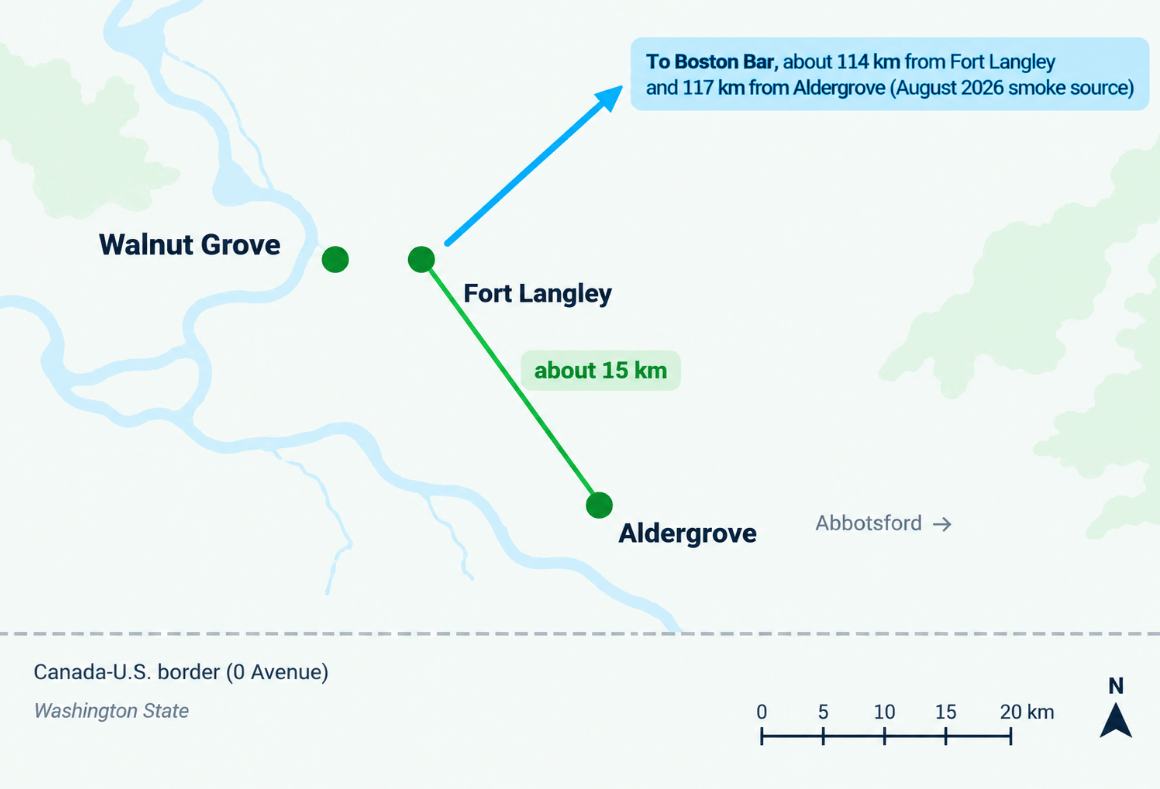
When we plotted the Township's communities from published coordinates, Fort Langley and Aldergrove came out about 15 km apart; Aldergrove borders Abbotsford in the Central Fraser Valley zone, so its air can differ.
Filterbuy's advice: in Walnut Grove, Willoughby, Murrayville, or Fort Langley, check AirMap's Langley station; in Aldergrove, check the Abbotsford stations too, alongside the B.C. AQHI zone forecast.
Where Does Wildfire Smoke in the Township of Langley Come From?
Filterbuy.ca's main finding is that in the Township of Langley, smoke is the everyday risk and flames are the rare one.
Distant B.C. Fires: The August 2026 Smoke Event
On 3 August 2026, Metro Vancouver issued a yellow air quality warning citing smoke from wildfires near Boston Bar. Two days later, Environment Canada rated the Southeast zone, which includes Langley, at 6 (moderate risk).
By our calculation from published coordinates, Boston Bar sits about 114 km from Fort Langley and 117 km from Aldergrove, yet the Township still fell under the warning.
"In the Township of Langley, the question is rarely whether something nearby is burning. It is whose smoke you are breathing, and how much of it reaches your living room."
— Filterbuy.ca Air Quality Team
Fires South of the Border
The Township's southern edge is the U.S. border, and its wildfire plan notes that fire-season winds blow mainly from the south and southeast. In August 2021, Metro Vancouver issued an advisory for smoke from both B.C. and Washington State fires.
Fires Inside the Township
Reading the Township's 2023 wildfire plan was the Filterbuy.ca team's most useful research step. It counts 47 recorded wildfires in or within 1 km of the Township since the 1950s; none passed one hectare, and all were human-caused. In the 1920s, by contrast, about 8,900 hectares burned in 91 fires.
The Township is also a FireSmart community and provides Home Ignition Zone assessments in eligible areas.
Is That Smoke a Wildfire or a Burn Pile?
With this much farmland, not every column of smoke is a wildfire, and no smoke map can tell a burn pile from a brush fire. The fire department's permit page, checked in September 2026, shows burning permits are issued for yard cleanup in spring and fall only, on properties of 0.2 hectares or more, under Metro Vancouver's open burning rules.
As of mid-September 2026, fall permit dates were under review until after Thanksgiving. If you see smoke or fire, call 911. To report a wildfire elsewhere in B.C., call *5555 on a cell phone or 1-800-663-5555.
When Is Wildfire Smoke Season in the Township of Langley?
The Township's wildfire plan gave Filterbuy.ca the clearest local calendar we found: a dry season from late April through September, with fire danger peaking in August. What smoke usually means by season:
Spring and fall: a permitted yard-waste burn is possible, so check the permit status before assuming a wildfire.
Summer, especially August: smoke most likely comes from a wildfire; check the live map and AirMap.
Before August: install a fresh MERV 13 filter and keep a spare.
What Do AQHI Readings Mean During Wildfire Smoke?
The Air Quality Health Index (AQHI) is Canada's 1 to 10+ scale for the health risk of outdoor air. During smoke events, B.C. readings are driven by fine particulate matter (PM2.5), the tiny particles in smoke.
Source: Environment and Climate Change Canada AQHI health messages, via the B.C. AQHI page, condensed.
Metro Vancouver's wildfire smoke guidance lists higher-risk groups as people with lung, heart, or other chronic conditions, pregnant people, infants, children, older adults, and outdoor workers. Seek medical help for severe symptoms such as chest pain or trouble breathing, and call 911 in an emergency.
When smoke pushes readings into the higher-risk categories, follow Metro Vancouver and local guidance first, then close the house up, set the furnace fan to On with a MERV 13 filter installed, and use a portable HEPA cleaner in each occupied room.
How Can I Protect My Township of Langley, BC Home From Wildfire Smoke During B.C.'s Fire Season?
Health Canada's wildfire smoke advice comes down to four habits: keep windows and doors closed, use the highest-quality filter your ventilation system is rated for, run a certified portable air cleaner, and change filters often. Our take: the furnace filter treats the whole home, and a portable HEPA cleaner treats its room harder, so use both.
Smoke Day Setup for B.C. Homes
Close windows and doors; if a heat wave arrives too, Health Canada advises staying cool first.
Set ventilation to recirculate, limit exhaust fans, and follow your heat recovery ventilator (HRV) maker's smoke guidance.
Install a MERV 13 filter, as Health Canada's guidance recommends, and check the size and fit as usual.
Set the thermostat fan to On so air passes through the filter continuously.
Run a certified HEPA air cleaner in each occupied room, bedrooms first. Skip ozone generators, which Health Canada advises against.
Skip candles, incense, frying, and the wood stove, and wet-mop instead of vacuuming unless your vacuum has a HEPA filter.
Check the filter during the event and replace it when it looks dark brown or black, which can be well before its usual interval.
Health Canada suggests an AHAM-certified portable unit sized to the room, and a BC Centre for Disease Control fact sheet reports that portable air cleaners cut small particle concentrations by 40 to 80 percent in most studies.
Filterbuy.ca carries MERV 13 Optimal air filters in over 600 sizes, plus custom sizes, with free shipping to Canada. The U.S. EPA notes that most furnaces and HVAC systems can use a MERV 13 filter without equipment problems, as long as it is replaced often. Pleated filters capture particles, not the gases behind smoke odour; for odours, see the Odour Eliminator carbon air filter line.
In an apartment or a home without central ducted heating, portable HEPA air cleaners are your main defence. Strata residents can ask their property manager which filter the building uses, and anyone whose home cannot stay clear can ask the Township or Fraser Health about cleaner air spaces.
"Most furnaces, older ones included, can run a MERV 13 filter as long as it fits the slot properly and gets changed when it's dirty rather than on a calendar. If your home has an HRV, it has its own filters, so check those too and follow the manufacturer's smoke guidance. During a smoke event that lasts several days, pull the furnace filter and look at it often. Once it's dark brown or black, swap it, even if it hasn't been in long."
— David Clark, Licensed HVAC Technician
Supporting Statistics
1. Closed Windows Help, but Not Fully
With windows closed and no air cleaner, indoor PM2.5 runs about 55 to 60 percent of outdoor levels; running the HVAC fan with a high-efficiency filter may cut it about 50 percent.
Source: U.S. EPA, Strategies to Reduce Exposure Indoors.
2. Size Air Cleaners to the Room
The EPA advises a tobacco smoke CADR of at least two-thirds of room area in square feet: 80 for an 11 square metre (120 sq. ft.) room.
Source: U.S. EPA, Preparing for Smoke and Heat.
3. U.S. Wildfire Area Burned Has Doubled
About 3.2 million hectares (8 million acres) burned yearly from 2017 to 2021, more than double the 1987 to 1991 average, including 162,000 hectares (400,000 acres) in Washington State in 2021.
Source: Congressional Budget Office, Wildfires, June 2022.
Wildfire and Smoke FAQs for the Township of Langley, BC
What MERV rating do I need for wildfire smoke?
MERV 13. Health Canada and the U.S. EPA both recommend filters rated MERV 13 or higher during smoke events.
Is there a wildfire or forest fire in the Township of Langley right now?
Check the live map above and the BC Wildfire Service. If you see smoke or flames, call 911.
Is the Township of Langley the same as the City of Langley?
No. They are separate municipalities, and the Township surrounds the City, but both sit in the Metro Vancouver Southeast AQHI zone.
How do I get emergency alerts in the Township of Langley?
Subscribe to any Township eNewsletter category; that also signs you up for Local Emergency Notifications. For evacuations, check the BC Wildfire Service map.
How often should I change my furnace filter during wildfire smoke?
Check it during every smoke event and replace it when it looks dark brown or black, even if that is well before its usual interval. A Filterbuy.ca air filter subscription keeps a spare ready; edit, skip, or cancel anytime.
When can I open my windows after the smoke clears?
Health Canada advises looking at AQHI forecasts and air quality advisories before opening windows, then airing out with clean outdoor air, which clears smoke trapped indoors.
Glossary
Air Quality Health Index (AQHI): Canada's 1 to 10+ scale for the health risk of outdoor air.
MERV: Minimum Efficiency Reporting Value, a filter efficiency rating; Filterbuy labels MERV 8, 11, and 13 Standard, Superior, and Optimal; see our MERV guide.
HEPA: High efficiency particulate air filtration.
CADR: Clean air delivery rate, how much filtered air a portable cleaner delivers.