
Surrey, BC Live Wildfire Smoke Map
Get Alerts For Wildfires In Your Area
The moment a wildfire starts near you, you'll get an instant alert and simple tips to reduce your smoke exposure.
What's In The Smoke
30xSmaller than a human hair
Fine enough to reach deep into the lungs. A MERV 13 is built to capture it.
How Far It Travels


It Doesn't Stay Local
Smoke rides the wind far downwind — you can get smoky air with no fire nearby.
What To Do During A Smoke Event
Simple steps to reduce indoor exposure.
- Stay In, Close UpShut windows and doors to keep smoke out.
- Set Fan To "On"Keeps air cycling through your filter, not just when heating or cooling.
- Recirculate AirSwitch off fresh-air intake so you're not pulling smoke in.
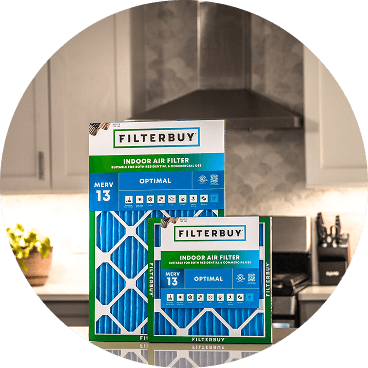
- Run A MERV 13Built to capture the fine PM2.5 in smoke.
- Add A PurifierExtra filtration for the room you use most.
- Wear an N95 if OutsideFits snug to block fine particles — a cloth mask won't.


The Best Air Filter For Wildfire Smoke
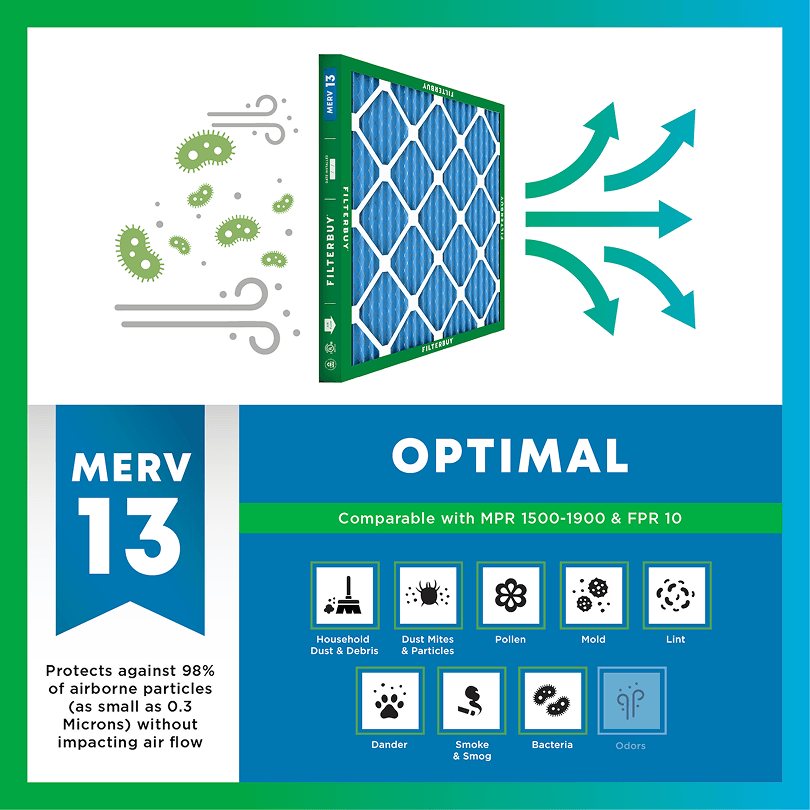
During smoke events, the EPA recommends upgrading to a MERV 13 filter — or the highest-rated filter your system can handle — to help reduce the fine particles smoke brings indoors. MERV 13 is the level most home HVAC systems can run while still capturing PM2.5, the fine particulate that makes up the bulk of wildfire smoke.
- Captures PM2.5 particles
- Blocks ash, soot, and smoke odor
- Keeps your indoor air safe—even when the outdoor air is dangerous
- Meets the EPA's recommended rating for filtering fine wildfire smoke particles.

Wildfire Smoke FAQs
Facts About Wildfires
Over 70,000 wildfires burn in the U.S. every year.
Wildfire smoke can travel 1,000+ miles, affecting states that aren't even near the blaze.
Exposure to wildfire smoke can worsen asthma, trigger heart issues, and lead to ER visits.
Indoor air can hold more fine particles during wildfire events unless it's properly filtered.
The EPA advises using MERV 13 filters or portable HEPA air cleaners during wildfire smoke events.
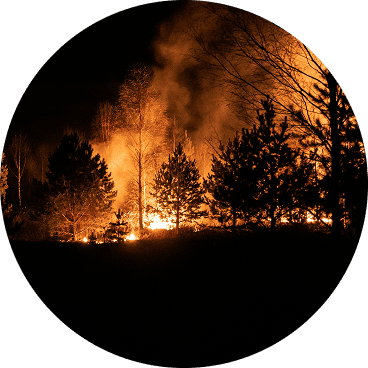
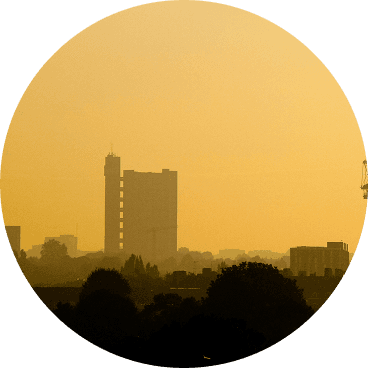
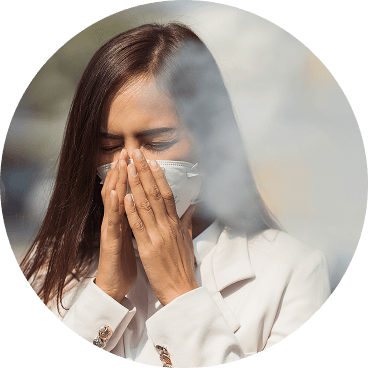
Don't Wait Until The Smoke's Inside.
Use the live wildfire smoke tracker and upgrade your air filters today to protect your lungs and your home.
Shop Filters For Smoke Protection
Live Surrey, BC Forest Wildfire & Smoke Map Today: Local Air Quality Tracking & Indoor Protection Solutions
By Michelle Wan, Brand Manager and Air Quality Writer, Filterbuy Canada | Reviewed by David Clark, Licensed HVAC Technician | Published 24 September 2026 | Updated 24 September 2026
TL;DR
Four official tools track wildfire and smoke in Surrey, BC: the BC Wildfire Service map for active fires, the FireWork smoke forecast for the next 72 hours, Metro Vancouver's AirMap for hourly readings, and the AQHI for Metro Vancouver - SE, the zone covering Surrey. Recent Surrey smoke came from distant fires, including one about 126 km away in August 2026. On smoky days, health agencies advise closed windows, running filtration, and and a MERV 13 or higher furnace filter.
Key Takeaways
Surrey's official AQHI forecast zone is Metro Vancouver - SE, shared with Langley and White Rock.
In August 2026, smoke from the Brunswick Creek fire near Boston Bar, about 126 km straight-line from Surrey City Centre, contributed to a yellow air quality warning across Metro Vancouver.
During wildfire smoke events, Environment and Climate Change Canada calculates the AQHI hourly from fine particulate matter (PM2.5) alone.
Metro Vancouver advises homes with a built-in ventilation system to install filters rated MERV 13 or higher during smoke events.
Where Can I See a Live Wildfire and Smoke Map for Surrey, BC Today?
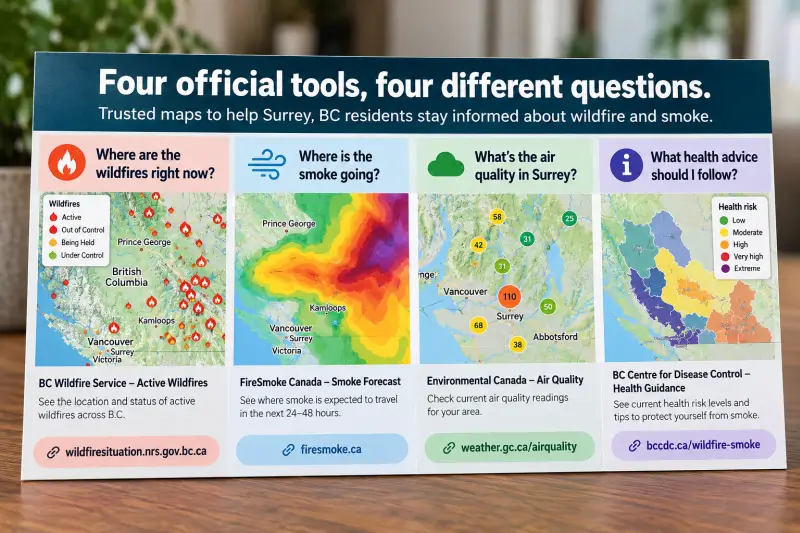
No single map answers every smoke question in Surrey. The BC Wildfire Service map shows fire locations, FireWork forecasts smoke movement, Metro Vancouver AirMap reports measured air quality, and the Environment Canada AQHI page turns readings into a health-risk score. Checking all four, in that order, gives a complete picture of conditions today.
The Filterbuy.ca team built the Surrey Map Finder after checking each tool against its publisher's update schedule in September 2026. Our takeaway: searches like "fire map Surrey BC" and "smoke map Surrey BC today" are really five different questions, each with a different best answer.
Surrey Map Finder: Which Official Map Answers Which Question
Update timing reflects each agency's published schedule as of September 2026.
Because Surrey borders Washington State, the U.S. AirNow Fire and Smoke Map helps when smoke drifts north, adding satellite smoke plumes and monitors just south of the border.
Which Air Quality Zone Covers Surrey, BC?
Surrey falls within the Metro Vancouver - SE forecast zone for the Air Quality Health Index, alongside Langley and White Rock. Metro Vancouver operates the Lower Fraser Valley monitoring network, including the Surrey East station, with the Fraser Valley Regional District and Environment and Climate Change Canada. The zone AQHI averages representative stations, and Environment and Climate Change Canada notes that areas near traffic or industry usually have higher pollution than the average suggests.
Zone boundaries also matter on smoky days. On 5 August 2026, Environment Canada rated the northeast and northwest parts of Metro Vancouver at 7 (high risk), the southeast zone that includes Surrey at 6 (moderate risk), and the southwest zone at 3 (low risk). When the Filterbuy.ca team reviewed those readings, Surrey sat between smokier air to the east and cleaner coastal air. Our advice: check the Surrey zone, not the regional headline.
Which Station Should Surrey Residents Watch?
Surrey is a big city, and AirMap lists only one station named for it: Surrey East. Filterbuy's tip: open AirMap and compare Surrey East with the neighbouring North Delta and Langley stations. If one reads noticeably higher, smoke is likely thicker on that side of the city.
For street-level detail, AQmap, built by UNBC researchers with Environment and Climate Change Canada, adds low-cost home sensors to government monitors. Treat those sensors as a guide: the project lead notes they are less accurate than regulatory monitors, though still very good.
Why Does Wildfire Smoke Reach Surrey From Fires So Far Away?
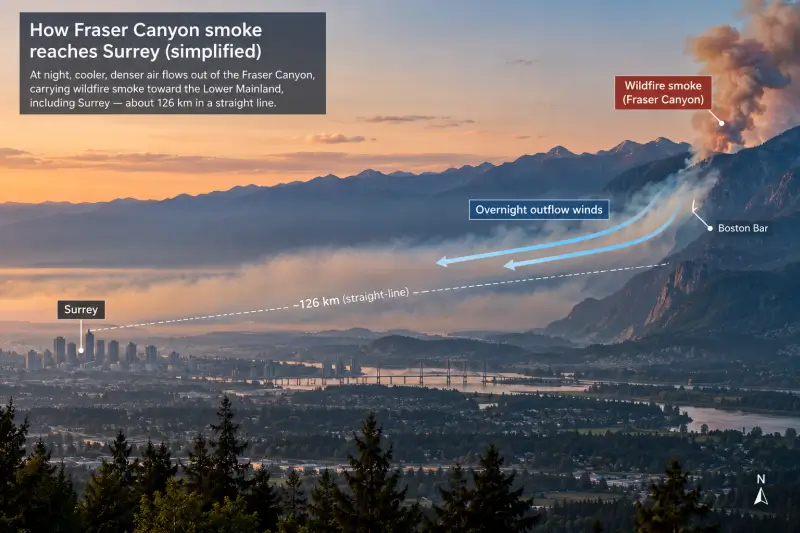
Wildfire smoke over Surrey typically comes from fires burning well outside the city. In a July 2026 Metro Vancouver release, the regional district described smoke travelling down the Fraser Canyon overnight, with onshore flow of cleaner air expected to clear it during the day. A southerly flow can also push smoke north across the border from Washington State.
Surrey Smoke Distance Check: The 2026 Brunswick Creek Fire
At Filterbuy, we wanted to know how far smoke travelled to reach Surrey, so we measured it. Using published coordinates for Boston Bar and Gateway Station in Surrey City Centre, our calculation puts the 2026 Brunswick Creek fire area about 126 km away in a straight line, or roughly 130 km from Newton. Distance did not protect Surrey: on 5 August 2026, Global News reported smoke from the Brunswick Creek and Big Bar Complex fires blanketing the region, with a yellow air quality warning for Metro Vancouver and an orange warning for the Eastern Fraser Valley.
Smoke days can bring a second pollutant. A Metro Vancouver warning on 22 July 2026 noted that hot, sunny weather, local emissions, and wildfire smoke pushed ground-level ozone up in eastern Metro Vancouver and the Fraser Valley, while smoke raised PM2.5 region-wide.
Fires Closer to Home
Local fires happen too. In July 2016, a Burns Bog fire in neighbouring Delta burned nearly 80 hectares, and Surrey and Langley residents reported falling ash and the smell of smoke. Inside Surrey city limits, call 911 to report any fire. Elsewhere in British Columbia, report a wildfire to the BC Wildfire Service at 1-800-663-5555, or *5555 from a cell phone.
What Do Surrey's AQHI Numbers Mean for My Health?
The Air Quality Health Index runs from 1 to 10+. Scores of 1 to 3 mean low risk, 4 to 6 moderate, 7 to 10 high, and above 10 very high. During wildfire smoke events, Environment and Climate Change Canada calculates the AQHI hourly from PM2.5 alone so the number responds quickly to changing smoke. People at greater risk include children, adults over 65, and people with health conditions.
AQHI Risk Bands and Official Health Advice
Source: Environment and Climate Change Canada, About the Air Quality Health Index, updated May 2026.
Metro Vancouver's colour-coded warnings add a second layer: yellow signals high health risk and advises limiting outdoor activity, while orange signals very high health risk and advises avoiding it. Metro Vancouver lists people with lung, heart or other chronic conditions, pregnant people, infants, children, older adults, and outdoor workers as higher risk. Seek medical help for severe symptoms such as wheezing, chest pain, trouble breathing, or a severe cough, and call 911 in an emergency. Fraser Health, the regional health authority serving Surrey, publishes local wildfire smoke guidance.
How Do I Protect My Surrey Home From Wildfire Smoke Indoors?
When to act. This guide's action line is a U.S. AQI of 100, or on Canada's AQHI scale a reading of 7 or higher, or any Metro Vancouver air quality warning, whichever comes first. At that point: MERV 13 in the furnace, thermostat fan set to On, a portable HEPA air cleaner in each occupied room, and the house closed up. The EPA recommends MERV 13 or higher during smoke events. The trigger point above is ours, not the EPA's.
Filtration is one layer, not the whole answer, and official guidance comes first. The BC Centre for Disease Control reports that portable air cleaners reduced small-particle concentrations by 40 to 80% in most studies.
Smoke Day Setup for Surrey Homes
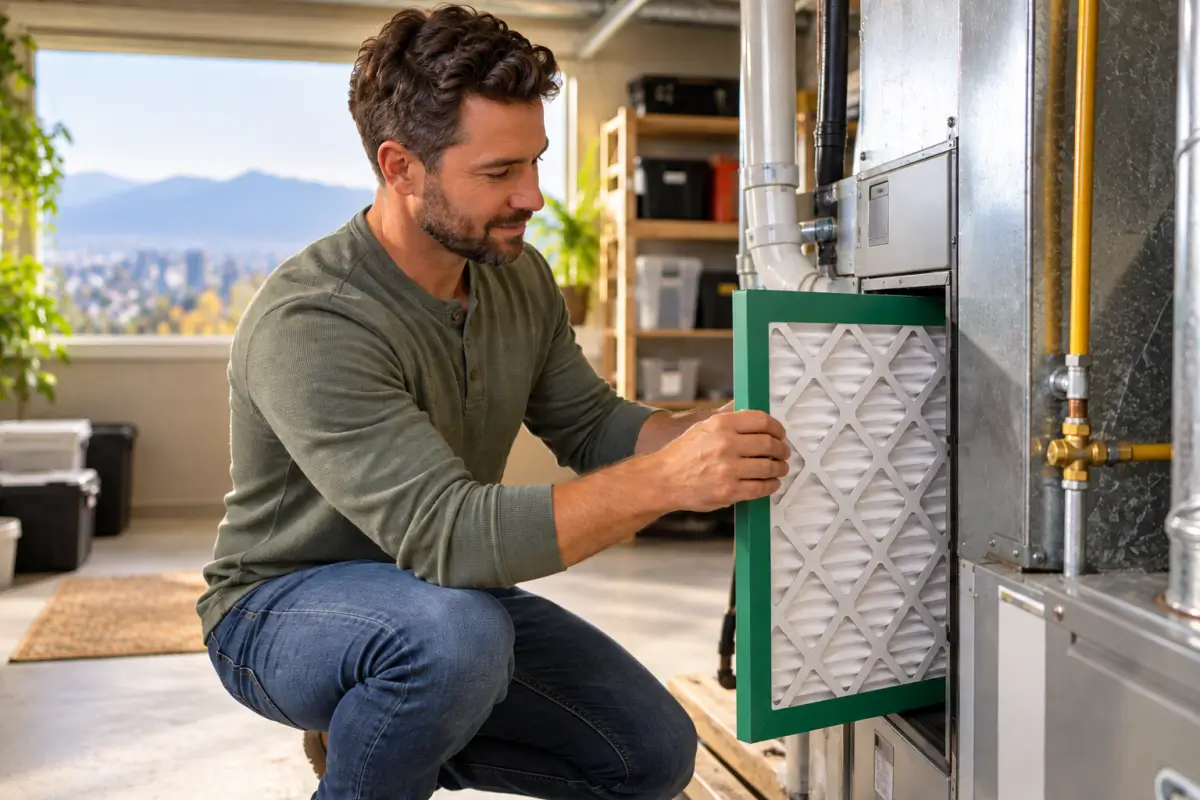
Switch to MERV 13 in the furnace. It is the whole-home layer, because the central system moves far more air than any portable unit. The U.S. EPA recommends a filter rated MERV 13 or higher during smoke events and notes most furnaces accommodate one when it is replaced often. Confirm the slot size the way you would for any filter.
Set the thermostat fan to On. Auto filters only while the system is heating or cooling; On filters continuously.
Add a portable HEPA air cleaner in each occupied room, bedrooms first. The EPA's clean-room guidance covers a single room; this guide recommends one per occupied room. Size it by the EPA rule: a smoke CADR of at least two-thirds of the room's floor area in square feet, so a 300 sq. ft. (28 square metre) bedroom wants a CADR near 200. Skip any cleaner that produces ozone.
Close the house up. Windows and doors shut, fresh-air intake closed if your system has one, and nothing added to the indoor air: no candles, no frying, no vacuuming without a sealed unit, no smoking.
Check the filter during the event, not on the calendar. Replace it when it looks dark brown or black, which can be well before the normal interval, and keep spares on hand.
Two situations change the plan. Homes with ductless mini-splits or hydronic heat, including many condos and rentals, have no furnace filter to upgrade. For those readers a portable HEPA cleaner is the primary defence, not a supplement. A do-it-yourself box-fan cleaner built with MERV 13 filters is a reasonable stopgap rather than a replacement for a certified unit: EPA research found the design effective and advises certified fans made in 2012 or later, never left running unattended. On hot days, BCCDC cautions that closing up a home without air conditioning can be dangerous, since heat stress is a bigger risk for most people than smoky air. Metro Vancouver suggests air-conditioned community centres, libraries, or malls instead.
A Surrey Smoke-Season Calendar
May: confirm your filter size, keep a spare MERV 13 filter or two, and sign up for Metro Vancouver warnings.
June to September: Metro Vancouver typically posts air quality updates in this window. When fires are active, check FireWork each evening.
Smoky night ahead: if FireWork shows smoke moving down the Fraser Canyon, close up and start filtration before bed.
After the smoke clears: air out the home, as the EPA advises, and replace any filter that looks dark.
Filter Options for Surrey Smoke Season
Filterbuy's take: two details matter as much as the MERV number.
Fit. Filters are cut slightly under their nominal size so they slide in; a Filterbuy 20x20x1 MERV 13 measures 19.50 x 19.50 x 0.75 inches. Measure the slot and close any gap, because air that slips around a filter is not filtered.
Timing. Our read of the EPA chamber data: a smoke-loaded filter can keep moving air after it stops cleaning it, so judge it by colour and smell, not vent airflow.
Filterbuy.ca carries MERV 13 air filters, the Optimal level in our colour-coded MERV system, rated to capture 98% of airborne particles, in more than 600 sizes plus custom sizes. Pleated filters capture particles, and odour is gas-phase, so odours route to the Odour Eliminator line, which uses activated carbon. The Filterbuy air filter subscription ships every one, two, or three months with an extra 5% off; edit, skip, or cancel anytime. Going deeper? Compare MERV 13 vs HEPA for wildfire smoke or build a Corsi-Rosenthal box for a room without ductwork.
"I don't want anyone to feel like they need an HVAC license just to pick the right filter. My job is to give you the straight answer, explain why it matters, and let you get back to your day."
Michelle Wan, Brand Manager and Air Quality Writer, Filterbuy
Supporting Statistics
Three U.S. federal studies back the filtration steps above.
55–60% of outdoor smoke still gets indoors.
Applies with windows closed and no air cleaner running.
Ranges from 30% to 100%, depending on the home.
Source: U.S. EPA, Strategies to Reduce Exposure Indoors, 2026.
Smoke-loaded filters lost about 96% of their cleaning power.
Clean MERV 13 filter: 111 cubic feet per minute of clean air.
Smoke-loaded filter: 4.3, even with airflow barely changed.
Source: Holder et al., Indoor Air, 2022, U.S. EPA.
More than 1,700 monitors feed the U.S. smoke map.
Continuous PM2.5 data comes from state, local, and Tribal monitors, plus temporary monitors and sensors.
Useful when smoke crosses the border into Surrey from Washington State.
Source: U.S. EPA, Fire and Smoke Map.
Frequently Asked Questions
Glossary
Air Quality Health Index (AQHI): Canada's 1 to 10+ health-risk scale for air pollution, based on ozone, PM2.5, and nitrogen dioxide.
PM2.5: Fine particles 2.5 microns or smaller, the main pollutant in wildfire smoke.
MERV: Minimum Efficiency Reporting Value, a standardized rating of how well an HVAC filter captures airborne particles. Filterbuy labels its MERV 8, 11, and 13 filters Standard, Superior, and Optimal.
HEPA: High-efficiency particulate air filter used in portable air cleaners.
CADR: Clean Air Delivery Rate, a measure of how much filtered air a portable cleaner delivers.
BC Wildfire Service: The provincial agency that manages wildfires and publishes BC's official wildfire map.
FireWork: Environment and Climate Change Canada's model forecasting wildfire smoke 72 hours ahead.
Metro Vancouver AirMap: Metro Vancouver's live map of station data from Horseshoe Bay to Hope.
Metro Vancouver - SE: The AQHI forecast zone that covers Surrey, Langley, and White Rock.
Surrey East station: An air monitoring station in Surrey within the Lower Fraser Valley network.
Outflow winds: Interior-to-coast winds that can carry smoke down the Fraser Canyon into Metro Vancouver.
Air quality warning (yellow or orange): Metro Vancouver's colour-coded alerts: yellow for high, orange for very high health risk.
Your Next Step
Filterbuy's point of view: a Surrey smoke plan is decided before the smoke arrives. Know which map answers which question, keep a correctly sized MERV 13 filter on the shelf, and swap it when it looks dark.
Bookmark the Surrey Map Finder, sign up for Metro Vancouver air quality warnings, and prepare your home before the next smoke event. Shop MERV 13 filters, find a custom size, or read the Filterbuy guide to MERV ratings. Questions? Call (855) 345-8289 or email info@filterbuy.com.
About the Author and Reviewer
Michelle Wan is Brand Manager and Air Quality Writer at Filterbuy and fronts much of the brand's educational video content. She holds a B.A. from the University of California, Santa Cruz, and works with Filterbuy's U.S. manufacturing teams.