
Aurora Real-Time AQI Tracker
What's Actually In Aurora Air Today?
What High AQI Means for Your Lungs in Aurora
How to Read AQI
The Air Quality Index (AQI) measures how polluted the air is and how it may affect your health.
0–50 (Good): Air quality is satisfactory.
51–100 (Moderate): Acceptable, but some pollutants may pose minor concerns.
101–150 (Unhealthy for Sensitive Groups)
151–200 (Unhealthy)
201–300 (Very Unhealthy)
301+ (Hazardous)
Moderate
Still okay for most, but if you have asthma or allergies, take it easy and avoid long outdoor workouts.
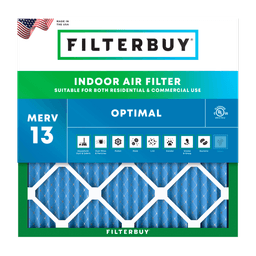
Shop MERV 11 filters→What's the Right Filter for Your AQI Level?



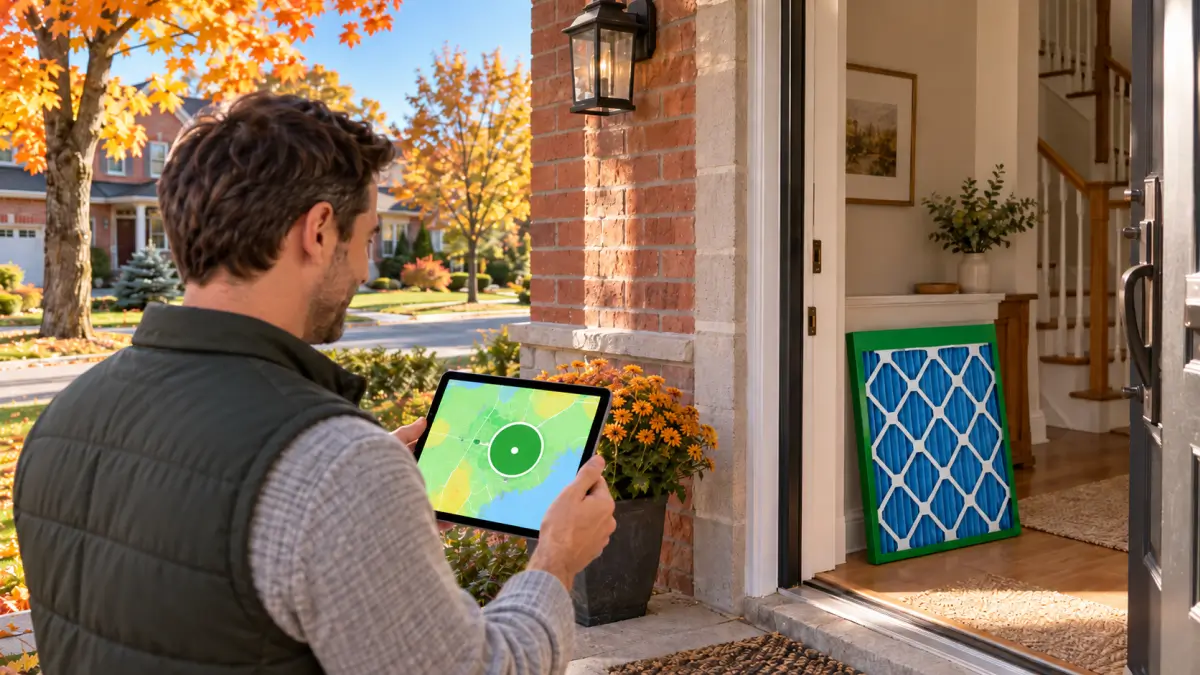
Live Air Quality Index AQI Map Aurora, ON Today
TL;DR
The live map at the top of this page shows Aurora's air quality right now. Most days, Aurora, Ontario, sits in the low-risk range, and wildfire smoke is the usual reason readings climb. At AQI 100 or higher, Filterbuy recommends MERV 13 in your furnace, the fan set to On and a portable HEPA air cleaner in each occupied room.
What Is the Air Quality in Aurora Today?
Aurora's current air quality is on the live AQI map directly above this article. Check the marker nearest you. Green (0–50) is good, yellow (51–100) is moderate, and orange or higher means sensitive groups should ease off outdoors.
Ontario's official Air Quality Health Index (AQHI) for Aurora comes from the Newmarket station, roughly 6 km north of the town centre. See the current Newmarket AQHI, which updates hourly, or compare Newmarket air quality today and the Ontario air quality map.
"We built this page so Aurora homeowners don't have to pick between two numbers. Use the map for what is happening near you and the AQHI for official health advice." The Filterbuy Canada team
Key Takeaways
• The live Filterbuy AQI map above is the fastest way to check Aurora air quality now.
• PM2.5 (fine particles small enough to reach deep into the lungs) usually drives the AQI.
• Ontario's official AQHI (1–10+) comes from the Newmarket station, about 6 km north.
• AQI 100 is Filterbuy's line to act: MERV 13 in the furnace, fan On, a HEPA air cleaner in each occupied room and the house closed up.
How to Read the Aurora AQI Map
The Aurora air quality map uses the Air Quality Index, a 0-to-500 colour scale where a lower number means cleaner air. The highest single pollutant score becomes the AQI, and in Aurora that is usually fine particulate matter (PM2.5).
The U.S. EPA tightened its PM2.5 breakpoints in May 2024; Table 1 uses the current ranges.
Table 1: AQI categories and PM2.5 ranges
Source: U.S. EPA Air Quality Index; PM2.5 breakpoints effective 6 May 2024.
Why the Map and the AQHI Do Not Always Match
While researching this page, the Filterbuy team found three reasons they differ:
• Different scales. The AQI reports the worst single pollutant; the AQHI combines three.
• Different locations. The map shows the nearest monitor; the AQHI averages community stations.
• Smoke-day switch. During wildfire smoke, Environment and Climate Change Canada calculates the AQHI hourly from PM2.5 alone.
Filterbuy's take: use the map for timing and the Air Quality Health Index for health advice. Its risk levels:
• Low (1–3): Usual outdoor activities.
• Moderate (4–6): At-risk people with symptoms ease off.
• High (7–10): At-risk people, children and older adults reduce strenuous activity.
• Very high (10+): At-risk people avoid strenuous activity outdoors.
Health messages from Air Quality Ontario.
Is the Air Quality Bad in Aurora Today?
Air quality in Aurora is bad today if the map above shows orange or higher (AQI over 100), or the Newmarket AQHI reads 7 or more. The highest readings usually come from wildfire smoke drifting in from elsewhere.
The Aurora Air Check: Three Steps, Two Minutes
Filterbuy designed the Aurora Air Check to turn one map reading into three home decisions.
1. Check the map. Note the colour and AQI number at the marker nearest your home.
2. Confirm with the AQHI. Look up the Newmarket station on Air Quality Ontario or the Environment and Climate Change Canada Newmarket AQHI page. Watch for colour-coded (yellow, orange or red) air quality alerts for York Region.
3. Adjust your home. Use Table 2 to match the reading.
Table 2: The Aurora Air Check, from map reading to home action
AQI 100 is Filterbuy's action line. Orange starts at 101 on the EPA scale.
What Affects Air Quality in Aurora, Ontario?
Aurora, Ontario (not Aurora, Colorado or Illinois) sits in northern York Region, along Yonge Street and west of Highway 404. York Region names traffic-related pollutants as a main local source of air pollution.
• Winter (November–March): Still air traps particles, and wood burning produced 56% of Ontario's PM2.5 emissions in 2016, says York Region. Change your furnace filter every 60–90 days.
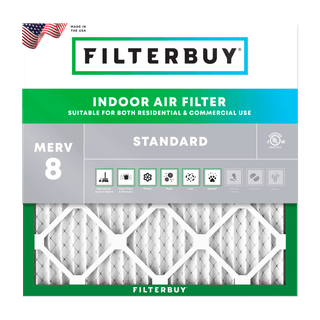
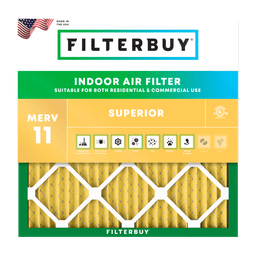
• Spring (April–May): Tree pollen rises even when the AQI is low; a Filterbuy MERV 11 suits pollen and dust.
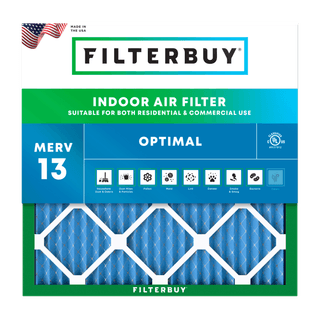
• Summer (June–August): Ozone builds on hot days, and smoke can bring sudden orange or red readings. For smoke, the tier is MERV 13.
• Autumn (September–October): Ragweed peaks and furnace start-up stirs dust. Start the season with a fresh filter.
Wildfire Smoke and York Region
In June 2023, wildfire smoke put York Region under a Special Air Quality Statement. Track smoke on Filterbuy's live Ontario wildfire smoke map.
What to Do When Aurora's AQI Reaches 100
Start with official guidance: check Environment and Climate Change Canada alerts and follow any advice to stay indoors or leave. Then, at AQI 100 or higher, Filterbuy recommends four steps, in this order:
1. Put MERV 13 in your furnace. It's the whole-home layer, because the central system moves far more air than a portable unit. Shop Filterbuy MERV 13 filters in your size.
2. Set the thermostat fan to On. Auto filters only while heating or cooling; On filters all the time.
3. Run a portable HEPA air cleaner in each occupied room, bedrooms first. It treats that room harder than the central system can. Pick one whose smoke CADR (clean air delivery rate) is at least two-thirds of the room's square footage: a 300 sq ft (28 m²) bedroom needs roughly 200. Skip models that produce ozone.
4. Close the house up. Shut windows and doors, and skip candles, frying, smoking and vacuuming without a sealed unit while smoke is in.
The two filter layers do different jobs, so use both. The EPA and Health Canada recommend MERV 13 or higher in central systems during smoke events. It also notes that most furnaces can run MERV 13 without equipment problems when the filter is replaced often. HEPA belongs in a portable cleaner, never in a furnace slot.
A pleated filter captures particles, not gases or odours, so it reduces smoke in the air without making the air smoke-free. If you have a heart or lung condition, follow your doctor's advice.
Check and Replace Your Filter During Smoke
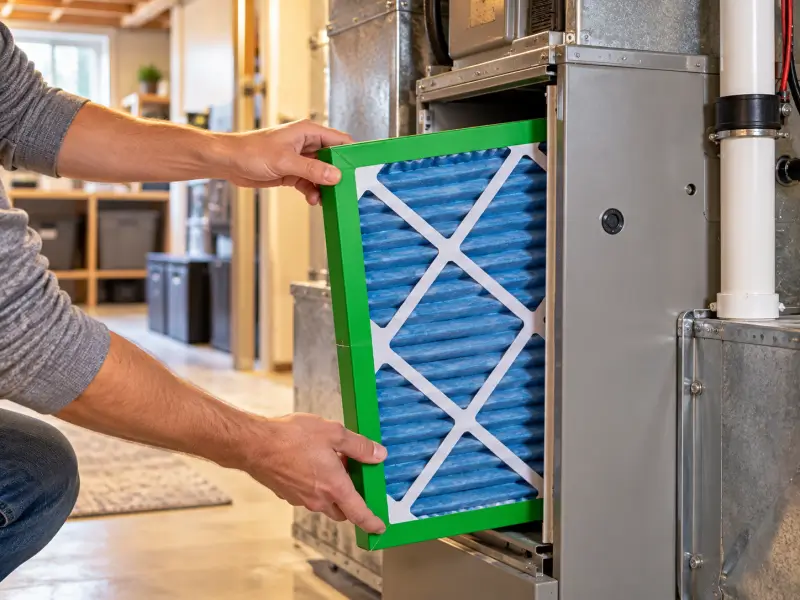
Smoke loads a filter far faster than dust. The EPA advises replacing it when it looks dirty, which can be well before the normal interval. Filterbuy MERV 13 media starts blue, so darkening is easy to spot. Keep spares on hand.
Homes Without Central Air
• No ducts or forced air: In apartments and older homes, portable HEPA air cleaners are your primary defence, not a backup. Use the sizing rule above in each occupied room.
• Stopgap: A DIY box-fan cleaner with a MERV 13 filter can fill in until you get a certified cleaner. EPA advises a 2012-or-newer fan with a UL or ETL mark.
• HRV or ERV owners: Environment and Climate Change Canada suggests running these continuously day to day. During smoke, check your manual for a recirculate setting.
Get Ready Before Smoke Season
1. Find your filter size. It's printed on your current filter's frame (for example, 16x25x1).
2. Get MERV 13 in early. Install it before smoke season and keep a spare Filterbuy MERV 13 on hand.
3. Set a personal alert. The WeatherCAN app lets you set custom AQHI notifications from 3 to 10+. Sensitive people may want the moderate range (4–6).
Find the Right Filter for Your Home
Filterbuy makes its filters in U.S. facilities it owns, in over 600 sizes, and ships free across Canada with prices in CAD. Over 85,000 five-star reviews back them.
Supporting Statistics
The government data behind this page:
1. Most days are low risk: 92%
– Ontario's AQHI was low risk 92% of the time in 2023.
– Province-wide, wildfire smoke drove 49 of 55 alert days that year.
– Source: Ontario Ministry of the Environment, Conservation and Parks, Air Quality in Ontario 2023 Report
2. Indoor air matters most: about 90%
– Canadians spend about 90% of their time indoors.
– Source: Environment and Climate Change Canada, Indoor air quality
Frequently Asked Questions
What MERV Rating Do I Need for Wildfire Smoke?
MERV 13. It's the tier Filterbuy recommends for smoke, paired with a portable HEPA air cleaner in each occupied room. See Filterbuy MERV 13 filters.
Where Is the Closest Air Quality Monitoring Station to Aurora?
The closest provincial AQHI station is in Newmarket, about 6 km north of Aurora's town centre. Ontario established the Newmarket station in 2001.
Can I Check Aurora's Air Quality by Phone?
Yes. Call 1-800-387-7768 (toll-free) for recorded AQHI readings, or sign up for Air Quality Ontario email alerts.
How Often Should I Change My Furnace Filter in Aurora?
Change a 1-inch (2.5 cm) filter every 60–90 days in normal conditions. During smoke, replace it when it looks dirty. A Filterbuy Subscribe & Save plan delivers on your schedule.
Glossary
• Air Quality Index (AQI): The U.S. EPA's 0-to-500 colour-coded scale of outdoor air pollution; lower is cleaner.
• Air Quality Health Index (AQHI): Canada's 1-to-10+ health risk scale combining ozone, PM2.5 and nitrogen dioxide.
• PM2.5: Fine particles 2.5 micrometres or smaller; the main pollutant in wildfire smoke.
• MERV (Minimum Efficiency Reporting Value): A 1-to-16 rating of how well an air filter captures particles.
• MERV 13 (Optimal): Filterbuy's highest residential tier and the one it recommends for smoke.
• CADR (clean air delivery rate): How much filtered air a portable cleaner delivers; use the smoke rating for sizing.
• HRV/ERV: Heat or energy recovery ventilators that exchange stale indoor air for fresh outdoor air.
• HEPA filter: The high-efficiency filter used in portable air cleaners, never in a furnace.
Sources
• U.S. EPA: Wildfires and Indoor Air Quality
• U.S. EPA: Guide to Air Cleaners in the Home
• U.S. EPA: Create a Clean Room to Protect Indoor Air Quality During a Wildfire
• Environment and Climate Change Canada: WeatherCAN custom AQHI notifications
• Environment and Climate Change Canada: About the Air Quality Health Index
• Ontario Ministry of the Environment, Conservation and Parks: Air Quality in Ontario 2023 Report
• Environment and Climate Change Canada: Indoor air quality
• Air Quality Ontario: Air Quality Health Index (AQHI) and health messages
• Air Quality Ontario: Sign up for air quality alert email notifications
• Environment and Climate Change Canada: Newmarket Air Quality Health Index
• Government of Canada: Air Quality Health Index
• Health Canada: Guidance for Cleaner Air Spaces during Wildfire Smoke Events (2020)
• U.S. EPA: Final Updates to the Air Quality Index for Particulate Matter, fact sheet (2024)
• York Region: Region-wide fire ban and Special Air Quality Statement (June 2023)
• York Region: Climate change and health vulnerability assessment, air quality chapter
• York Region State of the Environment Report 2005, air resources chapter
About the Author and Reviewer
Michelle Wan writes indoor air quality guides for Filterbuy.ca, translating official air quality data into practical steps for Canadian homes.
Filterbuy has manufactured air filters for more than a decade and publishes live air quality maps for communities across Ontario, including Newmarket.
David Clark, Licensed HVAC Technician, reviewed this guide for technical accuracy, including the furnace fan, filter compatibility and filter change guidance.