
Kamloops Real-Time AQI Tracker
What's Actually In Kamloops Air Today?
What High AQI Means for Your Lungs in Kamloops
How to Read AQI
The Air Quality Index (AQI) measures how polluted the air is and how it may affect your health.
0–50 (Good): Air quality is satisfactory.
51–100 (Moderate): Acceptable, but some pollutants may pose minor concerns.
101–150 (Unhealthy for Sensitive Groups)
151–200 (Unhealthy)
201–300 (Very Unhealthy)
301+ (Hazardous)
Moderate
Still okay for most, but if you have asthma or allergies, take it easy and avoid long outdoor workouts.
Shop MERV 11 filters→What's the Right Filter for Your AQI Level?





Check Today's Live Real Time Air Quality Index AQI Map in Kamloops, BC Now
TL;DR
Kamloops has a dedicated listing on British Columbia's Air Quality Health Index (AQHI), and the live map at the top of this page shows the current reading. On Canada's 1 to 10+ scale, 1 to 3 is low risk, 4 to 6 moderate, 7 to 10 high, and above 10 very high. Summer smoke and winter inversions drive the worst readings.
Key Takeaways
Kamloops has a dedicated B.C. AQHI listing with current readings and forecast maximums.
Two provincial monitoring stations serve the city: one at the Federal Building downtown and one at the City works yard in Brocklehurst.
The Kamloops Air Quality Roundtable found that readings at the downtown Federal Building are the highest in the city, and that air quality generally improves with elevation.
In B.C., an AQHI of 7 or higher is usually caused by high levels of smoke particles (PM2.5).
What Is the Air Quality in Kamloops Today?
The live Kamloops air quality map at the top of this Filterbuy Canada page shows current conditions. The city has a dedicated listing on the Province of British Columbia's Air Quality Health Index page, which posts the observed AQHI and forecast maximums for today, tonight, and tomorrow.
We leave a fixed number off this page on purpose, because Kamloops air can move from low to high risk in a single afternoon during wildfire season. For the hourly air pollution detail behind the map, including today's PM2.5, open the provincial Kamloops Federal Building station page.
How Do You Read the Kamloops AQHI Right Now?
The Air Quality Health Index (AQHI) is Canada's official air quality scale. It runs from 1 to 10, with anything higher shown as 10+. Environment and Climate Change Canada (ECCC) writes a health message for each band, and B.C. publishes those messages alongside every Kamloops reading.
Source: Environment and Climate Change Canada (ECCC) health messages, as published by BC Air Quality. The at-risk population includes people with heart or breathing problems, who should follow their doctor's usual advice about exercise and managing their condition.
AQHI, AQI, or PM2.5: Which Kamloops Number Are You Looking At?
Three different numbers describe Kamloops air quality. The AQHI is Canada's 1 to 10+ health-risk index. The U.S. AQI is the Environmental Protection Agency's 0 to 500 scale, and when we searched for Kamloops air quality and AQI maps, several of the top third-party results showed this U.S. number instead of the AQHI. PM2.5 isn't an index at all. It's the measured concentration of fine particles, in micrograms per cubic metre.
B.C. adds a smoke adjustment to the AQHI. Every hour, the province calculates it twice, once from ozone, nitrogen dioxide, and PM2.5 combined and once from PM2.5 alone, and reports the higher value (BC Centre for Disease Control). Under the PM2.5-only calculation, each 10 micrograms per cubic metre of one-hour PM2.5 adds one point, so a reading of 61 to 70 equals an AQHI of 7.
The AQHI and the U.S. AQI use different formulas and scales, so a U.S. AQI reading cannot be converted directly into an AQHI, and we never convert one into the other.
The BC Centre for Disease Control advises relying on BC Air Quality and the WeatherCAN app rather than values from other websites and apps. Filterbuy's live air quality map for Canada puts the scales side by side.
Where Is Kamloops Air Quality Measured?
We traced the Kamloops number back to its source and found that it is measured inside the city, not borrowed from a neighbouring community. The Kamloops Air Quality Roundtable identifies two provincial stations: one at the Federal Building downtown and one at the City works yard in Brocklehurst. You can see both on the province's interactive station map.
The Official Number Reflects the Valley Floor
The Kamloops Air Quality Roundtable brings together provincial, health, First Nations, municipal, industry, and university partners. Its 2018 update compared Federal Building data with an Upper Aberdeen station, historical samplers, and resident-installed PurpleAir sensors. It found that Federal Building values represent the highest levels in Kamloops, and that air quality generally improves with elevation.
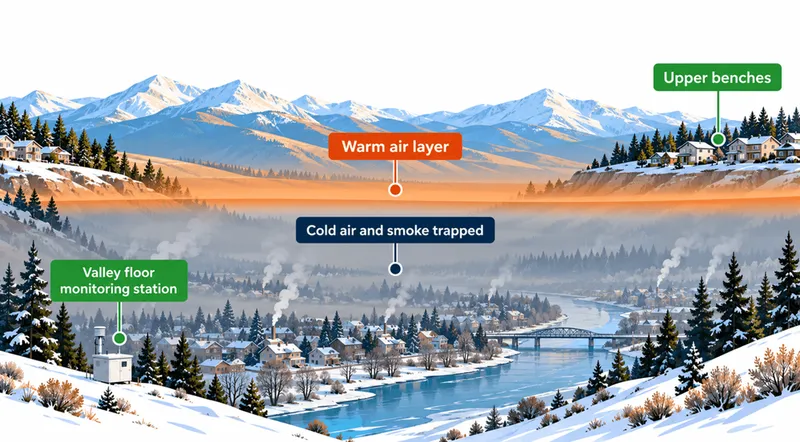
Our takeaway: the posted Kamloops AQHI is a valley-floor reading. On a still winter morning, residents of higher neighbourhoods such as Upper Aberdeen are generally breathing air no worse than the posted value. Wildfire smoke is different: it can settle over the valley and the hillsides alike.
How We Read the Kamloops Number: A Three-Check Method
Confirm the scale. Use the AQHI (1 to 10+), not an app's 0 to 500 AQI.
Look ahead. Check tonight's and tomorrow's forecast maximums as well as the current value.
Adjust for season and height. During winter inversions, the downtown station reads highest; in smoke season, assume the whole valley is affected.
"Before writing this page, I traced the Kamloops AQHI back to the monitors behind it. The detail that changed how I read the number was the Roundtable's finding that the downtown station reads highest. If you live up on the benches, think of the posted value as the valley floor, not your street."
Michelle Wan, Brand Manager and Air Quality Writer, Filterbuy Canada
Why Does Kamloops Air Quality Change by Season?
Kamloops air quality shifts with the seasons: road dust in spring, wildfire smoke in summer, and temperature inversions in late autumn and winter, when warmer air traps pollution at the bottom of the Thompson River valley.
In spring, the City begins street sweeping in March; its sweepers spray water to cut the dust but can't eliminate it. In summer, the Filterbuy live wildfire and smoke map for Kamloops shows active fires and smoke plumes. In winter, we found that the City flags wood burning as a problem mainly during inversions; see its wood burning guidance.
Is the Air Quality Bad in Kamloops Today? What to Do
If the live map shows a moderate reading of 4 to 6, most people can continue their usual outdoor activities unless they notice symptoms. Once readings reach high (7 to 10) or very high (above 10), ECCC advises people with heart or breathing problems, children, and older adults to cut back on strenuous outdoor activity, and everyone to watch for symptoms such as coughing or throat irritation.
Move strenuous activity indoors, or shift it to a time of day with a lower reading.
Keep windows and doors closed while outdoor readings are high.
Set up AQHI alerts through Canada's WeatherCAN app.
If you have a heart or lung condition, follow your health care provider's advice.
The City of Kamloops notes that its facilities can give residents a break from heat and smoke, but they aren't equipped with the specialized filtration needed to operate as designated clean air shelters.
How Can You Keep Indoor Air Cleaner in a Kamloops Home?
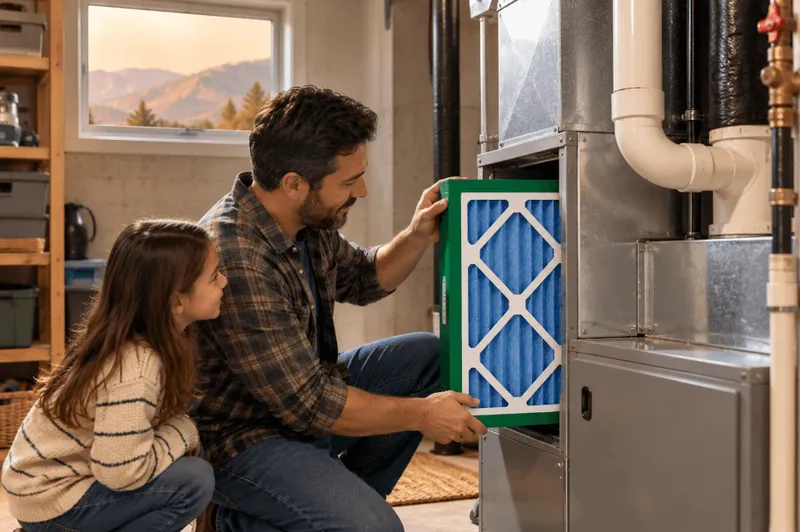
On smoky or inversion days, your furnace or central air system is a practical tool for lowering indoor particle levels. The fan pulls indoor air through the filter, and a MERV 13 filter captures a larger share of fine particles, including smoke, than a MERV 8 or MERV 11.
Keep windows closed and run the system fan on continuous. If your home has a heat recovery ventilator (HRV), follow the manufacturer's guidance for smoke events.
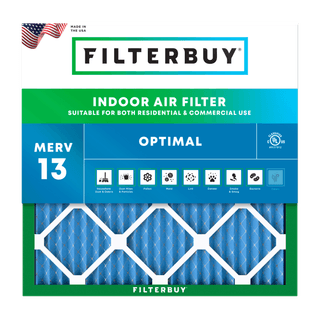
We suggest upgrading to MERV 13 filters before summer smoke arrives, as long as your system is rated for them; our MERV 13 vs HEPA guide for wildfire smoke explains how to check. In the Filterbuy colour-coded MERV system, MERV 13 is labelled Optimal.
Check the filter monthly during smoke and inversion stretches, and replace it once it looks grey or loaded. Otherwise, a fresh filter every 60 to 90 days suits most homes during heating season.
For smoke or wood-fire odours that linger indoors, consider an Odour Eliminator carbon filter.
If you rent or live in a condo, ask your landlord or strata council which filter size and rating your system takes.
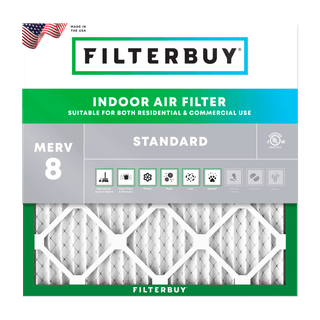
Filterbuy Canada carries MERV 8 (Standard), MERV 11 (Superior), and MERV 13 (Optimal) filters in over 600 sizes, backed by over 85,000 five-star reviews, with free shipping to Canada on every order. Subscribe and save with an air filter subscription: edit, skip, or cancel anytime. Our guide to MERV ratings explains which rating fits your furnace.
Supporting Statistics
1. Closed Windows Keep Out Only About Half the Smoke
Indoor PM2.5: about 55% to 60% of outdoor levels, with windows closed and no air cleaner.
Range by home: 30% to 100%.
Fan on continuously with a high-efficiency filter: about 50% lower.
Source: U.S. Environmental Protection Agency, Strategies to Reduce Exposure Indoors
2. A Filter Works Only When Air Moves Through It
Test home: Portland, Oregon, built 1928, during the September 2020 wildfires.
MERV 13 filter, fan cycling on and off: indoor PM2.5 at 55% of outdoor.
Add one portable HEPA cleaner: 21%.
Indoor average: about 134 micrograms per cubic metre, over five times B.C.'s 24-hour objective of 25.
Source: Antonopoulos, Dillon and Gall, Pollutants (2024), EPA author manuscript in NIH PubMed Central
3. Wood Heat Is a Small Source with a Big Winter Footprint
Primary heat in about 2% of U.S. homes.
About 28% of wintertime PM2.5 emissions (EPA 2023 National Emissions Inventory).
Source: Shlipak et al., Science Advances (2026), indexed by the U.S. National Library of Medicine
Frequently Asked Questions
What Is the Air Quality in Kamloops Today?
Check the live map at the top of this page for today's Kamloops AQHI. Readings of 1 to 3 are low risk, 4 to 6 moderate, 7 to 10 high, and above 10 very high.
Is the Air Quality Bad in Kamloops Today?
An AQHI of 7 or more means high risk, and in B.C. that level is usually caused by smoke. At high readings, ECCC advises people with heart or breathing problems, children, and older adults to reduce strenuous outdoor activity.
Is the Kamloops AQI the Same as the AQHI?
No. The AQHI is Canada's 1 to 10+ health-risk index, and the U.S. AQI is a 0 to 500 scale. They use different formulas, so one cannot be converted directly into the other.
Where Can I Check Kamloops PM2.5 Today?
Open the provincial Kamloops Federal Building station page, which shows hourly PM2.5 in micrograms per cubic metre. B.C.'s 24-hour objective for PM2.5 is 25 micrograms per cubic metre.
Why Is Kamloops Air Quality Often Worse on Winter Mornings?
On calm winter mornings, temperature inversions trap cold air and pollution, including wood smoke, on the floor of the Thompson River valley. Readings usually improve once the inversion breaks and the air starts to mix.
Glossary
Air Quality Health Index (AQHI): Canada's 1 to 10+ scale for the health risk of outdoor air, with a PM2.5 smoke adjustment in B.C.
Air Quality Index (AQI): The U.S. EPA's 0 to 500 air quality scale; not the same as Canada's AQHI.
PM2.5: Fine particles 2.5 microns or smaller in diameter, measured in micrograms per cubic metre; the main component of wildfire and wood smoke.
Temperature inversion: Warmer air sitting above colder air near the ground, trapping pollution in valleys such as the Thompson.
MERV: Minimum Efficiency Reporting Value; higher numbers capture smaller particles. Filterbuy colour-codes its MERV 8, 11, and 13 filters so the rating is easy to spot.