Shop by
September 14, 2026

Air pollution is an established trigger for heart attacks rather than a direct cause. EPA research finds that a rise in fine particles, PM2.5, over a few hours to a few weeks can trigger cardiovascular events and death, with the risk concentrated in people who already have heart disease. For those patients, EPA treats an AQI of 101 as an action threshold.
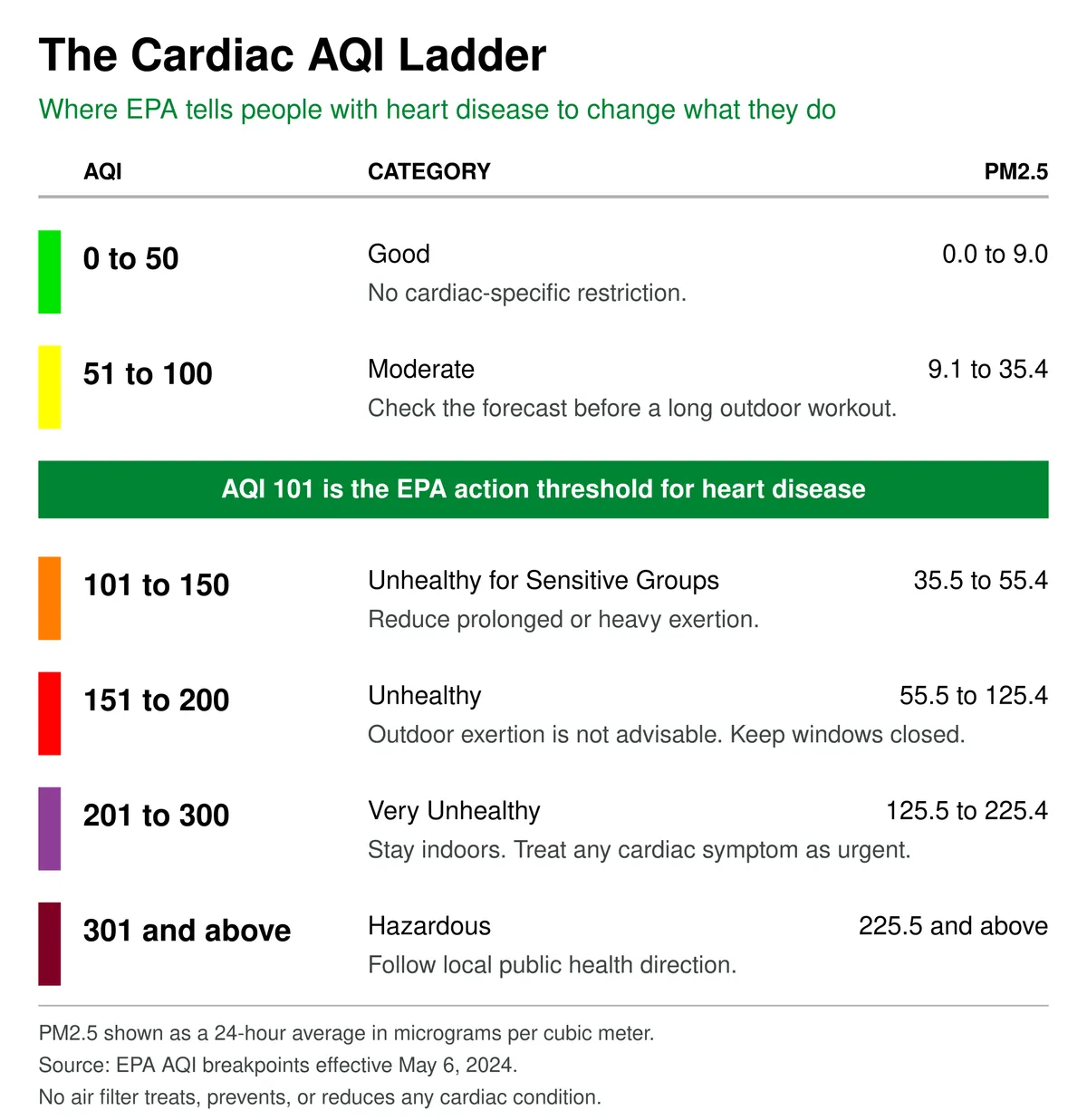
AQI 0 to 100: no cardiac-specific restriction, though a long outdoor workout is worth a forecast check.
AQI 101 to 150: the EPA action threshold. Reduce prolonged or heavy exertion.
AQI 151 and above: outdoor exertion is not advisable. Keep windows closed and run indoor filtration continuously.
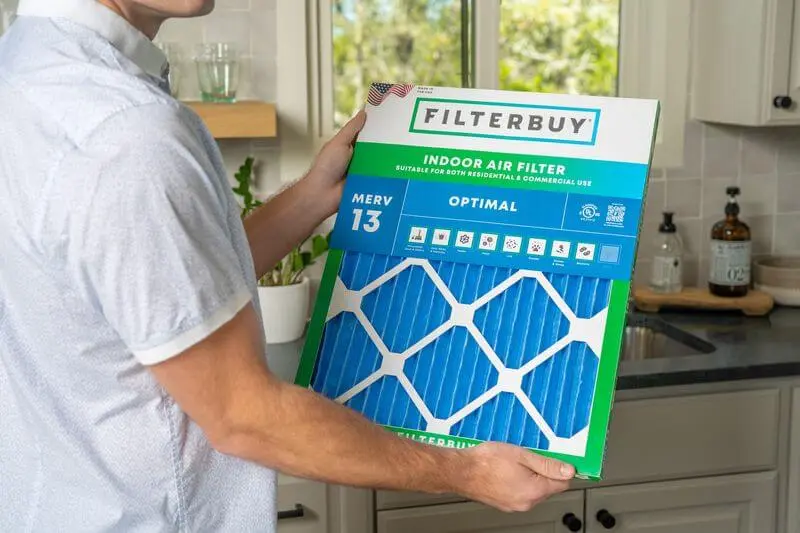
Indoor particle levels rise when outdoor levels rise, which is why EPA points to filtration and ventilation on bad-air days. Filterbuy is an American air filter manufacturer building pleated filters in MERV 8, MERV 11, and MERV 13, in standard and custom sizes.
No air filter treats, prevents, or reduces any cardiac condition. This page is educational and is not medical advice.
Not sure which filter your system takes? Answer a few quick questions and we'll match you to the right one.
Air pollution is an established trigger for heart attacks, and the cardiac evidence is at least as strong as the lung evidence. EPA research finds that a rise in fine particulate matter over hours to weeks can trigger cardiovascular events and death, with risk concentrated in people who already have heart disease. For those patients, an AQI of 101 is an action threshold rather than a suggestion.
PM2.5 is the fraction of air pollution most closely tied to cardiac events. EPA lists heart attack, arrhythmia, heart failure, stroke, and sudden cardiac death among outcomes that rise with it.
AQI 101 to 150 is the Code Orange band where EPA advises people with heart disease to cut back on prolonged or heavy exertion. It starts at 35.5 micrograms per cubic meter.
Chest tightness, palpitations, unusual fatigue, lightheadedness, and shortness of breath are the symptoms EPA lists for chronic heart disease after fine-particle exposure.
Outdoor particles migrate indoors. EPA notes that high outdoor levels raise indoor particle concentrations, which is why filtration and ventilation matter on bad-air days.
Air pollution does not cause heart attacks the way a blocked coronary artery does, but it acts as a trigger. Research by EPA and others has found that increased concentrations of PM2.5 over a few hours to weeks can trigger cardiovascular heart attacks and death. The American Heart Association reached a parallel conclusion in two scientific statements, in 2004 and again in 2010.
The distinction matters. Fine particulate matter layers on top of the traditional risk factors, which EPA research on air pollution and cardiovascular disease lists as male sex, older age, raised blood pressure, high cholesterol, low HDL, and smoking. Across a population, both short-term and long-term exposure raise hospitalizations for coronary syndrome, arrhythmia, heart failure, stroke, and sudden cardiac death, hardest among those with established heart disease.
PM2.5 particles are small enough to travel deep into the lungs and set off effects that reach the cardiovascular system. The American Heart Association scientific statement in Circulation describes several plausible pathways, including enhanced coagulation and thrombosis, a propensity for arrhythmias, acute arterial vasoconstriction, systemic inflammatory responses, and the long-run promotion of atherosclerosis.
EPA puts the average human hair at roughly 70 micrometers across, about 30 times wider than the largest fine particle. Once inflammatory and clotting responses are underway, an artery already narrowed by plaque has less margin. That is what cardiologists mean when a pollution spike sets off an event in a patient whose disease had been stable. MESA Air, a long-running US cohort study, found faster progression of atherosclerosis in people exposed over years.
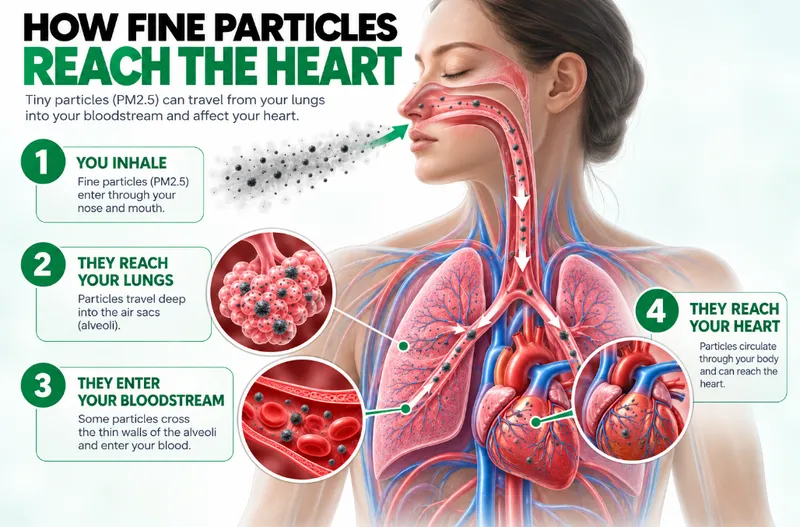
The cardiovascular response to a pollution spike is fast, and the long-run response is heavier. EPA places pollution-triggered cardiac events from a few hours to a few weeks after concentrations rise. American Heart Association guidance for heart patients reports that short-term exposure raises the risk of heart attack, stroke, arrhythmia, and heart failure, and that the risk of death is greater from long-term exposure.
An AQI of 101 is the practical action threshold for anyone with established heart disease. AirNow guidance on asthma and heart disease and EPA clinician materials place people with heart or lung disease, older adults, children, people with diabetes, and people of lower socioeconomic status in the sensitive group advised to reduce prolonged or heavy exertion once the particle AQI enters the Code Orange band.
PM2.5 concentrations in micrograms per cubic meter, 24-hour average, using the EPA breakpoints effective May 6, 2024.
Two details are easy to miss. First, the breakpoints changed. EPA's 2024 particulate matter rule reset the AQI value of 50 to 9.0 micrograms per cubic meter while retaining 100 and 150 at 35.4 and 55.4. We checked while building this page and found charts published well after that date still showing 12.0. Our full AQI scale explainer carries the current categories.
Second, read the ladder one row stricter than the public advice, and do not wait for symptoms, because the first symptom can be the cardiac event. Filterbuy's live AQI and wildfire smoke map gives today's number by ZIP code, and our guide to which AQI levels are unsafe for sensitive groups covers who qualifies.
The number has limits. It measures outdoor air only, and reports whichever pollutant is highest rather than the one that matters most to your heart. An AQI of 110 driven by ozone and one driven by PM2.5 are not the same cardiac signal, since the evidence is strongest for fine particles. Most displays name the driver. The American Lung Association also reports roughly 2,295 US counties have neither pollutant monitored.
Wildfire smoke is largely PM2.5, so a smoke day is a high-particle day by definition. The evidence tying smoke specifically to short-term cardiac events is less settled than the broader PM2.5 evidence. Some studies find elevated cardiac arrest and heart attack encounters during smoke episodes, and others report null effects.
That disagreement is worth stating plainly. A retrospective cohort across 58 US health systems found significant increases in heart attack, cardiac arrest, heart failure, and atrial fibrillation encounters for every 10 microgram per cubic meter rise in weekly wildfire-specific PM2.5, reported in a 2025 analysis of wildfire smoke and acute illness. Other reviews report inconsistent results. EPA lists people with pre-existing heart conditions among those most affected by wildland fire smoke, and the steps are the same as for any high-PM2.5 day.
The AQI and a MERV rating measure two different things, and the gap between them is where homeowners get stuck. The AQI describes how concentrated particles are outside. A MERV rating describes the share a filter pulls out of the air passing through it. Neither number alone tells you what you are breathing indoors.
Filterbuy is an American air filter manufacturer, and we build pleated filters in MERV 8, MERV 11, and MERV 13. A filter only acts on air the system moves. On a Code Orange day, a MERV 13 filter behind a fan set to Auto does a fraction of the work it could. The rating on the frame is a ceiling, not a result.
"We have been building filters for two decades, and the thing homeowners miss is that the rating on the frame is a ceiling, not a result. A MERV 13 sitting in a system with the fan set to Auto spends most of a bad-air day doing nothing at all."
— David Heacock, Founder and CEO, Filterbuy
Three figures frame why air quality belongs in a cardiac care plan: how often heart attacks happen in the United States, how many cardiac patients already breathe air that fails a federal standard, and how much of the country the wildfire smoke behind many of those failures now reaches.
Heart attacks are common. Someone in the United States has one every 40 seconds, and about 805,000 people a year, 605,000 of them for the first time, according to CDC heart disease facts.
Cardiac patients are disproportionately exposed. Close to 10 million people with cardiovascular disease live in counties graded F for at least one pollutant, and nearly 2.1 million in counties failing all three, per the American Lung Association State of the Air 2026 report.
Smoke is now a routine driver of high-particle days. National Interagency Fire Center records show 77,850 wildfires burned 5,131,474 acres in 2025, with the fire count well above both the five-year and ten-year averages.
EPA lists five symptoms people with chronic heart disease may experience after fine-particle exposure: heart palpitations, unusual fatigue, lightheadedness, shortness of breath, and chest tightness or pain in the chest, neck, or shoulder. Any of these during a high-AQI stretch is a reason to stop and get medical attention.
Do not wait to see whether it passes. EPA patient guidance is explicit that symptoms which come and go still warrant seeking help immediately. Call 911 for chest discomfort, pressure, fullness, or squeezing lasting more than a few minutes, or that goes and returns. This page is educational and not medical advice.
Most air quality guidance ends at talk to your doctor and stops there. These five questions are worth bringing, because the answers depend on your condition, medications, and activity level rather than any general threshold. A cardiologist can set a personal AQI number that no published chart can.
At what AQI should I change my activity, given my condition and my medications?
Do any of my medications change how I tolerate exertion or heat on a high-AQI day?
Should exercise move indoors at that point, or is a lighter outdoor session acceptable?
Which symptoms should I treat as urgent rather than waiting out?
Do indoor sources at home, such as a wood stove or indoor smoking, change your advice?
Indoor air is not separate from outdoor air. EPA notes that fine particles outdoors penetrate homes, so high outdoor levels raise indoor concentrations. EPA wildfire guidance recommends a filter rated MERV 13 or higher during smoky periods, and adds that most systems take one if it is replaced frequently.
Fit matters as much as rating. A filter that leaves gaps lets air bypass the media entirely, which is why Filterbuy builds standard and custom sizes for odd slots. With no central system, a window unit or mini split will not filter the whole house, and EPA's guidance is to build a cleaner-air room. A higher-MERV filter does not treat, prevent, or reduce any cardiac condition.
For system-level guidance, see what MERV rating to use on high-AQI days, the best MERV filter for wildfire smoke, and how MERV 13 and HEPA filtration differ.
Does Air Pollution Cause Heart Attacks?
Air pollution acts as a trigger rather than a sole cause. EPA finds that rising PM2.5 over a few hours to weeks can trigger cardiovascular heart attacks and death, with the strongest effect in people who already have heart disease.
What AQI Is Dangerous For Someone With Heart Disease?
AQI 101 or higher is where EPA advises people with heart disease to reduce prolonged or heavy exertion, which corresponds to a 24-hour PM2.5 concentration of 35.5 micrograms per cubic meter or more. Above 150, outdoor exertion is not advisable.
How Quickly Can Air Pollution Trigger A Heart Attack?
EPA places pollution-triggered cardiac events from a few hours to a few weeks after concentrations rise. The American Heart Association describes elevated risk of heart attack, stroke, arrhythmia, and heart failure within hours to days in susceptible people.
Does Wildfire Smoke Raise Heart Attack Risk?
Wildfire smoke is mostly PM2.5, so smoke events produce the same exposure implicated in cardiac events. Results on short-term smoke and cardiac outcomes are mixed, though EPA lists people with heart conditions among those most affected.
Can An Air Filter Lower My Heart Attack Risk?
No air filter treats, prevents, or reduces any cardiac condition. A higher-MERV filter captures a larger share of fine particles from air moving through the system, one exposure-reduction step alongside closing windows and following AQI guidance.
Air Quality Index (AQI). The EPA scale, 0 to 500, that converts pollutant concentrations into one color-coded number describing daily air quality.
PM2.5. Fine inhalable particulate matter with a diameter of roughly 2.5 micrometers or less. PM2.5 is the pollutant most consistently associated with cardiovascular events.
Code Orange. The AQI band from 101 to 150, Unhealthy for Sensitive Groups, where EPA advises people with heart or lung disease to reduce exertion.
Atherosclerosis. The buildup of plaque in artery walls. Ruptured plaque can produce a clot that blocks blood flow and causes a heart attack or stroke.
EPA. The US Environmental Protection Agency, the federal agency that sets national outdoor air quality standards and publishes the Air Quality Index.
MERV. Minimum Efficiency Reporting Value, the scale describing how well an HVAC filter captures particles in defined size ranges. Higher numbers mean finer capture.
Filterbuy. An American air filter manufacturer producing pleated residential and commercial HVAC filters in MERV 8, MERV 11, and MERV 13, in standard and custom sizes.
