Mini Split vs. Furnace (and Why Many Homes Should Run Both)
October 15, 2026
The right choice depends on your ductwork and your winters. A furnace needs ducts and only heats, but it delivers full output in any weather. A mini split heats and cools without ducts, though its output drops as temperatures fall. Find your home in the list below.
Furnace: You have ducts, long cold winters, and low gas prices.
Mini split: You have no ductwork, or you need to heat and cool a garage, addition, or ADU.
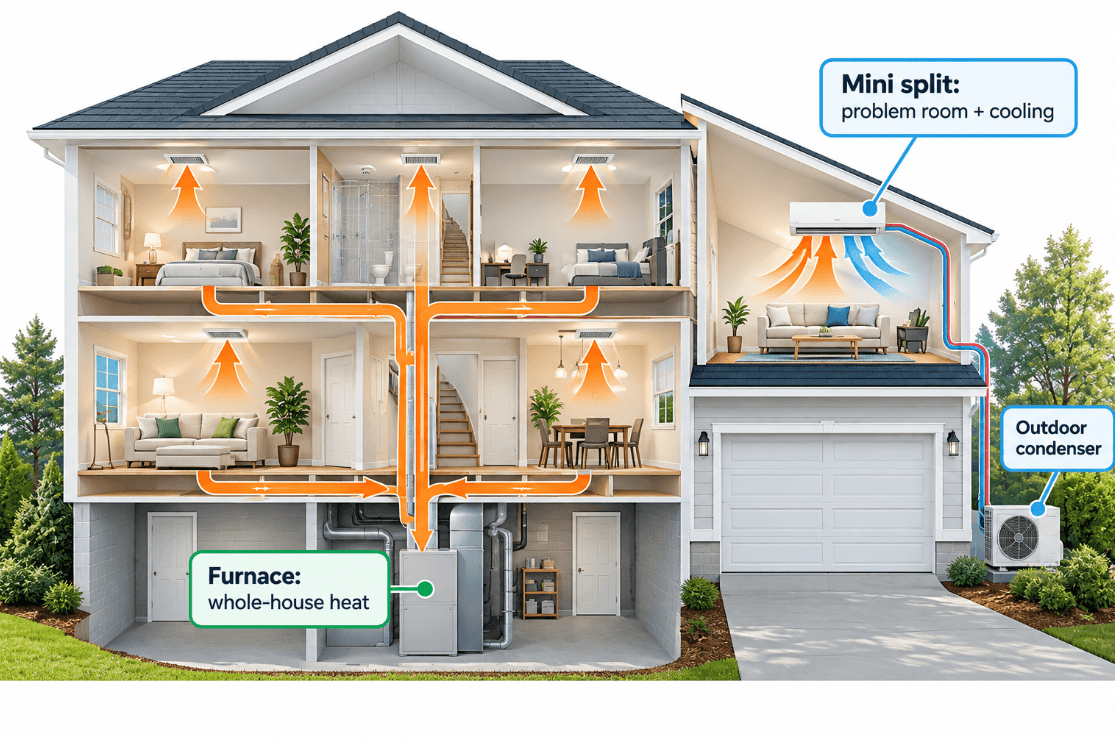
Both: Your ducted home has one room that's always too hot or too cold.
Take the quick quiz below to see which mini split fits your space.
Filterbuy single-zone mini splits start at $749 with fast and free 2-day delivery to most US states, plus a 7-year compressor and 3-year parts warranty. Professional installation is required.
Shop Mini Split Systems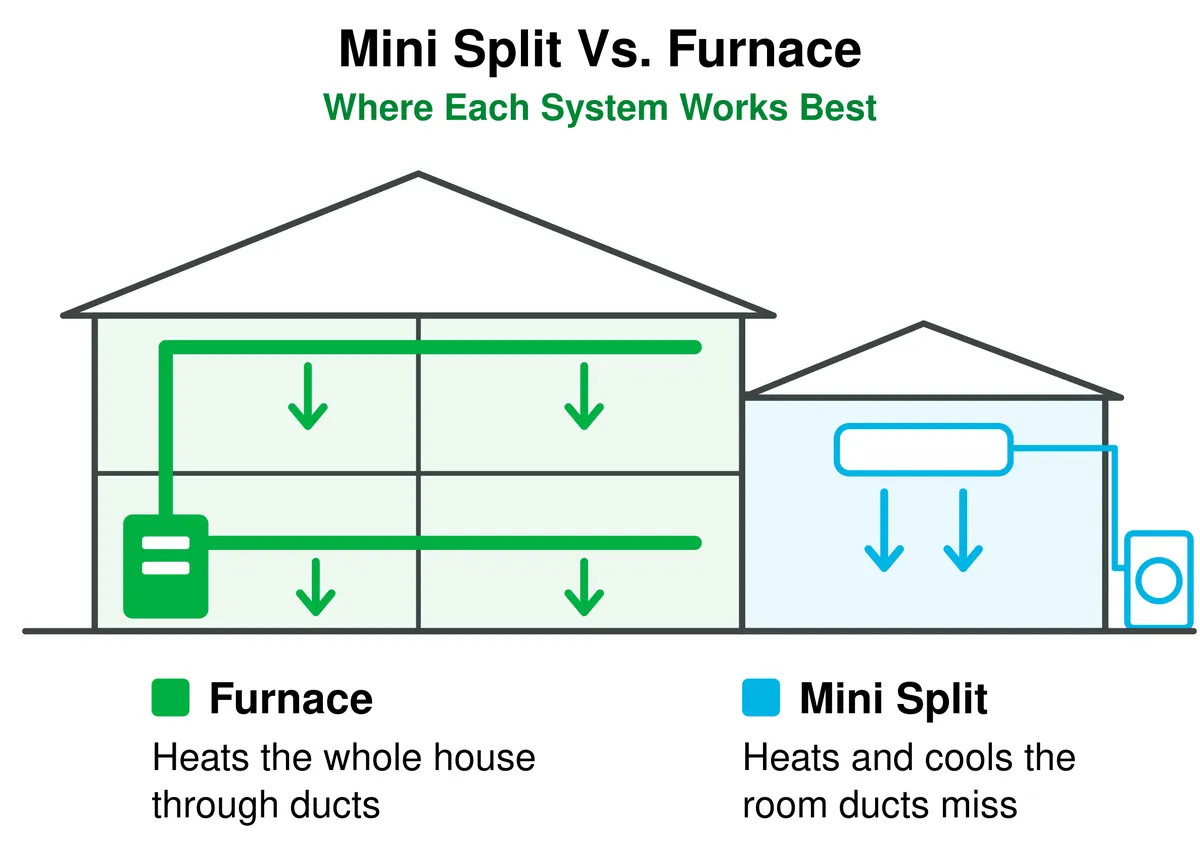
Find Your Mini Split Match
Answer a few quick questions and we'll match you to the right mini split for your room.
Mini Split vs. Furnace: The Short Answer: A furnace is usually the cheaper way to heat a whole ducted home through a cold winter, while a ductless mini split is the more efficient way to heat and cool one room. For many homes, Filterbuy's answer is both: the furnace heats the house, and a mini split fixes the room the ducts never quite reach.
Key Takeaways
A single-zone mini split costs $2,000 to $6,000 installed nationally, versus $3,800 to $10,000 for a gas furnace. Filterbuy's published-price systems install for about $1,349 to $2,849.
Filterbuy's analysis of 2024 U.S. Energy Information Administration (EIA) prices shows a mini split needs a COP near 3.3 to out-save a 95% gas furnace, from 1.6 in Florida to 5.2 in Michigan.
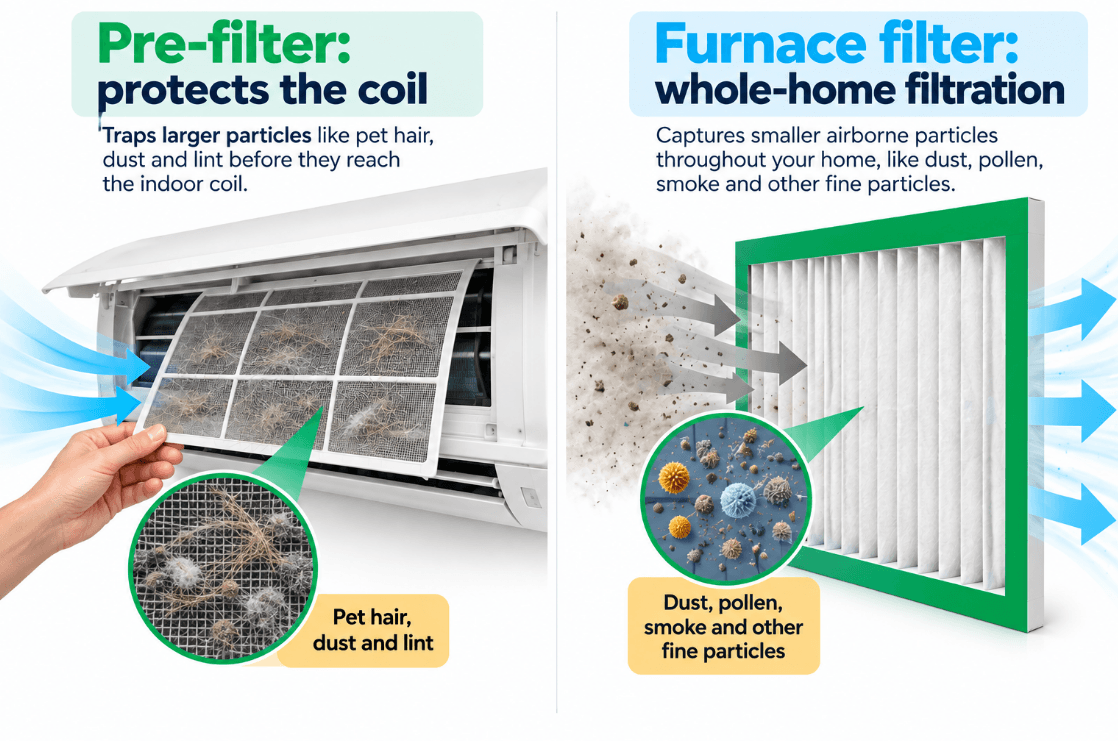
A mini split's pre-filter protects the coil, while your whole-home furnace filter does the heavy lifting for air quality.
Mini Split vs. Furnace at a Glance
Cost ranges come from Filterbuy's mini split cost guide and furnace replacement cost guide; local quotes vary.
How Much Does a Mini Split Cost Compared to a Furnace?
A mini split costs less upfront than a furnace because it covers less space: about $2,000 to $6,000 per installed zone nationally, versus $3,800 to $10,000 for a gas furnace. If your furnace is healthy, one added zone is often the best value.
What a Filterbuy Single-Zone Mini Split Costs Installed
Filterbuy-brand single-zone mini splits come with published prices, free 2-day delivery on in-stock systems, and a 7-year compressor / 3-year parts warranty. At 17 SEER2 they clear the federal minimum and are built for value rather than maximum efficiency, which suits a supplemental zone like this. Installer labor is the main variable:
Prices come from Filterbuy mini split systems (checked October 15, 2026) and our mini split installation cost guide. Professional installation is required, and the warranty is void if the unit is self-installed. Permit and electrical requirements vary by jurisdiction.
Which Costs Less to Run in Your State? Filterbuy's Break-Even Analysis
Upfront price is only half the story. Running cost depends on a mini split's coefficient of performance (COP) and local energy prices, so we used 2024 EIA data to calculate the COP it needs to beat a gas furnace:
Filterbuy analysis of EIA electricity and natural gas prices, excluding fixed charges and duct losses.
If your mini split's spec-sheet COP at a typical winter temperature beats your state's number, it heats for less. In cheap-gas Michigan the furnace stays cheaper; in Florida and Texas the mini split wins far more of the year.
Incentives. The federal 25C Energy Efficient Home Improvement Credit, which covered 30% of a qualifying heat pump up to $2,000, was terminated for systems placed in service after December 31, 2025. Check the ENERGY STAR Rebate Finder for local rebates, and confirm eligibility with a tax professional.
Is a Mini Split More Efficient Than a Furnace?
A mini split is usually more efficient than a furnace in mild weather, because it moves heat instead of burning fuel. In deep cold, though, its output falls while a furnace keeps delivering full heat.
How furnaces are rated. According to the U.S. Department of Energy, high-efficiency furnaces turn up to 98.5% of their fuel into heat (98.5% AFUE). AFUE ignores duct losses, though, which DOE says can reach 35% when ducts run through an attic or garage. Mini splits skip ducts entirely, and the DOE's Building America Solution Center notes that top models now exceed 35 SEER2.
What happens in the cold. To earn ENERGY STAR's cold-climate designation, a heat pump has to keep a COP of at least 1.75 at 5°F. Filterbuy's units are rated for reliable heating down to 5°F, so in cold climates they belong alongside a furnace, not in place of one.
Which Is Better for Comfort and Indoor Air Quality?
A mini split wins on single-room comfort. A furnace wins on whole-home air quality, because every room's air passes through its filter.
Air quality. The U.S. Environmental Protection Agency explains that most mini split filters catch large particles like pet hair and lint to protect the equipment, not fine particles. EPA's benchmark for fine particles is MERV 13 or higher, a rating many furnace filter slots can hold.
That creates a trade-off. Every hour the mini split carries the heating load is an hour your furnace blower isn't pulling air through that filter. Our MERV rating guide shows how to check what your system can handle.
Can You Use a Mini Split and Furnace Together?
Yes, and for a ducted home, a mini split with furnace setup is one of the most cost-effective upgrades available. First, though, rule out the free fixes. Make sure the room's supply register is open and the filter is clean, then have a pro check that duct run for leaks.
If the room still won't cooperate, here is the typical setup:
The furnace stays primary and heats the whole home.
The mini split takes the problem room.
The mini split supplements the furnace in spring and fall, and the furnace takes over in deep cold.
Thermostats stay coordinated, so one never cools while the other heats.
A nameplate rating is a lab number taken at 47 degrees. It tells you almost nothing about the coldest morning of the year. The first thing I want on a proposal is published capacity at the design temperature. Without it, the sizing is a guess dressed up as a spec."
— David Clark, Licensed HVAC Technician, Filterbuy HVAC Solutions
What Is a Dual Fuel Mini Split Setup?
A dual fuel mini split setup pairs a mini split with a fuel-burning furnace so each runs when it's cheapest. The mini split handles mild weather, and the furnace takes over below an outdoor temperature called the balance point.
You choose the handoff:
Seasonal switching: mini split in spring and fall, furnace in winter.
Setpoint staggering: set the furnace a few degrees lower so it runs only as backup.
Smart controls: outdoor-temperature controllers, where supported.
Your money-saving balance point is the outdoor temperature where your mini split's COP drops to your state's number in Filterbuy's break-even table.
Should You Choose a Mini Split, a Furnace, or Both?
For most ducted homes, Filterbuy recommends keeping the furnace and adding a mini split to the room that never feels right. Then upgrade the furnace filter to MERV 11, or to MERV 13, the EPA's fine-particle benchmark, if your system's airflow allows it. Without ducts, a mini split alone is simpler.
"The best filter is the highest rating your system can move air through, changed on schedule. A MERV 11 you actually replace beats a MERV 13 you leave in for six months."
— David Clark, Licensed HVAC Technician, Filterbuy HVAC Solutions
How to Maintain Filters When You Run Both Systems
You'll have two filters to look after. The mini split's washable pre-filter protects its coil, while the furnace filter does the heavy lifting for whole-home air.
Furnace filter: Replace a 1-inch pleated filter about every 90 days, sooner in homes with pets or heavy dust. On the Filterbuy production floor, we've learned that depth matters more than pleat count: our 4-inch filters have fewer, deeper pleats yet last months longer than our 1-inch. See how often to change your HVAC filter.
Mini split pre-filter: Rinse it about every two weeks during heavy use. Filterbuy mini splits include a filter-cleaning reminder, and Filterbuy carries replacement filters for common mini split sizes.
Shoulder seasons: Run the furnace fan now and then so the whole house still gets filtered.
The costliest mistake our service team sees:
"After hundreds of service calls, the systems we see underperforming or failing early almost always have the same thing in common: a filter that's been left in place for 12 or 18 months."
— Filterbuy HVAC Solutions service team, from our mini split cost guide
At Filterbuy, we see the mini split vs. furnace question from both sides. We've made furnace filters in the USA since 2013, and we now sell Filterbuy-brand mini splits too. From where we sit, most homes don't have to choose, and the right setup affects filtration as well as comfort. Set up Auto Delivery and the next one arrives on time.
Supporting Statistics
1. 60% of U.S. homes heat with a furnace, and 42% also run secondary heating equipment.
About 74.4 million of 123.5 million homes heat mainly with a furnace, and 51.8 million also use a second heat source, so supplemental heat is already common.
Source: EIA, 2020 Residential Energy Consumption Survey
2. Natural gas heats 47% of U.S. homes, while electricity now heats 42%.
EIA credits better heat pumps for part of that rise.
Source: EIA, Today in Energy, October 10, 2025
3. A mini split added to an existing central system cut heating and cooling energy use by 34% on average.
Research conducted in Florida homes found average heating and cooling energy savings of 34% when a mini split served as the primary system and the existing central system operated only as needed. Results in colder climates may differ.
Frequently Asked Questions
Is it cheaper to run a mini split or a furnace?
Whether a mini split or furnace is cheaper to run depends on local energy prices. At 2024 national EIA averages, a mini split needs a COP above about 3.3 to beat a 95% gas furnace, an easier bar in mild weather.
Can a mini split replace a furnace?
A mini split can replace a furnace in homes with mild winters, open floor plans, or no ductwork. Filterbuy's largest single-zone system covers up to 1,100 square feet and is rated for heating down to 5°F. In cold climates, keep the furnace as backup.
How often should I clean a mini split filter?
Rinse a mini split's washable pre-filter about every two weeks during heavy use, or as often as your owner's manual recommends.
What size mini split do I need for one room?
A mini split's size depends on the room's square footage and how well it holds heat. Filterbuy's single-zone systems are rated for up to 550 square feet (12,000 BTU), 850 square feet (18,000 BTU), or 1,100 square feet (24,000 BTU). A licensed installer's Manual J load calculation confirms the right size before you buy.
Do I need a special thermostat to run a mini split with a furnace?
A mini split and a furnace don't need a special thermostat, because each system runs on a separate control. Set them to similar temperatures, and never let the mini split cool while the furnace heats. Filterbuy mini splits run from a wireless remote or a WiFi app that works with Alexa and Google Home.
About the Author
Michelle Wan is Brand Manager and Air Quality Writer at Filterbuy, where she works with our U.S. manufacturing team. "I don't want anyone to feel like they need an HVAC license just to pick the right filter," she says. Technical review by David Clark, Licensed HVAC Technician, Filterbuy HVAC Solutions.
Glossary
Mini split: A ductless heat pump that heats and cools individual zones.
Furnace: A fuel-burning central heater that sends warm air through ducts.
AFUE: The share of a furnace's fuel that becomes heat.
SEER2 and HSPF2: Heat pump cooling and heating efficiency ratings.
COP: Coefficient of performance, heat delivered per unit of electricity.
Dual fuel: A heat pump paired with a fuel-burning furnace.
Balance point: The outdoor temperature where heating switches to the furnace.
MERV: A 1 to 16 filter capture rating. Filterbuy makes MERV 8, 11, and 13 filters.
Sources
U.S. Department of Energy: Furnaces and Boilers
DOE Building America Solution Center: Ductless (Mini-Split) Heat Pumps
U.S. EPA: Do ductless mini-split heat pumps filter fine particles out of indoor air?
U.S. EIA: Electric Power Annual 2024, average residential price by state
U.S. EIA: Natural Gas Annual 2024, Table 23, average delivered price by state
U.S. EIA: Highlights for Space Heating in U.S. Homes by State, 2020 RECS
U.S. EIA: Electricity use is becoming more common for residential heating
U.S. DOE – Integrated HVAC Control Methods for Supplemental High-Efficiency Mini-Split Heat Pumps in Existing Homesps