Should You Cover Your Mini Split in Winter? (Not If You Heat With It)
October 22, 2026
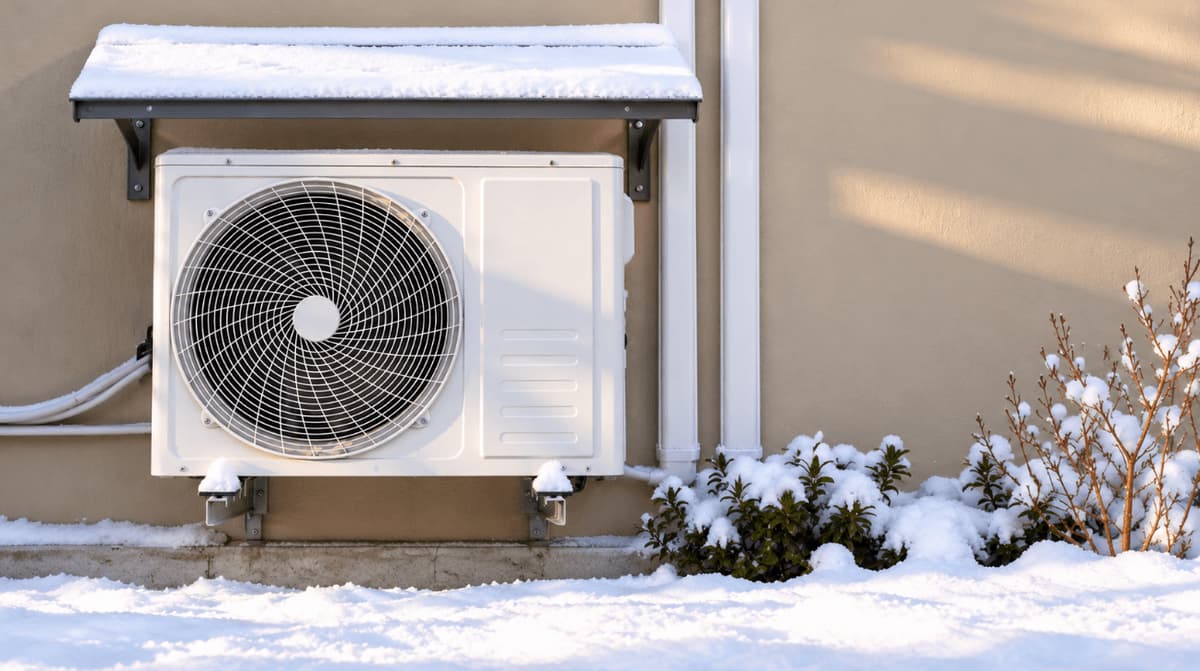
No, not if you heat with it. A mini split that heats your home keeps its outdoor unit running all winter, and that unit needs open air on every side to pull in heat and shed frost. A full condenser cover blocks both jobs. If the unit needs protection, the safe choice is a snow shield mounted above it, with open air underneath.
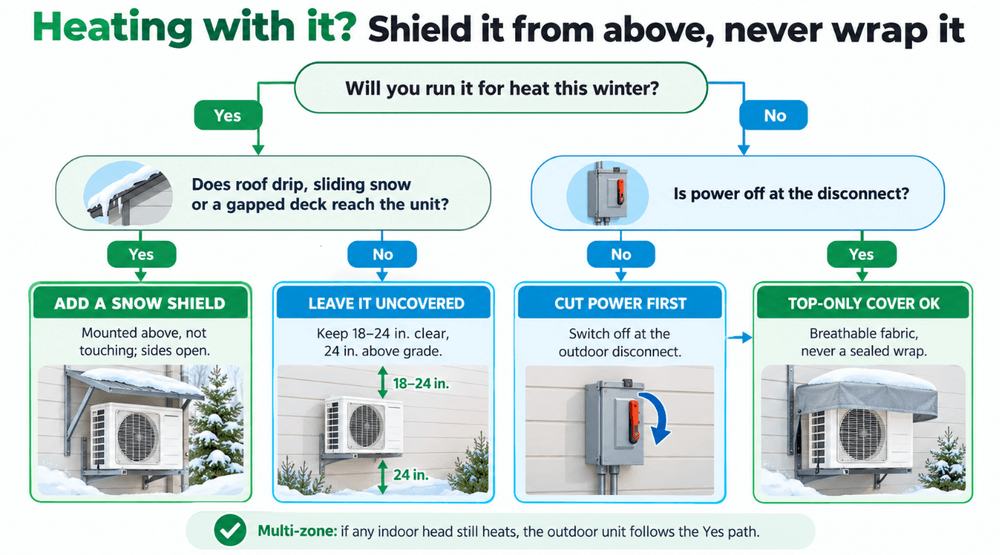
- Heats your home: leave the outdoor unit uncovered all winter.
- Under a roof drip line: add a snow shield above it, not a cover around it.
- Cooling-only and powered off: a breathable, top-only cover is fine.
Planning a mini split that heats all winter? Take the quick match quiz below.
Shield it from above. Don’t seal it.
Find the Right Mini Split for Your Space
Filterbuy mini splits deliver reliable heating down to 5°F, with intelligent defrost built in. Answer a few quick questions and we’ll match you to the right size.
Already know your room size? Shop Filterbuy mini split systems
TL;DR
A ductless mini split is a heat pump, so its outdoor unit works all winter. If you heat with it, never wrap that unit, because blocked airflow stalls heating and defrost and can damage the compressor. Where roof drip lands on it, add a snow shield above instead, and save breathable top covers for cooling-only units that are off for the season.
Key Takeaways
Never wrap a mini split you heat with; its outdoor unit needs every side open.
A snow shield is not a cover. It's a small roof above the unit.
Most homes don't need a shield. Filterbuy's 60-second roofline check tells you whether yours does.
Covers are for idle units only, and only after cutting power.
Start With One Question: Does Your Mini Split Heat Your Home?
Filterbuy starts every cover question here. Most ductless mini splits, including Filterbuy's, are heat pumps, so the unit that cools your home in July also heats it in January and needs to stay powered and uncovered.
Not sure yours heats? Look for a heat mode on the remote, usually a sun icon. Our guide to heat pump vs. mini split explains the overlap, and the three-question cover test below covers the rest.
Why Does a Cover Hurt a Mini Split You Heat With?
A heating mini split pulls warmth out of cold outdoor air, so its outdoor coil has to breathe. Frost builds on that coil as it works, so the system periodically runs a defrost cycle, briefly reversing to melt the frost and let it drain.
Wrap the unit and you block that air and trap the moisture defrost leaves, so heating drops and the compressor strains. That's why HVAC maker Goodman advises cutting power to the outdoor unit whenever a cover or obstruction is in place (Goodman).
Filterbuy mini splits, for example, pair reliable heating down to 5°F with intelligent defrost and a chassis heating belt, features that assume open air. Cold by itself isn't what hurts a heat pump: cold-climate models keep heating well below 0°F, as our guide to whether mini splits work in cold weather shows. Blocked airflow is the real risk.
Which Mini Split Covers Are Safe?
Filterbuy's rule: shield a mini split from above, never seal it around. Most outdoor-unit covers are sold for air conditioners that sit idle all winter, which makes many of them a poor fit for a mini split you heat with.
For a truly idle unit, Trane product manager Tim Storm has said a cover is OK as long as the fabric breathes and doesn't trap moisture (HGTV), and Filterbuy's winterizing guide agrees.
What Is a Mini Split Snow Shield, and Do You Need One?
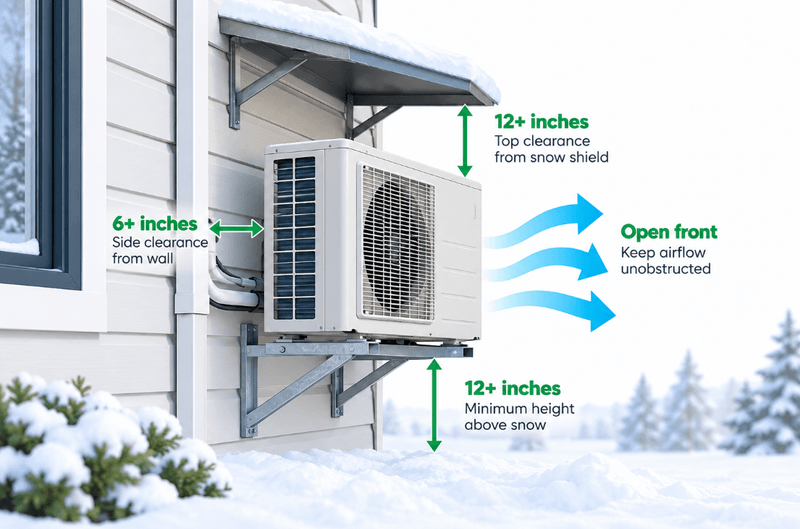
A mini split snow shield is a small, rigid roof mounted above the outdoor unit, with open air between the shield and the cabinet. It's also sold as a snow hood or deflector.
New York's Clean Heat program requires a snow deflector on program installs under a roof drip line, though it notes the better fix is a gable-end location where no drip falls (NYS Clean Heat). Many homes need none.
Do You Need One? Filterbuy's 60-Second Roofline Check
Look straight up from the unit. An eave, gutter or roof valley overhead puts it in the drip line.
Check after rain or a thaw. Drip marks, top-panel ice or icicles mean water lands on it.
Look at any deck above it. Tight boards protect the unit; gaps let drip through.
None of these apply? Skip the shield and let height and clearance do the work.
What Does a Snow Shield Cost?
Shields for side-discharge mini splits cost $40 to $300, while vertical-discharge units need approved options that run up to about $600. Filterbuy's read of NYS Clean Heat's product list: you're buying a small roof, so extra money mostly pays for manufacturer approval.
Prices from NYS Clean Heat's April 2025 product sheet; retail prices vary. Filterbuy is not affiliated with or endorsed by the brands named.
NYS also cites one estimate of a 2% to 4% efficiency loss when a deflector turns exhaust air outward.
How to Mount a Snow Shield the Right Way
Check your manual first; unapproved attachments can void warranties.
Keep the shield off the cabinet unless it's a manufacturer-approved accessory; your installer can mount it to the wall or stand.
Leave every side open. Skirts and side panels push exhaust air back into the coil.
Let it overhang the front and slope away from the house so snow slides off.
If your unit blows air out the top, use only a manufacturer-approved deflector.
"A cover looks like care, which is why people reach for one. With a heat pump, care means keeping the air moving and the drain open. After the first storm, walk outside and check the back and sides of the unit, because drifts close those off before the top."
— Michelle Wan, Brand Manager and Air Quality Writer, Filterbuy
What Clearances Does a Mini Split Outdoor Unit Need in Winter?
Give the outdoor unit 18 to 24 inches of open space on every side and above it, and mount it at least 24 inches off the ground wherever snow piles up.
Filterbuy planning numbers; if your manual's minimums are larger, use those.
The National Renewable Energy Laboratory (NREL) sets a minimum of 6 inches above the snow line (NREL SWS). Low units are where meltwater refreezes into an ice collar, which our winterizing guide covers.
When Does a Mini Split Cover Make Sense?
A mini split cover only makes sense when the system won't run again until spring, such as a cooling-only unit or a closed-up seasonal room. Before you cover it:
Run fan mode for two to three hours to dry the coil.
Clean the mesh filters in each indoor head (how to clean mini split filters).
Cut power at the outdoor disconnect.
Fit a breathable, top-only cover.
One exception applies to multi-zone owners: if any room on a shared outdoor unit still needs heat, the unit stays uncovered.
Already Covered Your Mini Split? Do This Now
If the unit heats your home, take the cover off today. Don't chip at ice; our guide to thawing a frozen mini split safely shows how to let it clear.
If the heat stays weak, the frost never clears or an error code on the indoor unit appears, it's time to call a licensed HVAC technician.
The Bottom Line
Because we make air filters, we'll add the filter side: the mesh pre-filter in each indoor head protects the coil, and your whole-home filter does the heavy lifting for air quality. Rinse the pre-filter on schedule this winter. Our mini split winterizing checklist and mini split maintenance guide cover both.
Each Filterbuy mini split system is a single-zone unit rated for reliable heating down to 5°F; professional installation is required, and the warranty is void if self-installed. For your furnace, Filterbuy auto-delivery ships your exact filter size, made in the USA.
Supporting Statistics
Up to 29%
Reverse-cycle defrost can cut a heat pump's heating capacity by up to 29% in worst-case conditions.
Efficiency (COP) drops up to 17.4% in the same case, as cited by Pacific Northwest National Laboratory researchers.
Source: PNNL / U.S. DOE field study, ACEEE 2024
Down to -25°F
A 1-ton ductless mini split in northern Minnesota kept heating down to -25°F.
Output held steady from 10°F to -15°F, though researchers still advise backup heat below -15°F.
Source: Center for Energy and Environment (Minnesota), 2018 field study
About 2 Million Homes
About 2 million U.S. homes heat with a ductless mini split.
1.06 million use one as main heat; another 0.93 million use one as secondary heat.
Source: U.S. EIA, 2020 Residential Energy Consumption Survey
Frequently Asked Questions
Should I cover my mini split in winter?
Filterbuy's answer is only if it isn't heating your home, since a heating mini split must stay uncovered to draw air and defrost.
Is a mini split snow cover the same as a snow shield?
No. A snow cover wraps the cabinet and blocks airflow; a snow shield is a hood above it with open air underneath.
Can I put a condenser cover on my mini split while it's off?
Yes, if it's breathable and top-only and the power is off at the disconnect. Sealed covers trap moisture and shelter rodents.
What should I do if snow buries my mini split?
Brush the top and sides with a soft broom, then clear the drain outlet. Skip shovels and hot water. If the unit keeps getting buried, have a licensed installer look at raising it on a wall bracket or stand.
Glossary
Mini split: A ductless system linking one outdoor unit to one or more indoor heads.
Outdoor unit (condenser): The outside cabinet holding the compressor, coil and fan.
Defrost cycle: A brief reversal that warms the outdoor coil to melt frost.
Snow shield (snow hood, snow deflector): A rigid roof mounted above an outdoor unit, with open air underneath.
Michelle Wan is Filterbuy’s Brand Manager and Air Quality Writer. She works directly with Filterbuy’s U.S. air filter manufacturing team in Alabama, Florida, Pennsylvania and Utah. Reviewed for technical accuracy by David Clark, Licensed HVAC Technician.